Vnomad
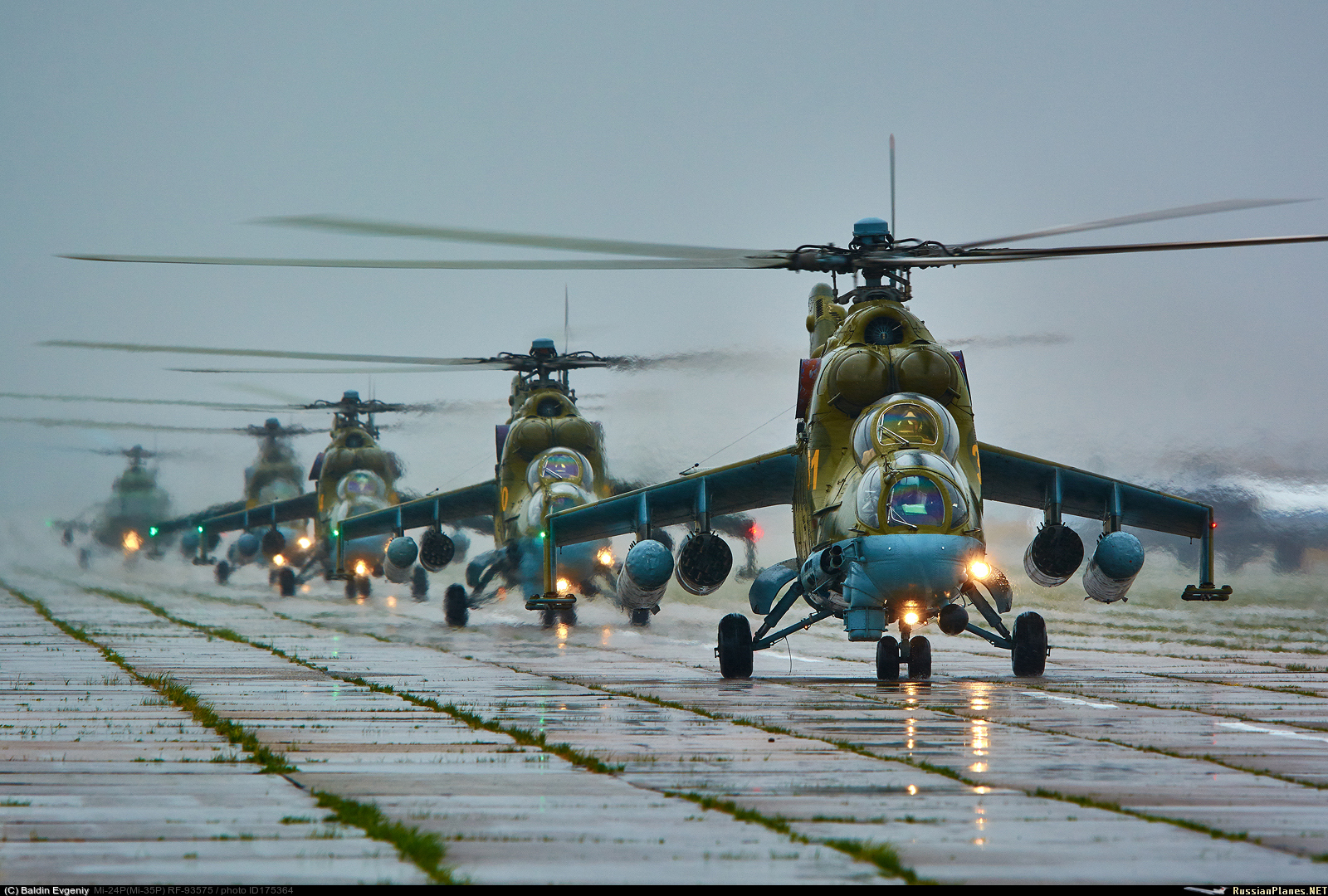
That is the Mi-24P- instead of the chin 12.7mm turret on the Mi-24V, it gained the monster twin 30mm cannons attached on the sides of the front fuselage.
Looks quite impressive. But don’t the rocket pods already perform the same basic function? (As opposed to the 12.7 mm which could be used off-axis, most likely against infantry.)
VnomadIs the chin gun detachable? I can’t really spot it.
VnomadIn other news IAF is finally stating its datalink program will be operationalized in 2-3 years. Its pilot program passed off successfully last year or so. That’s been another hugely delayed, ambitious program. Right now AFAIK, only the Su30s are datalinked with their native datalink which was part of the original package.
I remember the Tejas carrying out some demonstration where its Litening feed was transmitted to a display on ground. The upgraded Mirage 2000s reportedly have the JTIDS system. Though not IAF, the LUSH Harriers are also equipped with a datalink.
Question is, will all IAF fighters have two sets of datalinks, or will the same DL module transmit two or more different waveforms, or.. something else?
VnomadExactly.. But with the exception of Tornado, none of these are going away. Which means those countries will be operating F-35s alongside the F-15s. Where is the low component of the hi-lo mix?
Quite on the contrary, they are being left without any light asset… Which is just… overkill..
Are you suggesting they should have used a conventional fighter for long range offensive missions and a ‘light’ stealth fighter for defensive missions & air policing?!!
(BTW in addition to the British & Italian Tornados, the Israeli ‘Baz’ fleet & Japanese F-15Js will be retiring over the coming decade too.)
The most capable aircraft in your fleet should hardly be the shortest ranged one. And the fact that you’ve chosen to ignore, is that the challenges facing the air forces operating in East/SE Asia and the Arctic have hugely evolved over the last decade.
15 years ago, even with a growing Flanker fleet, the Chinese had no real way of challenging the US and its allies, even over their core area of interest (Taiwan/SCS). 15 years from now, the PLA may dominate the region utterly. And if you intend to tangle with PLAAF/PLAN over the high seas, its hardly wise to send F-15s to do the job while retaining a F-35 ‘Lite‘ for homeland defence.
Its the same for the Arctic states (US, Canada, Norway, Denmark) – you can’t protect your interests in a disputed region, if only your adversary has the legs to get there in the first place.
As far as the F-35 program is concerned, its perfectly reasonable to design it around the requirements of 80% of its users, rather than force them to compromise so that the remaining 20% get a customized product.
VnomadOhh, don’t say.. I might be wrong on this but nations with long history of operating aircraft like F-5 Tiger II (Korea), A-4 Skyhawk (Israel, Singapore) or F-16 (US, Japan [technically], Israel, Korea, Singapore) might want to have something lightweight and quite affordable, in the first place..
F-15E, F-15SG, F-15J, F-15K, F-15I. To which you can add the F-111C & Tornado.
Seems their ambitions in terms of reach aren’t as limited as you may have preferred them to be.
Hmm, more F-16 and F-5 users.. But now they all suddenly NEED a range of a Flanker..
Did China or India ‘suddenly NEED a range of a Flanker’? They didn’t, until they did.
Italy operates both the Eurofighter & Tornado, neither of which is short ranged. Norway may prefer something with longer reach in light of its interests in the Arctic. Turkey could have arguably gone without, but they already have a program to deliver a lighter cheaper complement to the F-35A.
That leaves just Netherlands, Denmark and Canada. Despite operating F-18s, the RCAF would value additional range for obvious reasons. And as the ice caps continue to melt, so would Denmark (via Greenland), albeit to a lesser extent.
VnomadIf it had been designed for that role, it would not have sold on 4,000+ numbers. In reality, most nations want a lightweight fighter which can be reconfigurable at will.
Do they? The US, UK, Australia, Japan, Israel, South Korea & Singapore want something that can operate at relatively long ranges, especially over the sea. Norway, Italy and Turkey are borderline cases – the latter two will welcome additional range at least for carrier ops. LM’s (naval) pitch to India too will be stronger for being a medium rather than light fighter.
That leaves – Netherlands, Denmark, Finland, & Poland as F-35 customers who would probably have preferred a lighter aircraft (but would opt for the F-35 even if Boeing was marketing the Gripen).
Vnomad[ATTACH=CONFIG]240793[/ATTACH]
What happened in Siberia? :confused:
(Edit: Kamchatka Peninsula)
Vnomad“USAF” (or any other military organisation for that matter) and “best for the nation” don’t belong in the same sentence. If USAF had its way the US military budget would be $3 trillion/yr and USAF would get 80% of it.
That may be something of an exaggeration. But even if true, that’s its perception of ‘what’s best for the nation’. Nobody is suggesting that the military be given the responsibility of drawing up the country’ annual budget.
The question here is why shouldn’t the USAF have the right to publicly air an organisational viewpoint, same as say… POGO?
Perhaps the service would like to encourage a more positive image of the F-35 program. That way they’d be fewer politicians questioning the Air Force’s professional judgement based on ramblings on some outraged chap on his blog. Or alternatively they may hoping to encourage greater exports, further depressing the cost, allowing the USAF to buy more of them. Or they may be interested in the interoperability aspect – the F-35 centric USAF would mesh better with an ally in joint operations/exercises if the ally was also operating the F-35.
I haven’t seen any evidence of unethical behaviour so far.
VnomadNone of them is US made.. Buying weapons is primarily a political message..
Not for most the air forces buying it. They’re all committed to the F-35. An apt example being the ROKAF’s public campaign resulting in the overturning of the F-15E purchase.
You’re not making much sense now.. Both F-15E (14.3t empty) and F-18E (14.5t empty) are in similar weight class as the F-35… and most/all of those NATO countries already operate MLUed F-16s which they slowly seek to replace..
The empty weight of the F-35 should be 9-10t @ $100mil, not 13.2t-15.8t @ $150mil.. with an 150kN-class engine, even at the cost of reduced range/payload, it would be perfectly suited for needs of most countries..
Okay. If we’re sticking to a weight bracket, what exactly is wrong with a MLUed F-16? If they’re running short on airframe life, there are new F-16C/Ds available. 9-10t @ $100mil. If they want something slightly higher end, there’s the F-16E/F still available.
So how is anybody being strong-armed into buying the F-35?
VnomadThe question is not what they knew but what they could have influenced… and especially, what other options were left..
Options aplenty incl. the EF, Rafale, Gripen (the latter’s not doing too badly).
Now you hit the nail on the head.. What option do the states who find the F-35 overkill but otherwise want to buy American have?
F-16C/D, F-16E/F, Super Hornet, F-15E, F-15SE.
VnomadThat is the point.. The F-35 was advertised as an affordable and lightweight supplement of the F-22 and a viable replacement of the F-16 series for NATO forces. But it ended up as a heavyweight F-15E class strike fighter, with corresponding procurement and operating cost. Now, your arguments in style “hey, but it can carry 6 bombs at xxx km range” are moot because that was not what the F-35 buyers were asking for.. Most nations don’t need to haul six 1,000 pounders over 1,200 km distance and back.
Who exactly are you referring to there? All participants in the JSF program knew what weight class the F-35 would roughly be in (+/- 1000 kg) when they signed up, save perhaps for the UK which got involved at an earlier stage. All later entrants/customers also made an informed choice.
Its true that the F-35 is built primarily around the US requirements, but so was the F-16. Those that found it overkill had the option of going for a 75% solution in the substantially cheaper F-20.
VnomadLOL
What, or more accurately who, is the “USAF?”
It is not the junior pilot or technician on the front line.
So in your opinion the junior pilots and technicians are.. what itching to get back to the Hornet and F-16?
It is senior people seeking and holding political influence that are telling the guys on the front line to say things are great.
Why do they need to tell the junior guys to say things are great if indeed things really are great? The junior guys will be saying it anyway. They are not unless they are ordered to.
Its the Air Force’s PR dept. Unlike a radio station, the ‘talent’ doesn’t get to script its own show/segment. They’re supposed to follow (or peddle, if you prefer) the official USAF line. Its not a bully pulpit for every individual to broadcast his or her opinion.
If you or others cannot see the problem here there is little hope for the supposed values of the western world.
The problem is your conspiracy theory is getting rather unwieldy. The USAF top brass is on the take. Fine. But UK, Norway, Netherlands, Italy, Turkey, Israel, Japan, South Korea and now Denmark & Singapore? The list would even include Canada going by the RCAF’s public stand. The only operator that’s been lukewarm is the USN, most of who’s brass are non-aviators.
That the air force(s) want the F-35 is quite evident at this point. Whether you agree with their decision is a different matter.
VnomadSMH more of Obama’s failed Iran policy.
On his watch Irans has nukes, Su-30s and S-300s
The only way to conclusively stop Iran from going nuclear would have been a full scale US-led invasion followed by a drawn out occupation, which is something even the hardest of hardliners in the US Congress have no stomach for. A sustained bombing campaign would at most delay the program. The third alternative i.e. sanctions could only increase the economic cost that Iran pays for its nuclear ambitions. It wouldn’t stop them any more than it stopped Pakistan’s nuclear program.
Its true that the current deal may not have been the best possible one that could have been negotiated, but it varies from that only in terms of degrees. The other thing to remember is that the US isn’t the only party involved. The sanctions that brought Iran to the negotiating table wouldn’t have succeeded without the active involvement of the EU (which also led the negotiations) , Russia, China, India, Japan and everybody else. The credit/blame for the outcome is therefore also shared by everybody.
As for the Su-30s & S-300s, that shouldn’t bother anybody any more than their presence in Syria does. The purpose of the sanction regime was never to militarily incapacitate Iran. Russia & China would never have gone along with it, had that been the case.
VnomadThere was an outcry from Russia regd. the J-11s few years ago, since then the waters have calmed down. I imagine that there is some kind of agreement between Russia and China which clears the situation.. something in style, you guys can do your indigenous non-licensed Flankers and we keep one eye closed, but only as long as you don’t try to mix in the export market.
Do I have evidence for that? No.. Does it still make sense to assume that some kind of agreement did occur, in the end? Yes..
Such disputes are always about leverage. Back then China was still a major defence market for Russia, and China in turn still depended on Russia for much of its higher end gear. Today China’s annual defence imports are minuscule ($2bn out of ~$150bn) as its domestic systems continue to replace imported ones, though compared to other countries that amount is still substantial.
The last vestiges of its dependence on Russia (such as the AL-31) will also fade and fairly soon at that. At that point, the only obstacle will be a political one. There too the equation is tilted heavily in China’s favour.
VnomadIt wasn’t. Granted, Chinese have replaced Russian subsystems and avionics to create J-11B, J-11BS, J-11BSH, J-16 and whatnot, but there are zero indications about the design itself having been thoroughly modded / indigenized. The fact that China did go to the lengths of acquiring a T.10K-7 prototype from Ukraine in order to design their own J-15.. If they had the Flankers researched to the level as you guys imply, then they probably would not bother,.. I also don’t see much sense in reworking the Flanker over and over if you got so much else to do (J-20, J-31, UCAVs, Y-20, WZ-10, Z-19, Z-18…)
By indigenization, I mean what percentage of components are sourced from Russia? Just the engine AFAIK. Of course there’s the legal aspect, but from what I understand that’s already been flouted without consequence. And that too in an era, when the power balance between the two countries was far less lopsided than it is today.


 Sign In