 Steve T
What a shame…though not really a surprise. I’d have hoped perhaps the flightdeck and maybe one of the engines could have been rescued for the Trenton collection. Now if they want to represent the CC-106, NMRCAF will have to “fudge” things and use part or all of a Britannia…itself a rare type now.
By my reading that leaves only the one CL44-O extant of the whole series (Britannias and the distantly-related Argus aside)…and even that Guppy looks to be very much on borrowed time.
You lose a few, you lose a few…:(
S.
Steve TLast Saturday, early evening, was on my way to a classic-car cruise in Brantford in convoy with friends (they were driving their 1950 Studebaker and I their ’58); passing through Ancaster, not too far from Hamilton airport, heard a nice racket from the northwest that I was pretty sure was CWH’s Mitchell (which I’d seen airborne earlier in the day), craned out the car window to confirm, soon the Mitchell roared overhead, low level, headed toward Mount Hope–but not on her own. Off each wing, tucked in fairly tight, was a T-28…and in the slot, also nice and tight…Jerry Yagen’s Mosquito. ‘Oh YES!‘ I bellowed almost involuntarily. What a sight. I’d forgotten one of CWH’s scheduled events was last weekend, so the impending visit of the Mossie et al had slipped my mind. It’s nice enough when friends lend you their classic car to drive to an event…a marvellous surprise like that evening diamond-four of Warbirds during the same occasion is a real cherry on the sundae!
S.
Steve TYou could, if you had say a Lear or some such at your disposal, see six intact Lancs in Canada in a 24-hour day…going west to east to take advantage of the prevailing wind… 🙂
FM136, Calgary, Alberta
FM159, Nanton, Alberta (…you’d have to drive from Calgary and back, as Nanton has no nearby airfield)
FM213 (“KB726”), Hamilton, Ontario
KB944, Ottawa, Ontario (plus a nicely-presented forward fuselage)
KB882, Edmundston, New Brunswick
KB839, Greenwood, Nova Scotia
To those, eventually, two more will be added, being FM104 at Toronto and FM212 at Windsor, but both are currently disassembled, with 104 in store awaiting resolution of the status of the former Toronto Aerospace Museum and 212 under rebuild.
I’m not troubled in the slightest by the use of the nicknames for the two Lancs now on the circuit over ‘ome, and had already thought of the nice tie-in with Dame Vera Lynn (who appeared at the 1990 Hamilton airshow BTW)…but I do wonder why VRA’s name suddenly appeared at the start of the Lanc’s tour, twenty-six years into her civilian flying career! For the record I quite like it. Previously she’d always been referred to as the Mynarski Lanc, as VRA, or as FM213. Nobody here ever seems to call her “KB726”. Whatever the nomenclature, I’ve been revelling in the photos and videos presented online showing the pair in flight together. Magnificent. Living in Hamilton I frequently see VRA in the air (and always know when I’m about to: that sound is like nothing else and can be heard for miles)…throat gets lumpy and both eyeballs fog up every time…even if I was born in 1965. What a thrill it must be to see two firsthand.
That scrapyard pic is fascinating and melancholy in equal measure. To think Guy Gibson’s ED932/G ended up like that…
S.
Steve T…Just to add, a book ought to be written about the early “got while the getting was good” warbird collectors…some were vilified as hoarders from time to time, and one or two genuinely were (Ernie Simmons certainly), but present-day enthusiasts owe them a great deal.
S.
Steve TYorkie–
Well not necessarily; but the departure of any other relics from Newbury would depend on Mrs Soplata, who seems–quite understandably–simply to wish to be left alone. Walter sold eight or nine aircraft and parts of others over the years: the aforementioned F2G and Mitchell, an FG-1D, one and a half P-82 Twin Mustangs (both of which are slated to fly again), a P-80, one and a half BT-13s, an O-52 Owl and an F-84F, plus, many years ago, a wrecked P-51 and a prewar American Eagle biplane which had reportedly tried to take off by itself when Walt was doing an engine run!
And yes, as John points out, Ernie Simmons was a similarly fascinating character up here in Ontario. He collected anything and everything mechanical: cars, trucks, tractors, aircraft, and motorcycles, which latter items became targets for theft…in 1969 Ernie fired one of his collection of shotguns at some would-be bike thieves, was cleared of any wrongdoing, but was himself then shot when another group of thieves turned up, and ended up in hospital in the dead of winter, returning to his insufficiently-heated house earlier than the doctor said was wise, contracted pneumonia and died in early 1970. His massive mechanical hoard was auctioned on Labour Day weekend in 1970, and the aircraft fleet at that time consisted of thirty-six NA-64 Yales and seven Fairey Swordfish, plus a vast quantity of Anson parts and probably some Lysander stuff too (his one intact Lizzie he’d sold in the 60s…it was eventually restored to fly by Dwight Brooks and went to USAFM then NASM, where it remains on show at Dulles). All but about two surviving Yales are ex-Simmons, and most of the extant Swordfish came from that hoard as well. Vintage Wings Canada’s Swordfish, HS554, was registered C-GEVS, Ernie’s initials, by its restorer and initial operator Bob Spence, in tribute to a remarkable collector.
S.
Steve TYep, Walt Soplata’s place has shown up here and elsewhere on the net many times, but as “mostlyharmless” points out, there’s always someone who hasn’t yet heard about Walt and his fleet of stray-cat Warbirds…so certainly no need for anyone to delete the thread! Most of the plums from Walt’s fleet have moved on, with two, a B-25 now belonging to Jerry Yagen and an F2G Corsair racer belonging to Tom Ungurean, having flown again…of course the F2G is no more, having crashed, tragically killing restorer Bob Odegaard, two years ago in North Dakota…just as Walter always feared would happen if any of his Warbirds flew again. (He had sold the F2G to the Crawford Museum in Cleveland for restoration for static display, but the museum resold it and a flying rebuild was commissioned from Odegaard, who had earlier restored the other surviving F2G racer to fly. That one still operates, occasionally, with Ron Pratte out west, usually flown by Larry Perkins.)
S.
Steve TCopying my response from over on WIX…
Tom–
Excellent discussion topic. I may chime in multiple times as I think of other points…First off, though:
1. Focus. I realize not all museums have the luxury (i.e. cash) to hew tightly to a specific collection mandate, but for those that do, it’s essential. One of my favourites from that standpoint is the Canadian Bushplane Heritage Centre in Sault Ste-Marie, Ontario…built up on limited means, it is nevertheless unequivocally a display about bush flying and aerial firefighting and really nothing else, and a very fine collection of relevant airframes and artifacts has been put together. Additionally, there are volumes of support documentation presented with each airframe or other exhibit; with nary a docent in sight you can learn a ton there.
2. Atmosphere. CBHC scores very high here, too: all those bushplanes reside in a classic 1920s-vintage seaplane hangar right on the lake. That, of course, is fortuitous for CBHC (though doubtless the reason the museum is in that location to begin with), but still, it adds a great deal to the back-in-time experience. Similarly, in some ways I prefer the memory of the CWH collection in the old BCATP hangars over the “new” building…I used to work there back in the 80s, and once in a while I’ll actually have a dream set at Mt.Hope, which invariably features Hangars 3 and 4…in my subconscious world the new building, nice (and, er, more fireproof) as it is, doesn’t exist! One can, of course, build a nostalgic facility from new just as one can build a new Yak, FW190, Spitfire, et al. The beautiful retro-styled hangar built new by Vintage Wings of Canada at Gatineau is a prime case in point, though not technically a museum.
3. Space. My inveterate-shutterbug proclivities kick in here. Even a building that fosters a proper contextual atmosphere can be a bust if the actual exhibits are stuffed in in a manner that prevents them from being properly seen (and/or photographed; I do consider that important too, but that’s my bias). A prime, unfortunate, example of this problem is the recently-built Canadian War Museum. Their rare Spitfire IIB, when still in the old building, was crammed in against a wall with one wing removed, and with a pretty frightful-looking mural (featuring what I can only describe as a caricature of a Spitfire) as a backdrop. I thought at the time it wouldn’t be possible to display the poor Spit in a worse way. Wrong. Now she’s crammed up in the rafters–literally–and really can’t even be seen fully, never mind photographed. Conversely, the CWM building itself is full of bleak, jagged, angular shapes, very nicely evoking the brutal nature of warfare. I really like the architecture. The exhibit design, on the other hand, is sometimes lacking, and never more so than in the case of the Spitfire.
That’ll do for the moment…
S.
Steve TCouple shots from the early 1980s…two F-84Fs in the US midwest…SEA-camo F in the Walter Soplata Collection in Ohio (now with the MAPS museum at Akron)
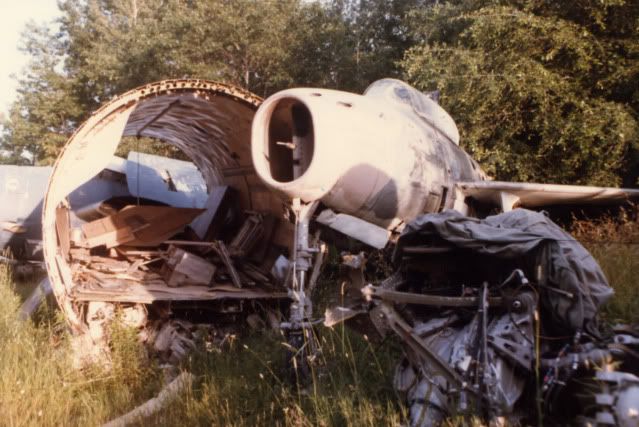 [/URL]
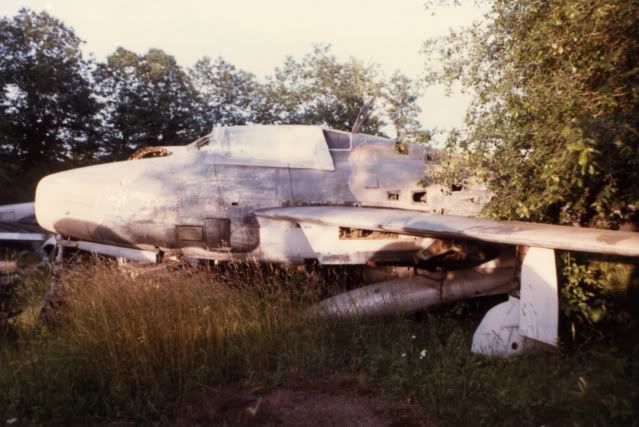 [/URL]
Interesting civilian-schemed F out to pasture at Kalamazoo, Michigan, 1982; thought to have been an instructional airframe not flown in this livery…
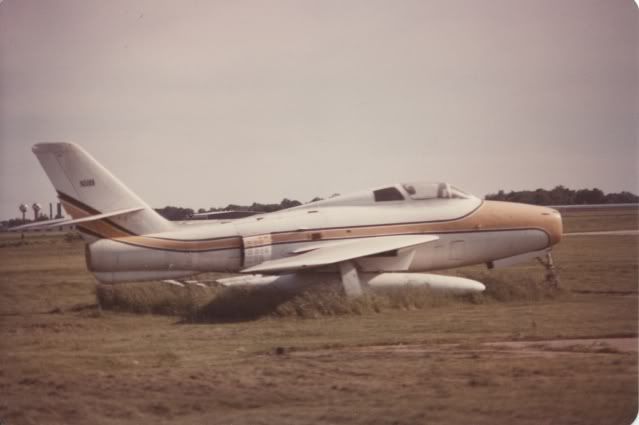 [/URL]
S.
Steve TGood score on the ex-Whirlwind seat! Always enjoy hearing about the rescue of a vintage relic like that.
Here’s a different (and somewhat newer) M-B bang seat, a prized “exhibit” in my loft since I moved here in 1995 (seat acquired in 1987)…this was the first officer’s seat in HP Victor K.2 XL191 that crash-landed at Mt.Hope in June 1986.
S.
Steve TBruce–
Ta. It’s just possible then that you may have been the fellow who saw to it that I took a seat in W4050; my dad and I had just arrived for a very memorable week-long UK visit from Canada, and had found out just after arrival that MAM was open only that first day, so we took a taxi to London Colney right after arrival at our B&B in London. It strikes me that the gent we conversed with at quite some length was named “Bruce” (also my brother’s name so it tends to stick). Any of it ring any sort of bell? I’ve never forgotten the hospitality we met at MAM, topped off with the seat time in W4050 (and TA634, too) just a few hours after arriving at Gatwick…far beyond our expectations!
S.
Steve TBruce–
O/T but something I’ve long wondered: would you have been involved with the Mosquito Museum in April 1989??
S.
Steve TWhat an interesting project.
It might be worth trying to find someone involved at Canadian Warplane Heritage back in the day, too. For a time in the early 1980s, there was a partial tail turret and cupola, very beat-up, stored in Hangar #4 where the Lancaster initially resided after its 1979 arrival from Goderich. The turret was said to be the tail turret from a Halifax. It certainly wasn’t a Lanc unit. Very few Halifaxes were ever in Canada, but among those which were there were five Mk.Vs that were instructional airframes at the RCAF tech school at St.Thomas; quite sensible, since so many 6 (Canadian) Group squadrons operated Hallies and their complement of “erks” would benefit from experience on the type…anyway, one or more of those Halifaxes were scrapped postwar by metals dealer Cam Logan at Scotland, Ontario, who (seemingly paradoxically) was an aircraft enthusiast and early member of the Canadian Aviation Historical Society. I can’t be sure, but I’ve surmised that Mr Logan may have kept this turret from one of the ex-tech school Hallies he processed postwar, and that it later passed to CWH at Mt.Hope, not far away. I have not seen the turret in about thirty years and have no idea of its eventual fate; I’m confident it was not lost in the 1993 Hgr#3 fire, as such a relic would not have been kept in what at the time was the museum’s active maintenance bay…perhaps someone else on here knows what became of it…
S.
Steve TCees’ point is a good one…substantial relics treated as well–perhaps as an appendix. That Hurricane hulk at Hendon comes to mind, as do some major bits that have remained here in Canada. The book produced to commemorate the opening of the then-new museum at Rockcliffe features just such a chapter, which covers the (then) NAM Aichi D3A, the Arrow and Jetliner noses, et cetera.
I’d go piston-engined only on the Hawkers, and maybe, at least to start, up to the Tempest only–leaving the Fury/Sea Fury series, with its all-postwar history (and horrendous complications about identities in recent years), for future treatment alongside Sir Sydney’s jets. The first few Hawker types would be included; all else aside there are very few of those extant anyway (two Cygnets and a Tomtit, iirc). The 1930s biplanes would be mainly known quantities (with the possible exception of a couple of the ex-Afghan hulks), and I’d include the former Patrick Lindsay Fury replica, also, despite its not really being of Hawker (or licensee) origin.
I’d be quite happy to do some writing in connection with a project like this, though my firsthand knowledge is limited mainly to recollections about some of the Canadian Hawkers. Can’t quite believe I’m suggesting leaving out the Sea Fury, my longtime favourite aircraft type, but there you go, it’s what seems most sensible to me!
S.
Steve TInteresting thread. I well remember reading about the arson destruction of the Valetta; my second thought (after an initial reaction of anger, of course) was “what’s left could be used on a full-scale Wellington lookalike”. Sorry to hear the remains were probably scrapped off instead. Yes, of course they’re structurally different, but the shape is the same…and much as with late-mark metal-winged Ansons, they’d have allowed a replica with much the same character as the original design. The Elvington Halifax with its Hastings wings is conceptually similar too, though, in that case, the actual structure of the wings is fundamentally the same between the two types.
The engine debate, too, is interesting. Nought to do with Wellingtons, but I’ve long thought the “easy” way to achieve a flying (or even taxiable) Beaufighter would be to go with Merlins in Lanc/York cowlings, in the process reincarnating the extinct Mk.II night fighter…the TT.10 at Rockcliffe would’ve been a particularly good candidate for that sort of conversion…
S.
Steve THere’s the online gallery for the Canadian Aviation Artists Association, for whom I’m secretary/treasurer; Ronald Wong and Charles Thompson, mentioned earlier in this thread, are members of this group as well as GAvA…
http://www.aviationartists.ca/Galleriesmainnew.htm
S.


 Sign In







