 Steve T
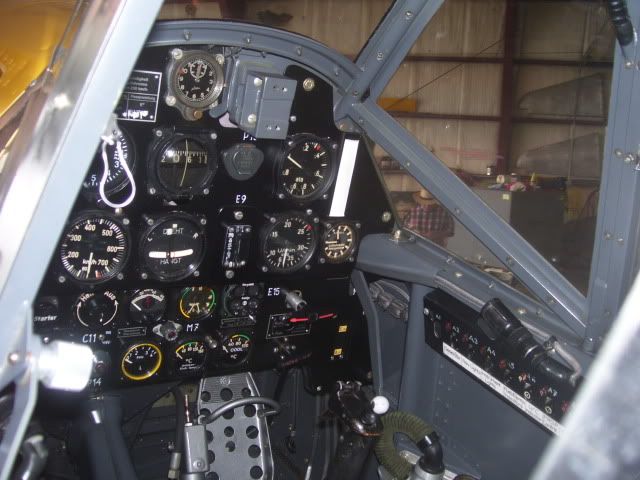
Bf109E CF-EML, seen probably much as it currently looks, but this shot and the next one were taken in one of CHAA’s hangars at Tillsonburg, rather than at Niagara South airfield where Mr Russell’s fleet was based.
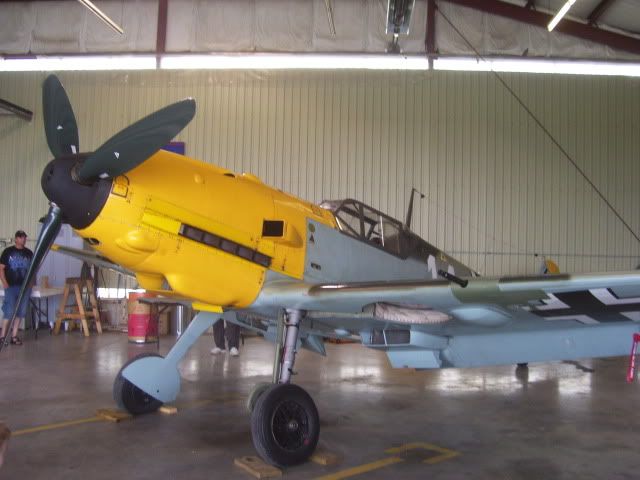
Ace’s office…
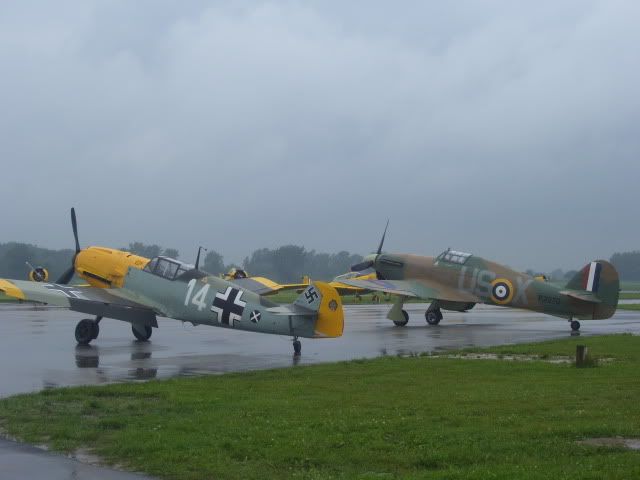
Parked with the Hurricane during a spell of very British weather…
CF-EML taxiing out for its duo display with the Hurricane.
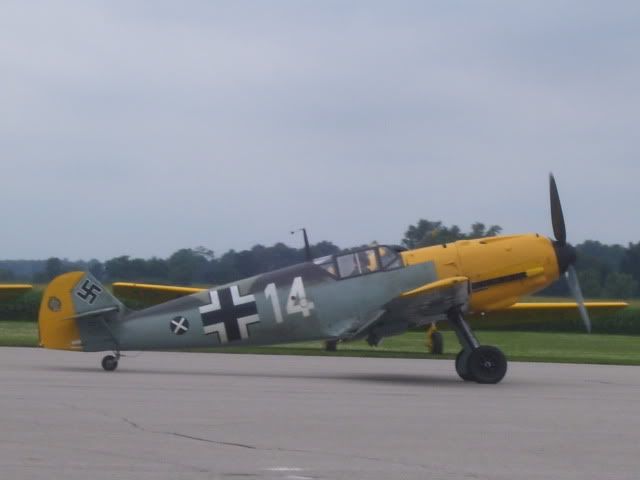
Goes without saying, I miss seeing these…but then I’d have declared nuts anyone who told me 15 years ago that I would see a DB-engined Messerschmitt airborne over southern Ontario…ever! Thanks, Mr Russell.
S.
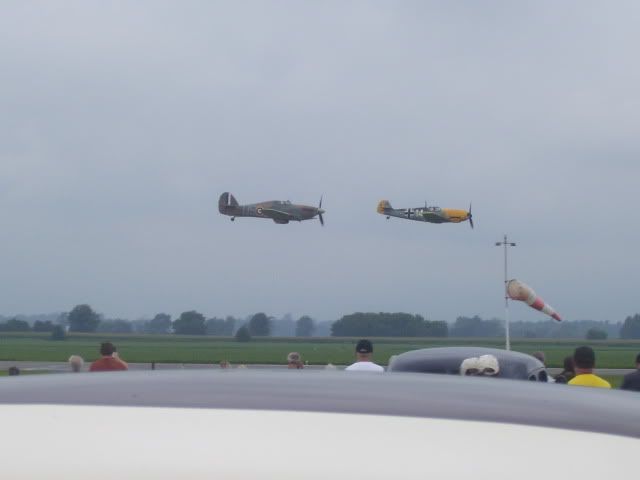
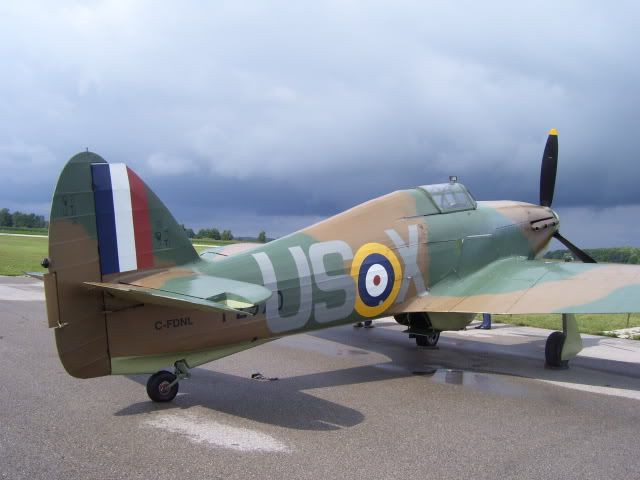
Steve THurricane XII 5481/C-FDNL at Tillsonburg
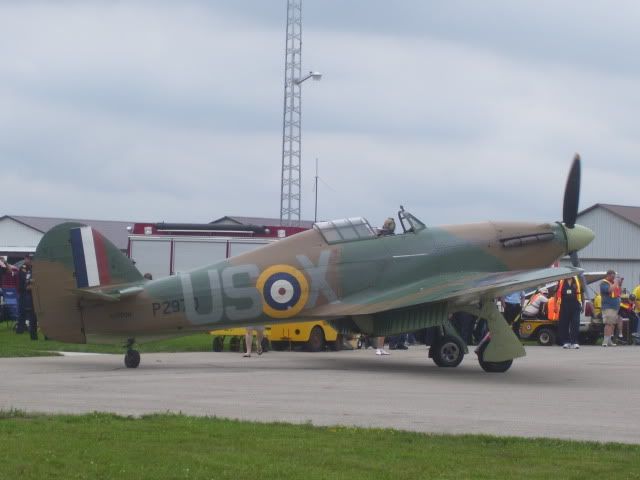
Taxiing in

Flyby in company with the 109
Aft view, parked
109 next…
S.
Steve THere are a few pix of the Russell Group fighters…taken during two of the CHAA Wings & Wheels car/air events of the past few years at CHAA’s Tillsonburg, Ontario, base (I took my 1962 Studebaker Lark to these shows).
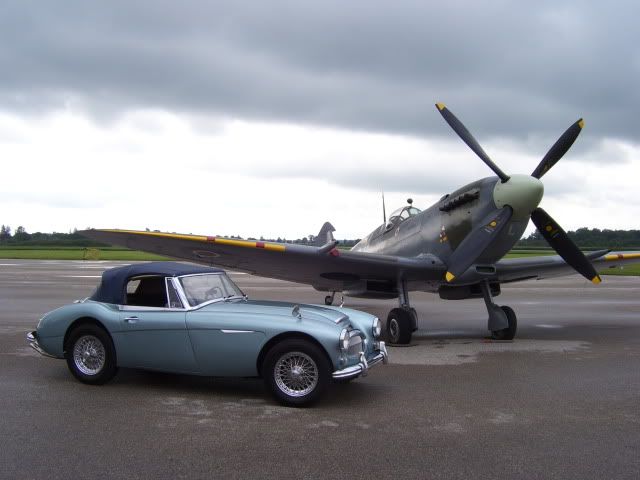
Spitfire MK912/C-FFLC, Mr R’s initial post-lawsuit acquisition. I referred to this Spit as “Mad Mickey” for the furious-looking mouse cartoon on the cowl! (And I decided the reg stood for “Conjured Forth From Legal Confrontation”…):rolleyes:
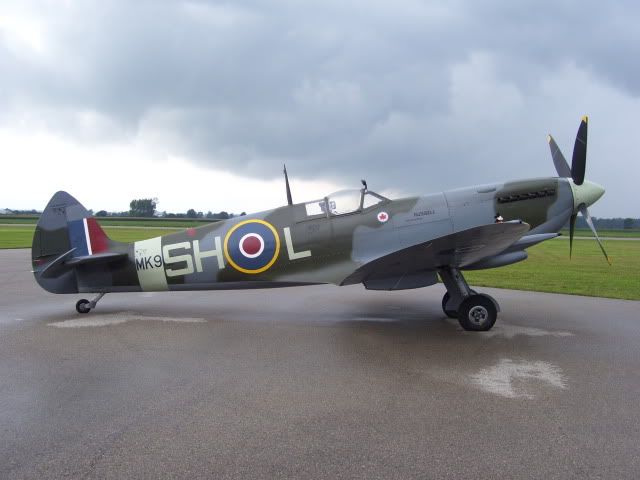
C-FFLC with another charismatic British classic, a Healey roadster…
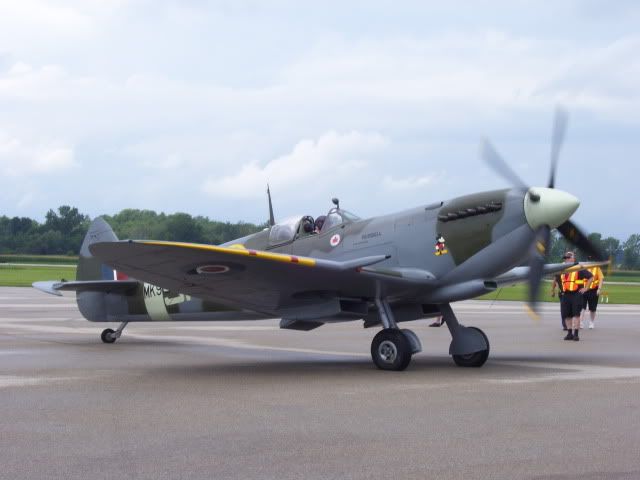
The Spit taxiing at T’burg
Airshow pilot Rick Volker belts past in the Spit
Hurricane and 109 to follow…
S.
Steve TIt’s not really a “sudden” loss of interest on Mr Russell’s part; his three fighters and his Harvard have been off the scene here for a couple years now. Reading between the lines a bit as I do not know Mr Russell, but I think, when he dove into the Warbird business after his litigation win about a decade ago, he was very much keen to do much of the flying himself, like Michael Potter in Gatineau; however that did not happen–others can correct me if I’m mistaken but I do not think Mr Russell ever flew any of the single-seaters…not sure about the Harvard. I think he did do some dual work on a T9 Spit in the UK early on.
Mr Russell did, for about eight or nine years, campaign his Warbirds widely in this area, including shows at Hamilton, Geneseo NY, and Willow Run MI, not to mention hosting air shows at his own airfield near Niagara Falls several years in succession. Several fine display pilots from both sides of The Pond flew the three fighters during that span, greatly enriching the local circuit during a period when things had become rather quiet. For that I tip my hat to Mr Russell. (And I’ll make no secret of the fact I wish some arrangement could be made to bring the Hurricane to CWH at Hamilton; it’d be so much more interesting than the plastic Hurri-shaped thingy that replaced the real deal lost in the 1993 hangar fire…)
S.
Steve TIndeed; some Spits, for instance the time-capsule OTU Mk.I at Chicago, are especially valuable as artifacts for reference, to establish the sort of details we see being thrashed out with great effort on this forum regarding, say, the Hornet, Whirlwind and Stirling cockpit projects. Fortunately there are enough Spits extant that not only is it practical to operate some of the survivors, but critical mass of the type has been achieved so that a cottage industry has come into being in support. (Compare that with the Tempest situation.) There’s certainly room for both, and some of the museum Spits really should remain static permanently.
As to not enough possible “Spitfire reincarnators” to render viable a theoretical haul of hulks from underneath old airbases in Myanmar…surely that would be at least partially because never before has such a haul been mooted as a possibility! And I’d think that even if Mr Cundall’s effort were to bear fruit, not all of the resulting airframes/parts would perforce become projects to fly: surely some would become museum rebuilds, and some even conserved for display as found. I think there’d be enough interest to find homes for any number of exhumed Spitfires. Heck, if I had the space and the cash, I’d take one on…and it’d become one of the “as-found” displays…
S.
Steve TInteresting subject. It also pops up (probably during slow news periods) here in Canada, concerning our own nine-plane of jet trainers, the RCAF (nee CF) 431 (Air Demonstration) Squadron, aka the Snowbirds. Talking of teams who fly aircraft of decreasing relevance operationally or in the market…the Snowbirds are now the sole purveyors of the downright geriatric Canadair CT-114 Tutor, the surviving fleet being kept going solely for the team’s displays. RCAF (and other NATO) fast-jet training has long since been handled by Raytheon CT-156 Texan IIs (which we call “Harvard IIs”) and…BAe CT-155 Hawks. Yet the Tutor carries on with the demo team, five decades after the type’s first flight and 43 seasons after the Snowbirds were founded at 2 CFFTS using the group of Tutors formerly equipping the Canadian centennial demo team, the Golden Centennaires. Snowbirds shows remain very well-received both here and Stateside, accorded a sort of timeless iconic standing like CWH’s flyable Lancaster, and while it’s inevitable the team will someday be stood down (or at least re-equipped), there doesn’t seem to be the will to do the deed just yet. One can at least say that the Tutors are paid for…! (And now that a team flying half-century-old trainers is part of this discussion, the thread unquestionably does belong in Historic…) 😀
Steve TAEG G.IV twin-engined 1918 night bomber in good nick on show at the Canada Aviation and Space Museum (former CAvM/NAM), Rockcliffe (Ottawa), Ontario. One of just three survivors from the substantial war-prize haul brought to Canada in 1919 (the other two being a Fokker D.VII and a Junkers J4/CL.I).
We Canucks have a particular fondness for the Siskin, since it was the RCAF’s first fighter type (though obsolescent when acquired). One is said to have survived inside the Kingston (Ontario) armoury as late as the middle of World War II, but it is of course long gone.
There’s possibly an easier way to get at least the look and feel of a flying Siskin. Remember the French Latecoere 17 replica built for a film in the 1980s? It was made over from the basic airframe of a Noorduyn Norseman. I once chanced upon a disassembled Schweizer AgCat cropduster in a storage yard, and remarked to myself that it had the feel–and the size–of a Siskin. Did a quick sketch based on three-views of both types. With all-new wings and tail, and extra cosmetic-only struts added to the undercart, the result was a pretty convincing theoretical Siskin lookalike, with even the big uncowled R985 up front looking “right”…
Is there anywhere an online (or print) listing of extant inter-war military aircraft? A few that come to mind, not mentioned in this thread yet, would be the Romeo 38s ex-Kabul scrapyard, Hendon’s Hart Trainer, and the Blackburn Ripon in Finland. I bet the full list would be surprisingly long and very interesting!
S.
Steve TWow…a Wapiti? I too would very much enjoy seeing one of those fly–or even seeing a representative “Whatapity” at all. The Wapiti was one of the first three combat types on RCAF strength (the other two being the now-extinct Atlas and Siskin). We wish one of these types could be found, even as a hulk, for restoration for our national museum in Ottawa. Instructional airframes survived at Canadian tech schools into the 1940s, only to be discarded to the last one. Good on the IAF for having held onto a Wapiti, and for taking this initiative.
With India developing into an economic powerhouse, could this be the thin end of a very interesting wedge, I wonder? Could we see more than one Spit? How about…a Tempest or two?
S.
Steve TCol Pay’s H87 Kittyhawk was disinterred from the earth in Alberta…
And some of the folks at the Canadian Air & Space Museum (nee Toronto Aerospace Museum), when it was still based in the old deHavilland Canada facility at Downsview, were trying to investigate a persistent rumour that said a war-prize Messerschmitt 262 was buried on the old airbase…nothing was ever found, and with the present circumstances at Downsview I doubt anything ever will be–whether or not part or all of a 262 is interred there.
And then there are the F2G Super Corsair remains said to be buried at Hopkins Airport in Cleveland…the airframe (less engine, which went to the Crawford Museum) of N5590N, the 1949 Thompson Trophy champion, used for firefighting practice at Hopkins in the fifties and said interred once too crispy to be of further use. Again, little chance of verification, and what would be down there would be unrestorable anyway.
S.
Steve THmmm. Have to say I’m really not sure: when I was a youngster I was mad keen on cars, not getting into airplanes until I approached my teens. I went to at least two air shows (Seneca 1972–rained out–and Hamilton 1975) before I really developed an interest in aviation. It’s also just possible I saw the PR.19 on display at Toronto alongside the destroyer Haida (PM627, now in Sweden); and if T.9 TE308 was at the ’75 Hamilton show I’d have seen her, but remember neither. I would have seen NH188 at Rockcliffe during a school trip there in ’78. In ’77 or ’78 (or both), MK923, flown by Jerry Billing, would’ve appeared at Hamilton airshow. I certainly recall my dad telling me a Spitfire was coming to the show one of those two years. And we went to Florida in 1976, and I’m pretty sure we called in at NASM in DC en route, so EN474 is an outside possibility. Which one do I really remember seeing first? That would have to be MK923 at Mt.Hope, whichever year in the late 70s she showed up. Happily I saw Billing fly that Spit quite a few times over the next decade and a half or so (including a glorious Alain deCadenet-style Rotol haircut experience on 1982 Hamilton airshow arrival day); have never seen any other Spitfire so memorably flown!
S.
Steve TJames–
Interesting. Not sure off what (aircraft, factory equipment, etc) the plate would have come, but datewise it would be postwar…during wartime the Malton aircraft manufacturer was called Victory Aircraft, descended from the aviation division of National Steel Car (which company BTW still exists, building railway cars here in Hamilton). It became A.V. Roe Canada Ltd. when it became an Avro subsidiary after the war, strong links with Avro having been formed, of course, as NSC/Victory took on the manufacture of Lancasters (and one each York and Lincoln) during World War II.
S.
Steve TI clearly recall seeing the wreckage of WD901/CF-BDH laid out on the floor of CWH’s hangar at Mt.Hope after that aircraft crashed into Lake Ontario during the 1977 CNE airshow. A very sad sight. Years later I was surprised to find the tailcone structure and the two external wing tanks from BDH stored in the loft at the back of the hangar. The aft-fuselage section seems to have migrated east eventually to join the project then under longterm work in Maine…
I’d missed WD840 having moved to DX. This was, I think, the former Bob Diemert aircraft (CF-CBH) that had been flying in the seventies with a Merlin engine out of a York…? Only time I ever saw it was the bare airframe inside the hangar at the Lone Star museum in Galveston, Texas. A well-travelled Firefly for sure.
S.
Steve TMartin–
Wrong fighter; Walt’s P-47 fuselage was off by itself in the brambles next to the remains of a Seabat helo, under a sheet of corrugated metal…what was inside the mid-section of the YB-36 was a P-63 and also parts of an XP-82. (The latter is now being reconstituted to flying condition by Tom Reilly.)
S.
Steve TActually it appears they’re X1Vs…that’d be the transonic version by Bell, no? :rolleyes:
I’m skeptical about this. But then most were equally skeptical about that P-38F supposedly entombed in the ice in Greenland, too…
S.
Steve T…Incidentally, the pic of “RAB” at the top of the thread looks like a painting, as distinct from a digitally-drawn image. Is it? And if so, who executed it? I’s a very nice piece of work. (Whether or not it’s digital it’s awfully nice.)
S.


 Sign In







