 mabie
mabieRe SDB doing a vertical dive, my understanding is this was an attack mode added at the request of troops on the ground who did not appreciate the additional time it would take the weapon to glide in from stand-off distances w/c is its normal mode of employment. A vertical attack would cut the time-to-target but it requires the aircraft to be somewhere above the target w/c may make it more vulnerable.
mabieIn another thread re F35s the problems with new alluminium spars in the F35Bs failling was mentioned: –
http://www.aviationweek.com/aw/blogs…c-d57c7a6537e6
With the lack of progress with the testing of the F35B, the hardware failures and the White House’s view that monet could be saved by not progressing with the B I am not too sure that the B will ever go into mainstream production, it would seem to me sensible to totally rationalise the range to the C model. longer range for a bomb truck seems good to me.
The A & C variants are ahead of plan, the B is behind but catching up to plan.
The structural problem with the bulkhead was on a unit undergoing during durability testing. STOVL jets involved in flight test will simply be inspected on a regular basis until the engineers come up with a fix but the pace of testing continues. I’m not concerned about the viability of the B model and its eventual production.
http://www.lockheedmartin.com/products/f35/
F-35 LIGHTNING II OCTOBER 2010 FLIGHT TEST UPDATE
FORT WORTH, Texas, Nov. 4, 2010 – The F-35 Lightning II flight test program continues to track ahead of plan on both the conventional takeoff and landing (CTOL) variant and the carrier variant (CV), while the short takeoff and vertical landing (STOVL) variant flight completions remain behind schedule. Overall, the program has completed 321 flights this year, 28 flights ahead of plan through October.
The F-35 flight test team completed 52 flights against a plan of 50 in October. The CTOL aircraft logged 22 flights against a plan of 17; STOVL jets flew 27 times against a plan of 28; and the CV jet flew three times against a plan of five. Additionally, the STOVL jet flew supersonically, and at Mach 1.3 has flown faster than any other variant to date, and achieved 7 g’s, the highest load condition to date and maximum design g’s for the STOVL.
The CTOL variant is 66 flights ahead of plan and the CV is three flights ahead of plan; however, the STOVL variant is 41 flights behind plan for the year. STOVL aircraft component reliability continues to be the principal challenge. F-35 program officials are pursuing a multi-faceted approach to improve tempo, including working to obtain higher levels of spare parts from suppliers to keep the aircraft in a flight-ready condition, while completing the analysis and corrective action planning to address the root cause of any issues. The plan calls for 51 flights in November, toward the total of 394 for 2010.
mabieMy worry, is that the current leader who is obviously fast approaching the end will want to do something to be remembered by. An attack against the South, no matter how poorly executed and no matter the cost, would ensure his place in history
A definite consideration. He may not be able to replicate the destruction caused by his father 60 years ago but may still want to go out with a bang rather than a whimper.
mabieShort answer is nah.
Longer answer is “Every generation thinks it is going to be the last.”
Every advance gets hailed as the ultimate when it comes out, yet if every new thing is the ultimate then it actually follows that nothing is the ultimate!
Was the FW190 the ultimate fighter ever? Spitfire mkV pilots might have told you that back in 1942.
Going back further you have the Fokker Menace of World War One in (i think) 1916.
The point being that if you take a narrow snapshot in time it is entirely possible to claim that x is the best.
To refer to an earlier post of mine how long is that period and how much did it cost you to get there?
I’m exploring the proposition that technology is superseding the human being and cite as proof the ability of relatively inexperienced pilots consistently defeating experienced veteran pilots. As tech advances, the pilot is bound to become marginalized and even less of a factor. Tech is changing the rules of the game is all I’m saying. Sadly, a future where pilots may not even be necessary is a very real eventuality.
mabieCertainly its been true in the past that pilot experience and skill are the major factors in determining the outcome of an aerial confrontation between two more or less evenly matched opposing platforms.
But aren’t we at a point where the technology is now making it possible for even novice pilots to consistently defeat very experienced drivers in less advanced platforms? Witness rookie F-22 pilots with 50 hours Raptor experience defeating pilots of adversary squadrons with thousands of hours flying time in F-15s and F-16s. The jet is that superior that unless the rookie makes a dumb mistake, he’s almost assured of victory every time.
mabieSomething is puzzling me a wee bit .
I don ‘t get it yet … While the F-22 won the exercise (not by much), why the Rafale pilots are saying that TVC is overrated ?
Perhaps its because TVC really isn’t that useful at lower speeds? The F-22 has massive control surfaces along with two massively powerful F-119s and a sophisticated FCS contributing to its incredible maneuverability. I think it was Paul Metz who said the primary benefit of TVC would be at high speeds and high altitudes where the thinner air would degrade the effectiveness of the control surfaces.
Around 4 years ago when reports started leaking out about F-22s in DACT with legacy fighters, one F-16 pilot was quoted as saying that the Raptor had no problems defeating him in BFM combat.. and he made a point of adding that this was achieved without the benefit of the Raptor’s TVC capability. Says a lot, I think.
mabieJust some things i’d like to be clarified on:
If the Raptor remains radar silent, opens its sidebay door and extends an AIM-9 on its trapeze from its bay, is the missile seeker still blind? Why couldn’t it detect its target? If and when a HMD becomes available on the Raptor, cueing the Sidewinder should become even simpler, right?
If OTOH the F-22 uses its APG-77 in LPI mode, isn’t the sensor fusion capability on the Raptor supposed to instantaneously pass on any radar targeting data to the sidewinder? Would this really take such a long time that the Rafales would have enough time to maneuver into a firing position to launch its counterstrike? Isn’t this akin to a quick-draw where you have the F-22 and its AESA in LPI mode vs. the Rafale’s SPECTRA. For the latter’s sake, the pilot can only hope SPECTRA can defeat the LPI transmission. A lot will be riding on that hope.
mabieIt’s a truism from the earliest days of air combat that the enemy you don’t see is the one most likely to kill you. Stealthy fighters just reenforce this trend.
mabieThe search party has found remains of the ejection seat and personal remains in the crash debris.. Capt. Haney did not eject prior to the crash. My condolences to his family.
mabieit appears the seat isn’t part of the wreckage or else the searchers would have been able to determine this rather quickly, right? So if the seat is missing, that leves hope that an ejection did take place.
mabieI think they should prioritize upgrading all the earlier Raptor blocks to the latest standard first. If they egt tied up in a debate to build more jets, the proposed upgrade program could be derailed. AFAIK the upgrade proposal still needs to get the go-ahead though.
mabieHey, I’m not dissing the ANG, and you are correct that the times have changed. The ANG and the USAFR play right along side the active duty force, mainly due to force structure (read: funding) reasons. But the overriding point is that the ANG does not need to be equipped with F-35’s to perform it’s domestic airspace security role – new build F-18’s are highly capable 4.5Gen aircraft that cost far less than the F-35 to buy and maintain. If an ANG unit is activated for active duty service, the F-18 will serve them well.
You aren’t going to convince the AF to incur a larger logistical footprint by adding the F-18 to the inventory. Getting them to buy new F-16s would make more sense but the AF isn’t interested in more Vipers if its their choice. The ANG may not need the F-35 domestically but what happens when they are assigned abroad and the mission calls for long-range interdiction vs a credible IADS, for example? They must have the flexibility to integrate and contribute seamlesly with the regular AF.
mabieNever is too strong of a word. But historically the ANG used prior models of of active duty aircraft. There are hundreds of examples. The ANG units who fly the B-2’s and F-22’s do more so for force structure reasons rather than security policy.
Times have changed. The AF is downsizing. The ANG’s role has changed with the times. The ANGs capabilities are factored into any air campaign from day one as they were during GW1. The USAF could not, for example, have maintained its level of operations without them. The same situation applies in the current WOT. They would be expected to provide similar performance and capabilities as regular AF units. In fact, the AF would be crippled w/o the KC-135s, C-17s, C-5s, C-130s and other assets the ANG brings to the fight.
mabieExcept that the ANG has a primary domestic mission – they are not supposed to be a first striker, and are not equipped for that mission, and never have been.
Never have been? Among the aircrtaft flown by the ANG : A10, B-2, F-22, F-15C, F-16 .. and yes, the F-35 too will be assigned to ANG squadrons. The Guard Units may be based domestically but in time of conflict they can be mobilized and are expected to do the same sort of missions as the regular AF squadrons.
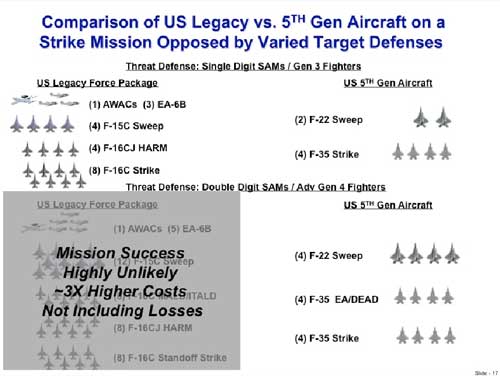
mabieMaybe this will help.. just the strikers, doesn’t include tankers and other support assets of which the legacy package would require more of while still offering a less chance of success. Slide from a presentation of Gen. Dave Deptula.


 Sign In







