 Tu22m
Tu22mIf they are not going to fulfill the same mission set then it’s not “better” and would not even be cheaper.
Well, did I say it was without sacrifice?
If you strip the crap in the JSF program that has issues for the kinematic performance you are very likely to have improved kinematic performance. Its just a simple trade off in capabilities. Skip commonality with STOVL, dont make it short enough for the WASP, dont fit 2000lbs JDAMs in the belly and the airframe will be less draggy and most likely fly better.
Unless the aim is day one strikes against IADS the F35 suffers from poor design choices. For most airforces the aim is obtaining air superiority in or near your own airspace or stopping the enemy from getting air superiority. Ie, no need to have a short, slow and chubby plane. For expeditionary forces like the Royal Navy and USN the optimal fighter is short and requires short runways so you can fit as many as possible on as small ships as possible. So for that the F35 is a perfect match.
Take a look at the F-15SE. It has no internal bay, better kinematics, better range, twin engines, no VLO, simpler avionics, etc and is more expensive than an FRP F-35A.
Why pic the F15SE when Pak FA roughly is in the weight class of F35C and conforms to the example better? But ok, lets take your choice and compare.
The F15SE isnt a VLO aircraft, it is a RO/LO aircraft and it is superior in all areas it is designed to be superior in while being cheaper… and it has internal bays holding 4 AAM. On a stealth AA mission (Boeings name for it) the range is 720nm.
Do we have a real FRP price for the F35? All Ive seen so far are broken promises in terms of costs.
A low-build solution that even tries to match the F-35 simply cannot beat the Economy of Scale, especially in the Dev and sustainment areas.
You still arent reading what you reply to.
If it could be done then established builders like Rafale, Saab, etc would be doing it. The fact that they are not speaks volumes.
But it can be done and Sukhoi + Shenyang AC are doing it as we speak. SAAB are working on TFX with the turks as well as FS2025 for the Swedish government but no formal order has come yet for the final product, while in the case of the F35 there was already an order waiting and the whole competition was funded from the start.
The US where first with 4th gen fighters. Can you honestly say that the best 4th gen fighter is american? When did Super Hornet win an open competition lately? Or F16. Or F15…
The Eurocanards and the Flankers are the best money can buy in that class, and in the case of Gripen even the costs are lower (while having better performance than Super Hornet and F16).
Anyways, topic is the best looking stealth fighter. Something must be wrong if we mention the F35 in that thread… The winners are the usual suspects, YF23 + Su47 if all flying projects are accepted or Pak FA if only adopted designs are accepted.
Tu22mIt never ceases to amaze me how some people (the YouTube creator, not you OB) can think that a company that has ZERO VLO experience, ZERO modern avionics experience, and no recent production experience can somehow design an almost-clean-sheet, twin-engine, heavy VLO fighter (that weighs empty the same as an F-35 is loaded) that will somehow magically be cheaper than the F-35A.
Throw in the absolute absence of any Economy of Scale savings (in development, production, and sustainment) and the claim of being cheaper than the F-35 shows it’s true absurdity.
The problem of the F35 is the extreme ambition. If a competitor wanted to surpass handling, speed + range and match internal AA-weaponry, RCS and roughly have the same avionics performance (save the TV-helmet) it would be possible to do so and do it at a lower price.
How is that possible?
Well, by sacrificing capabilities like STOVL and commonality with a STOVL version. By sacrificing the size constraints (not short enough for WASP for instance) and by not demanding it to carry 2x2000lbs JDAMs in the belly the flight characteristics would have a buff right off the bat. This would mean better fuel efficiency –> less fuel needed for the same range –> less energy needed to reach high speed, if it is designed properly.
This already means better kinematic performance, more freedom in the construction (lowers cost) and possibly a lighter airframe. By using as much COTS as possible costs could be kept down.
Tu22mIf the Russian did not, why should they have to take the blame?
But they did.
They said so in the recordings.
The BUK-TEL was missing a missile and was removed the day after.
It was in the same area as the rebels have gunned down other aircrafts.
It is not the russian state that shot the plane down, it is the russian backed separatists.
Tu22mDid everyone but the Americans and Soviets believe they couldn’t achieve air superiority?
Did anyone else even have the potential to achieve it?
Tu22mWhen is the Gripen E slated to declare IOC?
The Apg-77 was not the first fighter AESA, The F-15C had AESA before it ( IOC 2000) and I believe the F-2 did as well (could be wrong on this).
IOC is never, FOC though is also 2018.
Tu22mConsidering that GaN offers 3 times the energy output (expected in early generations, the potential is more than 10 times higher output) I have to lean towards assuming increased cooling is required.
But if we do a quick check to see where on the GaN curve we are.
Gripen E will be the first operational fighter with GaN based AESA jammers and datalinks (the Demo is already trying it out). This is a first, Rafale will probably field GaN based jammers shortly after followed by Raytheons Next Gen Jammer.
Unless SAAB finds a way to fit the GaN modules in the Gripen E I expect we wont see fighters using GaN based AESAs until after 2020 (considering how far ahead SAAB are in the GaN area with first operational GaN based EWS and first delivered GaN based AESA in the Giraffe 4A).
And speaking of it, GaAs based AESAs havent been around in fighters for that long. It started (AFAIK) in the APG77 which got operational in 2005. It’s just 9 years. Usually technology shifts take longer time. There are still modern fighters with PESAs coming out. The latest Gripens where delivered in fall last year with PESAs, and I expect the latest tranches of Eurofighter have been delivered with PESAs as well.
But I agree that a GaN based AESA would be awesome to see right off the bat, and we know that the technology is ready for it at the time of delivery. Question is if the customers will pay for it.
Tu22mI’d say that it’s much more likely that the event was actually provoked rather than just being a case of bad luck. Now with all the propaganda on both sides, you’d be hard pressed to tell what really happened unless you were there.
Both versions sound pretty plausible, infinitely more so than the “putin did it” jonesy picked up from british newspapers.
Nic
Well, I find it very unlikely that Russia would order the rebels to shoot a civilian aircraft. But if the operators arent properly trained (as would be expected for a militia) they are likely to mistake transport aircrafts from civilian transport planes, especially at that altitude. This is what James Mashiri says (from Finnish army with training/experience on the Buk M1).
State actor culpability is harder to address, but asking: ”Did Russia equip the rebels with powerful and dangerous long range weapons systems such as the BUK surface-to-air missile and the Grad rocket launchers without providing for the required situational awareness systems, thus creating a considerable risk of indiscriminate and non-distinctive use of force?” Such a question may help assess the culpability of Russia as a State actor.
Assuming that the rebels possession of BUK-systems was known to Ukrainian authorities, the Ukrainian culpability can be easily assessed as an airspace control issue, asking: ”Did the State take prompt and responsible action to control and regulate the use of its airspace in order to remove the danger to civilian air traffic — knowing in advance either that the rebels were in possession of SAMs with ranges in excess of 5 km, as demonstrated by the downing of a AN-26 cargo plane on Wednesday, or knowing that the SAMs had been captured from the Ukrainian armed forces in the end of June?”
They are both responsible, one side by incompetence and the other by either neglect or intent.
Tu22mAs I said I’m 99% sure it’s a false flag.
Nic
False flag as in the Ukrainians poking the militia to see what happens (and thus get useful intelligence or sympathy from the rest of the world with no risc for losses at all) or false flag as in it wasnt the militia that fired?
Tu22mNow look who’s talking conspiracies?
Nic
Do you know if it is common that aircrafts (civilian) in contact with air traffic controllers are 300 miles off course?
Tu22mNot to point any fingers but…
It is a war zone with active IADS. Unless you have IFF, radar warning or contact with the ground forces… don’t fly there!
With that said it is already confirmed that it was pro russian rebels/militia that fired the missiles and that the russians are helping them to hide the Buk TEL.
Tu22mGuess I might have been wrong about GaN in the radar. It’s still a long time to 2018 and it still is possible that GaN may find its way to the radar, but it feels less likely after this interview.
Now, as US firms such as Raytheon begin to use them in ground radars, Sweden’s Saab is to use GaN on the Gripen E, albeit not in a radar, but in wingtip electronic warfare systems.
The substance will be used in jammers and passive warning systems, boosting efficiency by 25 percent, said Ulf Nilsson, the head of the Gripen program.
The firm recently announced it was using GaN in its Giraffe 4A land radar, with development underway for a launch customer.
“GaN was costly but that has changed — it is now in mass production,” said a spokesman.
Lennart Sindahl, Saab’s deputy CEO, told reporters that Saab was now ahead of the curve on GaN.
Tu22mNot sure if people have or even want to see this, but I found parts interesting 🙂 It’s from Farnborough, a bit less than a week old.
http://wms.magneetto.com/saab/2014_0714_webcast2/view
So much good stuff in there…
@19 minutes Sindahl confirms that directional datalinks are (and have been for a while) operational. He also confirms that targeting can be done by off board sensors (like ship radar, ERIEYE etc) and the jets can engage targets without using any on board sensors. Not even the wing mans radar has to be used. Upgrades (MS20) for using METEOR + SDB will come fall 2014/early 2015 and also include improved radar modes and jamming.
@29 he confirms that Gripen C/D will get the new AESA in a future MS20.X-upgrade.
In the Q&A they confirm GaN AESA based jammers in the wing tip units as well. By the looks of it Gripen E will have 6 AESA jammers + potentially a front T&R unit.
Tu22mI disagree; low wing loading translates to low Cd true, but also translates to high A. For delta’s, total CdA has been higher than conventional wings. One reason no one used it in the past. However; Typhoon has sufficient thrust to give comperable STR at subsonic speeds, and use all the advantages of canard-delta configuration at supersonic regime. I don’t agree on the part Typhoon has substentially better maneuverability than legacy 4th gen fighters.
Speaking of AOA limits, 20 deg limit will not affect any fighter aircraft’s combat performance, because they would be sticking much less AOAs. Sure, MiG-29 achieves its maximal turn at 26deg AOA, but its quickest sustained turn at 9Gs is at 12deg AOA. F-16 and Su-27 also sustains their 9G turn at ~10-11 deg AOA.
As dogfight is hardly about sustained 9G turns alone, where aircraft would also making turns at 5-7Gs, AOA requirement is even lower.
I will just make a short reply to this.
The lower wing loading may or may not have a huge impact when flying in a straight line, but when the aircraft has to produce several G in lift, the lower wing loading makes it require a lower alfa. Lower alfa means less drag. Below is the chart for BAE Lightning: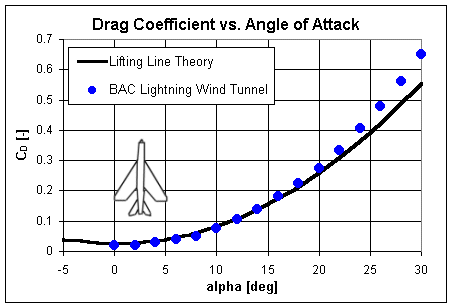
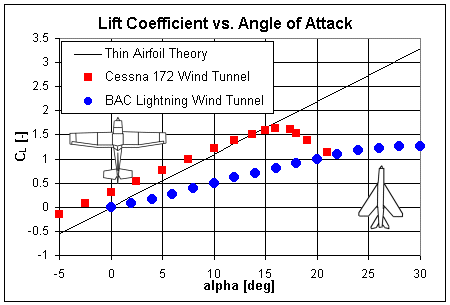
As you see, lower wing loading requires less lift force created and thus lower alfa. Hence my comment on Taffies turning. Yes, thrust is required as well but I think i have made myself clear without having to write an essay 😉
Tu22mI think a lot of us are getting this IR suppression thing wrong. From what I understand, the IR signature suppression is something that is there to avoid detection from IR sensors, not protection from IR missiles at eyeball range.
Look at the tail booms and you see the “IR suppression”. The tailbooms cover the exhaust. It doesnt have to be more advanced than that.
From an engagement perspective, how much difference is M1.4 at AB going to make to a Meteor shot from 20 miles compared to M1.1 at mil power? Is the tiny bit of extra speed worth letting your target spot you early, giving them time to evade/counter attack?
Its easier to say for a non throttlable missile like the Aim120. The Meteor can simply cruise at 1 mach less (throttle back) and thus extend the range accordingly.
Tu22mSome points,
1) The Argentinian Air Force is now “falling apart” at the seams. If no new fighters (and cargo planes, trainers, maritime patrol aircraft, etc.) are eventually procured in the next few years it faces the real prospect of extinction. The human element will not stick around to try to carve a career out of an inoperative airforce. No means plus no people means the endo of everything.
Coments?
Hammer
Rent/lease Gripen C with avionics upgrades and a buffed up engine?
I can not spot any RCS reducing measures.
Most of that comes from new composite materials and RAM. Looking at the shaping today it is pretty well designed from a RCS perspective already.


 Sign In







