 Tu22m
Tu22mWell not exactly, the studies conducted post war showed 90% of the casualties were made by Rifle fire at range. Both sides would get into line and trade fire until one side or the other broke. After that cannon was the next most significant cause of casualties, cavalry and eventually the bayonet were way down. In the second half of the American civil war most units considered to be cavalry were effectively mounted infantry using the mobility of the horse to get them into position before dismounting and fighting as infantry with rifles. Most famously at Gettysburg when Buford dismounted his cavalry to hold the low ridges to the north-west of the town.
Still love this scene in the film:
Sorry guys to bring a debate about the American Civil war into the F35 debate, it is a personal hobby of mine…
While at the topic:
However, there are good points on both sides.
* The F35, no matter how awesome it is, will still be limited by missile load and Pk of the missiles.
* Radars will always be vulnerable to jamming. This will make fighting ranges shorter than advertised, even in the future. In a jammed environment, will the forces see eachother with passive systems first or will it be radar?
* Density of the air (ie flying low) will always have a very negative effect on missile range, not as much on say the Meteor as on a rocket propelled missile, but it will still make ranges a lot shorter than advertised.
* Expensive airplanes with many man hours per flight hour will give you fewer airplanes in the air, ie where the battle for air superiority is won.
* Low cost airplanes gives you the oportunity to saturate the enemy capability to physically take your forces down.
Lets just for sh!ts and giggles say that Lockheed makes a new F16 version. It can carry 4 MRAAMs close to the fuselage and in Pak FA like underving “pockets” it can carry 2 Aim9x. Additionally it will use IRST, PAWS-2 with panoramic view and DIRCM integration, new AESA and use the new datalinks (either from Super Hornet, F22 or F35). On top of this they will improve shaping and making it a little bit lighter. The only things they focus on are survivability and costs.
Personally I think this would be very attractive, it would relatively cheap because of weight etc.. A further improvement of the demonstratior below with a little bit wider under carriage to fit a few missiles. Maybe carrying a missile pod.
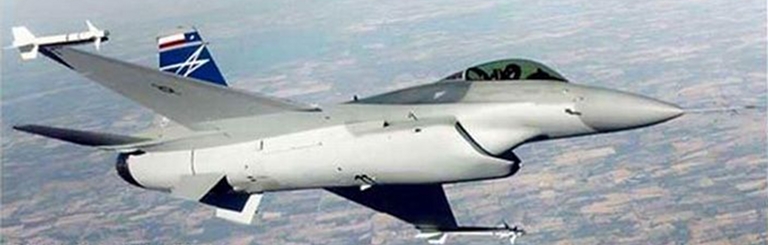
And basically that is what the F35 was supposed to be. And then it was also a STOVL aircraft with bombs internally. And then it was a carrier version added with even larger payload requirements. And then they wanted it to have longer range. And then they wanted it to still be very short because… costs and size req on assault ships? The F35 fits perfectly to all requirements except costs. That is the truth. Within those size requirements it is impossible to make a fighter with the same range and internal payload capability… and space for a STOVL engine that performs any better than the F35.
Boeing tried and came up with pretty much the same flight performance.
So in the end, would one prefer to have a good enough fighter at a low cost or a high tech marvel that costs 3 times more while maybe not offering any advantage in needed areas? We see this in Austria now. They got the Typhoons basically for free, but cant afford to operate them. This is a country that is richer than several (like Denmark, Greece, Israel) countries that will get the F35. Now a country with 1/3rd the size of the economy will take over the air force role for them because they can afford to operate their fighters. http://kurier.at/chronik/oesterreich/ungarische-gripen-sollen-wien-sichern/71.253.890
So even though many dont like to admit this, costs still matter. Maintenance/flight hour matter. And a Gripen C with gun only is better than a Typhoon on the ground. Same goes for the F35 (which costs more than Taffy), will airforces really afford it? After all, it is 20% heavier than the Eurofighter with a lot more costly integrated stuff in it, not to mention coatings.
Tu22mSeems like Austria will replace their airforce with Hungarian Gripen C… http://kurier.at/chronik/oesterreich/ungarische-gripen-sollen-wien-sichern/71.253.890
😀
Tu22mI often wonder the reason for these intercepts.
So the Russians are trying to gauge our response times? Why don’t we just track them and ignore them.
Then they won’t have any data. It’s unlikely they would actually overfly the UK.
During WW2 not all incursions into our airspace were contended. Some where feints and ignored.
These incursions are not even during hostilities.Now, if we had a few Lightnings that would make an interesting intercept, and keep the Ruskies guessing 🙂
The reason is first of all to identify what is happening. Is it a hijacked plane like 9/11, is it an enemy recce mission and so on. So first of all, identification.
Second is, deterrence. Show what ever target you are intercepting that they are detected, identified and will encounter resistance if they try anything.
In the event of the russian easter where they performed EW-attacks against sweden they encountered no intercept. At the time it seemed embarassing for the Swedes but later it was confirmed that it was a SIGINT operation. The Swedish Army wanted to see what EW-capabilities the Russians currently have and record the way their systems operate. An intercept would likely have disrupted that mission.
So as a response to you. All options are on the table, but normally the choice is intercept, identify and escort for a while and then return home.
Tu22mObviously it is good that one F35 has reached 1,000 hours, it has taken 4 years for this to happen. That suggests about an hour a day, is that usual for a test aircraft in a very high profile program?
Well, it depends on what you compare it with.
Number of hours != quality of flight tests.
This is how SAAB tests 130’000 test points. https://www.youtube.com/watch?v=OXKvNe2VWt4&t=1140 in 25 flights.
Compare that to the pase Lockheed runs tests. http://www.lockheedmartin.com/us/news/press-releases/2012/may/120508ae_f-35_update-flight-test.html
So many test hours doesnt actually mean better testing. But they do stress the airframes longer giving more reliable result in that area.
Tu22mI kind of agree with Tu22m. The Yanks would be better off sending those planes and the military support they planned to send to the al-Maliki regime to the Kurds. The Kurdish Peshmerga seem to be the only disciplined military force in Iraq that doesn’t run away from a buch of thugs driving techincals. It was amazing to see the kind of gear the Iraqi army just abandoned as it ran away. They had armored cars, APCs and even Tanks and they just abandoned that equipment and their arsenals and ran away. You could drive a T-72 up to one of those ISIS technicals and crush it without having too much to fear from an RPG-2 or even an RPG-7. If the new citizens militia really manages to beat off the ISIS the abject humilitaion of al-Maliki and of the Iraqi army will be complete.
The worst warriors in the history of mankind are the Arabs. Unless they fear for their lives or believe god has sent them they wont fight.
The Soviets saw that in Afghanistan (from wiki)
On December 27, 1979, 700 Soviet troops dressed in Afghan uniforms, including KGB and GRU special forces officers from the Alpha Group and Zenith Group, occupied major governmental, military and media buildings in Kabul, including their primary target – the Tajbeg Presidential Palace.
That operation began at 19:00 hr., when the KGB-led Soviet Zenith Group destroyed Kabul’s communications hub, paralyzing Afghan military command. At 19:15, the assault on Tajbeg Palace began; as planned, president Hafizullah Amin was killed. Simultaneously, other objectives were occupied (e.g., the Ministry of Interior at 19:15). The operation was fully complete by the morning of December 28, 1979.
Then they met the Mujahedins who, contrary to the Afghan Army, actually put up a fight. After some 9 years the Mujahedins where decimated, attacks where rare and the Soviets hade trained over 300’000 Afghan soldiers as well as given them the same military equipment they had used for all years. (The Soviets where on average <120’000 soldiers stationed at any given time).
The Soviets left and within <1,5 years the almost decimated Mujahedins, just like ISIS in Iraq, overthrew the leaders. Despite losing 75% of the strength (to deaths and combat wounds) the Mujahedins beat an army 3 times larger than the soviet army previosly on site and subsequently took over all military equipment. Some of it still used to fight UN troops.
We see similar things happening now in Iraq. When they feared for they lives (Saddam in power vs the Persians) they put up a fight, when they feared the enemy more than their leader (US invasion) they deserted, and now, when they have no fear for their leaders and dont believe they are chosen by god they surrender even if they outnumber the enemy (ISIS) with a factor of 40:1. We have seen this in Libya as well (MB and Al Qaeda took over the country… at least they didnt get Rafales first), we saw a similar development in Eqypt (even though they depend more on US aid and thus easier to control). So unless the US can control the country (Iraq has to much oil so they have to be physically on site or have a mean dictator that controls the country).
Ofc this is in general terms but historically this is how it has ended in the ME. Without dictatorship it will end up with fanaticism. (Pakistan MAY be called an exception) Who, in their right minds, would sell modern weapons to anyone in that region after invading said country?
Tu22mDon’t think they will do the ISIS much good….
Well, ISIS have gone from “just being rebels” to something we can actually call an army without a country.
After the assault on Mosul they now have increased their money supply with about $430 million, a number of blackhawk helicopters, armored Humvees (at least resistant to small arms fire and usable when attacking US guard posts…) and so on.
Oh, and they have all equipment previously owned by the 2nd division. http://en.wikipedia.org/wiki/2nd_Division_(Iraq)
It consisted of the following:
Its subordinate formations include:
5 (Citadel) Motorized Brigade (formerly 4th Bde)
6 (Scorpions) Infantry (AAslt) Bde (former 2nd Brigade, 2nd Division)
7 Infantry Brigade
8 Infantry Brigade
2nd Motor Transport Regiment
So now ISIS also have light armor/APCs in mint condition, logistics support vehicles, a lot more guns…
Thank god they didnt assault an air defence regiment or better yet, a wing of the Iraqi Air Force. It would be interesting to see Al Qaeda in a couple of years with heavy IADS, F16 pilots (with enough flight hours), US made M1 Abrams and attack helicopters.
This might not intimidate NATO, but it is enough to scare Iran, Syria, Lebanon and others in the region. IF ISIS gets IADS and fighters it isnt unlikely that they, by force, will take over a small country in the region. Just think about it. A dumbed down F16 with Aim7M is lightyears ahead of what Iran can emass. Or maybe not lightyears ahead of the Iranian F14s, only a few decades if we consider the missiles and avionics.
Tu22mI hope they send as few aircrafts as possible to the Iraqis. They will just end up in the hands of ISIS anyway.
Tu22mTo judge by what I have been reading and hearing of late – and I’m not long returned from an EW conference – that is not the case. A modern EW system knows the bearing from which the last pulse came, and knows the range of frequencies within which the next must fall, as well as the electronic characteristics that it will exhibit. The goal is to spot that next pulse and respond within a time interval measured in nanoseconds. The speed with which that process can be done, compared with the length of the enemy pulse, will determine the effectiveness of the jamming.
Well, in order to be effective at those more exotic ways of jamming you need to…
A: Crack the frequency sequencing (pretty unlikely to do that in real time, there will always be a delay), so the only alternative is to crack the sequencing at forehand (either by sampling or industrial espionage).
B: Guess the intervals between pulses (which is varied on modern systems to prevent this)
C: Get target position and closing speed to produce likely doppler shifts. (Not very easy to get without actiating the radar…)
And that is against a monostatic radar system. Against a multistatic array (like PS-05 with TIDLS)… you just dont get enough information and every coutnermove you try gives the enemy your bearing and range (ie position).
So even if the system itself is capable of advanced jamming, there still isnt any guarantee that is actually will work. And for every mose there is a countermove.
Regarding pulse length etc… you have a great example on mixing here https://www.youtube.com/watch?v=MViVyocQhVw&t=10m
In case you, or someone else is wondering, the speaker in the video explains exactly how mixing and fmcw radars work (in 6 minutesx) as well why pulse lengths is totally irrelevant. Just think about what adding random frequencies will do to the processing time required by the EWS.
🙂
Tu22mYes, more on the APG-81 with the same general here:
http://breakingdefense.com/2014/06/a-gods-eye-view-of-the-battlefield-gen-hostage-on-the-f-35/Love this one:
“And you’re right, the AESA radar has tremendous capacity to play in that game. Boil all that down and it comes to this. Gen. Hostage is saying that the F-35′s cyber capabilities are so effective — combined with space assets, which are often difficult to distinguish in effect from cyber capabilities — that the planes have to stop using them so the pilots can shoot at each other.”Good info in those articles!
Very good read. But, as with most features, its nothing new.
I do remember Dassault claiming “virtual stealth” capabilities in SPECTRA, I know that EWS-39 has some pretty awesome features (and has had it for quite some time), Growlers hade very impressive jammers etc.
What they dont talk about however is that since these have been around some time others have not only tried the features out but also adopted countermeasures. At least for the high end systems.
Lets take the virtual stealth/fake targets for instance.
Basically one needs to do an advanced DRFM-attack where false echoes are sent simulating different dopplershifts and differende target ranges. Against older systems it may even be possible to have horizontal/vertical displacement. But todays radars have exceptional angular accuracy so against AESAs and modern PESAs one might manipulate range readings making it rather difficult to obtain a radar lock on.
A way to counter this is radarsamverkan, or radar cooperation over datalinks. Currently in use with PS-05 in Gripen C. That means you only need bearing from two systems to get a 2D positioning of the target or three radars to get a 3D position with high resolution. Even if the target is jamming. Radars that arent emitting may also be listening to get bearings.
And that has been fielded for quite some time now.
In order to foil a modern radar one needs to break the randomization keys, and considering how good todays hashing and randomization algorithms are Id say good luck breaking it in real time… In other words, one needs to know when the pulses will come from the enemy jet.
Now, if you quickly look at the competitors you will see that… everyone else will use GaN-based directional jammers, towed decoys (with DRFM-AESA jammers) as well as in some cases airborne multistatic radar systems and/or lower band radars as well as top of the line IRST-systems.
Gripen pilots had an excercise in the UK a few weeks ago where they went up one Gripen vs 2 Eurofighters. http://blogg.forsvarsmakten.se/flygvapenbloggen/2014/06/06/verklighetsnara-taktikutveckling-av-jas-39-i-england-meatball-ur-en-pilots-perspektiv/
It showed that obtaining a radat lock was really hard, even at WVR ranges! In tis scenario the range started at 25 miles with closing speeds above 1100knots. Roughly 7,5 s before merge. And neither one could get a radar lock so both moved over to IR. The fight didnt end until the fighter was on the tail of the target to get a clean kill.
This is just one example on why a fighter needs to be able to handle WVR. The Typhoon couldnt get radar locks on Gripen, Gripen couldnt get radar lock on Eurofighter, both went over to IR and then it was a matter of getting into position (wasnt dog fights over according to LM?) to get a solid killshot.
This is still congruent with all other excersices. Jamming today is so darn good that radar lock is almost impossible against a modern fighter.
Tu22mIt’s a sort of land based refuelling/rearming solution. In a certain scenario or if the fighter would run out of juice, it’s always a nice option to be able to land on a road. And it’s really quick to get up again. That said, the wheels are moved around a bit which generally is a big no-no…
The roadbases are a little more than just refuel and re-arming even though that is the main purpose. As you will see in the first clip there is an underground bunker system for accomodation och pilots and technicians as well as hangars for repairs etc. Below you will see field hangars, one built as a classic countryside barn, and some more modern hangars protected from airburst weaponry and small arms fire (up to .50 cal).
Ze barn version from base 60:
[ATTACH=CONFIG]228937[/ATTACH]
Base 90:
[ATTACH=CONFIG]228938[/ATTACH]
The simplest road and wind protection:
[ATTACH=CONFIG]228939[/ATTACH]
Sometimes these barns/hangars/storages are painted as summer houses (dark red with white corners on the house).
Images from http://www.femorefortet.se/Arsmote-090329.htm (veterans meeting)
For operations in action (where accomodation rooms, briefing rooms, topless mechanics, driving characteristics of SH37 and AJ37 along with low level flying and road base operations will be displayed), se this vid.
This will show a part of STRIL that in some areas is part of the road base system, about 2 minutes later you will see a real intercept mission outside of Gotland (target US RC135)
https://www.youtube.com/watch?v=PoQtnugT6A4&t=10m10s
So the road bases where a pretty well integrated part in the whole system and it had its own command & control-units, in cases where there where clusters of road bases they usually hade several underground radar systems as well nearby.
In many cases though the only thing needed would be land, rearm and take off so many road bases where optimised for that.
Tu22mWhat are the protrusions on the inboard missiles?
From Wiki:
In many respects the Kh-31 is a miniaturised version of the P-270 Moskit (SS-N-22 ‘Sunburn’) and was reportedly designed by the same man.[5] The missile is conventionally shaped, with cruciform wings and control surfaces made from titanium.[3] The two-stage propulsion is notable. On launch, a solid-fuel booster in the tail accelerates the missile to Mach 1.8[5] and the motor is discarded. Then four air intakes open up and as in the Franco-German ANS/ANF the empty rocket case becomes the combustion chamber of a kerosene-fuelled ramjet, which takes it beyond Mach 4
Pretty awesome
Tu22mAgreed, four days is what it took. Serbia had a good SAM and Radar network, up against NATO they got a couple of shoot downs. One A-10 lost an engine just to correct your list.
Was that during night time and was i combat damage? 😉
Did you notice the ranges btw?
Tu22mFredaykin, this might be of interest for you: http://forum.keypublishing.com/showthread.php?128354-will-stealth-become-irrelevant&p=2109855#post2109855
From that post:
On 24 March at 19:00 UTC NATO started the bombing campaign against Yugoslavia.
At about 8:15 pm local time march 27, with a range of about 8 miles (13 km) several missiles were launched. According to Sergeant Dragan Matić, who was identified in 2009 as the soldier who fired the missiles, they detected the F-117 at a range of about 50 to 60 kilometres (31 to 37 mi), operating their equipment for no more than 17 seconds to avoid being locked on to by NATO anti-air suppression.
It was shoot down on the fourth night. Hardly a long time to learn its “regular patterns”, but from a mission planning perspective the lesson was that 4 days may be enough for the enemy to learn your routines.
Another fun thing is that according to GWAP the F16 was more effective in actually hitting the targets. Night time losses can be summed up as follows from Desert Storm + Allied force.
F117 – 1 damaged, 1 lost (8:15 in march is night as it is dark in Serbia at that time…)
F-16 – 0 damaged, 1 lost
A-10 – 0 damaged, 0 lost
Those are the actual numbers.
Tu22mJF-17, which is declared to be the 1/3 price of Gripen and good enough for air police mission……
If that’s the level one is looking for, why bother to replace the F5 at all?
Just restrict the envelope and add new avionics.
Tu22mSintra, Tu22m you should visit F-16.net, there they all agree that F-35 is as cheap as Gripen E 😉
http://www.f-16.net/forum/viewtopic.php?f=58&t=25426&sid=d62593586dbb54479ba85d3b11b254a9
Wow.. or we just go with real world numbers…
OTOH it is a proven fact that bias impairs ones ability to do simple calculus. I wonder if the F16.net fanboyism is worse than in the F35 thread.


 Sign In







