 Tu22m
Tu22mGripens at F17, 90% availiable. Clocking 4500 hrs spread over 20 airframes. The ones in hangar are just waiting spares that never show up because of the logistics system.
(see post in the Gripen-thread)
Tu22mSomeone asked, and someone found 😀
Manufacturing cost, Gripen ~250m SEK or ~$39m
http://www.svd.se/naringsliv/reservdelar-saknas-jasplan-star-still_3372318.svd
Out of 20 aircrafts 2 are usually in the hangar for maintenance due to the crappy logistics system PRIO. I’d say 90% of the fleet availiable despite long delivery times for spares is pretty decent.
On average they fly 225 hrs per Gripen. 4500 hrs with 20 jets every year.
http://www.forsvarsmakten.se/sv/organisation/blekinge-flygflottilj-f-17/
Tu22mSince the next step (for the latest fighter’s MLU’s starting in the twenties (or thirties)) is conformal 360 AESA coverage for both detection and EA, a rotating plate is a dead end in my opinion.
Nic
Conformal radars may very well be the future, but we arent there yet. 200 degree radar coverage is pretty good for an interim solution.
Tu22mAny photo wiz can make this countable ?
A quick calc gives 988, ofc with a margin of error of a few %
Here is a higher rez pic http://www.aviationweek.com/Portals/AWeek/Gripen%20Radar.jpg <– Obviously they run DotNetNuke 🙂
Speaking of the radar, this graphic show why a moving dish is so important during sc gimbal turns.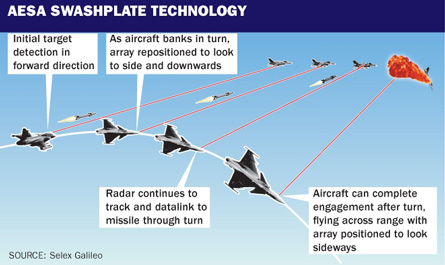
Tu22mCould some of the swedish speaking folk dig up some official documents on how much the Gripen E will cost the Swedish government? Program cost, unit cost, total life cycle cost, anything.
There has to be some official documents about fund allotment?
Nic
In Sweden they count it differently. The 90bn SEK for instance are just earmarked for the increase of the “cost frame” for the Gripen system. But we have the danish offer, fixed price for everything needed over 20 years 458 mDKK or 580 mSEK in 2008. ~82m$ per pop
För ett helt Gripensystem med 48 plan, utbildning, service och reservdelar vill Saabägda Gripen International ha 22 miljarder danska kronor.
Då har man räknat ut livscykelkostnaden på 20 år.
Utslaget per plan blir det 458 miljoner danska kronor eller 580 miljoner svenska kronor.
Prislappskuppen
Att så tydligt gå ut med en bindande livscykelkostnad ses i Danmark som en kupp från Saabs sida.
http://www.nyteknik.se/nyheter/fordon_motor/flygplan/article263165.ece
In Netherlands we get very close as well (also in 2008) and ~84,6m $ per pop assuming USD/EUR at 1,5. http://www.jsfnieuws.nl/wp-content/Saab_OfferGripenNG_170409.pdf
Total Price EUR 4792 Million
The life of the engine is 4’000 hrs or… 20 years. So i dont think they include spare engines.
Tu22mIf it isn’t emitting then how is it going to even know that the target is there? Something will have to be.
Same way that fighters today get target data from AWACS and only use their radar when they are close.
Tu22mAnd that is where the utility of the F-35 emerges. If the obsolete Libyan air defences could impose restrictions on Rafale operations, the situation can hardly be better against a more professional, better trained, better equipped adversary. The F-35 wouldn’t have a free run of it either, but it certainly wouldn’t require as a high a margin of safety.
Still, EOTS/IR controlled AAA and short range IR missiles would impose some restrictions regardless.
As stated in the ‘cheap bomber thread’, stealth is a cheap way to allow for less sophisticated avionics without sacrificing capability. The F35 will at IOC have avionics that are amongst the best (in all fields), in order for a Rafale or Gripen to have similar capability to avoid being targeted they would need jammers that are a generation ahead of the F35.
Tu22mForgot to say, as Clement Ader flew before the Wright brothers, this is a definitive clue about french designs are ahead of US no?
Yes. After all, the French have had longer time to perfect the understanding of aerodynamics. But I think Greece are the best in the world considering their history of flying goes back to Ikaros, not to mention the rocket scientists of India who have been pioneers in weapons grade rockets since Hyder Ali in 1792…
Tu22mRafale F3, not F2
Wrong, Thales is producing more atm. (11 for normal Rafale production + some for F1 upgrade)
Well, I guess Selex has a backlog stretching it to 2040 for the current Eurofighter and Gripen orders… systems that are due to be operational by the end of 2023.
Or maybe the production capacity numbers are grossly underestimated.
Tu22mIt may be possible.
If the weight is kept low, if the engines are cheap cots and the avionics are second tier…
Cost increase as you make the aircraft more survivable. Ironically stealth in the form of shaping is the cheapest approach as it allows for less sophisticated avionics without sacrificing survivability.
An enlarged manned global hawk could do the trick and get it right for less than $100m (in 2005 flyaway cost was $35m).
Would that fit your bill?
Internal payload for an enlarged RQ4 could easily reach some 10’000 lbs. Especially if fuel was sacrificed.
Tu22m@djcross
SAAB fielded the ERIEYE airborne AESA in 1996. Does this mean they are the best in the field?
Just because the corporate website say stuff like leading the field, best or first in its class doesn’t make it the best. However, the spec sheet of power output, noise tolerance, resolution, radar band etc do tell a story.
Tu22mOr is it this other “example” of an SR-71 with a radar cross section the size of a large conventional fighter being seen by a static S-band radar site in Sweden from the side that means stealth is a laughable concept?
Who is saying that?
Oh, and do you have a source for the SR-71 RCS?
What we know is that a fairly well designed LO aircraft (at least from the sides) could be tracked at 400km+ (the second PPI incident) from a radar @4GHz and 20KW average (Vostok E is 30KW avg, 40dB SP over noise enhancement etc).
Does this mean stealth is a laughable concept? No.
But it does show the fanboys that what is great in one frequency might not be as good in others. And with more intelligent missiles (like Meteor) a very aproximate position is more than enough for the missile to be useful.
The playing field is constantly changing, stealth is one advantage, but so is speed, the weapons carried and the avionics. Relying one one feature is a laughable concept. Dont you agree?
Tu22mCan reach much more than 40 dB nowadays… Much much more.
I kind of expect that 😉 After all, filtering in 1975 improved noise cancelation by over 40dB. Computers have evolved a bit since then.
Just to get a reference. If a fighter wants to hide in the noise it will have to reflect less than 1/10’000 of the noise to avoid detection by the radar after a couple of sweeps. Assuming the radar is from 1975.
Next threshold is antenna sensitivity.
I do look forward to passive antennas.
Tu22m1. The SR-71’s level of stealth relative to the radars of the era is nowhere near where the F-117/B-2/F-22/F-35 are.
This is evident in the fact that the both the F-22 and F-35 HAVE to carry special RCS enhancers to ensure that civilian radars can see them when needed.
2. That picture shows not a track, put two points where the SR-71 was seen, from the SIDE where the RCS of a VLO aircraft is HUNDREDS of times larger than from the front.
Once again, no relevance for a mission where the VLO aircraft is attacking the radar site.
1. I gave you the source, it’s a solid track, even when it turns head on towards the radar. Or rather the track is at its strongest head on an while banking. I was just kind enough to mark two spots.
2 You are right, it’s not relevant because today’s VHF radars have much better signal processing. Heck, 10 years after the PS 66 the radars had gone from 10 dB in signal over noise improvement to over 40dB. How much did RCS go down in the same time? I know, it’s a trick question.
Could you please give me the RCS numbers for the SR71 from the sides? You seem to have numbers that dont support reality so I would be happy to see them.
EDIT; Yes. The F117 was an improvement, but obviously not good enough. A radar of the same era could track the F117 before it reached the coast (Source Zoltan). Considering the location of the shoot down we are talking about weak signals out to 100 km + and strong signals at some 40km despite some jamming. F35 is said to be fairly close in RCS.
Tu22mYou can’t see me? My stealth must be good 😉
No, its not the stealth. You are just below the radar horizon. (A tactic commonly treated as obsolete by the LM fanboys)
As we see from examples with real life reduced RCS ac, like the SR71, its not that hard to track despite crappy signal processing.
[ATTACH=CONFIG]226183[/ATTACH]
from https://www.youtube.com/watch?v=rAUodXI4LPw#t=1640
This one (PS-66) had a signal enhancement of 10dB compared to noise, 10 years later, 1975/1977 signal processing in the Giraffe had improved to >40dB over noise level. (the year is wrong in my pic, radar is from 1966, hence the name. PS-66)
What LO is saying is absolutely plausible.


 Sign In







