 Tu22m
Tu22mThe bays are by far the biggest problem, yes. They are simply too large, dictating the overall size of the fighter. DAS is another relatively useless feature occupying much space. The EOTS could be kept/enhanced as IRST replacement.
Is the EOTS really taking up more space than other MAWS on the market? The implementation in block 1 might be a bit ambitious and thus costly but I think that it will be the standard MAWS in say 10-15 years.
Tu22mIMHO there is no long term cost savings to going with SH-ish avionics at F-35 IOC and then developing more later.
The only thing that is saved is initial development funds and time.
Actually, it would cost a lot more in the long run.
1. Any new avionics will have to go through recertification again.
2. Any new hardware will have to go through a lot of physical testing.
3. Lack of EODAS at IOC means that the F-35 has no IR MAWS.
4. Lack of EODAS means a lack of self-BDA.
5. Lack of EODAS means the rear-limited cockpit visibility has no way of being corrected.
6. Lack of EODAS also means that the WVR survivability is greatly diminished since it will not be able to do significant HOBS shots.
7. Lastly, many are crying about, and have made significant cuts in order to reduce, concurrency. By not including the full hardware suite at IOC then you are increasing concurrency costs considerably.
This list… Do you know what fallback means? Or backup?
I would say the Gripen development is exceptional in this manner, or Pak FA for that matter.
They all use systems already fielded, but give them space to grow. So the certification for the current avionics is about 90% done when they start flying. This means that if there is any delay somewhere the systems will still be operational on time. The potential cost overruns are low and limited to specific areas and there are fallbacks for everything.
The Gripen NG for instance can use the old PS05, the AESA or the new 4 channel AESA. For IRST they can use the old IR Otis or the new one from Selex (?) and so on. All these systems are already succesfully integrated (just not implemented on all ac). for the Gripen a lot of stuff (like the upgraded datalink, new cockpit design etc) was derived from Draken to reduce costs. Even the canard design was a legacy where they had a head start.
So if we go back to the list.
1 If you plan for growth you can start with a decent cpability and do a block upgrade a few years down the road fr the LRIP.
2 Thats why you dont start will LRIP to begin with. If you dont have a fallback solution then every little hickup on the way will delay the whole project. However, if you start with an infrastructure that already exists and simply gets more integrated and more capable with every step, then you will always have a decent capability at any given moment and small upgrades (mostly software) can be done cheaply after delivery with added capability as time goes.
3 Poor planning has that result.
4 –“–
5 –“–
6 Other aircraft can do this with normal HMDS, and yet again, this is just related to poor planning.
7 Correct.
The F35 could have reached some level of IOC already if it wasnt for the subsystems needing so much time. The early buyers would have to pay more for upgrades but they would have a machine that was close in performance to the F16 but with stealth. Instead they are sitting with an ultra expensive jet trainer.
Tu22mDemonstrated where? I have not come across any picture, or any article explicitly mentioning internal carriage of 8 missiles anywhere.
I thought it was 3 missiles per centerline bay + 2 on the sides?
Looking back it was a pretty convincing CGI i saw.
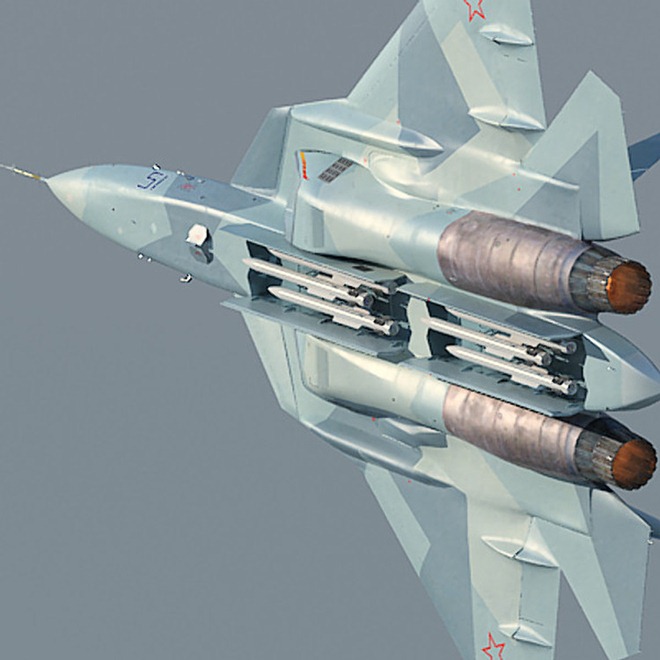
Tu22mI would say they used the same methodology that lead them to conclude (in 2009 no less) that the PAK FA would have Mach 2 supercruise and 8-10 internal weapons stations or that both the PAK FA and the “J-12/J-XX” would have “highly integrated avionics” equal with those in the F-22/F-35. (I do love how even before they knew the name of the J-20 they had already concluded that it was at least the equal of the F-22…)
Is that where the term garbage in, garbage out originates from? :rolleyes:
However, they seem to be pretty spot on with the internal weapons on the Pak FA (8 is demonstrated so far and there is plenty space left)… but even a blind hen sometimes finds a grain of corn.
Tu22mI remember when a certain Australian “air power” site used to claim that the F-35 couldn’t open its bays at supersonic speeds. :very_drunk:
I do wonder how they came to that conclusion considering that they accept that the F22, J-XX and Pak FA will be able to open their bay doors at supersonic speeds.
Tu22mYou are confusing sustained turn rate and instantaneous turn rate. The PS=0 line is the sustained turn rate. The + and – PS lines indicate a condition under which the aircraft either gains or loses energy.
Ok, i get it. I thought it was all sustained turn rates because of the text “Schnelleste kurve”, meaning fastest turn, ie full lap. In that case we can discard my chart. So the F16 can only sustain 6,5G maximum. That’s good to know.
Tu22mThe F-35 and the Infamous “Sustained G” Spec Change: Part 4 F-35 Vs F-16A
http://www.elementsofpower.blogspot.com/2013/06/the-f-35-and-infamous-sustained-g-spec.html
Why does he put the sustained turn rate for a clean F16 with 50% fuel and 2 x Aim9 at 14,3 degrees?
All other charts show a turn rate just over 19 deg/s (die schnelleste kurwe = tightest full turn = sustained turn rate).
see http://www.f-16.net/attachments/f16a-15k.jpg
So the final chart should be ~16,3 deg/s for the F16 with full internal fuel and it would likely be a little bit lower if Amraams are added.
It is a very good and informative post but as they say, garbage in, garbage out. His modelling is excellent, but the values he puts in to the model are very wrong for at least one aircraft.
EDIT: put it all in a chart, its easier to show what I mean by that. The F35 numbers are from your blog post and the F16 number is derived from the same calculations… only with a normal starting point.

Edit 2: I personally think the F35 numbes are too low.
Tu22mSTATEMENT
BY
DR. J. MICHAEL GILMORE
DIRECTOR, OPERATIONAL TEST AND EVALUATION
OFFICE OF THE SECRETARY OF DEFENSE
BEFORE THE
SENATE APPROPRIATIONS COMMITTEE
SUBCOMMITTEE ON DEFENSE
SAC-D – JUNE 19, 2013
F35A
As of the end of April, progress in test points required for 2B envelope fleet release is
behind the plan for the year, having completed 473 of 614 points planned for completion through
the end of April 2013, or 77 percent. Progress in weapons integration is also behind schedule,
having completed only 7 of 19 total separation events versus the plan to have completed 14
events by the end of April. Accounting for test activity prior to calendar year 2013, the program
has completed approximately three-fourths of the total number of test points needed to clear the
Block 2B flight envelope for the F-35A.
Mission systems
The test centers began flight testing Block 2A software in March
2012, and, as of the end of May 2013—15 months of flight testing later—had completed about
only 35 percent of the 2A test points, all of which should have been completed by the end of
February 2013, according to the integrated master schedule. The first build of Block 2B
software was delivered to flight test in February 2013, and, as of the end of May 2013, 54 of
2,974 Block 2B baseline test points—less than 2 percent—had been completed. As of the end of
April 2013, 303 of 1,333 total planned baseline mission systems test points for the year with all
versions of software had been accomplished. An additional 532 added (or “growth”) points were
flown to evaluate discoveries and for regression testing, which is 2.5 times the growth allotted in
flight test plans through the end of April 2013. If this trend in added testing is maintained
throughout Block 2B development, completing flight test by October 2014, as reflected in the
program’s current plans, will not be possible…
…with this new hardware to be able to fly. Initially, Block 3i capability will be more limited than
the Block 2B capability that will be concurrently fielded. This is because the timeline to
develop, test, and clear Block 3i for use in production aircraft next year requires that Block 3i
start with an early Block 2B version in lab tests very soon this year; thus, the capability provided
in Block3i will lag Block 2B by about six months. Maturing Block 3i hardware and software
will be a significant challenge in the next 12 to 18 months. Simultaneously, the program will
need to make progress on Block 3F development.
This is a favourite of mine 🙂
However, no amount of susceptibility reduction can eliminate the
possibility of an F-35 being successfully engaged, either by ground-based threats or by enemy
aircraft, particularly during high-risk missions such as visual close air support and within-visual-
range air-to-air combat (i.e., “dog fighting”). In such cases, the F-35 survivability can largely
depend on its ability to tolerate threat-induced damage; that is, its vulnerability reduction
features.
Whaaat? The survivability in dogfighting will to a large extent be depending on its survivability to absorb enemy bullets and missiles without blowing up??? Geez, thats a solid tactic. 😀 But the weight reductions prohibit measures to improve the ability to absorb that punishment…
This is the current protection level…
Tests have shown that the engine
can tolerate ingestion of fuel leak rates representative of single-missile fragment-induced
damage to fuel tanks surrounding the engine inlet. Further analysis is required to assess
the impact of multiple fragments, which are probable in any case where a missile
achieves a near miss on the aircraft, on engine response to fuel ingestion. A Concept
Demonstrator Aircraft engine test in FY05 showed that the engine could not tolerate
ingestion of fuel leak rates representative of damage from a larger gun projectile
So much for the new dogfighting tactic of eating bullets.
And then we have the usual thermal/cooling problems.
Happy reading boys and (not very likely) girls.
EDIT: Please note the use of conversational condoms, ie smileys. They are indicators that sarcasm and/or irony may be present.
Tu22mAt this point, the most logical approach for A2A Missile defense approach would be DEW’s.
The main achilles heel is the limited amount of targets the system can engage at any given moment. Lets just say it will be good enough to destroy an incoming AA missile, the simple solution is to fire two at the target. If the system can take care of two missiles, fire three.
Carrying anti AAM would offer better capabilities vs multiple incoming threats, and in a small package the numbers could be sufficient.
Where it eventuelly will go is for the future to tell. Research is being carried out in both fields.
Tu22mYes, many systems are years late coming onto Typhoon, thanks in part to different partners wanting different functionality at different times.
Now that is something we tend to see a lot of in many international projects and it is also a reason why open architecture (access to source code as well) is so important. It allows users to tailor the aircrafts to their specific needs without causing delays for all other users.
Tu22mSo you’re saying you’d rather fight against a Rafale or a Typhoon than against a Gripen…? I sure am glad you don’t work for the MOD procurement or we’d have ended up with a load of jets that the F-16MLU’s have no real trouble with. And it is a 4th gen fighter isn’t it, and it has been souped up, has it not? I think you know the answer.
Wait a minute, are we comparing the aircrafts as air superiority platforms now?
The Gripen and now the Gripen E are perfectly tailored for their role. In the case of the Gripen E the platform now finally has similar T/W ratios as the Eurofighter. It has a good AESA radar (actually larger than that of the Rafale), it is cleared for Meteor etc. The Gripen, in this coming iteration, will take the step from simple point defense/multirole ac to becoming an air superiority/multirole fighter.
The big difference between the three is that the weapon loads etc have a higher relative impact on the smaller aircrafts performance. Basically thats it. So depending on how you will use them, all fighters will have a potential edge.
The Gripen is very well integrated in supportsystems, like ground radar and ERIEYE, so asking who would rather fight who is pretty ludicrous without considering the support elements. But in BVR its a pretty even game. Comparable kinematic performance between all three (lightly loaded), all will use AESAs with the Rafale having around 900T/R modules, Gripen ~1000 and Typhoon a bit more (1200-1500?). All will use Meteor. Efficiency of jamming will likely be the deciding factor.
Tu22mPerhaps in your reality… besides, a souped up 4th gen fighter (many would say a poor mans Typhoon) isn’t even comparable anyway so it’s moot point, as the difference in customer clearly base shows – compare how many services want the jazzed up Gripen compared to how many want the F-35…
According to how LM defines the LRIP-stages it pretty much passes most of the crieria for the later LRIP (especially if we use it to measure maturity in a project).
What you call it just shows how little you understand. The Gripen A (and to a large extent the C) where low cost and less capable options than the EF and Rafale, but the E version has several areas where it comes out on top (compared to the EF there are several areas where the C version is better in pure performance). Even the C version has areas where the performance is better than the Taffie. So depending on what you need it may actually be the Gripen, despite an unlimited budget.
This is a news thread, I post news and updates. What is your added value? Unlimited BS as usual?
Tu22mVia Johan Grön MP http://manilastandardtoday.com/2013/07/03/pilots-eye-gripen-fighter-jet/
A random interview conducted by the Philippines News Agency on Tuesday indicated that Air Force pilots prefer the Gripen to other fighter planes because of its long-range anti-ship weapons, air-to-air missiles and lower cost.
Tu22mUm… there are already F-35s with the first operational unit, which is scheduled to reach IOC in 2015.
We will see when they actually each IOC. Until then both should be treated as in development. After all, the Gripen Demo (twin seater) already has improved the flight envelope, it has the new systems and it carries all the weapons. So it is around LRIP 7-8 in maturity. (It flew from Sweden to India as part of the certification for the improved flight envelope in 2010)
IIRC correctly some of the test aircrafts will be the production version and be used operationally.
EDIT: According to Svd the production ac will start production in 2015 with flight tests being carried out in 2017 with delivery and IOC in 2018.
Tu22mProductin of Gripen E has started.
It’s still test aircrafts, but they are closer to final production standard than the LRIP we see in the F35 program.


 Sign In







