 Tu22m
Tu22mHard to disagree with reality. But I’d put the Gripen in the F16 category. It is a jet that usually is bought to be flown. (Like the Czech or Thai ones) You can find examples of F16 fleets as well where the pilots don’t fly much (NoAF and the coming Romanians).
This will all be very relevant to the F35 as it is more costly than the Eurofighter, and the Eurofighter is already too expensive. F16V and Gripen E will have low enough costs to make pilot training affordable and are in my mind the most suitable options for the 99%.
Tu22m:highly_amused:
Sure, and with that same logic an AIM-120A has the same range as an AIM-120D, right? Same flawless logic right?
I would suggest that you not quit your day job.
I think it’s time you actually make an attempt to understand what you are trying to answer.
I see one person use sources and make valid claims (backed up by the manufacturer of the missile) and the other just trolling and attacking his persona.
Do you honestly expect anyone to take you seriously?
Tu22mOld news now confirmed. http://www.svd.se/naringsliv/branscher/industri-och-fordon/saabchefen-forbereder-forarlos-version-av-gripen_8250206.svd
Unmanned version is in the workings. It will be the same Gripen E but the upgrade will make it possible to use the jets without a pilot.
– Vi kommer att ha väldigt många obemannade flygplan framöver. Men militären har inte råd med dubbla system (både förarlösa och vanliga plan). Ska man vara kostnadseffektiv måste man kunna välja om planet ska flyga med eller utan pilot på olika uppdrag. Där har vi stora möjligheter med Gripen framöver, säger Håkan Buskhe.
– We will have many unmanned aircrafts in in the near future. But the military won’t afford double systems (both manned and unmanned ac). If you want to be cost effective you have to be able to chose whether or not to use a pilot or not in a specific mission. And that’s an area where we have great possibilities with Gripen, says Buskhe.
Tu22mAn interesting post. I wish I could translate the commentary.
Two points worth bearing in mind, however.
One is that these recording were made in the 1950s, 60s and early 70s, so do not represent current radar, EW and ECCM capabilities.
The other is that the Swedes are very switched on to anti-elint security, so would not have made any major attempt to counter the jamming.
Tell me what part you want translated and i fix it for you. The basic structure is description of the radar station, and for each “incident” they give a short brief on date, amount of targets, what targets and so on. Images of the targets are included. I have tried giving the relevant information.
It begins with the oldest systems and the one in the end was operational up to 2005, thats the system that tracked the SR71 with incidents in the 80s.
Jamming effects are for legacy systems, but on the other hand… it shows jamming on systems that, at the time, where pretty modern. Ie about equal maturity of radar stations and jammers.
Unfortunately there are very few videos (I dont have any) of more modern systems in similar situations.
EDIt. But your point is valid. These systems are not very modern. On the other hand, most low band radars arent.
Tu22mReally?
Yes, your only historical reference is related to 2 of those engagements where one wasn’t even a direct kill.
Of those 170 missiles fired, would you share with us how many were fired within their WEZ/NEZ, how many were fired to achieve mission kills, how many passed within their lethal range(or failed to, not due to being fired outside of their WEZ/NEZ), resulting in multiple missiles that would’ve achieved kills (but weren’t counted)?
Desert Storm resulted in 5 confirmed BVR kills, there was a total of 16 confirmed kills that involved BVR-shots. Most resulted in WVR kill shots. 36 Iraqi airplanes where killed in aerial combat + some helicopters, 174 missiles fired.
Out of these 36 kills 2 where gun kills.
Demonstrated Pk is <20%, from real life against aircrafts that where from the stone age compared to the american ones and with no AWACS support.
The average distance for BVR kills was 12,7nm or 23,5km where the shortest was from 8,5nm/15,7km and the longest 16nm/30km.
You’d be taken more seriously if in your range scenarios, you distinguished such things as the altitude/speed of the launch aircraft/target, what aspect the shot was (head on, oblique, tail). You may also want to note that if the target aircraft is manuevering wildly, it’s also losing energy due to bleeding airspeed.
I disagree. The more random assumptions I make the lower will the validity be.
We can look at flight envelopes of missiles and we see that altitude has a huge impact that is congruent with Obligatorys assumptions regarding drag, stored energy in the missile and so on. We also know that to turn properly you need dense air. The lower air density is the lower the authority to turn will be for the wings. But unless, say Raytheon, confirm at what altitude the Patriot missile can pull 30G instant 20G “sustained” after burnout we can start to build a scenario. We also need to take the variations in CL into account, and that form a missile body we dont have real data on other that the potential to pull high G:s at an unknown altitude in mach 5.
Lastly, you’re also taking for granted, that the target aircraft is aware of the inbound threat, which might not necessarily be the case, so you’re in effect giving the target all of the benefit of the doubt, while giving the launch aircraft every penalty possible. Modern AAMs are designed to engage 9g targets, if fired in their NEZ. The NEZ extends beyond the duration of the motor burn.
Thanks for kicking in an open door. If I dont give you the basic assumptions there is nothing to talk about. I prefer to stick with the base scenario because that is the only way to avoid goalposts being moved in a perpetual manner.
The alternative situation here is that the target does not get a warning in time. If that is the case we have a demonstrated Pk of almost 20%, but it will likely be higher nowadays because of better avionics in the missiles.
Another assumption could be that the target gets a late warning and can’t maneuver good enough. In this scenario it is very likely that the missiles short turn in 15-20G will be sufficient to assure a kill, even at 20nm.
But I don’t see why I should assume that pilots have sub standard equipment, poor training and/or slow reflexes. It will also be impossible to create a somewhat likely engagement envelope.
As long as the missiles flies over mach 3 it will be lethal against an adversary that either has slow reflexes or sits in a non maneuverable aircraft. Now consider what modern aircrafts are the worst performers in kinematics. They all pull 9G with light AA loadout (as one should expect). Only exceptions here are the Hornets and JF17.
Should my basic scenario be a target carrying 3 drop tanks, heavy bombs (like KAB 1500, Taurus, RBS15) and IR missiles while the hunter always is an F35 with 50% fuel coming from 4 o’clock? That seems to be the only thing that could make you happy.
Tu22mHe’s making the mistake of taking a limited amount of raw data, and then trying extrapolate. If you fire 2 missiles at a target, the best Pk you’re going to have is 50%, even if both pass within lethal range, simply due to the numbers game, rather than the actual effectiveness. The only way to really know the effectivness, is to exclude all shots outside of the WEZ/NEZ, and then look at how many missiles that were fired within the WEZ/NEZ passed within lethal range. You also need to factor in, that missiles are sometimes fired outside of their envelope, to achieve a mission kill, or to put a foe on the defensive, to set up the kill shot. You can’t hold these tactics against the statistical Pk of the missile itself.
I think you should try to listen to your own advise, again.
In Serbia the Aim120 shot down 5-6 aircraft (the last one might have been a Serbian friendly fire). [This is your best argument]
In Desert Storm I gave you the stats for over 170 missile shots and some 40 kills. [This is one of several events I use in my arguments]
So who is using the largest amount of data here?
My figures also happen to work well with the laws of physics, I don’t even need buzzwords to make my case and that usually means I am correct. (even though I’m always open to the contrary if a good case is made)
Tu22mIn AIM-120C-5 cases magical max range of 105km drops to 32km (20 miles) against fighter aircrafts.
I expect it to drop further if the target decides to dive early on. 😉
Tu22mIt might surprise you to learn this, but the S-200 is a thoroughly obsolete system. You might as well be using 1960s era AIM-7s as stand-ins for modern AMRAAMs, and in a sense you are.
As a system of 1960s-1970s vintage the S-200 is essentially an analog system that employes only simplistic guidance algorithms. Modern missiles are more than smart enough not to go weaving all over the sky because a target starts an S-weave…. all it takes is a computer smart enough to differentiate the path a target is actually taking and its vector at any given moment. A target executing an S-weave will present a dumb missile with a multitude of different intercept points causing it to continually maneuver to adjust its own path, while a smart missile will see that despite its weaving the target’s path still offers one reasonable intercept area to target. The missile will arrive in that intercept area without having wasted a bunch of energy jittering all over the sky because of the S-weave, with more than enough retained to execute any necessary terminal maneuvers.
Has the laws of physics changed that much since the 60s?
Missiles will always have to over compensate the targets movements, energy management has likely improved but drag works the same way today.
An analogy, since one appears to be necessary, would be to imagine yourself running to intercept a person on a football field. You would presumably head for an intercept point rather than simply running directly at whatever your target’s current location is. What if your opponent started an S-weave? Are you going to find yourself twitching back and forth as you try to update where you think he is heading? … of course not. You will recognize that the various little turns and jukes he may be making are of little consequence in terms of his actual path. That is the difference between your ~50 year old missile and a modern one. If you attempted an S-weave against a modern missile all you would do is hurt your chances.
The target mover vertically as well by mixing zig-zags, yo-yos and so on. Energy management has improved, but we are talking about a few seconds in the end game. If the target can make the missiles entry vector just half a degree off it will become impossible to get a hit.
You can use any buzzword you like in an attempt to refute it but the facts are what they are. If the missiles angle is just slightly off or if the reaction is just a little bit late or if the entry vector isnt perfect the target has very good chances of out maneuvering it, especially after burnout. But after burnout it is also quite possible to succeed in out maneuvering it anyway, even if it’s trickier.
Speaking more generally now. You seem to think your back of envelope calculations can somehow disprove the collective knowledge, experience and test results of the world’s leading air forces. Try going to Red Flag sometime and explaining your theories of what the AMRAAM, MICA, etc’s real effective range is. Do you honestly think you just cracked open some mystery that the various defense contractors and design bureaus around the world have not yet grasped?
Please note that I am talking about high Pk envelope (backed up by actual historical performance) and a lower Pk envelope (also backed up by statistics).
I am in no way saying its impossible to get the kills, only that a target with good situational awareness and high performance kinematic performance will be a very hard target once over 50% of the missiles agility is gone. Add to that the missiles rapid loss of speed if the target plays his cards right and it’s very clear why thrust is so important.
It’s no coincidence why Meteor has a booster + ramjet or MICA NG is getting a second boost for the end game or why Nudelman in the 60s used thrust in turning to improve the missiles turn performance and range. I am not disproving anything from the air forces, I just show how they numbers are broken down.
Some may say that as long as the missile has a speed over mach 3 the turn performance is good enough to be challenging for the target. If that is the definition of a good BVR engagement range in exercises then so be it. Historically that is enough to get a desired Pk of 25%, and 25% is ok if you get the first shots off and can get away from the situation afterwards.
Tu22mThe AIM-9X Block 2 is reported to use a lofted trajectory. Jane’s did some modelling of AIM-9X engagements a few years back and this confirmed that there would be a useful increase in performance.
Absolutely. The range will be increased, but its the “low Pk” part of the envelope that gets extended. Get it? The agility is lost and the loss of speed in every turn is huge once propulsion is gone. The missile will still fly, and if the target makes one steady turn it is easy to lead it without bleeding too much energy even at range. But if the enemy engages in yo-yos, zig-zags etc the situation is totally different.
If you look at this chart you will see what I mean. The range drops from 255km to 80km just because of target maneuvering. The reason? Energy bleed and loss of agility, because the radar is still the same.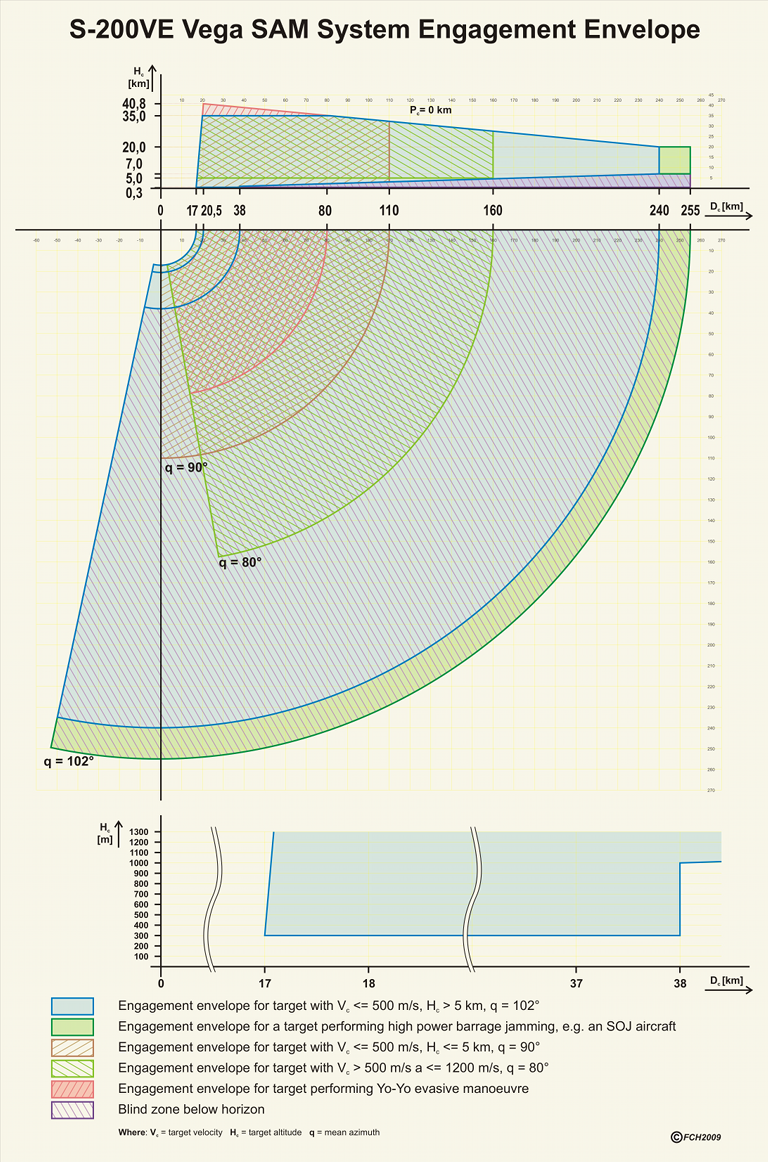
Tu22mWhat was inaccuarate that WW said? To say that “The D uses a different flight profile, to extend its range. The flight profile plays a large role in the range, not just the burn time.” is perfectly true. I’m not sure why you consider it wrong.
Why don’t you plot that out on a graphical chart, add the air density in that chart (needed for drag) and look at what angles you end up with. The lofted profile is only good for the very long range and low Pk engagements.
You have propulsion for 11km.
It needs a vertical change in position of 3km minimum to have any form of useful range extension, preferably even more. But everything after the 11km is a glide flight where over 50% of the agility is lost already. And after something like 2-5 seconds of sharp turning it has lost nearly 50% of its velocity and even more of its turn performance (and thats the result of a target doing zig-zag or yo-yo).
There are very good reasons why engagement envelopes look like this:
The one exception today is the Meteor but it has very little information regarding actual performance. Its even possible that an AIM120D can hit slow targets at a greater distance due to lower drag. Another exception may be the MICA NG, currently in development… and Python 5 that has a very very long sustainer. But the Python 5 has the sustainer to maintain some agility, not to have enough speed to chase down a target.
Tu22mThe D uses a different flight profile, to extend its range. The flight profile plays a large role in the range, not just the burn time.
Do the math, then come back with a new, thought through reply.
Recommended reads:
http://forum.keypublishing.com/showthread.php?97983-AIM-120-range-questions
http://en.wikipedia.org/wiki/Lift_(force)
http://en.wikipedia.org/wiki/Circular_motion
Best of luck, sincerely yours.
Tu22m
Tu22mI thought we all agree on this.. When a missile runs out of fuel and Thrust, its pretty much become SPEAR rather than an ARROW. It loose 75% of its agility and it drops quickly Down to being a STONE as it try to follow a target…
This is pure physics and Logic, Why is this so hard to understand!?
I guess physics only work when the target is not coming from Lockheed Martin.
Not true. According to RAF AIM-120C-5 has 10% better operational range than C-5 (2012 Air International , Typhoon A Year on the road). And yes -Raytheon gives 50% greater range to C-5, which is not the true value, according to RAF pilots the usefull range is much smaller. Choose what you believe.
The Aim120C7 has the same engine that the coming AIM120D will use. It is also the exact same missile used for SL-AMRAAM.
A SLAMRAAM fire unit will consist of four to six ready-to-fire AIM-120C7
The burn time is 9 seconds.
Tu22mConsidering the ancient F-16 has no problem with the magical Eurocanards and the F-35 is no slower in a combat configuration I think you’ll find your calculations belong in the dustbin. The growing list of potential F-35 customers would agree too it seems.
I think the pilots in the Norwegian Air Force might have a different story to tell.
This is from a Norwegian interview. http://www.nettavisen.no/side3/article2982856.ece
– Men hvem er egentlig best i den nordiske luftkampen?
– Det er vanskelig å avgjøre over tid. Ofte er det tilfeldighetene som avgjør. OK, la oss si det slik: Med blanke ark og fly som er likt konfigurert, svinger Gripen krappere og stiger raskere enn en F-16, det er tross alt et nyere fly. Men erfarne norske flygere har også klart å utmanøvrere Gripen.
– But who is really the best in the Nordic air battles?
– It’s not easy to say over time. Often it boils down to coincidences. Ok, let’s say like this: With clean sheets [equal terms] and airplanes with similar configuration, the Gripen turns tighter and climbs faster than the F16, after all it’s a more modern jet. But experienced Norwegian pilots have been able to out maneuver Gripens.
The Gripen does not win thanks to stealth (and the records are usually very much pro Gripen btw). It’s mostly about tactics, use of modern datalinks (like TIDLS) and so on. The F35 offers later detection vs radar but at the same time less mobility. The win comes from preparation and the ability to make use of the kinetic advantage in a specific part of the envelope. The situation (is the battle defensive or offensive?) is what tips the scale in favor of one or the other, that and the ability to be able to adapt fast enough to the new situation (from a combination of kinamatics, datalinks/SA and tactics).
But you may be defining combat load as drop tanks + 2x2000lbs JDAM + 2 AMRAAM? If I would define it as 6 AA missiles + fuel for 770nm+ we would compare the Gripen carrying two drop tanks + 6 AAM vs the F35 carrying 2 drop tanks + additional external loads (2 missiles). With this load the Gripen is much faster and the stealth advantage the F35 once had is really not that great.
Or do you only want to move the goal posts on one side but not the other?
Tu22mThere are more F-15s with AESAs (and numerous other avionics upgrades) flying, than there are Su35BMs, first of all. Secondly, I don’t know where you’re pulling these numbers from, in terms of the Irbis being superior to an APG-63(v)3/APG-82, which is what the F-15C/Es are being upgraded with, along with new computers, SATCOM, new digital electronic warfare systems, etc….and the Cs are supposed to get an IRST as well.
Know? What source? That’s some highly optimistic speculation, at best.
At IOC, the F-35 will be using C7/D model AMRAAMs, which are good for considerably more than 40-50km.
Read the burn times, energy drop off over time, maximum G that can be pulled by the missiles after burnout, availability of decent sensors for the Eurocanards, especially for the latest versions.
Against modern adversaries with good pilots the AMRAAM is very short ranged. Your 40-50km are only viable against surplus Soviet aircrafts with rdars and rwrs that don’t work… and you also need a bad pilot in the target ac. If all of that is true then sure, you can get the 40-50km kills.
I used the lowest RCS number for the F35 and put it on the graph where the Irbis E would track that size of target. In real life the target size would be larger and there would be EW.
That graph is making the assumption, that the Typhoon is supersonic, while the F-35 is subsonic. With a combat load, their speeds are pretty comparable. It’s also not an accurate comparison, because the Meteor couldn’t be used against the F-35 at anywhere near its kinematic range, whereas the F-35 could engage further out.
Why would I strap 3 drop tanks on the EF to make the F35 look good? I assume both ac are somewhat optimised for the engagment.
Typhoons can fly M1.4. This isn’t the speed that they fly for the majority of their mission, anymore than the F-22 stays at M1.8 at all times. So……you’re speed advantage relies on the Typhoon already flying at M1.4.
If…..the F-35 were receeding. The detection range head on is much shorter than that. You’re also forgetting that the acceleration times, that you’re using are for a clean Typhoon. Once you start hanging EFTs, and other stores on it, the times increase quite a bit.
Already been acconted for and the assumption is that both at are somewhat optimised for AA engagements. Even vs stealth ac involved you tend to know when the enemy is near because you can track the AWACS and the radars ucurrently used.
All of your arguments have been accounted for several times over.
What you are missing is that there are more sensors, that afterburners also make the jets easy to track from low band radars on the ground (the SR71 was easily tracked by its trail… and the fuselage, at the max range of th radar (just over 400km with the PS-66)).
Stealth is just one attribute and it is just as important as all the others (where the limiting factor always is the most important). For the F35 the limiting factor is missile performance vs detection range where the missile range gets a drop because of kinematik disadvantage.
The fielded sensors of yesterday has a target acquisition range of 50km+, the AMRAAMs high Pk range is <15km. The F35 will have a really hard time coming up from behind any of the Eurocanards. (Based on one sided supercruise, enemy having datalinks and additional radar sources like AWACS etc supporting from behind)
Tu22mFlying and buying modern jets costs a lot of money.
And there are only very few alternatives on the market.


 Sign In







