 Tu22m
Tu22mOk, there are quite a few misconceptions and factual things all mixed together. I’m not going into who said what or something correctly stated by who. CL and CD are COEFFICIENTS. When in the same flow regime, they are constants of similitude. What’s huge at speed is the associated lift and drag, not their coefficients. The aerodynamic limits for missiles are often actuator limits, hence some justifications for grid fins. Regarding missile list, after burnout most are from body lift due to ogive body flow and vortex. Stakes can also double up as lifting surface in addition to structural stiffening. How to reach higher Gs? Notice any V-N diagram, take the load to typical experienced by missiles and you’ll see the kind of speeds at the max load factor. The control fins/actuators have to be able to support that. Performance after burn out? You can’t used statics to describe dynamic performance….there are infinite solutions in that case. Use energy equations for maneuvering. Notice that it’s not how many Gs (that’s a static indicator) but the turn rate, radius, and required closing speeds for maneuverability…these are indicated by energy. One can trade altitude and speed for the right maneuver needed for successful intercept. For example, in end game without thrust speed can be traded for turn rate. Yes you lose speed but so what it’s end game anyways. Too much speed may not be good sometimes, large turn radius.
Thanks for the correction/addition.
However we have information regarding the actual turn capabilities to be expected in the missiles (extrapolated from Mercurius post).
I think G-loading in specific speeds are pretty relevant as that can help you get the sustained/instant turn rates (simply by getting turn rate from speed + G-forces –> circle circumference / time –> turn rate per sec). Understanding at what altitude this happens makes it easier to assess what the actual turn rates are as well as expected drag.
Either way it is pretty clear that manuevering in the end game (after burnout) costs a lot of energy and that actual turn performance is pretty low without engine thrust.
And you are perfectly correct in that statistics are hard to apply correctly when describing a dynamic situation. What they are good for though is to define the ballpark where the actual performance is expected to be.
BTW, I found a film clip with radar tracking of aircrafts when they use jamming, release chaffs as well as track and interception of the SR71. Might be interesting to see how a low band radar reacts to that. I’ll search for a thread where it is relevant.
Tu22mI wonder how well smelling works at high speeds and at altitude. Looks like a pretty capable fighter dog.
Tu22mThe F-4 demonstrated more than what’s listed here. Looking at the list a little closer it looks like maximum speeds that are from an old newsgroup. Has anyone tried to cross check these statistics?
Many are wrong. Would almost be an equally long errata.
Tu22m‘Flight’ recruited Graham Warwick (author of the article that DavidSubishi cited) around 1980, give or take a couple of years, and if my memory is correct, he was from the future projects office at Kingston. So if he thought that AMRAAM body lift was worth mentioning, it presumably played what he thought was a significant role.
Having sent more than a few missiles skyward in my earlier days, I am more interested in the reality of missile performance than in mathematical analysis. As I recall it, post-burnout performance was maintained until missile velocity had decayed to 50% or less.
It is all based on assumptions. And I can say them again.
1 The pilots will react in time.
2 The pilots will react in a correct manner and be difficult targets.
The missile turn performance mostly comes from thrust. Thats just a fact. You are correct in that high alpha will produce some body lift but the drop in speed will be really fast (@30kft it will take roughly 3 seconds to lose 25% of the airspeed –> even less authority for the control surfaces and body to produce lift, at lower altitudes, like 20kft it will happen in ~1,7seconds or <2km.)
So sure, the missiles may actually have a small window where they have some turn performance after burnout but it is short lived and its not the advertised 40G. The Patriot numbers feel like a very best case scenario at pretty low altitude. I also wonder what their definition of “sustained turn rate” is…
A few examples of missiles that are far from being “the least manoeuvrable object in the sky” after motor burnout:
1 Any short-range SACLOS SAM, which must turn continuously when fired against a closing target, yet still be able to cope with last-minute target manoeuvres.
2 AIM-9X – still America’s best dogfight missile, yet has a single-pulse motor with a fairly short burn time.
3 ASRAAM, which was specifically designed to use body lift and tail-mounted controls to provide high agility after sustainer-phase burnout. The ASRAAM design team rejected thrust vectoring because they wanted a post-burnout manoeuvring capability.
4 Patriot, which after burnout is still able to fly 20g continuous manoeuvers and 30g short-term manoeuvres.
1 Yes, they can maneuver, but the jets can usually turn better (if assumption 1 and 2 hold water in the case)
2 Probably true. But as I have said my assumptions (1+2) are not very likely to hold up if there is little or no time ro react.
3 How does thrust vectoring effect maneuverability after burnout?
4 As I’ve said, that is likely the very best case scenario and its for a missile reaching mach 5!
To translate this to air air missiles we get a lift force that is 64% of that (at mach 4/1200m/s) or 19,2 instant/12,8 sustained (according to the lift formula posted above) if we assume similar ratios for wing/body and lift area/weight. Now add a continous drop in speed and we get 56,25% of that performance after 1-5 seconds of turning (depending on alpha and altitude) or 10,8G instant/7,2 sustained.
So I might have under estimated the missile turn performance slightly, but 19,2 instant turn at mach 4 or 12,8 sustained is simply not good enough to kill a modern jet with a pilot that reacts in time. But if the reaction is a little bit slow, if the turn isn’t hard enough etc it will be a kill.
We also have to take altitude into acocunt. If the Patriot numbers are from… say 12’000 ft you will have to take the air density drop into account, further reducing the turn performance.
So we end up with the following for a missile similar in design to the Patriot missile.
@ speed instant/”sustained” turn where the result should be multiplied with air density coefficient.
@ 1500m/s 30G/20G
@ 1200m/s 19,2G/12,8G
@ 900m/s 10,8G/7,2G
It’s not unlikely to see a 50% drop in these numbers.
Tu22mNot really. I just don’t like seeing misinformation being spread hence me pulling you up on the AMRAAM body lift issue.
Do you even understand what you write? The quote in your article is this:
The missile is much faster than its
predecessor—about Mach 4 according to
some estimates—and there is more body
lift at higher speed.
The formula is 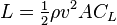 where p= air density, v = airspeed, A = lift surface/wing area, CL = lift coefficient.
At mach 4 with an alpha above 0 you will get some extra lift, but not much. Most will still come from the wings. And to be fair, at mach 4 even a wooden plank would produce more lift than a static or slower one. But it’s not built with a lifting body and the tiny amount of body lift is negligible.
Tu22mAt Mach4 Cl is huge (as is Cd).
Missiles hve very small fins (lifting surfaces) simply as they are fast: they don’t need that much surfaces to generate the necessary lift and then can keep drag low.
As I hve alrdy says on other forum, you can’t compare apples and oranges: W/S reasoning is completely irrelevant if you are not dealing with similar configurations.
In your formula you simply hve discarded the most weighted factor. Orherwise it’s a good read.
Well, I simply used the most relevant numbers. The max turn rate is around 40-45G and the thrust is likely 40-60G. So it is easy to assume most lift will come from the thrust.
If you, for instance, look at how CL is calculated you will see that it is based on a division by airspeed. And If you look at turn envelopes you will see a similar result. As yourself why it is that the F4 only can reach lower and lower G:s the faster it flies and how this effects a missiles agility when it has no excess power.
Tu22mI see two options, western as in Rafale or eastern as in Russian.
Western option:
30 Rafale with tech transfer
35 second hand and upgraded Mirage-jets, with datalink and some other avionics from Rafale.
Included: Technology transfer and Argentinian upgrades to the Mirages. This gives Argentina more “know how” in the field. Also local production of the missiles (will MBDA allow this?)
Option 2 if missiles cant be locally produced:
30 Pak FA
40 MiG 35 (with technology transfer) or J-17.
Locally produced missiles and partnership to create a ram-jet version of R27 or R77. J-17 uses the same missiles as the J11 (and Su27) so it should be possible to integrate the missiles in the Chinese platform.
I think that the second alternative is the best one. J-17 is good enough for a lot of tasks, like CAS, Air policing, AWACS escort, Anti ship etc.
The J17 is a fantastic work horse. Very light weight (6’600kg), decent range, ok speed and so on. Not the best for air superiority, but thats the job of the air superiority fighter.
Tu22mAFAIK the idea isnt to have a longer burn, but a second booster that will burn in terminal phase.
Ahh, thats a pretty good approach. The sacrifice is mid course maneuverability but I think thats a good trade off.
Tu22mConsider what “network enabled weapon” could mean.
The missile is first a node in a network. As such, it sends/receives data and requests for data by others in the network. Second, it acts upon that data/data requests. Launched in “swarms”, the lead missiles could provide situational awareness for the followers, and the followers could provide RF support to the leaders to improve P-kill. Jamming and decoys could be rendered ineffective.
http://en.wikipedia.org/wiki/P-700_Granit
The missile, when fired in a swarm (group of 4-8) has a unique guidance mode. One of the weapons climbs to a higher altitude and designates targets while the others attack. The missile responsible for target designation climbs in short pop-ups, so as to be harder to intercept. The missiles are linked by data connections, forming a network. If the designating missile is destroyed the next missile will rise to assume its purpose. Missiles are able to differentiate targets, detect groups and prioritize targets automatically using information gathered during flight and types of ships and battle formations pre-programmed in an onboard computer. They will attack targets in order of priority, highest to lowest: after destroying the first target, any remaining missiles will attack the next prioritized target.
Produced in 1974-1994.
Is that similar to what you had in mind?
Tu22mReading last posts, i guess that the present studies on MICA NG with dual boost engine are relevant.
If im not mistaken the Python 5 has a very long sustainer phase (not with enough thrust to sustain mach 4 but enough to keep it supersonic and aid in maneuvering).
To get the fantasy kills in the distance you either need ramjet or dual boost engine, preferrably you have a booster that gets droped after burnout and use a very long sustained boost time. (meteor for instance has a pretty large booster that kicks in before the ramjet)
It all boils down to physics. Can you fit enough stored energy in the missile without it growing to K100 in size? I sincerely hope the Mica NG gets the best of all worlds.
Well done, about how much turning performance is split between thrust vs wing loading
is dependent on pressure and angle of attack, they seem equal in the formula but is grossly dependent on pressure/WL/etc
the higher and slower the less pressure and thus lift comes from wings, -performance gravitate towards thrust,
if no thrust either tuff luck.
I think typical values could be 30.000 ft & mach 3, and perhaps 20* AoA, not sure about AoA tho
I think we shouldn’t speculate too much on that part. The missile will have higher lift per wing area as long as the speed is high enough but the wings also offer 1/5th-1/15th of a fighter jets wing loading. So the first part for the missile will be negligeable, it will turn, but no jet will be at risc of being out maneuvered.
And this takes my argument back to page one. Burn time of the missile is key to determine high Pk.
Tu22mI wonder if SAM designers would agree with your hypothesis. I have seen some pretty effective manoevring well after motor burnout.
I posted a pretty good read on the topic.
Part 6.12 is a good start.
http://www.aviation.org.uk/docs/flighttest.navair.navy.milunrestricted-FTM108/c6.pdf
I have put it all together (the formula for calculating the turn performance along with a description of how they all work togehter).
I would say that its more than a hypothesis. Max thrust is usually 40-60G, I don’t know exactly what it is for the AMRAAM.
So after burnout you wont see much turn performance. Im sorry.
EDIT: What you might have seen is a smokeless sustainer. Little thrust but enough to let it have some agility left. Or they have had better control surfaces. To be able to turn you need lift (larger wings provide more lift). But then again, all is relative. A modern jet with a t/w ratio in excess of 1 with a wing loading of 350kg/m2 will always out turn a flying body with no thrust and a wing loading of 2’200 – 4’400 kg/m².
EDIT 2: I may of course be wrong, but if I am please point out where the error is. So far it feels like it follows logic pretty well.
Tu22mno what i mean is if you have 2 perpendicular surface it will result in very high rcs , even if enemy come only a few degree from front that why most stealth fighter have v tail
There are two effects in play, one is the direct reflection and the other is the corner effect. You will still need to come in pretty much from the 90 degree abgle to make use of both but we can stick to 88-92 degrees if it makes you happy 🙂
Here are the charts of the RCS: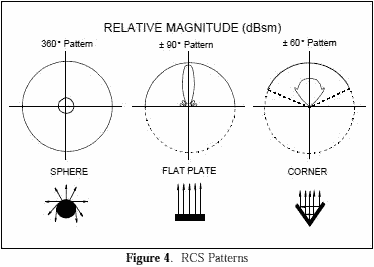
A perfect reflector on a normal ac is a perpendicular 90 degree corner, its the same principle as the radar reflectors yachts and/or decoys have.
depend on how modern the AESA is ,and algorithm
Always. Thats why the libraries and software continously get updates and need the updates.
i know what you mean but my point is that a small burn out missiles will be quite hard to detect , so may be the time pilot detect it they dont have enough time to maneuver , and yes missiles will lose speed by maneuver but they also gain some speed as they diving down , remember :eagerness: , btw we dont know the nez of aim-120 and meteor yet , why you assume they are 10 km and 30 km ???? , i think it much more at least for the case of meteor since it is ramjet the NEZ could be 60-70 km , about the high PK , i dont think you need very high pk even if the the pk is very low like 40 % then 2-3 missiles pretty much shot down target , it not an action movie so we dont need 1 f-35 to shot down 100 enemy aircraft right ?
Ok, I will explain it as good as I can.
To make sharp turns you need a combination of lift (derived from wing geometry and speed) as well as thrust.
A modern missile, like the AIM120D, has a wing loading of 2200kg/sqm and the jets have 250-350 kg/sqm + lifting body (usually).
This means a missile needs higher alpha (exponentially growing drag) which has to be countered by more thrust (otherwise it loses its speed and stalls).
So the turn capability of the missile is depending on thrust, or more specifically the combination of lift (from high alpha) and thrust lift where the control surfaces account for a very small part of the actual lift (as in the wings by themselves don’t do enough, they require lots of thrust to be effective). You also should remember that at mach 4 you need lower turn rate (deg/sec) to get high G.
When you remove thrust you basically have the least menuverable object in the sky. A modern MAWS will detect the missile before flame out and it will be hot enough to be spotted afterwards as well (but with shorter notice).
So thats why I only count the propelled part of the envelope as high Pk envelope and the area where you would want to engage enemies within. There are a few exceptions historically but generally this is how it looks.
More to read here: http://www.aviation.org.uk/docs/flighttest.navair.navy.milunrestricted-FTM108/c6.pdf
yeah and triangulation have very big problem gain low side lobe radar like an AESA :eagerness:
As long as you have to directional beams that intersect you can position a target.
Tu22mI already said it was simplistic.
That does not take away from the fact that it was, and is still, based in the realities of war.
As far as “multistatic receivers” goes, get back to us when they are operational and proven to work against VLO assets.
ASSR has been proven to work and it was fulle tested and verified in 2000, just to name one system (discontinued because it wasnt needed, ie no threat on the horizon).
http://www.foi.se/ReportFiles/foir_1265.pdf (and one for the people interested in english http://www.foi.se/ReportFiles/foir_0815.pdf not the same report but closely related, think its for you Haloweene)
Givet dessa indata är AASR sedan kapabelt att detektera, associera, positionera och följa inmätta mål. Positioneringen skall ske med avseende på både läge och hastighet, det vill säga målen skall bestämmas i ett 6-dimensionellt tillståndsrum. [cut out] Associeringen och positioneringen blir, som vi kommer att se nedan, icke-trivial med tanke på formen på indata.[/cut out] Det hela bygger på en viss typ av överbestämning via de bistatiska mätningarna, mätningar som förutom att ge redundans och robusthet, via sin geometri är extra lämpade att detektera smyganpassade mål.
Given this indata the AASR will then be able to detect, associate, position and track measured targets. The positioning will be account for both position and speed, ie the targets will be determined from a 6-dimensional position state… …It is all based on a type of position ‘over determening’ via the bistatic measurements, measurements that apart from giving redundance and robustness, via their geometry are specially suited to detect stealth targets.
Sorry for poor translation skills.
Expected cost: 900 nodes ~$156m.
It is also proven that lower radar bands can do wonders in detecting stealth aircraft (Serbia). Using a network centric system (also proven to work in Viggen + Gripen and most likely other foreign systems) you can have several radars/sensors to triangulate positions (also proven to work and it’s fielded).
However, the F35 is not fielded yet so I think we shouldn’t get all hyped up over imaginary (ie yet to come) features and capabilities. Especially considering that countermeasures have been around for a long time. We will see if the potential adversaries get these systems in time or not.
Another aspect is standoff missiles. Even against todays S300 and Pantsir the F35 is inadequate to drop cheap JDAMs, it will need longer ranged weapons. This in turn means boots on the ground in order to distinguish real targets from fake ones. Standoff missiles today have better range than the SAM systems (like KEPD350/Taurus) and they are fairly cheap, <$750’000 for Taurus. So I dont know If I can agree with you.
Tu22mOh no. Not package Q and Lockheeds commercial pics again… If one let salesmen run the numbers it will always end up the same way.
That graphic Spud posts every now and then is makes my simplistic chart regarding kinetic advantage look like a masterpiece in exact calculations. Something I for one know it is not.
The funny thing about that graphic is that a simple addition of multistatic receivers would make the threat looks exactly the same as it does vs package Q.
Tu22mOMFG i just gave the link to 2012 radar conference… Full of infos etc. Did anyone even clik?
Yes we did but it requires subscription


 Sign In







