 Tu22m
Tu22mContrariwise, Tu-22M, Spud’s proposed standard is an excellent idea…
I guess it all comes down to perspective…
Tu22mMaybe they should come out with a Cost Per Mission (CPM) model.
What does it cost to destroy target X at range Y guarded by assets Z?
The CPM model should include everything involved (all assets like IFR, ISR, etc).
That would be very poor accounting standard.
How do you factorize that into something workable?
[INDENT]* In a normal CAS/Strike mission over undefended territory (roughly 90-95% of all strikes the last decades) the F35 costs about 2x more than the alternative (slightly over 3x more than Gripen, ~2,8x Raffie…) with no added benifit.
* In SEAD both the F35 and legacy jets will need to use standoff missiles, the 4th gen fleet is likely to have lower hit probability, but by how much? UCAVs will still take the riskiest assignments and do so at the lowest cost.
* Air combat will be limited once standoff missiles have targeted enemy air fields, the main goal now is suppression and maintaining air dominance. SHORAD will be just as deadly to the F35 as it is for the legacy jets.
* These assumptions may change if the enemy is expected to be India, Russia or China.
And now we have to divide the TCO for the 30 years with the cost of each individual operation and of course we need to have an estimate of how often this will occur with a high confidence interval.[/INDENT]
Remember the numbers I showed earlier? If you replace 12 F35 with 12 Gripen you can buy additional ammunition for $ 2,64 bn (roughly 1800 Tomahawk missiles!). How to you put this in the calculation? In SEAD and standoff terms that is just over 3000 AGM 88E, >680 RBS15 Mk III, ~3600 Taurus depending on what you pick for a small fleet of 12 ac.
So no, it opens up the field for too much speculation instead of hard numbers.
Tu22mThese figures make no sense to me. How does one arrive at $25,000 per flying hour cost for F-16? All estimates I have seen put F-16 cost per flying hour at less than $15,000.
F16s at the end of their service life are pretty expensive to operate. The brand new and shiny F16s cost less to operate since they “just work”. My guess is that they take current costs (for the now old F16s) for the comparison.
Tu22mNukes are Pandoras box. Once you open it there is no turning back and you have, usually, accepted MAD. Here is one example of when nukes where present for both sides with nobody daring to use them. https://en.wikipedia.org/wiki/Kargil_War
Sure, one could argue that Pakistan didnt have many nukes at that time but it doesnt change the fact that nukes had very little effect. We also rarely see the US use any nukes in the conventional wars they participate in (only WWII)…
The big deterrence is a strong force that will be hard/impossible to beat with conventional weapons, ie a strong defence and good second strike capabilities. The F35 is an excellent offensive weapon as it gives less time for the enemy to prepare, but for a defensive role there are both better and cheaper alternatives.
Tu22m18-24 2nd hand Gripen A for air policing
3 cheapest AWAC ditto…..and the rest of the money i would invest in anything profitable with compounding interests working FOR me
to offset cost altogether, and give myself a justified reward.
The Gripen A isnt made for that size of an air force.
Gripen A has lower purchase cost and Gripen C has lower logistical footprint over time. The E version is even better in this aspect. So if you want to use them much over time with heavy loads the E version is actually the cheapest. (Inflation was pretty brutal in Sweden during the 80s and early 90s so it might look the other way around). In order to make good use of Gripen A you should have a lot of them with large reserves.
The A version was designed to be produced in high speed during the cold war, very likely during actual war, using cheaper materials. In the C version they improved the structure as well as avionics, engine and range + added the Link 16 as a part of TIDLS. So the Gripen C is more adapted to long term use and not only “invasion defence” as was the SwAF doctrine in the 50s-90s.
Tu22mTry as i might, i cant view it, when i press ‘play’ it finish in ~3 sec.
Is there an alternative way to view the info ?
Try pressing “next” or the >| button a couple of times.
Tu22mI would go for the “bang for the buck” option.
In a medium Air Force.
40-50 Gripen E as the main work horse, even for training as well as a few Gripen F or D+.
40 Stealth UCAVs for the attack phase when the enemy still has good SA syst as well as for CAS. Datalink via TIDLS
30 Recon stealth UAVs (smaller), also with TIDLS datalink, only function is to be an extended arm of the jets and as low cost as possible.
18 Blackhawk Helicopters.
5 C130, 3 as AWACS (maybe with ERIEYE installed on the roof) and 2 C130s for transport. The ERIEYE versions could be used for limited transports as well.
80 Pantsir S1 or CV9040 AAV to protect 4 main airfields, Pantsir preferred.
A large net of multistatic radars with TIDLS or Link 16-compatible transmit nodes (the multistatic receivers send data to a node that already is integrated in the Gripen system and this information gets sent to Gripen).
Logic:
Gripen is good enough. With good intel from the ground (the passive multistatic arrays) the Gripens can chose their entry point when intercepting, even vs stealth aircrafts. Basically the AWACS function moves down to the ground in that case. Gripen is also cheap enough to be used in training. Gripen E also holds its ground against most oponents today with the Meteor new engine + avionics.
The attack is the riskiest part of any war. Having stealth improves survivability, unless the enemy uses multistatic ground systems for a passive tracking and/or has popup shorad threats. It’s safer to sacrifice/risk stealth drones (like Predator C) that uses datalinks to communicate with jets and/or AWACS. Bitrate will be lower than usual but that is, at least to me, a tradeoff that is worth it. One could also, via software patches, have communication with one drone and by that controlling the others (with “master node” handover if it is destroyed). Either way there will be losses in the attack and I prefer it to be drones that cost less than 1/10th of a jet and dont have pilots on board.
I think that when considering bang for the buck this is a very good setup, even more if we assume a defensive role. I know it’s not very american of me but most countries don’t plan to invade others. They need a good defense with second strike capabilities.
Tu22mIt would be interesting to see wing loading of a vanilla AMRAAM.
I got it to ~2300 kg per sqm. Just a tad more than the 250-350kg per sqm that is common for a fighter jet…
Numbers from Raytheon: http://www.raytheon.com.au/rtnwcm/groups/rau/documents/download/rau_factsheet_aim-120.pdf%2Bamraam+wing+area&oe=UTF-8&gfns=1&hl=sv&ct=clnk
Diameter: 17.8 cm
Wing Span: 44.5 cm
Fin Span: 44.7 cm
Weight: 161.5 kgWing Area (usefull wing area) = 2x((44,5 – 17,8)/2)^2 + 2x((44,7 – 17,8)/2)^2
Tu22mNo no no. This is not how it works!
Good god man stop trying to lecture people when you’ve not got the faintest idea about what you’re actually talking about.
Please, try backing up some of your claims with sources. I’ll be kind to you and attach a graphic about the corner effect.
[ATTACH=CONFIG]217007[/ATTACH]
If me, sources and Halloweene aren’t good enough to convince you then I suggest you produce something to support your currently unimpressive track record.
Not to enter another endless debate, but about your source… I talked last WE with 3 piltts from “Gascogne” and “Provence” squads. They clearly stated that Rafale RCS was significantly lower then EF 2000 (which contradicts your source). Vertical tail prob is mainly the corner effect with wings… if you have a 90° angle.
Sry for using you like this halloweene, the timing was just so good.
Tu22mThe point here is that the 4th and 4.5 gen fighters are highly optimized for a the lowest possible frontal rcs without design compromises that creep in with 5th gen fighters. This is the problem with the Gripen , F-18E/F and all of the others. Your overall RCS management is quite poor and its next to imposible to have a 360 degrees controlled RCS like you do with the 5th gen jets. Granted that the RCS on the 5th gen fighters is also not as good from the sides as it is from the front, but they are much better optimized for overall RCS reduction compared to 4.5 gen fighters. Second, depending upon the scenario being talked about (Aerial campagain of an F-35 vs 4th gen fleet) they may need to carry more wapons a fuel to try to negate some of the advantage lost elsewhere. This would mean FT’s which would also not help with RCS management. All in all, there is a reason why 5th gen are optimized for permanent all aspect VLO even with the design compromises that come up with internal weapons carriage etc.
Sounds legit. I’m not saying that the 5th gen is a dead end. It is the future. But the current 4,5th gen fighters like the latest Super Hornet, Silent Eagle and Eurocanards do many of the things “good enough”.
If you sacrifice the old qualities like speed, agility and so on just to obtain lower radar cross section it’s ok if the missiles are up to the job. But they aren’t.
It’s ok to optimise against radar tracking, as long as you dont optimise it so much that you are an easier catch for other systems (like IRST). In the case of the F35 it is likely twice the detection range if the enemy uses IRST instead of radar. (also assuming some level of jamming)
Pak FA and F22 have made large advances in pure performance (agility, speed etc) while they also added VLO/LO characteristics. And that’s what one needs to opt for. Keep the old qualities and add the new ones on top of that. I would say that the reasons for the F15 and F16 being so succesful are that they kept the good old qualities and added the advantage of modern avionics and weapons to them. (In the case of the F16 that came later). Where would you put the F35 (accoding to the latest performance numbers)?
Tu22mfirst , the EF-2000 in comparison using an AESA radar so i dont think it really old :p , and here where i got my infor about RCS , as they stated missiles and vertical tail are main contributor for RCS
http://www.orkut.com/Main#CommMsgs?tid=5363091547610857956&cmm=58541394&hl=en
And I agree. The Vertical tail is a large reflector if… the enemy is coming in from a 90 degree angle to the side, in the case of the Gripen the bounce from vertical tail to wing to foe is much smaller than for jets like EF.
SAAB have already done work on conformal bays according the former hed of Gripen Operations. We also see the competitors releasing stuff lik stealthy weapon pods. So there are solutions to lowering the RCS on the market already. If potential enemies get missiles like Meteor we might see this get adopted. But unless there is a need it wont happen.
oh i thought you was talking about calculate range by looking at the picture of target :p , if this was just for target Identify that the resolution is fine , however if you dont have information about range then the PK of missiles will be even more horrible since the best flight for BVR missiles is climb and then dive to target but without range information that impossible , not to mention that without velocity and aspect angle information you will have to constantly datalink to the missiles to update because your missiles willnot be able to predict where to fly to
Well, the IR camera gets a picture. To get a “target acquisition range”, ie lock on range, you need enough pixels across to estimate range (accurately enough) to engage it. For a positive ID it’s six pixels. I use this definition: https://en.wikipedia.org/wiki/Target_acquisition
And you are absolutely correct that you will need to work harder to obtain the same result vs a stealth aircraft. But how do you set a probability of datalink failure? The climb/dive maneuver is a very good option if you are trying to hit something outside the propelled envelope. A fighter jet doing hard tunrs is not that type of target.
this what i can find
btw there something bugging me : what will stop the F-35 from hiding in ground clutter and cloud and then sneak up from behind these 4.5 gen fighter 😎 F-35 is very low RCS fighter and also a meteor fire from short range will be really hard to evade
You found storm clouds. Usually not the best cloud to be hiding in, even less so in the F35. And thats the only cloud at that altitude. (with some very rare exceptions)
i think the radar still have advantages , it always easier to hide and encrypted than to detect and understand ( i mean RWR can pick up the radar signal but dont even know it a radar signal let alone try to jam it )
Modern systems are pretty good at distinguishing them from a signature library. Either way they get the direction to the jammer or radar.
well at high altitude like in your example missiles will decelerate very slow compared to a missiles fired at medium altitude or sea level , and BVR missiles dont go straight to target but climb and the dive down so they can have some speed from the potential energy the total speed at end game of missiles could be mach 2-3 depend on situation , missiles with burn out motor will be less lethal but also much harder to detect , not to mention missile dont follow the part that target take like in movie but will try to intercept at a prediction point , unless you run aways it not that easy to evade a missiles your maneuver need to be at right moment , and unlike in the car vs the bow the closing rate of aircraft and missiles will likely be much shorter :p ( and if you are flying supercruise the closing rate will be even higher :p + harder to turn at high speed )
I have provided the data for circular motion and the G-forces experienced in those 10 sec turns. Im not talking about missiles gliding to the target (as that usually has meant a Pk that is almost non existant).
As i showed in the car example. You need thrust to make sharp turns. The missile has no thrust so turning will be worse and at every turn it lose even more speed.
This is why it will hae a very hard time hitting a jet that makes evasive maneuvers after engine burnout (the missiles engine)
but it dont increase the track , lock range of IRST so you dont know how far is the target 10 km -40 km -100 km or 200 km ..etc
You dont need increased target acquisition range. 50km is good enough. The detection and identification range is longer and the missile will only have high Pk within 11-15km (Aim120) or up to 30km (speculative for Meteor).
well ELINT system will have to solve some problem when going again aesa radar : detection range , recognize that an enemy radar instead of spike , clutter ; since AESA can use multi frequency at same time and frequency hopping => extremely hard to jam by DRFM jammer ,using noise jamming make yourself an easy target , RWR can tell you that there is an enemy there but no information about range => not very useful
Heard about triangulation? Two jets getting slightly different direction to the enemy and the intercept point is the location of the emitter. This has been around for quite some time but it is unknown if its good enough for missile engagement.
Tu22mThere is no way the Gripen has an RCS that small especially with weapons. The fact that it was simply a preliminary study should clue you in to the fact that figures such as these have no place in the real world. Also if they’re so stealthy then why do F-16’s have no trouble at all picking them up on radar at considerable ranges?
Would you mind coming back when you actually have sources, valid calculations or anything else of value? I have given you some pretty decent and solid sources and I have been open about where I get my numbers, as well as how I have implemented them. Please note that the RCS-figures are in the 0,05<0,5m² ballpark. The 0,1m² is no absolute truth.
Before mentioning the F16s you might want to read up on the Loyal Arrow results (at least to point you in the right direction) or read what RNAF say about the ac.
Tu22mBump.
Does anyone have a good compilation of data? If that exists I might put it in a fancy graphical chart.
Maybe this is from the stone age but here it goes http://www.powershow.com/view1/11f3a5-MWViZ/Beyond_Visual_Range_BVR_AirtoAir_Combat_powerpoint_ppt_presentation
Tu22mFirst off I have to say thanks for an excellent post. It has everything from sources to a friendly tone.
well like in the link i have posted the f-35 can detect clean EF-2000 at 120 km , we dont know how much pylon , missiles will increase the RCS number , and since supercruise consume a lot of fuel , they may need to carry fuel tank too which increase RCS even further likely much more than 200 % , and the most important thing aircraft with vertical tail will have RCS rised significantly compared to aircraft with V tail like F-35 when the enemy is not completely head on
But why make this into an apple vs oranges comparison? I go for the jets + weapons for a reason. Its the most comparable data you can get.
And btw, I agree that we dont know the true RCS figures. So I wont debate them. Sure, you can set the ‘un jammed’ range to 120km against the old Eurofighters if you want to. Shaping will always give you benifits in some aspects and disadvantages in others.
you still dont have information like aspect angle and velocity , not to mention IRST affected by cloud , weather , and your triglometry will have big problem for example : how do you know the enemy is an F-35A not F-35 C , or how you know it an F-16 not an F-2 ..etc there alot of aircraft look alike but have different size
6 pixels across is whats neded for a positive target identification according to FOI. As long as you got position of the enemy (approx) it is enough to fire the missile. The trajectory however wont be perfect but it will do the job.
Please enlighten me on how many clouds there are at 30’000 ft and above, or for that matter how often you see rain at those altitudes. Btw, that level of detail requires pretty short range between radar and target. If you have a target far away that isnt responing to IFF signals it is likely that its an enemy.
we dont know how good is jamming Vs AESA , and using jamming is more like saying hey iam here => F-35 can attack you by using ELINT system
Thats not how jammers work today. For every advancement on the detection side you have an advantage using the same technique on the defensive side (at least when it comes to radars), ir is trickier.
Aim-120 have NEZ bigger than that about 30-40 km , and meteor if i remember correctly have NEZ about 3 times of normal missiles , and btw just because missiles run out of fuel doesnot mean they are less lethal , for example if both F-35 and the enemy fly at high altitude the missiles will decelerate very slow , i dont think it easy to evade something at mach 4-5 while your aircraft is also moving toward it at speed of mach 1.5 ( think about it , it quite hard to evade a bullet when you are in your car , right 😉 )
Depends on how you count NEZ. In this case the best comparison would be an arrow from a longbow (usually starts at 300km/h) that had stron LED lights vs you in a car averaging ~100km/h. Pretty early on it will be very hard for a shooter to hit you in those speeds. And since you like comparing with cars I will ullustrate how to make the tightest possible turn with the highest possible exit speed.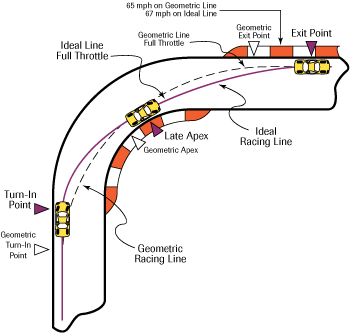
The key here is having full throttle once you have begun the turn. This is impossible without propulsion. So once you lose propulsion maneuvering will suffer, and every turn costs a lot of energy.
This is why the demonstrated Pk of missiles outside the 10nm range is almost laughable. If the enemy sees the missile coming, and the missile has no propulsion left, it is fairly easy to out maneuver it. That is why burn time is so important.
It is wuite possible that, say Aim120D or Meteor will have a Pk within the propelled range that is as high as 80%, but once propulsion is lost, a maneuvering target will make this go down all the way to 0% depending on the distance and maneuvers utilized.
since F-35 detect these 4.5 much further than they detect F-35 , doesn’t that mean the F-35 will have time to accelerate to very high speed and also climb to higher altitude before launch missiles :p
Absolutely, but that requires afterburner which increases IRST detection range.
about the RWR and AESA radar i think this a very good read
Thx. And that read confirms what I say. A rwr is pretty much the same as a passive radar. Lets say you have one that is 100 times smaller than a normal array, ie the rwr only has 14 antenna modules (receiver units). Now, is it likely that you get a reflection of 1% of the light you hit the target with at long distance? Not really. The sensitivity is normally in the -50 to -60db range (1/100’000 to 1/1’000’000 range).
And thats the expected returns at maximum range. If you have antennas made for LPI intercept (as EWS39 has had for over a decade) it sort of doesnt matter. But these numbers show you what reflection is expected in return at max range so if you have just over 1/316 to 1/1000 the amount of listening ‘receive modules’ as the enemy has in their radar you will have a relatively better probability of detecting their emissions before they detect the reflections.
Some more read up here: http://www.phys.hawaii.edu/~anita/new/papers/militaryHandbook/rcvr_sen.pdf
As I have stated several times. The whole scenario is too complex to be fully covered on paper. I will focus on the physical limitations in simplified scenarios.
Basically they are conservation of energy, kinetic advantage/disadvantage, the likely high Pk engagement ranges etc.
Tu22mNow add weapons and watch that RCS figure balloon.
(You’ve proved nothing, nothing at all.)
If that isnt denial I dont know what is. Yes, it is a preliminary study, but the numbers are in the right ballpark. Here is an excerpt about what you mentioned.
Två st eskorterande jaktplan med vardera 6 st långräckviddiga radarjaktrobotar och 4 st IR-robotar för närstrid. Motmedelskaplsar. Multimodkapslar med upptäcktsavstånd 100km mot ett mål med 1 m² radarmålarea. Signaturdämpande åtgärder har vidtagits. Radarmålarea 0,1m².
Google translated 4 u.
Two pieces escort fighters, each with 6 long-range radar missiles and 4 IR missiles for combat. Motmedelskaplsar [countermeasure pods]. Multimodkapslar [multimode pods] with detection distance 100km against a target of 1 m² radar cross [RCS]. Signature calming [reduction] measures have been taken. Radar cross 0,1m ².
Basically it is an estimate for the Gripen with weapon pods, added RAM and so on and the estimate is the closest metric number in 1 * 10^X where X is an integer (positive or negative). So the range is between 0,05<0,5 and the Russian attack aircrafts are assumed to be in the 0,5<5m² ballpark.
Another quote from the report “JAS-plan ur delserie tre”, aka Gripen C. Likely after upgrade to C+.
http://www.foi.se/ReportFiles/foir_0338.pdf
And what You provide to the disscussion in this post ? Nothing at all.
The real RCS value is classified, and You don’t know how much weapons increase RCS in this cases.
This is probably the only sources about Gripen RCS we have, and why you don’t questioning F-35 0,0015 sq m RCS claimed by LM ?
The problem is here – You believe what you want to believe, but you didn’ provide any sources to prove your statement. Just your own speculation.
Hehe, I think that quote got messed up. 🙂
But all these numbers are estimates, approximations or best case scenarios and should be treated as such.
I outlined the difference if I’m off by some 200% and the difference was a staggering 20% higher than what I set as a reasonable ballpark.
The F35 might, in a perfect scenario, have the advertised 0,0015m² RCS but it is more likely that the normal size is 10 times higher because of high alpha, emitter location etc.
Wear and tear also takes its toll. Its hard to find any jet today thats been operational a few years without damage to the leading edges near the intake etc.


 Sign In







