 Tu22m
Tu22mUntil some official pronouncement is made on AIM-120D range, I remain highly suspicious of all figures appearing on the internet.
So would I.
But we have some physical limitations and from that we can extrapolate a reasonable performance span.
The reason i put them as plausible is because I need to compare the test results with my own input to see whether or not it is likely or not. If the actual tests would have been inplausible by using my numbers it would have been clear that there is a mistake somewhere.
And with a throttlable output and chosen cruise speed on the Meteor a lot changes.
Just look at the drag force difference @40kft. Mach 5 = 4,4KN, mach 4 = 2,8 KN and mach 3 = 1,6KN…
When it comes to the AIM120D it wont be able to fit a lot more fuel than the Aim120C and I believe we will see a burn time cap at around 10-12 seconds. It is possible that there might be a special BVR-high alt edition that has a lower burn speed in the sustainer part and lower ΔV in the beginning. That will make it better in high alt BVR-engagements but lower the performance at lower altitudes where the enemy is more likely to be operating.
And as displayed earlier. Kinematic performance of the launch platform, air density and maneuvering does make huge differences. Not to mention target direction. Against the same target, at the same altitude at the same subsonic speed (only different vector) the Aim120A/B;s effective range is in the 15-55km span (as seen in the chart).
Tu22mHow do you know that the post-release sequence was being shown in real time?
Bacause of sound and movements.
20 or 25 seconds can’t be right – we know that the ramjet burned for only 15 seconds during this trial.
In the case I cited of the missile flying at Mach 3 plus for several minutes (= 120 seconds or more), we have no evidence that this was a lofted-trajectory shot. If we assume it was made at constant altitude, and accept Cola’s ‘rule of thumb’ table (although we do not know its origin), then the velocity loss after burnout would have been 25 per cent every 25 seconds.
This i your exact words:
“Meteor has flown at more than Mach 3 for several minutes during a test conducted at more than 40,000 ft.”
Assuming 60kft with normal velocity boost you will have about 25 sec burn at up to 1500m/s, 75 sec ~1125m/s and another 65 seconds over mach 3. Or a total of 165 seconds over mach 3 at an altitude that is more than 40kft.
So I can’t see the conflict of the information here. What you said is plausible without any need to modify the calculations and values.
You said it hit a GF5 target at 48kft at more than 100km.
Lets just count the performance here.
V(max) = 1200 m/s
Powered range = ~30km
Glide range, vg speed ~1100m/s = 25s = 28 km
Glide range, vg speed ~790m/s = 25s = 20km
Glide range, vg speed ~590m/s = 25s = 15km
V(min = 506 m/s)
So in a straight line, 8kft lower with a subsonic launch the calculations give us a supersonic range, at which it can still hit targets, of 90km.
If we lower the drag accordingly to air density at the higher altitude, adjust for higher launch speed and count on a lofted shot it gets prety clear that the 100km+ range vs a target drone is very plausible.
Just look at how altitude is key to range from this chart.
[ATTACH=CONFIG]216497[/ATTACH]
But with throttlable power the range is even better since not all fuel is wasted on accelleration, and with a higher launch speed it needs less fuel to reach V(max) and the rest can be used to have a pretty economical powered cruise.
Tu22mThis is why Viggen is a must have on the Swedish list.
Aggressive short stop https://www.youtube.com/watch?v=mJo7aqOfRww (turnaround <60 seconds from wheels touching the ground, turn around and be airborne again)
Look at how well it handles corners on tight roads 😉 https://www.youtube.com/watch?v=pLPrnc8GNPU&t=1m30s
It was the uggly Betty among defensive fighters and ahead of its time. (Adopted in 1971)
Tu22mImpossible task.
Sweden:
Viggen
Gripen (tough choice though, i mean how to you make that list without Draken or Lansen?)
US:
SR-71
F16
USSR/Russia:
Su35
MiG 21
France:
Rafale
Mirage III (and all of its iterations)
Don’t think there are any surprises there.
Tu22mGiven that the video sequence you linked to does not show the entire flight, and there are no clues as to whether the video is in real time, I am not sure how you obtained that burn time. But is correct for that particular trial, but perhaps not for Meteor in general. There has been only a single test Meteor test shot from a Typhoon, and this was a separation trial in which the powerplant burned for 15 seconds. I have not seen a figure for the maximum burn time in ramjet mode, but in practice, Meteor has flown at more than Mach 3 for several minutes during a test conducted at more than 40,000 ft.
At an altitude of 10,000 m, Mach 1 corresponds to 300 m/sec, so 1,200 k/s is Mach 4. This sounds a bit high for an average cruise speed for Meteor. It is more likely to be representative of the missile�s peak velocity.
In a long-range lofted shot (GF5 from a Tornado F3 at the Hebrides range), a Meteor missile engaged a target flying at 48,000 ft at a range of more than 100 km.
The release of the missile was in slow motion, the rest wasnt. If we estimate that the cutscene at 2:38 is about 5 sec after launch (i miscounted in my first post) because of the distance to the missile and contrail. That gives us roughly 20 seconds (24km) of powered flight (maybe even 25 seconds if we use Obligatorys measurement ->30km).
If we take your example of a launch @40k ft we get 24-30km of powered range @ mach 4 and another 25 seconds (29km) before it reaches mach 3. That is some 55-60 km in mach 3 or more.
If we assume a high speed launch that adds 25% to the V(max) we get 30-37,5km + 1325m/s*25s + 1075m/s*20s = 30-37,5 + 33 + 35,5km = 98-106
km at mach 3 or higher with a total flight time of 65-70 seconds in that speed.
But I know this is a bit of a stretch.
Just look at totoros/obligatorys post earlier. @60kft it takes 75 seconds for it to lose 25% of its velocity. Assuming V(max) of mach 5 (1500m/s) and 25 sec burn time gives us 100 seconds over 1’125m/s and another 60-70 seconds over 900m/s.
So what you are saying is quite plausible.
EDIT: V(max) is a statement related to the speed of the launch platform. IE, if the Meteor has a maximum speed around mach 4 when launched in mach 0,8 or 0,9 it is likely that it will have a top speed around mach 5 when launched at mach 1,8-1,9. Thus V(max) is increased from m4 to m5 simply by the carriers speed. (just to make it clear what terms i use and how i use them)
Tu22mI’m not entirely familiar with tactical maneuvering,
but i think yo-yo works best vs pro nav missiles
Since the turn radius is wider for the missile (higher G but also faster = lower degree/sec) it has to be pro nav. Otherwise you end up outside the targets turn radius and the missile will miss.
So basically, unless the missile is very pro nav it will overshoot with a margin that is too wide.
FYI (all interested parties)
https://www.youtube.com/watch?v=WSuCLKRnt9Q Meteor missile test fire. It seems like it detonates when the fuel is up (no contrail the last bit). This means about 15-16 seconds of burn time, with an average speed of 1200m/s that means a powered flight range of a staggering 18-19,2 km!
http://www.youtube.com/watch?v=mXTDrLs2n_E And here we have the Aim120C7 (SLAMRAAM edition) with 8-9 seconds of powered flight. That means 9,6-10,8km of powered flight if airlaunched, with an average speed of 1200m/s.
I think the question in the topic is answered now 🙂
Tu22mFuture ramjet missiles should be able to be designed around the 5th generation bays..I think Meteor can be modified to fit the F-35 if funded (Dont know exactly but i think i read somewhere) the Aim-120 could also be advanced, but i think beyond perhaps one solid upgrade beyond D the USAF/USN would probably want something new.
You can always make it longer to fit more fuel (if you go for solid fuel rocket engines)… Unless, of course, the bays wont fit that upgrade…
Anyhow… Found some good info on how the engagement ranges for SAMs change depending on altitude and movement of the target.
The interesting part is how large the difference is between normal engagements and the ones where the target performs a Yo-yo maneuver.
The difference for S-200 between max effective range against ew-aircraft and a maneuvering target goes down to 30% or about half the range against a supersonic target. Obviously maneuvering has a very large impact on the missiles effective range.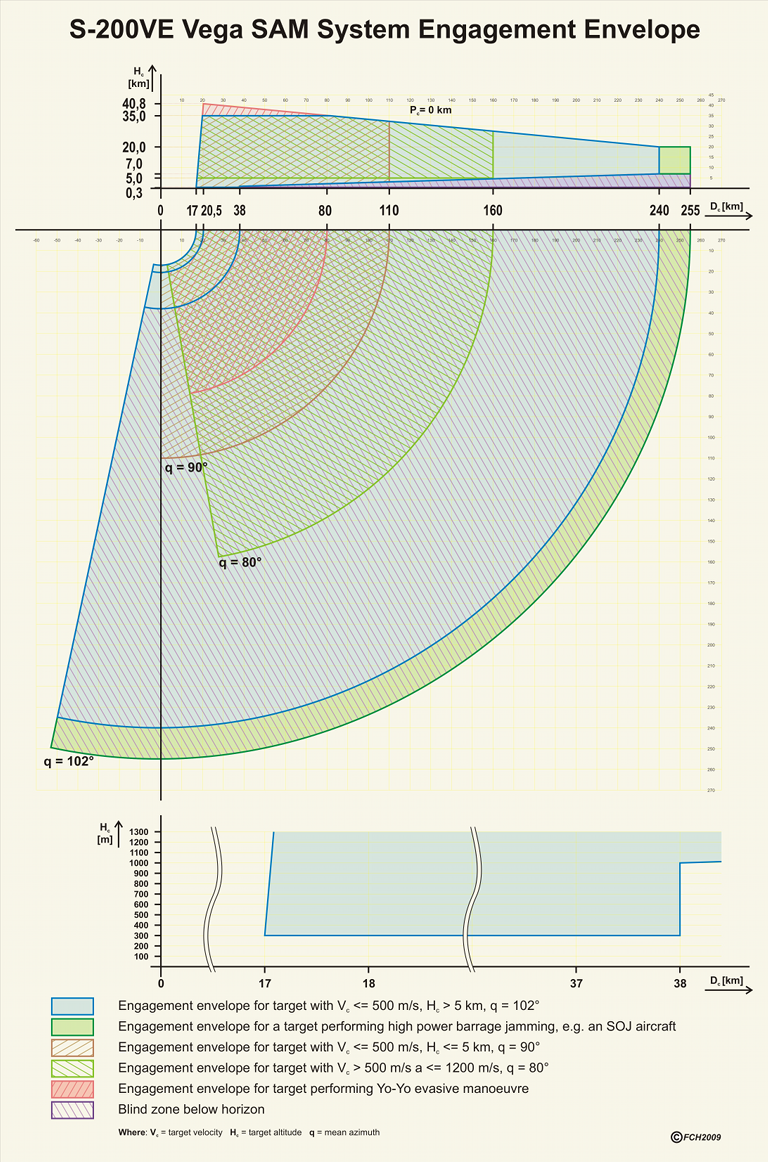
Tu22mThe Brahmos 2 would be a reusable system that would launch warheads and return?
Parachute and a little beacon?
After all, thats how Russians air drop their IFV and tank destroyers… (maybe not with a beacon though)
Tu22mhttp://www.flightglobal.com/news/articles/vympel-launches-r-77-ramjet-from-su-27-21749/
1995. That is an awful long time from test for there to have been no advancement down the line. Might be wishful thinking to assume that there is no R-77M1 which may be comparable to Meteor in range (if maybe not in guidance and ECCM).
Maybe there has been no need for it until the Meteor enters service?
If you really want to counter extended range for the potential missiles carried by an adversary (like the Aim120D) then adding a booster is a quick and dirty solution. Of course this is based on the assumption that the pylons and missiles can cope with the weight and weight distribution, that the missiles is adaptable enough (and that internal bays can fit it).
It can look like this:
Tu22mI agree, coming to terms with the PAKFA’s radar performance and stealth characteristics is one thing, coming to terms with its sheer kinematic performance and EW systems will be quite another.
No matter the stealth we still know that with decent modern sensors you pretty much always will detect the enemy outside the NEZ.
If we look at the expected kinematic performance the Pak FA is a Flanker on steroids. Currently the expectations are 175KN+ per engine with weight at ~18,1t (that is a thrust/weight of over 1,9 when empty or over 1,2 with combat load, with equal fuel as the F22 its over 1,32 where the F22 “only” has 1,11 with the same amount of fuel).
The Pak FA will also have exceptional lift to weight ratio with highly moveable control surcafes and 3D thrust vectoring.
So basically the Pak FA will be the absolute best fighter ever made from a pure kinematic standpoint.
When it comes to missiles there is a slight performance gap that widens even more with the Meteor (in favor of the western systems). But having that as the sole advantage over the Russians is a risky strategy. And we know that Pak FA will be able to carry longer range missiles than both the F22 and F35 because of the larger and longer internal bays.
Tu22mI think the biggest strengths of the Pak FA is the ability to engage AWACS at long range and its sick kinematic performance.
Tu22mYes I get it now. I bump my posts up. Ok 😎
Lots of love etc 😉
Tu22mWhere?
When you want the thread to move up again you bump it.
Explaination: http://www.urbandictionary.com/define.php?term=bump
It is ok to read more than the title when someone gives you an example. In Obligatorys case it was post #7.
Tu22mSorry I always keep track on my threads, DAILY so right was never a reply.
Its ok. Im in a forgiving mood. 😉
Tu22mRight?
About what?
Yes, with more fuel it travels longer.
Yes, with more fuel it weighs more.
You mention a weight at 47k lb or just over 21 tonnes… With that it basically can carry 2 Amraams + 2 Sidewinders for up to 3000km (just 10% less than ferry range which is max range clean + drop tanks, or 3300km).
Its not impressive nor economical since the SH consumes more fuel than both the Gripen E and Su27 while still having shorter range, not to mention the Rafale. All of these have a couple of hundred km longer range with same amount of, or more, missiles.


 Sign In







