 Tu22m
Tu22mIt’s the other way around. You don’t say “give me the best plane for $XXXX” Instead you say “What will it cost me for YYYY capability”.
And how do you, honestly, place the F35 according to that criteria?
Tu22mBeing fat is also relative to the size. A person weighing 90kg might be just right if he is 2,1 meters tall but would be called grossly obese if his height is 1,65.
If the F35 is fatter than the T50 (and it is) while being 20% shorter then we have a fat cat. The F22 is just a little bit chubby and would be the equal of someone with a BMI closer to 26, the Pak FA ~19 and the F35 somewhere over 33.

Thats just how the length/crossection goes. It’s Kipketer vs Hesser vs Philip Seymour Hoffman. The acceleration charts tells the same story.
Tu22mDo you know a EW system that can detect/jamm the APG 77?
Detect? EWS 39 for one has specifically been built for detecting LPI signals (operational since the 90s). But LPI is nothing less than normal pulses spread out in one band. The reflections have to be over the noise threshold and then they are combined making each pulse in the specific frequence weaker but when combined they give a good resolution and they are harder to jam.
However, barrage jamming (to name one type of jamming) over distance increases the noise levels across the whole band. This shortens the effective range. If the specific frequencies that the radar operates within are known then jamming will be more efficient.
However real performance is classified so we can only get a figure on how it works for narrowband s&t for the APG70/63. The above is in general terms how it works.
Mkay?
You did not pay atention: the F 15 and Su 30 MKI engaged only in WVR at Red Flag 2008. The guy talks about Cope India 2004 when the non-AESA F 15 radar couldn’t burn throught the powerfull Israeli-made jammers that the Indians use on their Russian planes.
“But he’s jamming so the missiles aren’t working” sound like they are talking about radar jamming that forces them into WVR in the end.
An AESA equiped F 15 (not to mention F 22) can very easy obtain a lock-on against a Su.
1 sqm is not a low RCS these days. And RCS and size are not necesarely correlated: look at B2 –it’s not too small. :p :p :p
Ok, I’ll just take your word for it… Jamming works the same way against AESAs and PESAs, the difference is that AESAs have higher jam resistance.
Detecting someone at a long distance is not the same as being able to get a radar lock on them.
Tu22mYou clearly don’t understand the capabilities of the F-22 and more so the F-35.
Further, if your scenario was remotely plausible. Russia wouldn’t be spending billions to develop the PAK-FA. It would just purchase more Su-35’s.;)
His scenario is pretty plausible and has been demonstrated in wargames like red flag.
In order for a F22 to fire a missile at a target it (or another jet with MADL) will have to track the target, most likely its another F22. This will alert the target that can respond by engaging ECM. For instance, getting a radar to lock an the large Su30MKI was almost impossible so the USAF-pilots in the excercise went for gun kills. http://www.flightglobal.com/blogs/the-dewline/2008/11/usaf-pilot-describes-iaf-su30m.html
The Su35S has a pretty low RCS for a fighter in that size (~1sqm) so having sensors warning the pilot in time isnt a problem.
What this means is that the Su35S is inferior in initial BVR capabilities and has to start the WVR or medium range engagements blind and in a defensive mode. It probably wont be a complete slaughter but not far from it when facing off with the F22. Thats the beuaty of having stealth + excellent kinematics.
Pak FA will be the way for the Russians to reclaim the title of having the most capable fighter in the AF.
Tu22mthe line in red => very big assumption without solid reason
You might be correct, but you might also be wrong. I just expanded the implication of the quotes if they where as I interpreted them in normal situations. (As in no jet got wierd penalties like reflectors etc)
according to the russian source , Irbis-e can detect target with RCS = 0.01 m2 from 90 km so if it can manage to go to the side or the rear , it will likely to be able to see F-35 , F-22 from far 90-100 km , but if we are talking about head on situation then it can only see F-35 from 55-50 km , and F-22 from 28 km assuming there is no jamming and narrow search pattern , even in the kind of situation F-22 , F-35 can still see the SU-35 from much farther distance , have more time to accelerate to their top speed => increase PK of their missiles
Thats where it all gets complex.
The modern jets, Su35S included, have good enough sensors to detect when a radar is emitting towards them before the jet is discovered. By discovering the emitter they will know where the enemy is (at least the direction) well before being engaged, for the F35 this is even more true.
At low altitude the drag will have a drastic range penalty on the missiles. The 45km of the OLS35M or 50ish km radar tracking might prove to be more than enough.
This masterpiece explains why http://forum.keypublishing.com/showpost.php?p=1534761&postcount=5
But on the other hand, nobody except LM and USAF have reliable RCS data…
Tu22mHmm up to 23 tons for rafale… But it has a cool air channel surrounding engines and exhaust, dunno about Gripen
Was I talking about MTOW? The F35 with full internal fuel and four missiles weighs over 22 tonnes. Thats the same as a F22 or a Flanker. (The MTOW is over 30 tonnes!)
What I went for was pretty much full tank and a few missiles. When it comes to IR signature I know that SAAB has worked a lot on that. Btw, WISCOM is something I think applies for Rafale as well.
Tu22mI would also be interested in a source to this.
Unlike most planes the F-35 does have active IR reduction, in addition to some passive techniques. The active IR reduction consists of using the fuel to cool things down — when the heated fuel is burned in the engine, you should at least in theory get a real IR reduction that would be difficult to get in any other way.
Note that Gripen also uses fuel to manage heat, but I do not know if it has any impact on the IR signature, Gripen has much less fuel than the F-35 to play with.
Pretty much all the features that the F35 uses to manage IR signature is already used by the others (like Rafale and Gripen). The big difference here is lower fuel consumption for the others, lower drag for the others (less frictional heating) and smaller size (F35 is the bulkiest and heaviest).
Smaller objects require less cooling.
Just think about it, the empty weight of a F35A is 13,5 tonnes! The Gripen is 7 tonnes and Rafale is 9,5. Loaded weight for F35 is 22,5 tonnes compared to just over 9 tonnes for Gripen and 14-15 tonnes for Rafale. This puts a loaded F35 in the same weight class as a loaded Su27 or F22.
Tu22mBased on what? Under what circumstances? Radar performance is like anything else… marketing data is awfully hard to use to build an accurate picture of what is going on.
Based on official numbers. “Captor C can track a fighter sized target at 185 km”, the N011M can do the same at 75 to ~100nm. Some sources claim 160-185km. The Russian numbers are pretty official.
Several big assumptions there.
As I said before, while that quote isn’t completely clear the impression I got is that the EF pilot was talking about the F-22 never allowing the two get closer than 20NM… that doesn’t say that the EF pilot was engaging or even detecting the F-22 at that range.(The EF pilot did say the F-22’s advantage was “overwhelming.”)
Even if he were detecting the F-22 at that type of range, he certainly doesn’t say with what. (IRST, radar, potentially something off-board, he never says. It could be he never found out how close the F-22s let him get until the debrief…)
Yes, the quote was incomplete.
Even if he were talking about detecting an F-22 at that range with his radar, we don’t know whether the F-22 was using an RCS enhancer and/or wing tanks, as it almost certainly was. (Standard procedure when exercising with foreigners.)
Ok, have you or have you not found any information on German Eurofighters that use Pirate except for the twin seat 30-42 that I have found? If they dont have IRST then the sensor used must be the radar.
First off, he never said he was able to engage F-22s at BVR. And again, according to at least one source they brought a Typhoon with an IRST.
Can you quote and paste the link?
For all we know the F-22s were flying with wing tanks… again, lots of assumptions.
Read ff1987s posts
Tu22m2. Misinterpretation – they can’t go closer than 20miles (32km). The other journalist like Jon Lake who was there said that:
http://forum.keypublishing.com/showthread.php?t=118901&highlight=german+eurofighters+scalp+alaskan+raptors
German Eurofighters Scalp Alaskan Raptors” Grumbrecht said that even if his planes did everything right, they weren’t able to get within 20 miles of the next-generation jets before being targeted.”
Looks like you might be right. The 20nm figure is how close they can get to the F22 without being targeted in situations like merges…(?) And the F22 has a better radar than the F35 (and no IRST)..
So the numbers probably include evasive tacticts (flying silent) and maybe even jamming? Either way 20 nm is a pretty leveled playing field when it comes to getting the kills. (Just imagine how this would compare to Su35S with both OLS35M (45km passive track head on) and Irbis E + sensors wating for enemy radar emissions)
4. I agree – i don’t believe 0,0001 sq m rcs, real average frontal RCS should be closer 0,01 sq m.
I can tell you that one guy who was there said that german EF-2000 detects Raptor from 44NM (81km) – but I don’t know if they done this by radar or IRST and I don’t know the aspects- rear or head on ( I can’t give You sources – CLASSIFIED – but I believe these guys)The other polish article said:
“Germany admitted, however, that the pilots realized their very aggressive tactics. Also added that they were not able to detect the Raptors from a distance of more than about 35 km, which proves their superiority in action over a greater distance.”
http://www.altair.com.pl/news/view?news_id=8265&q=red%20flag
So they probably detects (not track) Raptor by radar from max 35 km head on, but can’t go closer than 32km.
The sources should be realiable because Polish Air Force take part in those exercises with Raptor and EF-2000.
Its no secret that RCS changes depending on the angles. If the Captor C can detect and track a F22 at 44nm it probably is from the rear aspect or during bank turns. I just assume its by radar since Luftwaffe, afaik, only has one Pirate-equipped jet.
This would also explain the different results. One uses the best proven figures, the others for the most likely ones. Still, If they, from the frontal aspect, can track a Raptor at 32+ km then the Irbis E should be able to do so from 55-70km.
This is bad news for the F35 since it means that it will be tracked and probably engaged at distances outside the NEZ of the carried weapons.
This thread shows another interesting aspect of BVR.
http://forum.keypublishing.com/showpost.php?p=1534761&postcount=5
So BVR as well as WVR are about more than just see first, kill first. Its complex enough without adding jamming, decoys and chaffs.
Tu22maccording to US government the f-22 frontal rcs is 0.0001 m2 and the f-35 frontal rcs is 0.001 m2 there is no reason to make up different value for frontal RCS without clear information
in the case of EF-2000 and F-22 i think it may use irst or guide from AWACs or using very wide formation to be able to see f-22 from different angle
Btw the range that EF-2000 see f-22 is detection range => the track range to launch missiles will likely shorter
P/s : you may also want to look at some graph here
http://www.f-16.net/f-16_forum_viewtopic-t-16084-postdays-0-postorder-asc.html
even in your graph , the detection range of Irbis-e again target with RCS = 0.001 m2 is only 30 nm =55 km and that is only the detection range
So you are not disputing my assumptions, only my conclusions?
In that case please explain where I’m wrong instead of giving me a general “you are wrong” answer.
1 The radar performance (distance) for the Captor C is at N011M-level or 30% higher.
2 In order to not need to go closer than 20 nm in BVR they need to engage the target (firing missiles) at a slightly longer distance.
3 To engage in BVR you need to be able to track the target, if you dont have IRST/FLIR then most likely by radar.
4 The minimum frontal RCS is different from the general frontal aspect RCS. In the case of the F22 the general frontal RCS is closer to 0,01 than 0,001 aqm. If this is the other way around then the Luftwaffe Eurofighters didnt use their radar but got the lock on by some other means.
5 Assuming the other statements are true we get the range figures I have submitted when the enemy is using Irbis E.
My numbers range from X to Y assuming the shortest possible detection range enterpretation from the quotes and is likely a couple of km longer, unless of course they are talking miles in general and in that case the end result is pretty close to the stated numbers.
Mkay?
Tu22mirbis-e can detect target with rcs= 0.001 m2 at 50 km (although it a narrow beam search ) , su-30’s iris is not as good as the one on EF-2000 , it can only see fighter 35 km head on and have LFR range of 20 km http://igorrgroup.blogspot.co.uk/2009/10/ols-35-irst-option-for-su-30-family.html ,so i think F-35 still have good first shot advantages , especially if it use Meteor instead of Aim-120D
That is assuming that the F35 or F22 will have their most optimal RCS footprint. The Germans showed it to be wrong.
At 100 nm the Captor C can track a “fighter sized target” that usually is 1-5 sqm. This puts Captor C at 100-130% of the range performance in the N011M BARS in the chart. Irbis E has ~200% of the range performance of the N011M.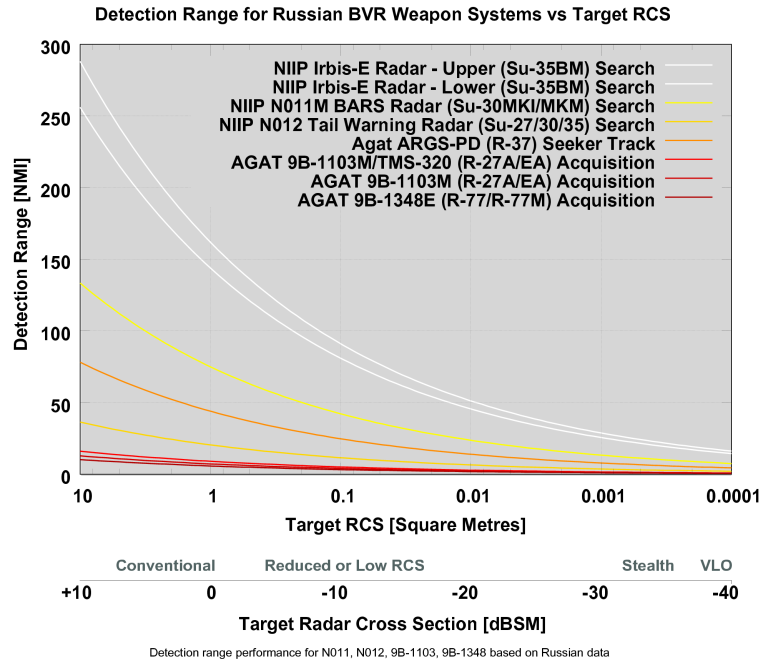
If a radar in the N011M-class (or with 30% longer range) can be used to engage a F22 at 20nm then the ballpark for the Irbis E will be 55-100% further away.
The general frontal RCS-figure for the F22 will be closer to 0,01 sqm than the marketed 0,0001 sqm.
Do note that the basic assumptions are the following: 1: the luftwaffe Eurofighters used their radar since I only know of one Luftwaffe individual with Pirate (twin seat 30-42) and 2: I purposely chose the shortest range given in the quotes. Real tracking range is most likely a bit longer.
Tu22mFirst off, we are talking about the Typhoon’s IRST, not its radar. The F-35 will have a smaller IR signature than an F-22 and a correspondingly shorter detection range.
Second off, 70km? Not a chance…
Well… you are talking about IR systems, I’m not. Do you have any information of Luftwaffe Eurofighters more than the twin seat 30-42 that have Pirate installed?
If they haven’t got Pirate installed then the only likely sensor to get a lock on the target is the Captor-C (currently).
Tu22min short, everybody can read it as he likes… nice diplomatic answer that means nothing and everything at the same time 😉
Haha, true story. My interpretation is pretty similar. But this is very relevant for the F35.
This should mean that a F35 has to engage threats like the currently fielded Su35S at distances over 70km to be sure about having the first shoot capability. (I assume that the F35 only is slightly less stealthy than the F22)
Is the Aim120 good enough (considering NEZ and kinematic disadvantage)? And more importantly, is this good enough of a range to counter the coming AESA-upgrades on the Flanker series?
I just try to count on the lower side so the stealth advantage isnt neglected.
Tu22mDid you read the post a few above this one? He already linked to info saying that the Germans brought one PIRATE equipped Typhoon to the exercise and that they claimed could pick up an F-22 at around 50km under at least some circumstances.
Isnt the only German Pirate equiped the twin seat 30+42? The one in the picture is 30+30.
Tu22mThe German Eurofighters AFAIK dont use Pirate. The only other way to get a missile lock on should be by radar.
Just expanding the implication of that:
The Captor-C (currently on the Eurofighters) can detect/track fighter sized targets at 185km (100nm) and they should have an equivalent RCS of 1-5sqm.
This would put the range performance at 50-65% of the performance in the Irbis E. In other words a Flanker (assuming equal jam resistance) should be abe to get a radar lock on a F22 at up to 31-40nm (57-74km) on a Raptor as long as it isnt a pure “head on” engagement.


 Sign In







