 Tu22m
Tu22mI concur.
Tu22mWhy not go with the “over nine thousand!”? http://www.blogcdn.com/massively.joystiq.com/media/2009/02/overninethou-sms-0209.jpg
This was a pretty interesting quote from the same hearing:
Dr JENSEN: Yes, but I put it to you that the reason they put a gun in the F22 was that the Americans learned
a very hard lesson in the 1960s with the F4 in Vietnam, where missiles and scenarios were not working the way
that they were supposed to perform. You had AIM9 missiles that were supposed to be shooting down 90 per cent
of their targets and they shot down 20-odd per cent; AIM7 Sparrows that were supposed to shoot down 75 per
cent to 80 per cent of their targets and they shot down 12 per cent. What happens if all of your electronic
countermeasures, with various manoeuvres and so on, the AMRAAM suddenly goes down to something like a 0.2
or 20 per cent probability of kill, so, therefore, even when you are shooting all four of your missiles with an eightversus-eight scenario, you have quite a few of your enemy coming in at you to within visual range and fight first
of all by shooting their long-range missiles at you. I would agree that with a stealth aircraft the probability of a
radar-guided missile killing you would be somewhat less than the probability of a radar-guided missile killing a
non-stealthy target, but there are some long-range infrared guided missiles out there as well. What happens in that
scenario?
Air Vice Marshal Osley: At the unclassified level, I have explained how the F35—the concept—works. I have not gone into classified detail about the exact tactics that would be used. I have indicated that we would play to our strengths. I would like to leave it at that, if I could.
Sort of reminds me of this thread…
What happens if the Pk of the missiles drop to the historically proven levels? (either by improved jamming, improved decoys, hardkill countermeasures or just a plethora of targets like drones, autonomous decoys + real targets in the midst of it all).
What happens when the enemy can arm UCAVs that are stealthier than the F35?
To say that the F35 will be superior in the following dogfights or that it will disapear completely thanks to stealth is pretty optimistic. But what is the “plan B” if the BVR tactics fail?
Current radar systems can detect a 0,001 target at over 50km, the upcoming N050 will do that in over 60km. And thats for two radar systems with only 9 years apart in technlogy. Better signal processing, higher power output etc might take that up to 70 or 80km by the time F35 enters service in the partner countries.
Tu22mSo its a number they just fool around with?
The physical ways of detecting enemy targets are pretty limited so it must be different ways of using the technology. There are still approximately 2 ways to find an enemy target (or three).
1 Target emissions (Heat, radiowaves, radar emissions, contrails)
2 Reflections (Active radar, Semi active radar, UV-light)
3 “Dark spots” or visually (silhouette against background or visual)
Another possible version is hacking old datalinks and get information that way.
But to get 650 different ways one really has got get creative.
EDIT: But checking against a threat database will increase it a lot. One could start with shape, dopplereffect, flight profile (if the target is in a formation or not). By counting all those modes its quite possible to reach 650 parameters.
The old and not so high techy jets will just show a marker in the hud or the LCDs and mark a target, if IFF works it might get colored as friend or foe. Frankly, I dont think it matters that much if the target has been software evaluated 200 times in different ways before its on the screen.
Judging by the context that is what it looks like. To me it looks like the F35 will, when its close enough, be a little bit faster in discriminating what type of target that is being detected. Aka if its a cruise missile or a jet. But by then its very close to the targets and probably engaged already.
Tu22m@Spud: Does your chrystal ball have a Lockheed Martin stamp on it? 😉
Tu22mYou mean exactly like the Mirage 2000 or Mirage III today?
Tu22mThe latest FA18E/F looks like a great option.
Just look at the proposed Silent Hornet in Brazil.
It has new CFTs, RCS-reduction and stealth cocoons.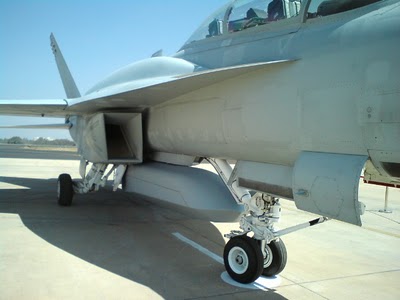
The FA18E (latest version) is a pretty good buy considering cost, range and general performance/versatility. If I was buying jets in Australia I would go for more FA18E and have the F35 on hold until a final price emerges.
Also stealth drone projects would be interesting, such as an upgraded GA Avenger (with A2A capabilities) or the others (X47b + Taranis). I think that would be pretty good for a large country like Australia and cost effective.
Tu22mWhat that small bump on the tail boom? Could that be the new placement of the KS-O? It wasnt there on the T50-1.
Tu22mSure the range and cost would be an issue?
If the claims from SAAB are correct (at least 10% lower TCO than the C version) then they have a margin of at least 11% in cost increases and still being the cheapest jet on the market.
As for the range im not certain it would be more than a marginal difference. One could fly at 80% of max thrust instead of 100%. It could be fuel efficient. Havent you learned your lessons in ecodriving? 😉
My only point is that a more powerful engine won’t neccessarily equal higher fuel burn than a weaker engine at the same power output.
Tu22mProbably mach 1,8.
Its very similar to FA18 (fuselage) and F16 (wings) and has similar thrust/weight ratio ans the FA18.
IDF Ching Kuo thrust/weight: 0,923
FA18 thrust/weight: 0,943
I think it might reach speeds of mach 1,8.
Images:
Tu22mThe F35 has qualities of its own, like being a stealthy control point for a UCAV-swarm.
I can only hope that a customer wants a Gripen E with the F414 EPE and thrust vectoring. That would be pretty interesting.
(There have been studies on that from SAAB and FMV as well as regarding a stealthification that is more extensive than the current LO design)
@tempest: Do you have more information regarding ETS? Its always interesting to hear opinions from people who actually have experience.
Tu22mI think you sort of proved you own maturity level. If they, as a newspaper, are defining supercruise as mach 1,5+ without A/B in level flight then why does this come up as a definition?
Supercruise
The F-22 is the also the first fighter to have the capability to cruise at supersonic speed for long periods of the mission. Previous fighters could only achieve supersonic speed in a “dash”-that is, for very brief periods on afterburner, which quickly eats up fuel. The Raptor, though, will be able to leap across swaths of real estate at over 1,000 miles an hour, do it persistently, and without resort to afterburner. Top speed of the F-22 is classified, but it does have an afterburner for high dash speeds as well.
In the same article:
However, the Joint Strike Fighter assumes the F-22, he said. The JSF does not have supercruise ability, he pointed out, nor is it designed to be an air superiority airplane.
And the rest of the world agrees. Supercruise is supersonic speeds without afterburners in level flight. The same newspaper says Pak FA (according to the Russians) can supercruise while they say that the F35 technically isnt supercruising.
There was something fishy about the “supercruise” that made them point out that it technically wasnt a supercruise. I, and others, have theories on what it can be without calling any party a liar. The concept of a dive, low fuel reserves, average speed (not a constant mach 1,2) etc are all plausible and congruent with all available information.
Your statements are not congruent and are basically calling the testpilots liars… and at the same time you dont provide any sources. I think I will trust the testpilots, LMs VP and John Tirpak @ AF magazine over a desktop warrior that has been wrong about 70% of all claims (including ones about the weather).
Provide one source that supports your bs claims, please. Thats all I ask for.
Tu22m@Hopsalot: Ok. Im happy we can conclude the new definition of supercruise is not related to level flight.
I welcome F86, Me262, Mig 21, Draken, Me 163 in the supercruise family since all of them (and many more) without a/b could sustain speeds exceeding mach 1 in steep dives for a dash of a mile or so in the attack flight profile.
Thumbs up bro. 😉
Or maybe we should stick to a supersonic level flight without a/b as the definition. What do you think? What the pilots say and what O’Bryan say is actually congruent if the F35 is in a dive (not very steep though).
Im not calling anyone a liar, you are. And I dont see anything to back up your claims.
Tu22mYou did not read his. He said that the F 35 can perform at least like F 16/18, i.e. the fighters that will replace.
The max. speed ever used in real wars was something like 1.4M. And BTW, at a max. speed of over 2M (that any of the euros can’t reach, since max. speed is 2M) an fighter isn’t even lightly armed, is no armed at all.
Yes they can. Lightly armed is with wing tip missiles and the flight envelope is usually with those on board.
And please, do everyone a favor and stop claiming supercruise on the F35. It is premature to reach that conclusion (that probably is very wrong). Not even the Bryan himself called it supercruise and he hinted it could be in a dive. In fact they said it “not technically supercruise”.
Only the religious hardcore fanatics of the F35 groupies claim the supercruise numbers for the aircraft. But hey, if thats the case than maybe we can call the me 262 a supercruising jet with a dash of 1 mile. If earth wasnt in the way it could probably supercruise longer in a vertical dive.
Tu22mAre you even reading the comments?
For interception you need to be fast, preferrably over mach 2 and supercruise capable. The Eurocanards delivers in this area, the F22 delivers and the Su35 sort of delivers (still no info about the supercruise), the F16 doesnt officially supercruise (?). All with top speeds lightly armed that are above mach 2, all with cruise speeds above mach 1,2.
MiG 31 is a perfect example of a great interceptor. It can fire missiles at above mach 2,83 (or above mach 3 in “war time”), the radar can tack a smaller size fighter target (5m²) at 282km.
That is what I call an interceptor with superior kinematics!
The MiG 31 is affordable, it has a superior radar, superior kinematics, superior weapons range, excellent service ceiling and is affordable. Does this make it the best fighter jet in the world? By following F35 fanboy logic it should be.
Tu22mNot quite, you cannot compare regular commercial CPUs like the ARM chipset on the iPhone 4S with older architecture, redundancy & cooling utilised in the 2 Hughes’ Common Integrated Processors (CIP) aboard the F-22.
Having said that, the progress of current parallel architecture’s computing grunt vs. power consumption is truly astounding. Using your example of the F-35’s >1 TFLOPS, a similar commercial system available next year:
I know you cant compare them side by side, but performance wise it sort of shows where we are heading. Also I did compare with a computer rigg based on a ATX motherboard that gave 16 TFLOPS at a cost of 3’000$ and power consumption <1000W.
What djcross said was true 10-20 years ago when the F22 and F35 where considered groundbreaking. But at that time an iPhone 4S would have been among the fastest computers in the world.
So being fast in adopting new cpu systems in the non critical systems of the aircraft is more important than having extreme power supplies (only exception is for the radar system because of physics).
@Spudman I just hope they need some recompiling, otherwise they tend to get very very sluggish. That being said, most modern jets are built to be upgraded and I’m happy that goes for the F35 as well.
So the CPU performance isnt the problem today. There is enough capacity in all existing jets (at least if they get new chips) to to all the analyzing. In the tiny Gripen there are 50 computers in the cluster, so by fitting the same amount of graphics cards the performance could be sick (dont want to think about the possibilities for F35. Bruteforcing IFF or encrypted transmissions?).
In 2009 AMD relased the 5970 HD card that alone produced 5 teraflops. Thats three years ago. In one card. Maximum power consumption 438 Watts. So its all about how fast new tech can be implemented and adapted for use in a fighter jet. A 6 year implementation phase for a supercluster could be outperformed by someone using two new chips with a one year implementation time.


 Sign In







