 Tu22m
Tu22mSubsonic R37? RBS15 MKIV?!
The Vympel R-37M is a mach 4/5/6 long range AAM and its the first time that i´ve seen soemeone claiming that it has a subsonic flight profile!!
The 1000 km´s RBS15 is nothing more than company studies.
What do you call this then?
According to Defence Today the range depends on the flight profile, from 80 nautical miles (150 km) for a direct shot[1] to 215 nautical miles (398 km) for a cruise glide profile.
Sounds subsonic or at least slower than mach 4/6. Yes, the RBS15Mk IV is a bit premature. Still, it has gone from 70 to 250 km of range from MkI to MkIII. And that is easier to do with subsonic missiles with jet/turbo engines.
You dont need to focus on the propelant to explain interesting gains in range, on the other hand if we look at flight profiles, aerodynamic characteristics and internal arrangement…
Look at what Matra did with the MICA in 1991. Or what Rafael is doing today with the Tamir.
The “9X” measures 3,075 meters, weights 85.45 kg´s and with a diameter of 13 cm, the MICA measures 3,100 meters, weights 112 kg´s and has a diamater of 16 cm, they are not much diferent in terms of size, but the French AAM in the past has blown to pieces drones that were 64 km´s away from the initial shooting point, this almost triples the “9X” range.
Matra did this with lifting devices along the AAM body and with flight profile. If we think of this “CUDA” in the lines of “half a MICA”… I wouldnt be too surprised if this concept outranged the “9X”.
Depends on how you measure range. Its not like the AMRAAM falls out of the sky at max range. But with aerodynamics being similar (but with higher relative drag for the CUDA), using the same fuel and similar flight patterns there will be a difference.
The R37 shows this in a great way by more than doubling the range simply by changing flight profile.
EH?! Ramjet R-27?!!!!!
Typo, i meant R-77 and R-77M1.
For the future? No, we could see stunning things in Istres by 1991, and by the way we are seeing stunning things today all over Israel.
The Israelis are shooting a 90 kg´s, 3 meters long SAM from the ground to targets 70 km´s away… That interceptor matches the 9X size perfectly…
If the French and the Isreali´s can do these things there´s no reason why LM cant do the same.
Does that missile have a booster?
The RBS70 has in the RBS23 configuration went from 8km to 20km range by adding the boosters, the missile is basically the same.
For a KE killer speed is key. So the CUDA has to be a lot faster than the target to make a good impact and maneuver at the same time while the AIM9x only has to get close enough to get the charge off, it can do this without being much faster than the target.
Having one missile that needs higher speed, that has to do more maneuvering will have an impact on the range vs the counterparts that can fly slower and do less maneuvering.
Most of the performance gains comes from more efficient use of the fuel and flight profiles today, the solid fuel itself is pretty much the same. That is why the biggest range increases comes from adding either boosters or changing to ramjets.
Tu22mDoes the thing suck liquid gold or what?
Thats probably without fuel.
Its usually specified as “weapon system cost” and includes airplanes, service throughout the lifespan and weapons. Fuel prices are hard to include in such contracts.
Tu22mSo there might be a stealthy ISR/Attack airplane with or without engines that has reached the skies at Groom Lake.
Sound like we have enough to start a real debate.
Could it be the FA XX or a new drone?
Tu22mI wouldnt discount that this concept could outrange handsomely the AIM-9X.
If the French and the Bristish in the nineties could field AAM´s in (roughly) the “9X” size but with longer legs (MICA and ASRAAM) i could see something smaller doing the same two decades later.
On top of my mind there are some pretty long legged PGM´s emerging from the bureaus lately, i am thinking on things like that Kongsberg JSM (one meter shorter than a latest generation Exocet or Harpoon but with a range over 280 km´s), or the 100 kg´s/100 km´s MBDA Spear.Cheers
I think it might be good not to compare super and subsonic missiles to get the data. The R37 for instance gets a longer range (up to 398km!) by simply changing the mission profile to a subsonic one, the JSM is a mix of rocket and turbojet engine and could possibly reach the same ranges as the RBS 15 (70km in Mk I, 250km in Mk III and possibly 1000km in Mk IV according to wiki).
So flight profile has a lot to do with the performance. And when it comes to propellants both the AIM9 and the AIM120 use AP/APCP with HTBP as binder (and fuel) and most likely Aluminum as primary fuel. And that goes for most other missiles as well.
I dont believe we will see any radical changes to the propellant, it will still have similar performance and will probably even still be HTPB/AP/fuel based. I mean, we still use AP as the main oxidizer (anno 1940s), Aluminum as the primary fuel (used since…?) and the only new thing is HTPB (anno 1960s). MBDA and Vympel looked the other way when it came to performance increases, they made the missiles with ramjets instead, in the case of R27 it doubled the range compared to the solid fuel engine.
My belief is that solid fuel rocket engines are what they are and that the biggest increases comes from changing burn rates, top speed, aerodynamics and flight profiles. Maybe someone will figure out something astonishing but thats for the future to tell.
Tu22mI count the forward thrusters (I’m pretty set at this point as to their use) as part of the motor in my calculation of the ratio. The reason is that the thrusters allow for much smaller control surfaces to be used thereby reducing drag and allowing the motor energy to be more efficiently used.
Sorry for the confusion.
I understandz, i just count forward thrust to get an idea on the possible range as well as fuel/weight ratio + drag (simple fineness index). I think that gives a good idea on what performance to expect.
If it uses a band that is not normally covered in a jammer (aka MMW) then it would be jam resistant. If LM was smart they would recycle their JAGM MMS seeker work.
For that matter, how many ESM sets even cover MMW?
Most modern sensor suits do, and adding a tiny jammer in a pod (like the weapons pod Boeing are showcasing) or in a towed decoy shouldnt be much of a hassle.
If there are russian missiles in that band you can be pretty certain that the eurocanards have active countermeasures in that radarband. However, the K-band is very sensitive to particles so maybe the chaffs and flairs might be enough?
But this is very futuristic and actually pretty irrelevant since the range will be way shorter than the AIM120-family and probably even shorter than the AIM9x/IRIS-T range. And that is the arena where the F35 is not supposed to operate because the enemy will have the means to engage it.
Tu22mGiven all of that, it is safe to say that the CUDA will have a much larger missile:motor ratio than AMRAAM or even Sidewinder.
Are you sure?
This is how the AIM9 looks inside, the CUDA will, because of the radome, take up about the same space for the tracker so you can remove the blue and black part and maybe, maybe shrink the green part a bit.
(all units are percentage of original design, in this case the AIM9x as measurement unit)
So this is what you en up with on the AIM9M:
Engine nozzle/exhaust ~9%/27cm
Electronics ~22%/66cm (maybe 56-60cm on the CUDA)
Fuel ~52%/156cm
Warhead + detonator ~16%/48cm
The CUDA is roughly 180cm. So this should mean it has 180-60(?)-27 = 93cm long tube of fuel compared to 156 cm in the AIM9M with the same width and similar drag.
The guidance in the front section is not for fuel storage (maybe to a small extent) and it is probably where the datalink will be as well.
Based on that the missile will have 59% as much fuel and be 62% as large (only counting length for simplicity). With higher drag that should equal shorter range.
If the image below is correct then they are pretty much equal (slightly higher propellant/size ratio for the CUDA). But it has a fineness number that is about half of the AIM9. So roughly the same propellant/weight ratio, way higher relative drag. I think there will need to be some serious breakthroughs in propellant tech to get “at least the same range” as the AIM9.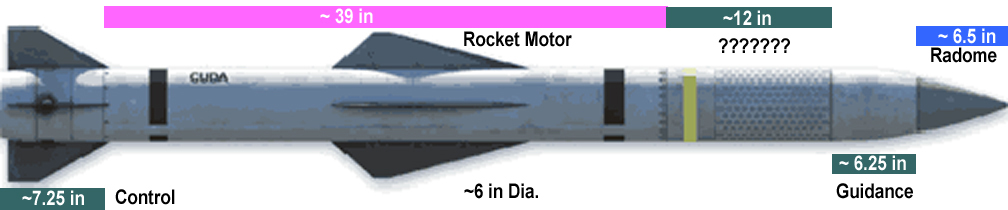
Looks like they did a sneaky thing here.. only using a “half radome” does save space but only holds a tiny radar assembly. Aka less jamming resistant.
Tu22mYes the AMRAAM (AIM-120C-5) has max. range of around 60-80km , but against non maneuvering targets , head on engagement , when both fighter and target seats above 15000 m at speed above 1,5 Mach.
But against 9g maneuvering targets , at 10km altitude , the range should be + 20 miles only.
For example R-27R1 ( comparable in range to the AMRAAM) could be launch succesfully from max. 35 km against fighter , when fighter and target altitude is 10km, and both has speed 900km/h , head on engagement.RAF : “In a typical BVR engagement, the AMRAAM is launched from a range of 20 to 30nmls “
http://www.raf.mod.uk/equipment/amraam.cfmI think that in high alt ( 50k ft) , and high speed (1,5 Mach ) BVR engagement AMRAAM could be launch succesfully up to 50km against fighter.
Also the AIM-120C firing in operation Allied Force was from around 25 km . The shooter was F-15C seats at 10000m , and 1,4 Mach speed . Target was MiG-29 , head on engagement. Some AMRAAM shoot from further range were evade by fighters ….
From BVR fights between EF2000 and F-22A we know that Eurofighter weren’t able to get within 20 miles of the Raptor…so AMRAAM usefull range isn’t so good against well equiped adversary.
So its basically a notch above gun range for the CUDA then? (If it becomes reality)
Tu22mIMHO that still gives the CUDA the advantage.
Why would the enemy even get within range?
Tu22mWhether it is the F35 (which could be the driver) or UCAV internal bays smaller more versatile weaponry is the way to go.
Sure, but for a platfporm that has stealth as primary means of survival versatility is more likely to come from weapons that can make use of that edge. If this missile is dirt cheap it surely has its place against weak enemies or in UCAVs.
If we compare it to a more modern missile like the METEOR it might actually fit a rocket engine. But it still holds less than 1/3 of the original AIM120s fuel with roughly the same cross section of the missile, aka similar drag.
The original AIM120 had a range of around 55-75 km, with less than one third of the fuel and similar drag this should translate into… <30km? (I added some range for the lower weight)
You be the judge if that is enough or not. At 30 km the F35 is detected by both the Irbis E as well as the OLS35.
The OLS-35 provides a coverage of +/-90 in azimuth and +60/-15 in elevation with a target acquisition range for non-afterburning aerial targets of 50 km facing up to target’s front hemisphere and 90 km facing up to rear hemisphere.
And the radar: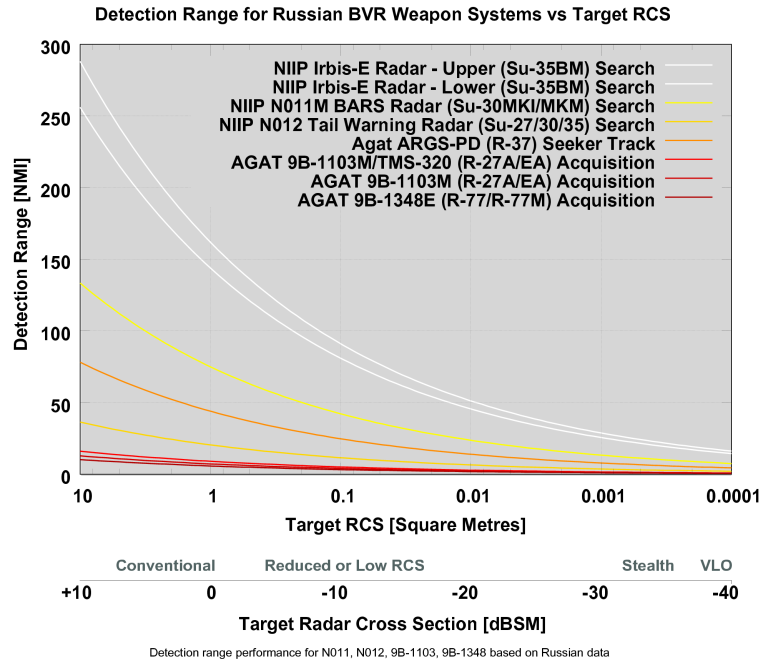
The F35s strength is that it can operate outside this area without being detected. It can stay lurking within the NEZ of the weapons without the enemy detecting it. The CUDA degrades the F35 to fight on equal, or actually worse, terms as the enemies its facing. Thus it wont become the standard armament but rather work as a complement (maybe as a hardkill countermeasure or self defence weapon when the long range missiles are used up).
Tu22mIm just counting seconds until the fanatics claim 8 BVR missiles (with greater range than the AIM120) will fit in the weapon bays… But this time I will be proactive! 🙂
The small one is 1,85m, the larger should be closer to 2 meters long.
So this will be a a very close range missile and will because of that probably never take place in an F35 unless its a missile that is cheaper than dirt and will be used agains Iranian F5-clones or similar targets.
Im guessing that the electronics can be made smaller nowadays as well 😉
Tu22mNice pics bro!
On the January pic you can the the finger operated levers for the hatches. No tools needed, just stick your finger in there. 😎
Tu22mTu-22M – “Release”? For shame! That, sir, is not a news release but analysis by the Dr Loren Thompson, PhD, a respected consultant whose name is synonymous with integrity and independence…
Haha, you cracked me up. Well, i consider it a press release from a third party.
I dont want to go into the business of discrediting sources while I’m still anonymous myself. I only want to disquss what the content of the claims are and the math simply doesnt add up when its compared to other fighters.
Tu22mAs for acceptable losses no loss is acceptable unless it’s a fight for your homeland or to stop far more loss of life
Sure, the attack helicopter has its role in a large army. It probably is the best QRF money can buy.
But will they survive at the front lines?
I’m a fan myself of the Battlehawk and Mi24/35 since they are so versatile. For a country like the US or Russia the Attack helicopters will be excellent force multipliers, for smaller armies like the Nordic (No, Sw, Dk, Fi) it would make more sense to have helicopters with transport as primary role and attack as secondary (if at all) since the enemy (Russia) will be expected to have air superiority, heavy AA, Manpads etc.
For countries like Germany its a more open playing field and they will probably make good use of having the attack helos.
Tu22mAccording to Lexington Institute-sourced report in defense-aerospace.com dated 29th November, things are looking good for F-35:
If the things stated in the release are accurate then it looks really good för the programme.
However… I am sceptical about the cost aspect. Can they really make the most avionics dense airplane that weighs about as much as the F15K at half the price? It sounds like a bargain that is too good to be true. Or matching the almost half as heavy F16 in price…
This is like someone saying you can buy a james bond car with all gadgets for the same price as you get a Trabant with AC and stereo. It might be true but I doubt it.
Tu22mThat’s a very confused reply – the majority of the USA’s fatalities in Vietnam weren’t even sitting in helicopters at the time – and regardless of the hugh heli losses that the US suffered they still continued to use them. How many tanks did the soviets and western allies lose in WW2, did those countries stop producing and using tanks after 1945? Is the tank obsolete in 2012?
There is a big difference now.
Even if you compare WWII with Vietnam there is a huge difference.
In WWII the US lost 600’000, In Vietnam they lost 60’000 (too much) and today 4’500 is too much.
Warfare changes and losses get less and less acceptable (at least in large numbers). Against a qualified enemy with SAMs or other AA I think the attack helos wont be very useful.
I just showed you what losses where acceptable at the time of the wars.


 Sign In







