 Tu22m
Tu22mAre you sure that are the accurate internal fuel capacities ? The fuel capacities usually associated with these birds are:
JAS-39 (A,C): 794 US gal (3,008 liters)
JAS-39 (B,D): 754 US gal (2,852 liters)
Tejas: Around 2460 Kgs ~3000 liters.
No argument is better than the sources used…
But i used several so it should check out.
Tejas 2458kg http://www.drdo.gov.in/drdo/pub/techfocus/2011/feb%202011%20.pdf
Gripen… of course unofficial source for the 4000kg http://jas39gripen.blogspot.se/ Max fuel according to SAAB is 7 tonnes… including external stores. That sort of throws out the 6tonne figure.
Based on your numbers (that actually fell pretty accurate) the NG or E version should have 4150 litres of fuel.
I should stop hunting numbers in the middle of the night, things get messed up when i do.
Tu22magree but no effect on IIR missille
Flairs have pretty good results..
many fighter radar have lock down / shot down mode
That can see through mountains?
in test Aim-120 also have very high PK
The AIM120 has a Pk of 0,46 against targets that dont try to evade it in BVR. If it can hit drones WVR is cool and impressive but the combat record speaks for itself. There are no BVR kills to this date against an enemy that has countermeasures.
may be but with DAS , DIRCM, JHMCS the F-35 actually very very dangerous
The F35 will be dangerous as long as it has missiles. And it currently only holds 4 internally (might get expanded to 6). But other fighters have similar capabilities to get off bore shots.
Here is some reading for you just to put the whole BVR thing in perspective and to sort of come back to topic. http://pogoarchives.org/labyrinth/11/09.pdf
And some extras 😉
. Operationally, the missile, which was designed for beyond visual range combat, has a Pk of 46% when fired at targets beyond visual range (13 missiles for 6 kills). In addition, the targets lacked missile warning systems, were not maneuvering, and were not attempting to engage the fighter that fired the AMRAAM. One of the targets was a US Army Blackhawk helicopter.[12]
In the biggest success ever for AA missiles the killrate, BVR and WVR combined, was 27% (Desert Storm), and thats a war where one side has awacs and the others dont even use countermeasures or radar warning receivers. Sounds like stealth fighters will have a walk in the park.
Tu22mbut AESA change frequency so fast , and quite close to the noise 🙁 , not to mention that you actually dont know the noise level of the environment caused it not stay the same all the time , even the reflect from fighter’s own radar and data link also create noise to it’s RWR , and if that fighter also use AESA or frequency hoping data link then the situation will get even more complicated
missile can use Doppler effect to find the real target so chaff are quite useless , most fighter only have 3-4 towed decoy , and often can carry maximum of 18-20 decoy like MALD-J or ITALD
Frequency hopping is useless against barrage jamming and that accounts for a false dopplereffect too.
Remember the example with the flashlight. You see a light that is 1/10th as bright, but he can only see your reflection. Its like ff1987 said, stealth is just as much about evading enemy radar as being able to do silent launches.
Data links that are beamed, like the next patch to TIDLS, wont be able to get intercepted. Or, in theory its possible if you are inside the beam..
in fact pylon reflect a lot , and even the missile and pod also have huge RCS , that why stealth fighter need internal weapon bay ,
secondly BOL ,BOZ only carry chaff or towed decoy both of that almost have no effect on enemy fighter radar ( chaff can be reject by doppler effect , towed decoy can’t repeat signal from AESA radar because they change frequency too fast ) => useless again missile guide by data link or IIR so they could never provide the level of protection that MALD-J and ITALD can provide 🙂
No, dopplereffect cant take care of the chaffs because of the following:
1 They are moving
2 The returns are larger than the original target
3 The target makes a split S so it wont give away a noticeable dopplereffect due to the perpendicular motion. The chaffs will also give small dopplereffects so tracking will probably fail.
4 There are a lot of false echoes.
5 Its up to the seeker in the missile to track the target, and that seeker is a pesa or a weak aesa when that time comes.
And towed decoys are supposed to give larger reflections and lure the HOJ systems. With barrage jamming the tiny missile seeker wont be able to track as it should so it will switch to HOJ, and that makes it target the towed decoy.
And i didn’t really talk about the kill , i just say , by using tatic the F-35 can still come near and get the first lock ,first shot at 4th or 4.5th gen fighter even if they were equipped with MALD-j and good IRST , and i have said before using the tatic the f-35 only fly half the distance as enemy fighter so it always get out of the IRST coverage before the enemy can get into th 80 km range , well unless the enemy can fly at mach 3.2
All fighters can get close to the enemy by using tactics. Flying like this will make it hard to get BVR kills… https://www.youtube.com/watch?v=lbp6JlBpDjs
In the Finnish army trials for countermeasure systems to their FA18s the BOL was successful in 57 out of 57 trials, that might sort of give a hint on where we are when it comes to missile effectiveness.
And close engagements is sort of the last thing you would want in the F35.
Tu22mwhat a load of c**p !
all the timelines you’ve stated are utter rubbish. The project itself was cleared only in 1983 and at that time, even the ASRs hadn’t been defined and even ADA hadn’t been established. But looking at your post, its clear that you’ve done no real research and posting the REAL timelines won’t make any difference to you.
Well.. I sort of got a better source from Twinblade so i have corrected my statement.
Still the design elements look very old fassioned with a lot of cylindrical shapes.
And it is very close to fighters of the 60-75 era, dont tell me you can’t see the similarities?
http://www.military-today.com/aircraft/hal_tejas.jpg
http://i9.photobucket.com/albums/a94/WtMiller/IMG.jpg
http://www.neomega-resin.com/mirageIII.jpg
And then we can check newer designs.
http://3.bp.blogspot.com/-gB3Fq3EQB84/Tm5MWtVYEtI/AAAAAAAAAII/JtNjh86zQRY/s1600/F%2BA-18E%2BF%2BSuper%2BHornet%2BStrike%2BAttack%2BAircraft.jpg
http://scisec.net/wp-content/rafale_c.jpg
You don’t immidiately notice that the newer fighters have worked a lot more with sensors, shaping etc from the beginning?
There are no wing tip units, the inlets are directly dirived from old times and where are the CFTs…? So just because the design elements are old, does that mean that it’s a bad jet? No. The airplanes of that generation (Mirage III, Draken, F5 etc) are mostly great. With upgrades most of them are even used today (like the Mirage, F5, F4). Building a new airplane based on improved designs from that era will give great performance, but the evolution and change in shaping have made the others have lower radar cross section, they carry a lot of fuel and so on.
A Mirage III with LERX, built from composite materials with a modern engine would perform well. The problem is to fit more fuel in the fuselage. And that will be a problem for the Tejas even though its just a similar and not copied design.
——–EDIT:
I was always under the impression that the Tejas had been around for decades and never got finished. But when I look at the new time table from Twinblade it sort of gets more clear. There should be delays and India shóuld do the development themselves this time.
I think thats a good ending for the argument.
Tu22mi dont know much about it about it but all information i can find say that it almost imposible for RWR to detected AESA radar :confused: , may be because the AESA changing the frequency too fast then ?
and Btw AESA radar like apg-77 change frequency 1000 times/sec so the power in each frequency may be 1/1000th ?may be it like trying to detected enemy aircraft in ground clutter :p , even when the RCS is big that still a very hard work
I’ve read some interesting papers from the Swedish army on background clutter and how one can use jamming to pretty much hide the airplanes and what tactics to use with it. Lets just say you have a copule of stealth drones behind your airplanes that randomly emitts signals and then go quiet and then emitt and go quiet etc.
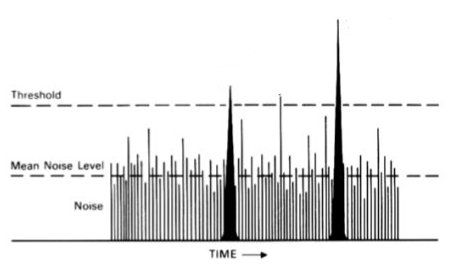
The top picture is just an extreme version of a high clutter/noise environment and the lower is LPI spikes. The F35 is very close to the noise level in pic 2 at distance, the closer you get with your emissions the higher the spikes/returns will get and when they are above the threshold you will spot the F35. In a peace time environment the F35 can be spotted at +45 km head on, in a war timw scenario with AWACS in the background the noise level might easily double. With random jamming (but constand barrage jamming) from multiple sources that emit a few bursts, disapear and then appear some place else (networked jamming) it will be hard to figure out if the returns are real or if someone is messing with you. The key is to make your radars filter threshold to up and thus ignoring the real targets.
So the LPI signals are weaker than normal, and old systems will ignore them while new ones (like SPECTRA) will find them.
In Pic 9, try to imagine finding a target that reflects around 0db. (This is what the missile is facing closer to the jammers). And then a burst of 40+ targets (a fighter can drop over 1000 depending on config) that all are refclecting 0db to +40db depending on output, all of them moving in different directions and clutter coming from various angles. I dont think that the missiles ever will win this battle unless the targets EWS is old.
actually even the powerful radar like irbis-e can only see F-35 from about 45 km ,Raven ES-05 will not be a problem 😮 , the main threat is the enemy’s main IRST that can look out to 80 km , have coverage angle of about 60 degree ,out of that coverage then the F-35 be safe :diablo: (iam talking about irst like EOTS , ols-35 ,OFS ,aas-42 not something like AAR-54 , DAS ) and in fact the cruise speed of most aircrafts is 800 km/h ( yeah i know there some supercruise fighter out there but not many ) and when the F-35 detected the enemy formation it can fly perpendicular at top speed of mach 1.6 for 46 km then it will get out of enemy’s irst coverage angle ( 80*tan (30 degree )= 46 ) , and F-35 do have quite long range of about 2200 km
P/s : at the moment there is no drop -able pylon so i think the enemy’s aircraft that have RCS of atleast 1 m2 and have cruise speed of about 800 km/h , they will be detected and track by the F-35 from 160 km , to get in the 80 km range for the irst to work they will have to fly for about 90-80 km
while to get out of enemy’s IRST cover angle the F-35 only have to fly for 46 km :), and the biggest advantage of F-35 is that it can see the enemy first
Depends. Pylons dont reflect that much. But i agree that IRST will get more and more attention. And this is an area where the Eurofighters and Russians are very strong.
But when we talk about decoys and dispensers… the BOL system (used by pretty much everyone) carries 160 dispensable packs in every unit. And there is one unit in every pylon.
So for a tiny fighter like Gripen E it will have 4 integraded units and at least 6-10 in the pylons. This equates to 1600-2240 disposables/decoys (chaffs/flairs or a mix).. per plane. With a jamming pod they fit more in the pod.
Does this give you an idea on how hard it is to actually hit a fighter jet with a missile (if they are prepared)?
Remember, all BVR kills have been against enemies that havent used any form of countermeasure (jammers, dispensers etc). (If anyone has a single source proving this statement wrong please post it)
BOL http://www.saabgroup.com/en/Air/Electronic_Warfare_Solutions/Counter_Measure_Dispenser_Systems/BOL_Advanced_Countermeasure_Dispenser/Technical_specifications/
Pod http://www.saabgroup.com/en/Air/Electronic_Warfare_Solutions/Integrated_EW_Systems/BOZ_EC_CM_pod_with_MAW1/Technical_specifications/
I know I only post SAAB stuff, but i just feel comfortable navigationg their site. I know many others have similar systems, this is just an example mkay?
Tu22mi think to be able to hold very heavy bomb and missile , pylon can’t be drop , not to mention the electric wire …etc , unlike pylon for tank
The electric wiring is no problem. Its pretty easy to build contacts that have a tolerance for movement and that doesnt stick to the connector. If that is in the base for the rack it can easily be made droppeable.
i think it almost impossible to intercept AESA radar ,no RWR today claim they can track , located AESA radar:p
Its harder to intercept LPI signals because of the realtively low energy pulses in each frequency. AESA radars have a small spread by default so it will be harder to detect than a legacy radar but far from impossible. Physics still rule.
Just to give you an example.
An old radar will send pulses, like from a flashlight, and the pulse will only be in one color… say red. You have glasses on you that only makes you see one wavelength at a time so the flash of light in the darkness that surrounds you is easily spotted. And since you are not covered in reflexes but a black coat the guy emitting the red light has a hard time finding you first.
Next up is the AESA (and maybe with LPI).
Its the same situation but the guy emitting light can send out bursts of not only green light but red, blue and yellow too. So the emitted light is 1/4th of the previous guys as far as you can see.
In the dark night, who has the potential to see the other guy first? And lets say that you need reading glasses… will you see the flashlight in your face first or will he spot you in you black coat first? (Remember that the human eye can detect a burning candle at 48km, take a guess on the distance you will be detected by the guy with the flashlight.
from some where i have read , the AESA radar signal appear like background noise to RWR
Its closer to background noise than legacy radars but its a clear distinction. You still need a reflected pulse that is stronger than the pitches in background noise.
all modern fighter today have radar coverage of only 60-70 degree except the irbis-E ( 120 degree , have to rotate to achieve that and it can only see F-35 at 45 km ) , and the F-35 will attack the enemy from the side
the only IR sensor that give 360 degree cover is the DAS on F-35 , ( Missile warning is not count ) , and actually if enemy use many IR sensors that can give total cover of 360 degree then the detection range of these sensor will not going to be high ,so as long as the F-35 keep the distance 50-80 km , and out side the enemy’s main radar , IRST coverage angle it is not going to be detected :p
last but not least , i dont think russian have any thing equal to ITALD or MALD-J at the moment
Raven ES-05 scans +/-100 degrees (200 degree sector). http://www.saabgroup.com/en/About-Saab/Newsroom/Press-releases–News/2012—7/Gripen-NG-flying-with-Raven-ES-05-AESA-radar/
Guess Pak Fa doesnt count… http://www.worldaffairsboard.com/attachments/military-aviation/21096d1275725455-pak-fa-news-sukhoi-t-50_pak-fa-close-up-cockpit-canopy.jpg
And no, you can’t fly around an enemy formation like that. If your airplane is slower than the enemies and has shorter range… how would that chase even be possible?
And i think we kind of lost the topic here… Stealth fighters vs BVR missiles.
Tu22mI bet you got your info from this link 🙂
http://en.wikipedia.org/wiki/Timeline_of_HAL_TejasThe recommendations to design a bird around a proven engine were given while designing these two. HF-25 and HF-73, as design upgrade of HF-24 and for DPSA.
I stand corrected and yes, that was my source. Still, the design looks very much like the Mirage III and other fighters from that era (1960-1975) so I didn’t bother to question it.
So maybe it isnt a disaster as a project, it’s just 23 years of waiting for a design that would have been modern in 1965.
About the second part.
I hate to divert this thread, but 2-4 years from now, India would be making more parts of Tejas at home than Sweden would be making of Gripen. In fact, everything, except the engine of course.
That is completely true. Its cheaper for SAAB to outsource parts of the work than to do everything themselves. But they hold the blueprints, they build the controlsystem, they assemple the jets etc. To redesign the fuel nozzles, the control stick and start a production line of composits that are old within ten years isnt economical. Maybe it will be for India since they have low salaries and can export the composite materials due to the lower production costs. If SAAB would do all that in Sweden the fighter would cost more than the Rafale or EF2000.
Its a tough choice, national pride in a 100% swedish production or getting a great product at a great price that countries actually can afford.
Tu22mUgh…What ?
Didnt see yourt edit…
The design they asked for in 1969 and got in 1975 is not the same as the current? Is that what you are saying?
Tu22mLook, there is nothing to gain for India to just go in for a ready-made fighter in the light fighter or light-medium fighter class. ADA/DRDO/HAL have come to the 90% project completion phase for the Tejas Mk1 and abandoning that would be the most near-sighted decision ever, one that is never going to be made since it would effectively end any future fighter/UCAV development in India.
Tejas is just a failed political project to build up an industry. Its basically a fighter from the 70s with modern materials. Considering the design its similar to Mirage III and Viggen (except for the canards).
* If they where to get the Gripen they would most likely get to build it themselves = know how in manufacturing for future systems (the purpose of Tejas).
* SAAB, as always, would offer them all the know how thats needed to alter the design and make a unique Indian version. A Naval Gripen E with F414EPE has been discussed, and that could become an Indian version.
* Open architecture for weapons integration (since the critical systems are separated from wepon controls etc. This makes it easier to implement custom specific systems like new pods, apps and weapons.
…oh, and they would get one of the best modern fighters money can buy. Lets say they build teh Gripen EI as a joint development with Sweden and with most R&D and all production in India? It would probably feel good for India to develop and build a high class fighter in 5-10 years when Tejas has been a project since 1969 with finalized designphase in 1975… with flying prototypes since 2001. I say just drop it and do it right the next time. 30 years ago Tejas would be a close contender to Mirage III and Draken, but today?
The offer to Brazil is similar. If they say yes then Brazil will manufacture all Gripens sold in Latin America. That is both a great business offset AND a great way to give them know how.
EDIT: Gripen A took 15 years from decision to introduction (delays included) and 9 years from first flight to introduction. Tejas has taken 32 years from decision to flying prototype and is expected (if there wont be more delays) to enter service 12 years after flight tests. That is a total of 44 years… unless there are more delays.
The program cost that American asked for selling 24 F-16C/D Block52 to Egypt during 2009 was also 3.2 billion USD.
If Switzerland can really introduce 22 JAS-39E with the program cost of “just 3.2 billion USD” at the time of 2018, then I will say that the program is so cheap that it is almost too good to be true according to the western world’s standard:D
The price is already fixed. SAAB usually delivers on time and with the agreed price tag, in this specific case the Swedish taxpayers will take any possible additional costs. My guess is that SAAB will make a small profit from this and a larger profit from the deal with Sweden.
Tu22mif iam not wrong then the only aircraft that can drop it’s pylon is F-22 ,and only when it carry fuel tank:D , and you cannot always fly in clutter
Its not hard to build dropable pylons. The locking mechanism should be electric, thats all. Currently there is no need for it.
RWR doesnot seem to work against AESA radar , at least in near future
RWR does work against AESA. What makes AESA trickier is the random frequency jumping and LPI-capability. The pulses in all other aspects look the same and many systems on the market have had LPI interception as standard for the last decade. (Ok, each pulse operate in a tiny bit broader band..)
To get a reflection from any object you need to illuminate it with a lot more than you want back. So the antennas in the RWR wil always have a huge advantage, and since most modern fighters already are LO designs it wont be that easy to get a big enough reflection fron them without alerting them.
no fighter operate it’s jamming pod all the time , because it like telling the HOJ missile to hit them , and in fact in the situation that i create , F-35 will only use APG-81 to detected enemy at long distance , when it re-engage it will use EOTS to lock and guide the Meteor or Aim-120D until the very last moment 😎
When the F35 uses EOTS the enemy can use their version of the system… jammers are only used to break tracking or a lock on. If it is networked jamming the output will be spread out on multiple emitters that do some bursts each, then others continue (if the jamming has to be constant which seldom is the case).
when decoy are common they will get used to it 🙂
good but they will not even see the F-35 :p so dont know where to go
You brought up the F35. Decoys are just extra targets. if they fly like real airplanes one will either have to waste 700’000$ per target, get close enough to identify whats what or bail out.
you dont have to fly perfectly perpendicular , the point of that is just to get out of enemy sensor coverage angle :p , and iam sure both the enemy aircraft and decoys will fly in same formation , direction ,dont think they will change direction a lot
because like i state before the F-35 will likely to spot enemy aircraft and decoys by radar at 160 km rather than 500 kmbut there not always clutter
to get to the bottom of this we need som examples of situations. This is what several fighter jets have today in sensors:
IR/Optical systems, over 45km range head on. 360 degree coverage.
Radars with +/- 100 to 120 degrees azimuth (sectors of 200-240 degrees), some Russian jets even have a tail AESA with +/- 90 degrees. I think its hard to escape those scan sectors.
The only way to get away from this is to fly outside the reach since it unlikely that one can escape the scan sectors. and by doing that you allow the enemy to get close enough to main base and release sead missiles.
But are we moving to the assumptions that the fighters both fly high altitude missions and that they use radar actively? Because that sort of has the same result as constant jamming. You show up with an approximate location.
Just to be clear, Im not advocating the use of decoys in masses. It was a fun thought experiment to elaborate on. But the fundamental principle is ancient. Give the enemy more targets than they can possibly handle and force them to get closer or waste all ammo. (Yugoslavia used it, in WWII its was SOP and i think Vietnam used fake targets. As long as the engagement cost more for the enemy it is a successful mission). The MALD and MALD-J cost 30-120’000$, AMRAAMS cost around 400-700’000$ depending on version.
Tu22m1-F-16 dont have any dual rack for air to air missile ( i have no idea why :confused:)
3- no software can help 1 missile to intercept 2 missiles 😀P/s : i just think about the decoy idea again , An aircraft that have rack and pylon will have RCS = 1m2 at least , so the Apg-81 on F-35 can track them from 160 km 😎 , while 80 km is the longest range any fighter can hope to see the F-35 by IRST , the detection range by radar is even shorter , so if the F-35’s pilot detected too many targets on his radar screen he may choose to fly perpendicular to the flying direction of these targets as most fighter have radar and irst that provide a 60° -70° coverage so if the pilot fly for 40-50 km perpendicular to the enemy then he will go out side the detection coverage of enemy sensor:p ( think of it as a triangle ) he then can turn back to attack enemy , the result is that the stealth aircraft still enjoy first lock , first shoot advantage :p even the range of the IRST on both side are the same
correct me if iam wrong
1 Correct
2 Lol, i think you got me there. I was thinking if you carry 4 IRIS-T, then its only a software issue wether or not you can engage multiple targets (unless the seeker head is from the stone age).
By flying low you wont expose your pylons to the enemy and the ground creates clutter. If you fly in a place like this: http://mb.cision.com/Public/183/9317381/9e89d517aac90fa7_org.jpg then what you carry doesnt matter. The purpose is an intercept for the expected enemy route and then unleash a hell consisting of a huge amout of targets. And now you have a clean fighter if you have dropable pylons. Maybe you might keep wing tip missiles.
Another thing is the fact that the target will have warning receivers that point out where the enemy is. So whoever uses their own radar tells where they are first.
And now we have moved on from countermeasures and missile seekers to “first shoot” ranges. Also… jamming will make the effective range shorter… way shorter. In the case of F15C vs Su30MKI the F15 could not get any sort of missile lock on at ny range! And that is a pretty large target. We will see how good the new AESAs are, but add a jamming pods (ALQ-218 and ALQ-99) on a few fighters and it will be borderline impossubru to rely on radar alone.
I think that the pilots trying to get a lock on a group of 8 F16, out of which 3 have ALQ-218+ALQ-99, jamming as soon as they are found and responding by sending off some 50 target drones to loiter in the area will fell like this:
What is the most logical thing to do? The fighters that sent of the target drones are now in a pretty clean config and can chase the F35s (or whatever the enemy would be) pretty far… and noone knows where the genuine targets are (except for one side…). Personally i would just rely more on tactics, countermeasures and IR missiles since the F35 cutaways show that it has very few dispensers. Just use MICA IR and some extra jamming pods and i have a hard time seeing how that would make you number two in BVR encounters.
But this whole mind experiment is fun and it might actually work. PS… how do you fly perpendicular to an object that loiters for 4-500km and follows GPS-coordinates, aka has no straight line in the path? DS
EDIT: Just because a human can se a burning candle up to 48 km away it doesnt mean we can repeat it with high clutter (like daylight, fog etc)
Tu22mboth ITALD and MALD-J better than IRIS-T because:
1-not many aircraft have dual rack for missiles now , F-16 dont , but there are already MERs and TERs for MALD-J and ITALD
2-IRIS-T can’t by any mean achieve 100 % kill probably , by contrast , if the enemy missile miss the decoy , they will fire another missile
3-even with 100 % PK , the IRS-T can only intercept 1 enemy missile at a time , but one MALD-J may be able to attack even more than 2 missiles
4-if the enemy fired 4-5 missiles at once you will not be able to lock and intercept all of them at the same time , by contrast with ITALD or MALD-J that just does not really matter
The thing about IRIS-T was just to make a point and was not meant to be taken litterally.
1 – It is proposed for the Gripen NG and it is used by the Hornets today. http://upload.wikimedia.org/wikipedia/commons/e/e5/FA-18_Hornet_VX-4_with_10_AMRAAM.jpg
And there are at least some sort of twin rack/twin pylon for the F16 that exists… http://www.f-16.net/gallery_item33568.html
2 – Couldn’t agree more. But once again it was to show that hardkill systems exist today. Who knows what will be out there within one or two decades?
3 – That depends on the software running in the missile. With better cpu, higher level of AI, discrimination, prioritization etc current IRIS-T could get that capability aftr a software patch.
4 – Still a software limit (mostly software/fire control).
But we are currently discussing counter measures that didnt even exist 7 years ago! Ok, maybe on the Tu22M3 (twin tailgun with radar controller). By no means am I saying that iRIS-T is the total gamechanger and only alternative, it is one. ITALD or MALD are other countermeasures that could be used.
To put it in perspective… most fighters dont carry more than 6 AMRAAMS as their standard BVR setup, The F35 will only carry 4 until they make internal twin pylons.
So i think countermeasures always will have an advantage in the BVR arena, at least as long as we are depending on radar trackers.
EDIT: Can anyone imagine how fkd up the airspace would become with all clutter after each enemy fighter (maybe 40) fires away 4-10 decoy targets at the same time flying in the same formations towards the presumed enemy positions? thats 160-400 targets to track and engage for an equally sized enemy of 40 fighters… I think its fair to say that the fight will become a WVR fight.
Tu22mRoE never let’s you take the gloves off. HOJ would make a difference and newer AMRAAM is multi mode, allowing dual active and passive strategies at the same time. You don’t want to rely on electronics for survival, they are simply a situational tool. Eventually you want to get away from them.
Thats why electronic jamming is just one of the countermeasures used.
Networked jamming from multiple sources go a long way to defeat multimode trackers.
And then you still have to beat chaffs + towed decoys + possible hardkill systems like IRIS-T.
Tu22mA new idea have just appear in my mind :diablo: , a rack like MERs can carry 6 ITALD ( have range over 400 km ) , TERs rack can carry 3 MALD-J ( range over 920 km )
No need. Jammers + towed decoys or chaffs in every pylon + more chaffs (deployed from integrated systems like BOL) + recce/jamming pods that have extra countermeasures will provide more protection than needed.
Then add stuff like IRIS-T (about half weight of the AMRAAM) that can be used as a “counter missile”.
IRIS-T’s exceptional precision in combination with a radar proximity fuze also enable the missile to intercept enemy missiles.
An F16 with twin pylons (possible because of the low weight of the IRIS-T).
Basically we could in theory be talking about an F16 that has upo to 8 free pylons (16 IRIS-T) + one jamming pod + 2 extra IRIS-T. If the marketed performance holds up one would need 16+ BVR missiles to kill an upgraded F16… and then hope that the chaffs, jammers etc are useless. Yes, this is highly speculative and meant as a free speculation based on marketing materials…
I think its fair to assume that dogfights will be a part of the future and that IR missiles will be more dominant than radar based missiles. Are we there yet? MICA IR is a first baby step… or maybe the R27ET was a baby step, MICA IR is the step after that…
So the BVR concept isnt dead, it just has to move more to passive systems. And that has other limitations in performance. Fights between modern fighters will get closer than anticipated. Thats why the F22, Rafail, Eurofighter, Gripen, Pak FA are excellent dogfighters.
Just as an example, the F15C radar (of the same generation as the AMRAAMs) couldnt get a lock on an Indian Su30MKI… and that was only because of electronic jamming… and the F15C radar was over 20 times larger than any radar that can fit in a AMRAAM.. I think this sort of gives an indication on what we can expect from jammed missile seekers.
Tu22mI think the comparison is based too much on the “official metrics” and speculation.
Has there, to this date, been any confirmed BVR kill on any airplane that has used jammers and taken evasive maneuvers?
AFAIK it hasn’t.
This is the playing field today, radar homing missiles:
Jamming. The missile seekers radar will pretty much always have a disadvantage against jammers. A small radar will pretty much always lose that figh. Barrage jamming, DRFM jamming (works well today), networked jamming (cross eye jamming with interrupted transmisisons) etc.
Better seekers (radars) wont make jamming useless. So one could add a new function like Home on Jam. But that works poorly when its tracking three targets that appear in different places all the time (networked jamming + cross eye jamming). And still… barrage jamming will be effective even with better seekers.
Decoys. Chaffs + jamming from random directions where there suddenly are 40 new targets, 20 larger than the original one, 20 of roughly the same size… + reflections from the jammers + split S that gives RCS-spikes and totally changes shape and RCS of original target… Which reflection is now what? All targets give doppler effects that could be genuine too…
Combine this with standard jamming and it starts to get clear why missiles will have a hard time hitting the planes. Stealth or no stealth.
The difference here between gen 4++ fighters and F35 is that the old ones usually carries towed decoys while the F35 only have them in external pylons… and external pylons are not standard for the F35. So the F35 will be harder to find, but it will have less countermeasures (by count).
And these are just a few of the problems for the missiles themselves that have to be overcome before we can disqus flight performance, radar range etc. In a high clutter environment… what performance is expected from a small radar anyways? And at what ranges do we expect to get a lock on?? Im sceptic about if its possible to get a lock on without alerting the enemy if one is using the onboard radar…
Just look at this video from Axalp. Is it fair to say that max range is totally irrelevant here? https://www.youtube.com/watch?v=lbp6JlBpDjs
So to sum it up:
The F35, as well as all other modern fighters, will have a great advantage over AAM if they can jam, drop decoys (towed ones of chaffs).
The main bottleneck when it comes to survival agains the missiles wont be the stealth, it will be the jam resistance in the missiles (that always will have troubles unless they are huge). During the coming 10 years AESA will probably become standard on all BVR-missiles, still… todays EWS systems will be hard to defeat, even with the new seekers.
In twenty years we might be able to crack the jamming of today. But by then both sides will have evolved.
Maybe when we have autonomous LOAL on BVR IR missiles we can start measuring flight characteristics och the various sorts and start calculating.


 Sign In







