Probably, depending on what they will deploy there. Naturally i expect some improvements in facility and personnel amenities at least.
——
Reading facebook group… I wonder why some people keep thinking that Russian SAM’s in Syria will shoot (or have to shoot )anything for Syrian. Where were SyAAF or their air defense. and Later blamed the S-300’s for “not intercepting” whatever Israeli shoot at Syria.
The limit lies in the pulse integration loss. Not all of them can be integrated by the radar, and thus integration loss occurred. This in radar range equation will actually increase the required signal energy for target detection.
I tried to generate 3D model and then “calculate” the RCS of the C-107 configuration. The frequency used is 10 gHz.
The 3D representative
Polar plot
Linear plot
All plot indicates that at least. the C-107 configuration is capable of attaining 0.12 sqm RCS in 10 gHz. The assumption is of course, no RAM and flying clean. For me it looks promising, especially when some RAM and internal weapon bay provided.
Another plot of interest is what’s KF/IF-X looks like in another frequency range. I generated a linear plot of frontal aspect of KF/IF-X in VHF straight to X-band.
Linear plot of frontal aspect in various frequencies (VHF to X band)
The result is wildly vary depending on frequency. Only specular RCS tho is considered in POFACETS. The contribution from creeping and surface wave are not considered.
So, Deir Ez Zor city is now liberated ? Nice 😀
What gain ?
Anyway Lambda/2 spacing from image above give scanning without grating lobes. Any other spacings be it less or more should have other consideration on choosing like say economy. The risk associated by using other form of spacing for ESA elements are limited steering angle. One example is ESA modules in TOR-M1 system which have wide spacing of lambda*3. The Russian designer opted such scheme for economy while providing best aperture area and gain possible. Whle accepting electronic steering angle of only 7 degrees.
Other possible reason for choosing non half wavelength scheme is stealth as to reduce bragg lobes. Bragg lobes
Improvements time. Trimming down some variables and Provide pre-calculated one. The calculator basically remains the same BUT hopefully it’s more user friendly.
[ATTACH=CONFIG]255520[/ATTACH]
The cover page now feature less clutters and lesser amount of input. Unfortunately as i said previously, pulsewidth and PRF cannot really be “automated” as it depends on the radar mode. Eliminating them will essentially locks the functionality of the calculator to X-band. While we know Russian developed L-band leading edge radar. and we have AEW AESA radar such as APY-9 and Elta Phalcon.
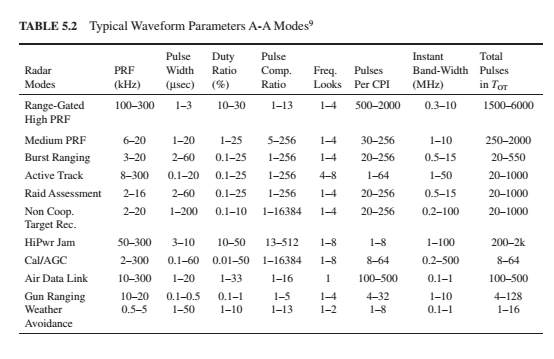
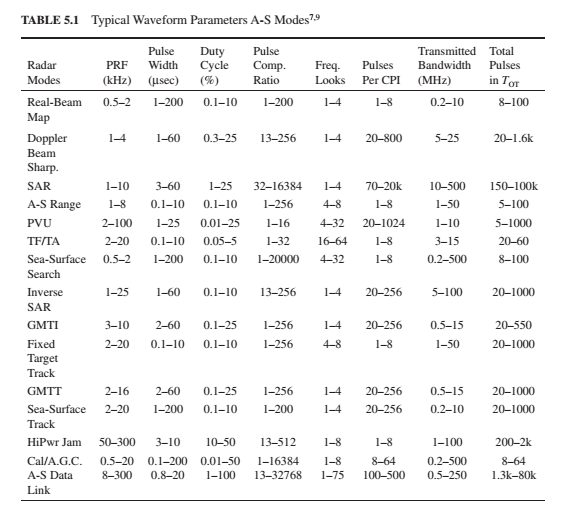
For filling guide for PRF and pulsewidth however. One can consult to following table, genereously provided by Carlo Kopp in Radar Handbook 3rd Edition. For both A2A and A2G modes
A2A
A2G
The second page of the calculator contains the pre calculated variables. One may still edit them. However it could be left as is. The pre calculated variables are based on generic information provided by radar literature in my possession.
[ATTACH=CONFIG]255521[/ATTACH]
Hopefully it could be more useful and easier to use. However feedback and input are appreciated.
Download link for the Improved version :
https://www.mediafire.com/file/7wrkyslc1p4d36r/AESACalcTrial.xlsx
@totoro Thanks for the input.
Let’s see what i could do. Using approximations is good however the calculators may lost its flexibility. and some variables like PRF can’t really be “automated” unless locking the calculator in specific frequency (say X-band) But we will see.
what do you mean @moonlight ?
Thanks @scar.
So Pantsyr can engage 4 targets and guide 2 missiles to each simultaneously.
Updates
Slight updates to the calculator. The Required SNR variable is now automatically calculated by the spreadsheet.
The Calculated SNR is for Swerling 1 or 2 target. Representative for maneuvering fighter aircraft, and basically the goal of any fighter/tracking radar designer (as making the target behaves in swerling 2 will reduce the required SNR)
As you see no more SNR variable.
[ATTACH=CONFIG]255484[/ATTACH]
Instead it’s become part of the calculated variable. The calculated SNR is for 90% probability of target detection. Which allows lock on. Thus the R90 in the bold coloumn is the range where target could be locked on by the radar and later fired upon by the radar platform.
[ATTACH=CONFIG]255485[/ATTACH]
The range coloumn
[ATTACH=CONFIG]255486[/ATTACH]
The R50% is the range where target detection probability is 50%. Such range is where radar might detect and track the target But not having the confidence of locking it for weapon system employment. It may however be used to cue other fighter aircraft or higher resolution sensors to establish more confidence on what being detected, is it real target or just false alarm.

wow 40km. 20km more and it would be at the upper limit of viability of command guidance (60 km).
Anyway how many guidance channels available to pantsyr ? as the number of missile guided to targets are directly related to it.
@Arihant.
Well the most important thing is at what range it acquired. There are no real “undetectable” low RCS target. Only at what range it’s acquired.
Well, this kinda messy. i wonder why we need to compare MiG-29 and Su-27 when they serve different Hi-Lo mix. Just like F-15 and F-16.
need more Gorshkov.
@haavarla
Supposedly our old SK and MKK birds (the TS-2701, 2702, 3001 and 3002) Will have such upgrades carried on in the Belarus company that win the maintenance tender and do the upgrades (There was also news the SK birds will get the Satellite Self Protection Jammer or carry Gardeniya) Unfortunately there are no real close images yet on the aircrafts in question, after their arrival here back in Indonesia like.. hmm some weeks ago.
Regarding Su-35’s hmm well we basically get same price as China, roughly 85-90 M USD. If we decide to pay more tho (something like 108M/aircraft) There would be additional features. But i have no idea on what feature is that.