stealthflanker
For comparison, Zaslon’s peak-power is only 5kW while diameter of antenna is only slightly bigger than antenna of Irbis.
Really ? thought it’s 10 kW given that the average power is 2.5 kW. Pulse doppler radar typically operates at duty cycle of 15-25% To prevent/reduce effect of eclipsing.
5 kW peak means it has 50% duty cycle. that’s FMICW realm
stealthflankerI found that website recently too. Article go from the most basic to very advance but all information are explained in an easy to understand way, and he has a reference list as well. Needless to say it is the best source of unbiased information that i have seen to date.It such a shame that this website isn’t nearly as popular as these BS blog from Picard and the like.
and you will have your answer on polarization there.
https://basicsaboutaerodynamicsandavionics.wordpress.com/2016/08/11/radar-fundamentals-part-ii/
stealthflankerIs it possible to make a mess that can transform vertical polarization to horizontal one ?
No.
How is that possible ?
Read D.K Barton’s description on how 5N63 radar works
http://ausairpower.net/PDF-A/DKBarton-MWJ-1994-05.pdf
and btw i read about cross polarization here http://www.radartutorial.eu/06.antennas/Cassegrain%20Antenna.en.html ,one thing i dont understand is how can the vertical polarized wave pass through horizontally oriented metal grid ??? shouldnt the horizontal wire block vertical polarized wave ? (same principal with mechanical wave ) did they made some mistake or did i misunderstood it somewhere ?
Then why horizontal mesh should block vertically polarized wave.
This is electromagnetic wave. Not mechanical one.
stealthflankerGuys ,related question: why polarization is important for radar ? iam not talking about specific kind but logically speaking , wouldn’t the polarization filter reduce the output of the radar and reduce the minimum level of echo that it can receive ? and if radar can only transmit/receive wave polarizated in one plane ,what will happen if there is a 45 degree wire mess on target ? ( since it change the polarize plane of the reflection)
By how many Db’s ? That is the most important concept. It is true that mismatched polarization can reduce the signal level received But. As long as it’s not cross polarized. You will only lose 3 Db’s. In other hand if the wave is cross polarized.. you will lost quite amount of 25Db. One type of radar, the 5N63 for S-300 took advantage of it by actually transmit and receive different polarization.
related to wire mesh.. do you seriously think that it will be a form of stealth just because it can help change polarization ? Note that the mesh also need to be quarter wavelength thick. Plus that wire mesh is used to convert linearly polarized wave (vertical or horizontal) into circular polarization. Thus the reflected wave would be in circular pol and you will lose signal.. but 3Db.
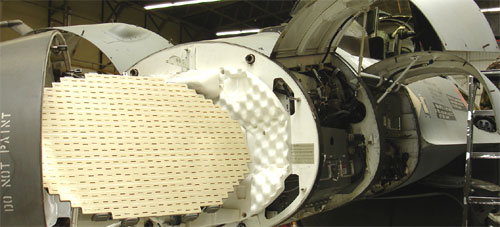
This look like it is polarized in horizontal plane
and this one is vertical
[ATTACH=CONFIG]246878[/ATTACH]
and so is An/APG-81.
and yeah i make mistake. It’s not the most common polarization for fighter aircraft application but.. it does handle vegetation absorption better than other polarization.
stealthflankerShouldn’t the antenna cover be transparent to radiowave so that radar beam can pass through? or only part of it is reflective?
Yes it is transparent to certain polarization.
Inverse cassegrain, and twist cassegrain antenna get around the typical feed blocking problem ofparabolic antenna by actually change polarization of the wave that being transmitted/received.
At that antenna cover’s reflector section. There is a mesh screen which oriented by 45 degrees and about quarter wavelength thick. It purpose is to change polarization of the wave being transmitted or received from the feed.
The mesh screen is transparent to radar’s transmitted polarization (say vertical) But will reflect other polarization. So the process is basically as follows.
The feed transmit wave in circular polarization.. the wave will hit the secondary reflector, which will change it’s polarization to vertical and reflect it to the twist reflector. The now changed wave will be reflected by the twist reflector and now can just pass through the secondary reflector.
Same process will apply when receiving. but in opposite sense.
The fllowing is a good DTIC paper on design on cassegrainian antenna. Highly recommended.
stealthflankerIam quite sure the one in pictures is offset parabolic design rather than offset cassegrain type, there is no secondary reflector in front of the feed
Inverse cassegrain antenna’s secondary reflector does not have to move. The secondary reflector on Sapfir 23 is the antenna’s shroud itself.

[ATTACH=CONFIG]246869[/ATTACH]
stealthflanker@stealth flanker: do you know why most antenna that use offset feed are gregorian or parabolic while Cassegrain design always use centre feed ? iam able to find some papers talking about hypothetical offset cassegrain antenna but never see a physical one and iam not sure about the reason ,they seem equally technical flexible for me
Hmm i wonder, i never seen any radar using gregorian feed. Most are cassegrain type. and no.. we’re already have cassegrain antenna with offset feed since 1960’s on some Russian radars.
Sapfir 23.

and N001 and N019 also have offset feed and being inverse cassegrain design.
More information about feed on parabolic antenna.
http://www.radio-electronics.com/info/antennas/parabolic/parabolic-reflector-dish-feed-systems.php
stealthflankersholdnt the value for slotted array lower than value for Phased array ? ( AFAIK , Phased array can prodce smaller beamwidth )
There’s more than narrow beamwidth to an antenna. Note that smaller beamwidth means more Sidelobe. I do not know how i could explain but.. you need an antenna pattern visualization.
And no. Being an ESA does not mean you can circumvent the physics of how narrow beamwidth is generated. Instead you can make it larger by applying some weighting factor to tradeoff angular resolution for lower sidelobe.
The following is some common weighting factor used in ESA radar. You can use it as K factor in the beamwidth equation i provided before.
[ATTACH=CONFIG]246856[/ATTACH]
stealthflankerwhat is the Taylor ?I never heard of that kind of antenna before
it is not name of antenna. it’s name for radiation pattern factor. Or antenna pattern weighting factor. Basically to shape the “lobes” of the antenna.
Some other examples are Hamming, Blackmann, Cosine etc.
stealthflankerAnd btw do anyone have a formula to estimate gain for different kind of radar ( parabolic vs slotted array vs AESA …etc ) based on their aperture size and frequency ?, i seen it before but cant find it anymore
Well the simplest formula one can find is :
G=30000/Hb*Vb
Where Hb is Horizontal beamwidth and Vb is Vertical Beamwidth. In Degrees.
Other books may give different constant like 26000 (Skolnik) or 23750 (Ingo Harre’s website) The beamwidth should be given in radians if these values are used.
To find beamwidth. You can use following formula :
Bw=K*Lambda/Ad
Where K is factor to account antenna illumination tapering factor.
0.886 is for parabolic antenna with no illumination tapering.
1.25 is typical for fighter aircraft antenna with Taylor -40Db. slotted planar array and may also apply on Phased array.
The value is in Radians so multiply it by 57.3 to convert it to degrees.
Usage example as follows :
We have an antenna with diameter of 90 cm (0.9m) works in X-band (3 cm or 0.03m) Find the beamwidth and gain.
First we have to estimate the beamwidth. Assume it’s a typical fighter aircraft radar with slotted planar array or ESA.
Bw=1.25*(0.03)/(0.9)
Bw=0,041 rad or 2.3 degrees.
Since the antenna is circular.. no need find the horizontal beamwidth as it would be the same.
We can find the antenna gain :
Gain=30000/(2.3*2.3)
Gain=5671 in non dimensional format. In log10 (decibel) format it would be 37 Db.
stealthflankeri dont quite understand ,isnt the radiation pattern of parabolic radar depending on the exact shape of the antenna ? and shouldnt ground radar be affacted mch more due to side lobes compared to airborne one ? ( since the ground is close to them the side lobes will hit the grond and reflect back )
Yes. But you can’t shape parabolic antenna to attain say.. radiation pattern of Taylor with -40 Db sidelobe.
On the ground clutter issue.. The ground based radar can just “cheat” by having MTI (Moving Target Indicator) Or rely on brute force by either having large antenna or operate in high frequency to make beamwidth smaller thus lessen probability of catching multipath propagation problem.
and their processing is easier compared to airborne platform where both target and the radar carrying aircraft are moving.
another question,why there is no fighter or ground based radar system use horn antenna ? they seem to have very wide band width and good gain
Do they have narrow beamwidth required for resolution ? Fire control, SAR or typical airborne radar mission need narrow beamwidth. Single horn won’t suffice for this.
You can use horn antenna but in shape of arrays. in fact i think some ESA’s like Russian Bars do use horn radiators.
stealthflankerThe reason for that..
Parabolic is simple to manufacture, high performance (high gain, easy to get narrow beamwidth) Plus it just can take any polarization (only depend on feed)
A downside of parabolic antenna in radar is that it has no control upon radiation pattern, making it bit susceptible to ground clutter for airborne application. Thus for requirements that does not need extensive clutter application or where low cost is needed. Parabolic is preferred.
The next generation slotted planar array antenna as one in AWG-9 and APG-66 address the radiation pattern control issues. Since it made out of smaller antenna that forms array. one can realize lower sidelobe than Parabolic antenna. Problem however it’s more expensive as it demands precision manufacturing to mass produce the antenna element. And circular polarization, if desired is difficult to achieve. Notice that most if not all slotted planar array antenna are either in vertical or Horizontal polarization. Vertical polarization is more common for fighter aircraft application as it can handle vegetation absorption of radar signal better than horizontal polarization.
stealthflankerHave Indonesia decided if they are buying 8 or 10 or 12 initially?
.
8 are more likely.
stealthflankerwe need weapon test footaaaage naaaaw.
yeah. would love to see PAKFA clip.. launching missiles or drop bombs.
stealthflankerWill we ever see other 636’s with pumpjets ?


 Sign In