 viscount
Basically keeping an eye on suspected terrorist cell/drug cartels/organised crime for the intelligence services/specialist policing units. Not a great deal ever comes out about their specific taskings, however I bet in a few weeks there will be news of a series of dawn raids in the local press. Ever wonder how they knew that Abu Katarder (spelling very suspect) was using a mobile a phone that was not permitted under his parole terms?
viscountBasically keeping an eye on suspected terrorist cell/drug cartels/organised crime for the intelligence services/specialist policing units. Not a great deal ever comes out about their specific taskings, however I bet in a few weeks there will be news of a series of dawn raids in the local press. Ever wonder how they knew that Abu Katarder (spelling very suspect) was using a mobile a phone that was not permitted under his parole terms?
viscountThere are several Diamond DA.42 aircraft used for ‘observation’ flights, supporting anti-terrorist and anti-drug law-enforcement forces in the UK. They have the ‘chin’ camera under the nose as described, a wide cabin section compared to the rest of the length of the aircraft, a T-tail; but the long wings with winglets are not mentioned in the description. While I would not describe the Twin Star as a noisy twin, the engine note is certainly different.
Mapping and environmental survey contracts around the UK are usually (but not exclusively) undertaken by Partenavia P.68 (Victors and Observers), Islanders, Navajo, Aztec or Cessna twins. These types certainly don’t match the description provided though.
One environmental survey aircraft your sighting wasn’t was a P.68 Observer – this one was flying circuits at Liverpool John Lennon today training. Ravenair at LJLA will shortly have 11 Victors & Observers, along with 4 Aztecs all equipped with vertical camera mount in the cabin and hatch in the cabin floor. From Chester APEM have an Islander, and 3 Victors/Observers, and they are not the only companies around the country involved in this work.
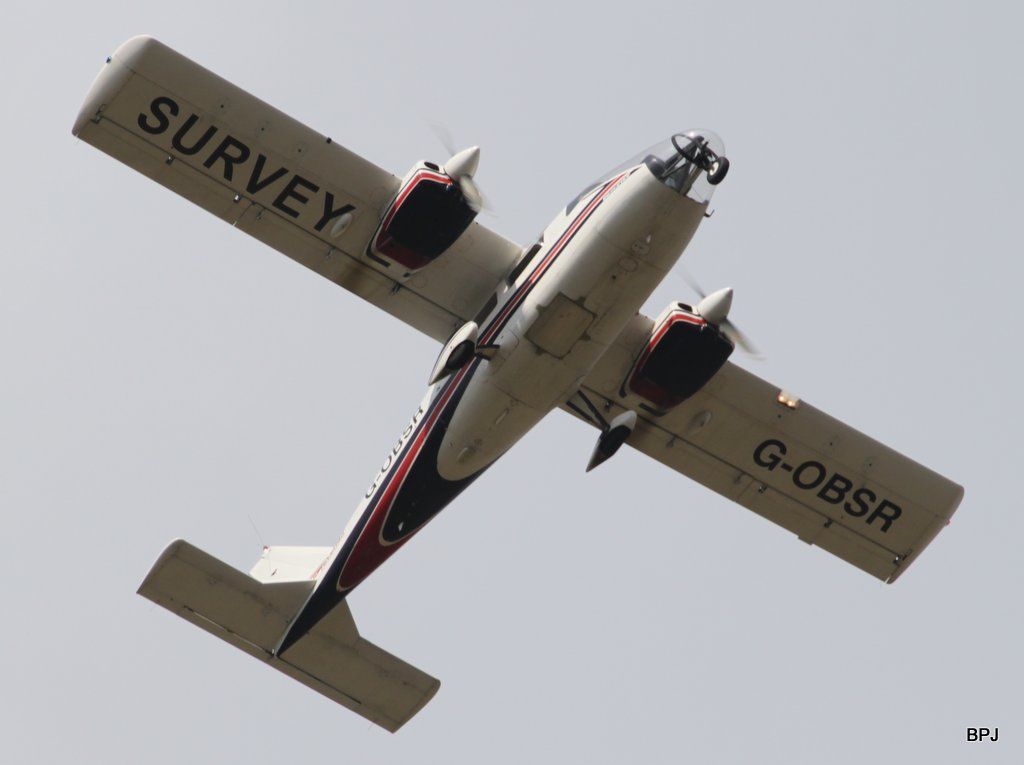
The only DA.42 Twin Star photo I can find that is my copyright, although not absolutely sharp, is this one at LJLA May 2010 – it is NOT one of the chin camera equipped ‘spy’ aircraft though.
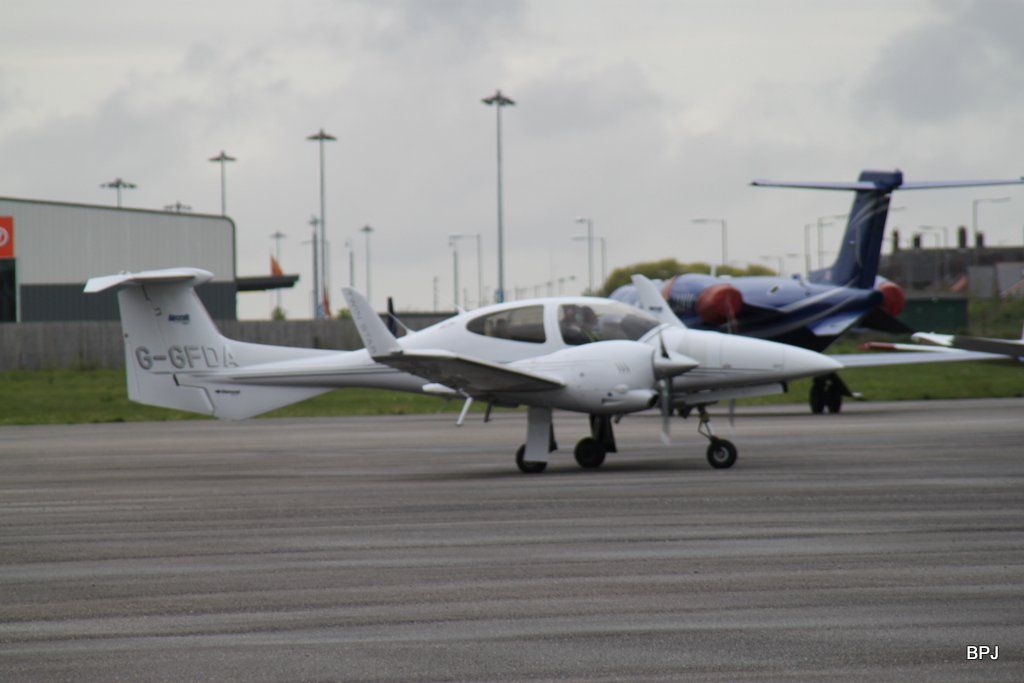
“Bazv’s” link in the next post provides a much better shot of one of my candidate aircraft, complete with ‘chin’ camera housing.
viscountThere are several Diamond DA.42 aircraft used for ‘observation’ flights, supporting anti-terrorist and anti-drug law-enforcement forces in the UK. They have the ‘chin’ camera under the nose as described, a wide cabin section compared to the rest of the length of the aircraft, a T-tail; but the long wings with winglets are not mentioned in the description. While I would not describe the Twin Star as a noisy twin, the engine note is certainly different.
Mapping and environmental survey contracts around the UK are usually (but not exclusively) undertaken by Partenavia P.68 (Victors and Observers), Islanders, Navajo, Aztec or Cessna twins. These types certainly don’t match the description provided though.
One environmental survey aircraft your sighting wasn’t was a P.68 Observer – this one was flying circuits at Liverpool John Lennon today training. Ravenair at LJLA will shortly have 11 Victors & Observers, along with 4 Aztecs all equipped with vertical camera mount in the cabin and hatch in the cabin floor. From Chester APEM have an Islander, and 3 Victors/Observers, and they are not the only companies around the country involved in this work.
The only DA.42 Twin Star photo I can find that is my copyright, although not absolutely sharp, is this one at LJLA May 2010 – it is NOT one of the chin camera equipped ‘spy’ aircraft though.
“Bazv’s” link in the next post provides a much better shot of one of my candidate aircraft, complete with ‘chin’ camera housing.
viscountI’ve cleaned-up and posted a wide variety of b&w Canberra photos on:
http://www.derbosoft.proboards.com/index.cgi?board=furtherafield&action=display&thread=10617
May help (scroll to WT480 perhaps?), but I fancy colour ones would be more useful. There must be a number of Canberra sites on the web and numerous photos too on a google of the registration.
Was this the thread you were looking for:
http://forum.keypublishing.com/showthread.php?t=115766&page=2
The way DCW’s b&ws were cleaned-up and presented as themes where the inspiration for me doing the the same elsewhere with a collection of b&w prints after 30 years in storage. His are better though!
viscountTwo shots of 2807/G-BHTH at the 1981 Liverpool Air Show – digitised from 35mm slides and not tremendous originals!
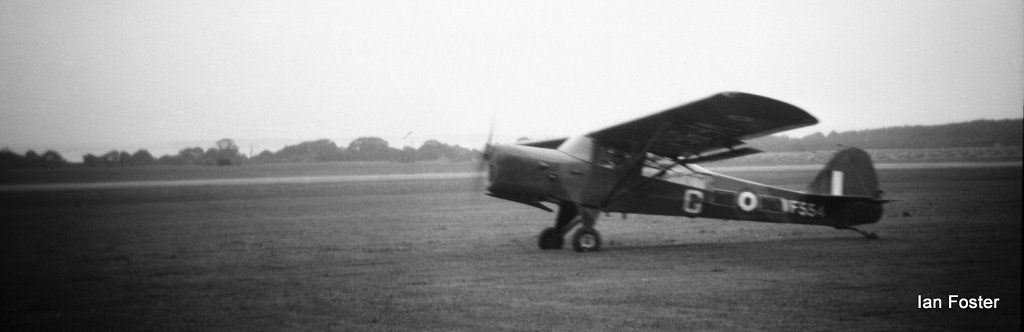
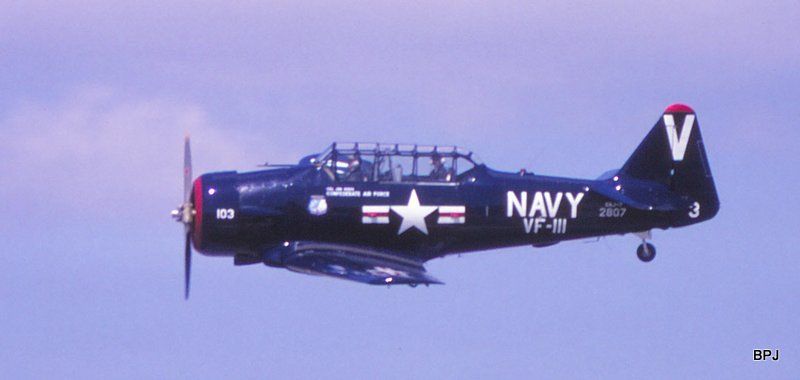
viscountLooks like I’m ‘Trolly Aux’s’ “clever person”! Thanks to those clues, I recognise G-BHTH. A quick dive onto G-INFO confirms the Adrian Reynard connection, and a dive into my records of Jim Keen’s aircraft at Liverpool produces an airframe history. On another forum I’m about to publish the story of Jim Keen’s endeavours on the 50th anniversary of the delivery of his first aeroplane to Liverpool Aero Club 8th March 1963 (a Piper Colt G-ARGO), a story that continues today with his son, Martin’s, Liverpool Flying School. There are very few aviation operations that have been owned and run continuously by the same family for 50 years, although through several changes of name. Quite an achievement. However, wandered off topic.
The T-6G Texan N2807G/G-BHTH
Following a visit to the USA during winter 1979/80, Jim Keen purchased two very fine aircraft, a Texan that became G-BHTH and a Stearman that became G-BHUW.
The North American T-6G Texan arrived at Speke’s Hangar No.4 in a ‘Sea-Land’ shipping container on 16th April 1980. Assembly and checking of the aircraft began immediately on arrival within the polythene ‘tent’ within the hangar. First flight in UK took place on 1st August 1980, with the aircraft now registered as G-BHTH, although this registration was not carried externally.
G-BHTH arrived and was kept in a very smart colourful scheme, painted to represent an SNJ-7 ‘2807’ of the U.S.Navy. The gloss colour scheme featured dark US Navy blue overall, with a red band around the front curve of the engine cowl. The ‘star and bar’ national insignia were in full colour, while in white lettering code ‘103’ on nose, unit ‘VF-111’ under the large ‘NAVY’ on the mid-rear fuselage, type ‘SNJ-7’ and serial ‘2807’ under the tailplane, with a large white ‘V’ on the fin and rudder. The wings had ‘NAVY 103’ port underside with ‘103 V’ on the starboard upper. However, despite these clearly well researched U.S. Navy colours these were not the aircraft’s true markings! Indeed the USN ‘number’ 2807 was arived at by painting out the N and G of former US civil regn N2807G, rather than a researched number to fit the markings applied.
Clues to the real background come from the registered type, previous identity and constructor’s number. It is registered as a T-6G Texan, with c/no 168-176 formerly 49-3072a, built in 1950. 49-3072 was the 176th of a large batch of 641 (49-2897 to 3537) re-manufactured aircraft processed at the Downey, Fresno plant of North American for the U.S.A.F., with full designation T-6G-NF. The T-6G was rebuilt from earlier wartime T-6 and SNJ airframes and embodied a number of modifications with an enlarged and new cockpit layout, modified undercarriage, new prop and spinner and greater endurance. The engine is a Pratt & Whitney R-1340-AN-1 Wasp radial of 550 hp. As both North American and the U.S.A.F. considered the T-6G as a new zero timed aircraft, all traces of the previous life of component parts were removed during the dismantling, inspection, conversion and rebuild process. Although the WWII origins have been totally erased, Jim Keen acquired a very fine example of a Texan (Harvard, being the name only for those supplied to the RAF).
The SNJ-7 is the U.S. Navy equivalent of the T-6G, so the markings carried are correct to the airframe type, however we never uncovered any indication that this particular airframe was ever transferred to the Navy from the Air Force. To be fair, we discovered nothing of its service history, or its subsequent civilian life until knowledge that in 10.76 as N2807G it was owned by Joseph Natoli of Nokesville, Virginia. It was in the State of Virginia that Jim Keen purchased the aircraft.
Jim Keen flew the aircraft from Speke a number of times each year over the six years he owned it, selling it shortly before his death in late 1986. The Texan was a thirsty beast, although a delight to fly. It certainly made a pleasing, loud, distinctive ‘rasp’ in the circuit. G-BHTH departed Liverpool 8th March 1986 for Wellesbourne Mountford on sale to Brynley Rossiter of Maidenhead, Berks. He only kept the aircraft for a year before onward sale, spring ’87, to Adrian Reynard of Oxford. G-BHTH was involved in a forced landing May 1991 following engine failure. The aircraft was sold to John Woodhouse of Aldershot, Hampshire who repaired the damage and fitted a new engine, before a new passenger Cof A was issued May 1994. However on 13th March 1995 G-BHTH was damaged in a fatal crash landing at Bourne Park Strip, near Andover when it tipped over onto its back crushing the pilot, the passenger walked away. The registration was cancelled as ‘permanently withdrawn from use’; however the aircraft was taken to Shoreham as a long-term restoration project, back to airworthy condition. Ten years later in June 2005, the aircraft was restored to the register as G-TEXN (not to be confused with the more recently Liverpool based G-TXAN/FX301) under the ownership of rebuilder Richard Dauncey. The current, WWII toned-down U.S.Navy mid blue scheme with serial 3072, coded ‘72’, was applied on completion of the rebuild. Early in 2006 G-TEXN was sold to Thunderprop Ltd of Dorking, Surrey who flew it for 6 years before sale to current owners early 2012, Spitfire Displays Ltd with a London City address. At the very end of 2011, total airframe time was declared as only 6,163 hours.
Probably more of an answer than ‘T J Johansen’ anticipated! I know the 1995 crash was covered in a detailed accident report on the aaib website, not sure of the 1991 forced landing though. As a matter of interest anyone know the current home base of 2807/G-TEXN?
viscountA photo taken at Martlesham Heath on 22nd February 1960, on the back titled: ‘Communications Flight’.
This photo the work of George Jones.
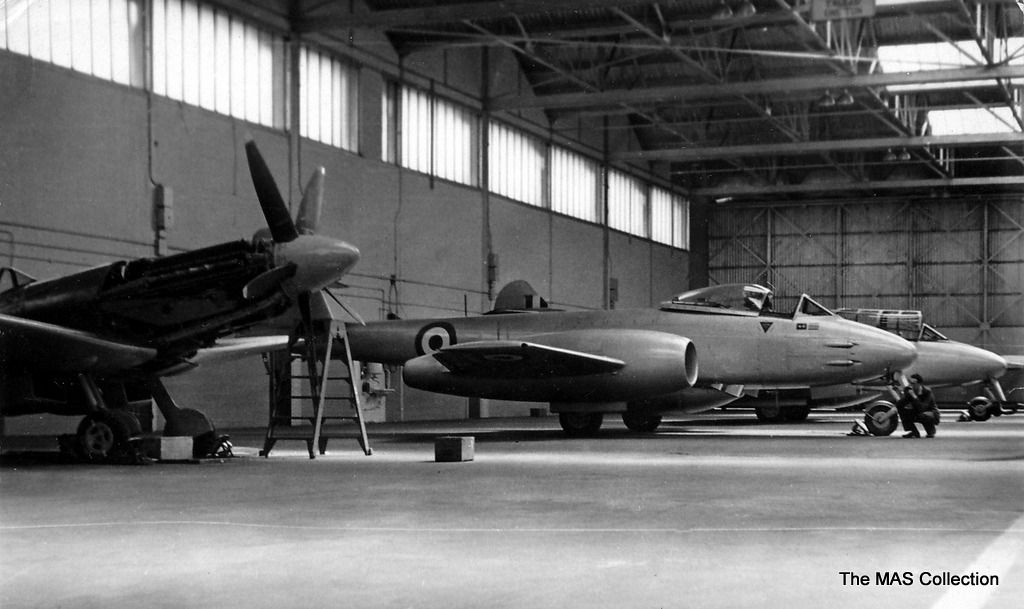
viscountQueenPee. I’m glad you persevered while the forum server was ‘misbehaving’. Lots of useful information tied down in one letter. Delivery to A&AEE, duties with A&AEE, last flight, total hours flown – all highly interesting information for the historian.
It would appear to have gone near enough direct from 20 MU Aston Down storage to A&AEE in 3.58 – or did it go via 10MU Hullavington? Indeed is Hullavington a ‘red herring’ introduced by ‘W&R’ in error, instead of the correct, but missing, Boscombe Down? The letter helps considerably in filling in what had been ‘missing years’ of knowledge. You must be pleased QueenPee that having attempted to get the aircraft into preservation some years ago, that it is now with a dynamic and growing museum collection.
So to combine all the information and discussion posts on this thread:
Time-line history for Meteor T.7 VW453
VW453 built by Glosters and awaiting collection 24.5.49
25.5.49 delivered to 203 AFS (Advanced Flying School), based at RAF Driffield. 203 AFS were the first unit to use the Meteor T.7 in any numbers.
1.9.49 No.203 AFS renamed No.226 OCU (Operational Conversion Unit) at Stradishall
1.12.49 transferred to 604 Sqdn, based at RAF North Weald. Involved in a flying accident 21.10.50, declared Cat 4. Three days later reasessed as Cat.3 and a team from Glosters arived 10.11.50 to effect repairs on site. Repairs completed 8.2.51 and returned to 604 Sqdn day after. Again damaged 7.7.52 an declared Cat.3, repaired by Glosters again on site between 21.8.52 and 1.11.52, whence back to 604 Sqdn.
18.6.53 loaned to Takali, Malta and damaged there 27.9.54, returned to Glosters in UK. Note: Takali as spelt at the time, now correctly Ta Qali.
25.10.54 arrived at Glosters in the UK for repair in the factory
14.7.55 delivered to 20 MU at RAF Aston Down where it was stored (or was this actually 10 MU at Hullavingdon??)
18.3.57 (a paper-work date) allocated to Controller (Aircraft), effectively struck off charge by the R.A.F., with a total flying time of only 381 Hours 25 minutes.
13.3.57 delivered to Aeroplane and Armament Experimental Establishment (A&AEE) at Boscombe Down. Used by A&AEE for ‘hack’ duties such as tasks involving photo-chase, instrumentation and navigational development. By 1964 noted to be coded ‘3’.
23.2.68 last flight with A&AEE. Total airframe time 2048 hours 5 minutes.
–?– Delivered to 5 MU at Kemble for storage and disposal. By 4.71 in outside storage at 5 MU RAF Kemble
24.3.68 Struck off Charge, VW453’s flying days were officially over.
–?– Airframe passed to the CDE (Chemical Defense Establishment) at Porton Down and used by MRE (Microbacterial Research Establishment) for testing bacterial persistance out in the open on Salisbury Plain.
by 1.77 airframe, (now known to have incorporated parts of WA709 eg cockpit canopy & frame), moved back into the CDE compound at Porton Down, by now decontaminated.
11.11.81 VW453 transported to RAF Innsworth. As a Cat.5(GI) allocated ‘Maintenance Number’ 8703M. Aircraft restored by CARG (Cotswold Aircraft Restoration Group) over a number of years at Innsworth.
5.3.94 unveiled on the gate at RAF Innsworth, replacing former gate guardian, a Javelin XH903 which had left the site by October ’93. Painted as VW453/Z of 604 Sqdn (yellow & red triangles formed fuselage flash)
late.12 Purchased on behalf of the Jet Age Museum at Staverton.
OK, the only uncertain information included above is the reference to a period at Hullavington in ‘Wrecks & Relics’. There is a need to confirm and tie down when she was delivered to 5 MU at Kemble and when she was delivered to Porton Down.
Took a while, but the airframe history has come together well and makes for an interesting read.
viscountOnly 5 posts showing on ‘New Posts’ between midnight and 9am Sunday morning – normally there are 30+ in that time period. The ‘problem’, if there is one started Saturday afternoon (UK), although I have had no trouble getting onto the forum during that time.
Added on edit: Took two goes to post the above, got a ‘Database Error – Key Publishing Ltd encountering problems’ message the first time and great difficulty getting this edit to load.
viscountOnly 5 posts showing on ‘New Posts’ between midnight and 9am Sunday morning – normally there are 30+ in that time period. The ‘problem’, if there is one started Saturday afternoon (UK), although I have had no trouble getting onto the forum during that time.
Added on edit: Took two goes to post the above, got a ‘Database Error – Key Publishing Ltd encountering problems’ message the first time and great difficulty getting this edit to load.
viscountThe history I quote in reply #2 and Wrecks and Relics likely have the same author – which makes me wonder when 226 OCU slipped into the history line. Was 226 OCU formed by renumbering 203 AFS I wonder? (added later on ‘edit: Thank you Graham, post 10, sorts that out as the unit was re-numbered while VW453 was serving with it).
As ‘Wrecks & Relics’ Ken Ellis, then published by Merseyside Aviation Society has been mentioned as a source, I’ve found a few relevant comments in the oldest editions I’ve got, from a time when I was selling them mail order for the MAS:
W&R 4 (August ’74) Chemical Defence Establishment (CDE) Porton Down, on the perimeter of Boscombe Down has two Whilrwinds. On Salisbury Plain to the SE of Boscombe Down is an unidentified Meteor T.7 used for paint durability trials.
W&R 5 (April ’76) essentially the same coment.
W&R 6 (April ’78) The Meteor T.7 is now known to be VW453 (ex 5 MU) and was moved from the Plain back to the CDE at Porton Down by 1.77.
W&R 7 (March ’80) A Whirlwind and Meteor T.7 VW453 are used for bacteria persistence trials by the CDE on the top of Battery Hill.
W&R 8 (April ’82) under Innsworth states that Meteor T.7 VW453/8703M, formerly at Porton Down, arrived at Innsworth 11.11.81 for restoration to static condition and eventual display alongside the Station’s Javelin XH903/7938M.
That brings the ‘knowledge gap’ down to a near twenty year period 1957 to 1974! Keep digging, we’re getting there slowly. The ‘Hullavington’ connection in this period needs expanding on.
viscountI have a history, well bits of history:
VW453 built by Glosters and awaiting collection 24.5.49
25.5.49 delivered to 203 AFS (Advanced Flying School), based at RAF Driffield. 203 AFS were the first unit to use the Meteor T.7 in any numbers.
1.12.49 transferred to 604 Sqdn, based at RAF North Weald. Involved in a flying accident 21.10.50, declared Cat 4. Three days later reasessed as Cat.3 and a team from Glosters arived 10.11.50 to effect repairs on site. Repairs completed 8.2.51 and returned to 604 Sqdn day after. Again damaged 7.7.52 an declared Cat.3, repaired by Glosters again on site between 21.8.52 and 1.11.52, whence back to 604 Sqdn.
18.6.53 loaned to Takali, Malta and damaged there 27.9.54, returned to Glosters in UK
25.10.54 arrived at Glosters for repair in the factory
14.7.55 delivered to 20 MU at RAF Aston Down where it was stored.
18.3.57 allocated to CA (no decode for this abbreviation)
By 1.77 the aircraft was with the Chemical Defence Establishment at Porton Down, and by now a composite airframe with WA709, parts of the original aircraft went to Norfolk and Suffolk Aviation Museum.
Oh dear, found this history in a survey of the background of all surviving Meteors in a 1980 local aviation group magazine, clearly compiled using the AM History Cards. This particuar airframe history rather peters away though. Clearly I cannot substantiate the claims in the final paragraphs.
Some gaps to fill, I hand the baton onto others …………
As to the question of the oldest surviving Gloster Meteor T.7. Well VW453 is in the first batch of registrations allocated to production T.7s for the RAF, VW410 to VW459 – so is presumably the 44th built for the RAF. Two F.4s were converted to T.7s: EE530 and EE573, while the prototype G-AKPK (f/f 19.3.48 at Moreton Valence) was delivered to the Royal Dutch Air Force 11.48 as their first. Certainly there are no earlier RAF T.7 aircraft in my 1980 UK survivors listing, what I don’t know is if there were any early production aircraft supplied to the R.Netherlands Air Force before 5.49, and if so, if they survive! I’m sure someone does though!
viscountI’m delighted at your success!
Once you’ve entered a couple of picture posts and actions have become routine, you’ll wonder why you hadn’t done so sooner.
viscountCongratulations OG!
Well done OG – I’ve been viewing your posts on the ‘….couple of olduns’ thread in the Commercial/Civil Aircraft Photos section. Well worth while.
PC’s are so frustrating, yet so satisfying when you achieve the right result more than once! I’m “fighting” my PC to do what I want it to, while restoring colour transparancies using Canon’s Silverfast programme. Can get one at a time, but I want to batch process dust removal and then load into Picasa – in multiples of 4! In dire need of a masterclass myself!
Moggie,
Having posted some 50+ photos through Photobucket in the past few days onto another furum, I can now say, having adapted to the new photobucket, I’m now happy with the changes, but wasn’t at first. Main advantage is that I’m posting from a large image on screen (so know exactly which image I am dealing with when posting multiples of the same aircraft type), also it is easier to skip around (to a degree) between stored images without returning to library. Do find I have to be gentle and never double click though, and sometimes the ‘hand’ image does not replace the ‘arrow’ when wishing to upload the direct link – but then it used to do that before the changes!
Brian


 Sign In







