 viscount
Leaving the question of Caledonian to one side for the moment, Ted, what type of photography are you aiming to concentrate on? May seem a strange question, but clearly the day course you are considering comes under the banner of ‘glamour’ photography, rather than ‘aviation’ photography ie the focal point being the uniformed model, rather than the aircraft.
As regards to courses, it depends how much you are already into digital photography. If you are only a recent convert from negatives, I would strongly recommend a local authority adult evening class (google adult classes or evening classes in ………… (nearest town/city)), they are likely to have a range from beginners to advanced and deal with best use of the settings on a digital camera, sensor cleaning, using photoshop/picasa, resizing, digitizing from prints/negative/transparences, internet posting etc etc ie a sound background for whatever subjects you wish to concentrate on. Most courses start early September, so don’t waste time worrying about if you should, go ahead and enroll next week!
I’ve never heard of courses specialising in aviation photography, I would think most photographers on the forum have picked up their techniques mainly by experience from standing at air shows or as near the end of the runway as they can legally get at their local airport! Talking to other aviation photographers comparing techniques can help too. The great thing about digital photography is you can bang away forever changing settings, then see what works for you, then cancel the rest without costing a penny extra – not like the old days of transparency 35mm film when every frame cost dear.
You don’t state if your camera is new, just that your PC is. If you are still using a film camera I would strongly recommend purchase of a digital camera. Members on this (and other) forums will be only too delighted to offer conflicting advice as to compact or SLR – but will always advise that the best camera and lens combinations is the one above your price range …. only jesting!!
Although not photographic courses, to stretch your capabilities and provide great opportunities, how about a night shoot – there were several at Coventry last autumn/spring organised by Classic Aviation. Not sure if their move to Newquay will affect their programme for this winter. As you state an interest in ‘older aircraft’ how about trying one of the Shuttleworth shows at Old Warden and Duxford’s ‘Flying Legends 2013’ (although for photographers, the position of the sun there can be a challenge, don’t let that put you off). Although mostly over for 2012, seafront displays can provide great opportunities (just look at Anna’s “wow” photos off a cliff top elsewhere on the forum).
Whatever, do have fun taking your pictures.
viscountSurely the first sentence of the initial post has this argument mis-stated. Being early generation jet fighters, at a time when ejection seat technology was in its infantcy, surely the statement should be:
“Reading the postings on the early 60’s ‘state of the art’ canopy/ejection seat design for the Lightning ………………”
Rather than the 21st Century retrospective view:
“Reading the postings on the archaic canopy/ejection seat design for the lightning ………….”
It is so, so easy to put 21st Century values on designs of 50 years earlier – especially when things go wrong. Sixty years of experience with jet power and ejector seats, constant research and learning from past mistakes make the current generation of aircraft so much safer all-round, but we must be careful when judging with the benefit of hindsight.
viscountWhile I don’t have the answer (to post #7), I’m not totally convinced by the proffered answer (post #13). As I recall, towards the end all the 6 FTS Finningley Jet Provost T.5Bs and for a period all the 4 FTS Hawk T.1s had the attractive blue top applied to the red/white training scheme. Neither unit had aerobatic teams, although performed flypasts at base Battle of Britain/At Homes displays. While the JP T5s were retired from service, the Valley Hawks later became air defence pale grey and more recently the current gloss black overall. Don’t recall the blue top on other red/white training scheme types though eg Chipmunk, Bulldog, Tucano, Varsity, Jetstream or Dominie. Although having typed that, think the Tucano fleet may well have gained blue tops, not certain without access to my photo collection.
viscountAccording to ‘British Independent Airlines since 1946’ Tony Merton Jones, LAASI/MAS 1976 (and more recent reprint by TAHS), Air Charter Bristol 170 Freighter Mk.32 named “Versatile” was G-APAU, delivered 6.57 and transferred to Channel Air Bridge 2.59. There is no mention of your incident, so presumably there was little damage to the aircraft.
Air Charter operated 3 B.170 Freighter Mk.31 G-AMLP 2.53, G-AMSA 2.54 & G-ANMF 8.54 (the 1st 2 later converted to Mk.32)
and 6 longer nose Freigher Mk.32s: G-ANVR 3.55, G-ANVS 4.55, G-AOUU 12.56, G-AOUV 12.56, G-APAU 6.57 & G-APAV 4.57.
Date is that of delivery quoted in BIAL. All 9 of their Freighters had individual names begining with ‘V’.
‘Piston Engined Airliner Production List’, J.Roach & A.Eastwood, TAHS 2007 (and other sources);
G-APAU was one of the last Bristol Freighters to be built.
First flight 5.6.57 (date given must be incorrect) as G-18-203.
Now regd. G-APAU, del to Air Charter Ltd “Versatile” 6.6.57
Sub-leased to Sabena 11.59-5.62 in Sabena colours (during this time Air Charter Freighters had transferred to Channel Air Bridge 2.59, while Air Charter had disappeared into British United 6.60)
Returned to Channel Air Bridge 5.62 and operated with Silver City “City of Edinburgh”
During 7.62 the Channel Air Bridge and Silver City operations merged and re-named British United Air Ferries 1.1.63, renamed British Air Ferries 1.10.67. Individual name “City of Edinburgh”.
Purchased by Midland Air Cargo Ltd 2.3.71
Withdrawn & stored Lasham, Hampshire .73, broken-up 5.75.
viscountSighted on the M57 early evening Wednesday 22nd – a logical route into Liverpool Docks.
Reported on the North West Air News forum.
http://www.derbosoft.proboards.com/index.cgi?action=display&board=local&thread=10336&page=1
viscountWhile the first generation four-jet airliners (B.707/720, DC-8-10 to 50, Comet 4, CV880/990) could fly higher and further than the previous generation piston and turbine airliners, they were built to a requirement by the airlines to fly West Coast Europe to East Coast USA Transatlantic, or East Coast USA to West Coast USA Transcontinental. Todays technologies permit the latest twin-jet airliners to fly half way around the globe non-stop.
While my own long-haul travelling has been limited, pulling out my passenger log I find summer 1971 African Safari Airways Britannia 314 (longer range mark delivered new to Canadian Pacific) on a sole user charter Gatwick to Nairobi had to fuel stop at Benghazi en route (flight times 5 hours and 8 hours at 300-330mph).
In summer 1975 Dan Air Boeing 707-321 (delivered new to Pan Am) ABC charter flight, Manchester-Prestwick (to collect more passengers)-Vancouver, with a fuel stop at Sondrestrom Fjord, Greenland (the over water leg flight times 3hr 25min and 5hr 45min outbound at 540 mph – a little quicker homebound).
Come 1980 then scheduled service Braniff Boeing 747-230 (del new to Lufthansa) and Gatwick to Dallas 9hr 25min at 600mph IAS – a lot quicker homebound. While in 1989 scheduled VIASA DC-10-30 Heathrow-Frankfurt-Caracas-Lima, with the longest leg 9hr 20min at 555mph. In 1991 Manchester to Chicago by American Airlines Boeing 767-300ER 8hr 30min outbound at 540 mph and more recently Virgin A.340 Heathrow-Dubai 7hr homebound at 550mph IAS. Speeds are those reported by ‘Captain Speaking’ so some are IAS, others ground speed.
Gone on a bit, main thing I’m trying to do is contrast the earlier Britannia and Boeing 707 flights with more recent types. While I have no access to route miles calculations, the total flight times on a B.707-320 MAN-YVR with need for a fuel stop at SFJ is roughly the same as DC-10-30ER FRA-CCS flown direct.
viscountYes, 1969 puts you firmly in the period of Boeing 707, Douglas DC-8, Comet 4, Convair Cv.990. Indeed 1969 witnessed the first flight of both the Boeing 747 and of Concorde. Short haul was progressively being dominated by BAC.1-11, Caravelle, Douglas DC-9 and growing numbers of Boeing 737s, replacing Viscounts, Vanguards, Electras, Britannias, DC-6, Dakotas etc. Piston engined airliners were being relegated to developing countries and freight operations.
An interesting aspect of your question, as asked, is that when compared to the Cv.990 Coronado, cruising speeds today are actually slightly slower by even the newest large jet airliners. This being due to aerodynamic design considerations with less sweep to the wing and more drag created by wider and longer fuselages despite far more powerful engines.
There are other factors that make your question interesting to consider. While direct UK to Middle East or East Coast USA flights times should be largely similar to those of a Boeing 707, flight times to Far East, Australasia, West Coast USA, Southern Africa and South America will often be considerably less – simply because Boeing 777, Airbus A.330 etc have way longer range so require fewer, or indeed no fuel stops en route. Today passengers are less stressed by overnight stops in hot climates and time-zone changes, although crews no longer have en-route stop-overs but sleep on the aircraft changing shift in-flight.
Another factor in the equation is that today airlines allow for far longer timetabling ‘block times’ than in the past – this covers for longer taxi-times, runway congestion, holding and ATC slot delays. By building-in far longer block-times into the timetabling than the actual flight times, airlines can boast how often they arrive ‘on time’ and passengers feel good when they arrive early! A local example, although short haul, is that a quiet time of day rotation, with a flight time of 30 minutes regularly arrives 25 minutes early, due to a block-time of an hour in the timetable. Back in the ‘Sixties, even with Viscounts the timetable block time was 45 or 50 minutes – but much more honest timings!
Looking back at the original question, if you had asked about how much the world has shrunk in terms of air travel times since 1959 – there would be a massive difference as the main early jet airliners, Comet 4, Boeing 707, Douglas DC-8 were only just being introduced to service. The slower and more frequently fuel-stopping Constellations, Douglas DC-7, Britannia etc were still in front-line service. The piston-engined intercontinental types were also far less mechanically reliable than the jets that replaced them quickly became, and far more subject to en-route weather delays as they flew lower.
viscountLincoln 7,
I know this question is getting very close to a long debated topic with entrenched viewpoints (eg the current data-plate rebuild “discussion”), but would it cost more to put a Spitfire such as LA255 which is currently essentially a complete airframe back into the air, or one which starts as a lump of twisted metal excavated from a crash-site? Either way theoretically (as she is clearly not up for sale), would the current value of a Spitfire such as LA255 be in the complete airframe (as is), in its historical heritage and connections, or in the potential as a rebuild project with proven provenance? Just wondering, ….. if indeed the question is answerable!
viscountThank you ‘AMB’ for pinning down the Farnborough dates far more accurately than I had.
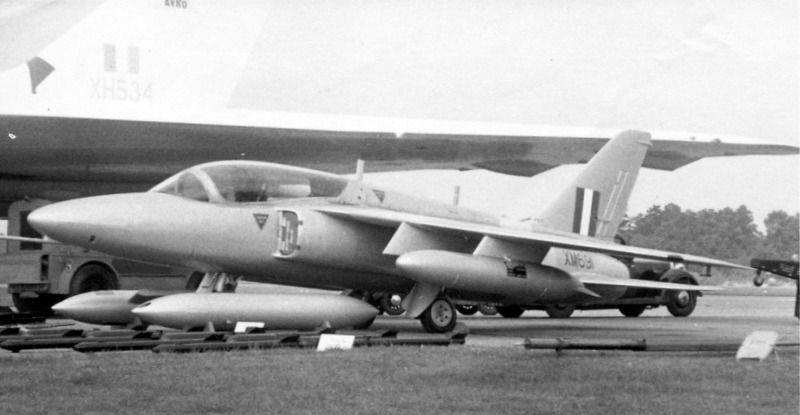
The colour print of the Gnat XM691 with red tips is so much more worthwhile than my b&ws. On behalf of thread initiator “Bluebird Mike”, I am delighted that my bringing this thread back to life has had positive results in turning up further photos of this aircraft in different colour schemes. Any more?
viscountHaving participated in this thread some months ago, while looking through an old box containing sundry b&ws collected during the late 70s and early 80s, was shocked to find that I have not only photos of XM691, but in two different colour schemes! Both are clearly at SBAC Farnborough in the early 60s. Photographer unknown, the prints look home processed.
With Vulcan XH534 (clearly on the original) in the background, prototype Gnat T.1 XM691 would appear to be painted silver, with a yellow T-band around the rear fuselage (and presumably wings). The drop tanks are interesting, as there are photos of XM691 with production style slipper wing tanks fitted and none at all. My magazine collection does not go back far enough to trace the year that particular Vulcan was in the static park.
Two very similar shots with a P.1127 behind, could be from September 1964, as a Tripartate Squadron P.1127 (XS688) was there that year along with XM691. Very difficult to tell the colours, but certainly no yellow T-band, while the tail tip (and fairly certainly the wing-tip too) is a very different colour to the rest of the aircraft. Could this be the day-glo orange patch scheme being searched for by ‘Bluebird Mike’ in post #5?, although if so the orange patches are not applied to the standard Training Command pattern. If (big IF), I have the photo date correct (9/64) and the retirement date from airworthy (1964) also correct (post #9), then these photos are presumably of its last paint scheme. Post #17, informs us that the red tip scheme on XM691 was actually September 1962, which makes nonsense of the final sentence – thank you ‘AMB’ for the correct info.
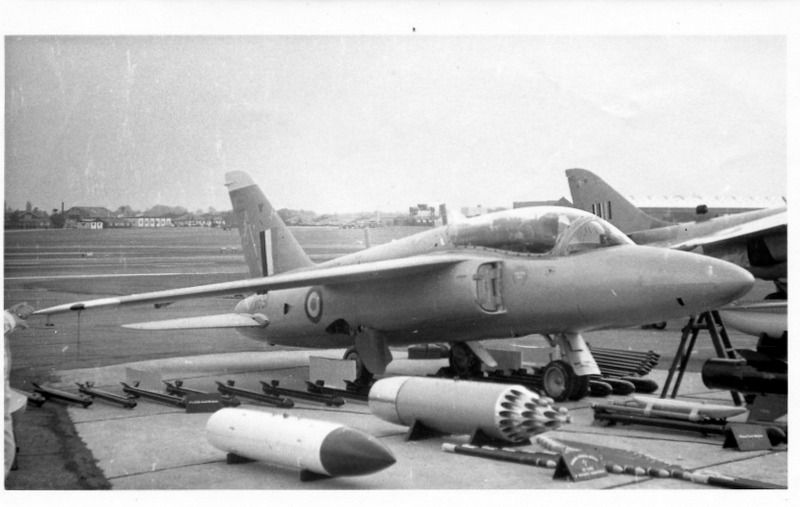
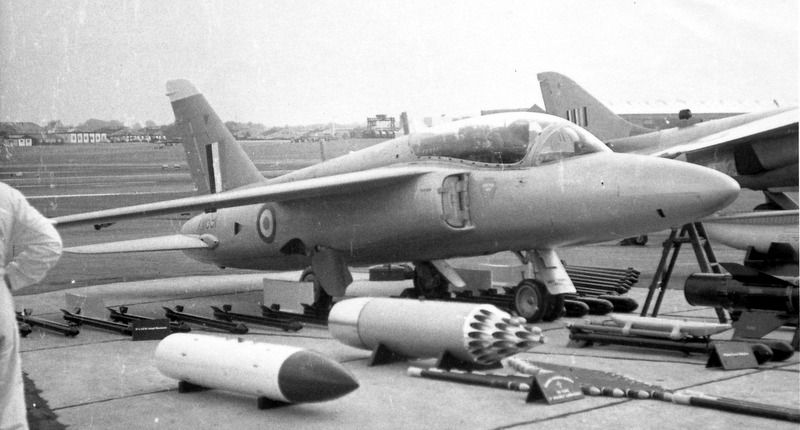
All 3 photos have been auto-contrasted to darken, but no further wizzardry applied.
If any one has logs for Farnborough 1960-1965, could they seach and discover which years XM691 attended; which year Vulcan XH534 was also in the static; and which year(s) Tripartate Squadron P.1127’s were also in the static, so pinning down a year for the photos. XM691 was certainly there in 1959, but with yellow T-band scheme and a clean wing. See post #17
viscountThis sounds rather like a variation of a thread some months ago that asked if you put big enough engines on, could a hangar door fly? I think the concensus was yes; but have you ever seen a hangar door with a fin and flying control surfaces?!! 🙂
I’ve also watched a NZ movie clip recently that showed a flying lawnmower – again sheer power over aerodynamics. Sorry it was sent to me as an e-mail attachment, not a link – it was titled ‘This is what happens when you get a Boeing engineer to mess about with your lawn mower’.
Also, again drifting off topic slightly, as it is the reverse of the question asked, I recall aerobatic pilot Neil Williams landing a Zlin inverted after the main spar failed. Well he approached inverted, then rolled upright immediately prior to touch-down, so keeping the wings aerodynamically loaded against the failed spar section.
Back on-topic, I remember seeing photos some years ago of a Pitts S-1 in the USA with a second undercarriage and wheels fixed above the wing – the party piece being to depart normally, then land and take-off inverted to land right way up again. If a Pitts fits “Hampden98’s” image of an ‘average’ aircraft, then this recollection of mine, would indicate the answer is most certainly, yes! (Wonder how long it will take the obscure recognition thread maestros to produce a picture?).
viscountThis sounds rather like a variation of a thread some months ago that asked if you put big enough engines on, could a hangar door fly? I think the concensus was yes; but have you ever seen a hangar door with a fin and flying control surfaces?!! 🙂
I’ve also watched a NZ movie clip recently that showed a flying lawnmower – again sheer power over aerodynamics. Sorry it was sent to me as an e-mail attachment, not a link – it was titled ‘This is what happens when you get a Boeing engineer to mess about with your lawn mower’.
Also, again drifting off topic slightly, as it is the reverse of the question asked, I recall aerobatic pilot Neil Williams landing a Zlin inverted after the main spar failed. Well he approached inverted, then rolled upright immediately prior to touch-down, so keeping the wings aerodynamically loaded against the failed spar section.
Back on-topic, I remember seeing photos some years ago of a Pitts S-1 in the USA with a second undercarriage and wheels fixed above the wing – the party piece being to depart normally, then land and take-off inverted to land right way up again. If a Pitts fits “Hampden98’s” image of an ‘average’ aircraft, then this recollection of mine, would indicate the answer is most certainly, yes! (Wonder how long it will take the obscure recognition thread maestros to produce a picture?).
viscountAlthough not much different to ‘Big Dan’s’ photos posted on the work in progress on Meteor F.8 WH364, a couple taken from within the public area at Gloucester/Staverton on Saturday 12th August, just as the day’s work was coming to an end.
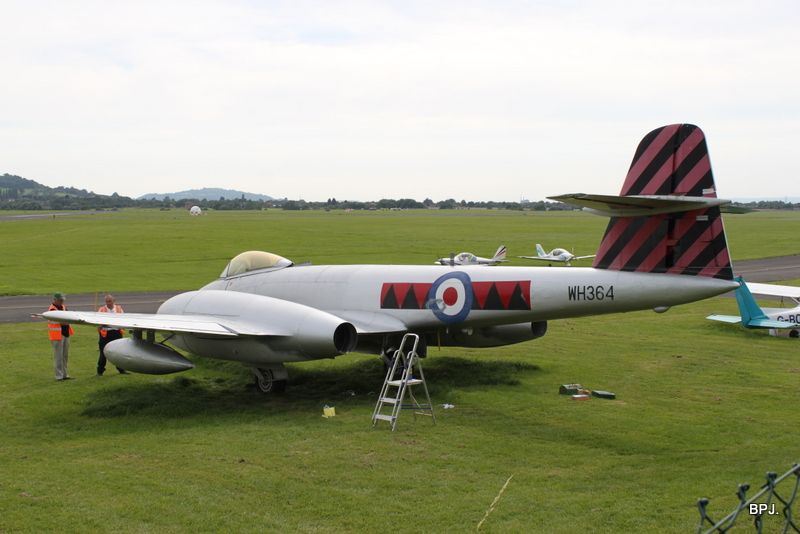
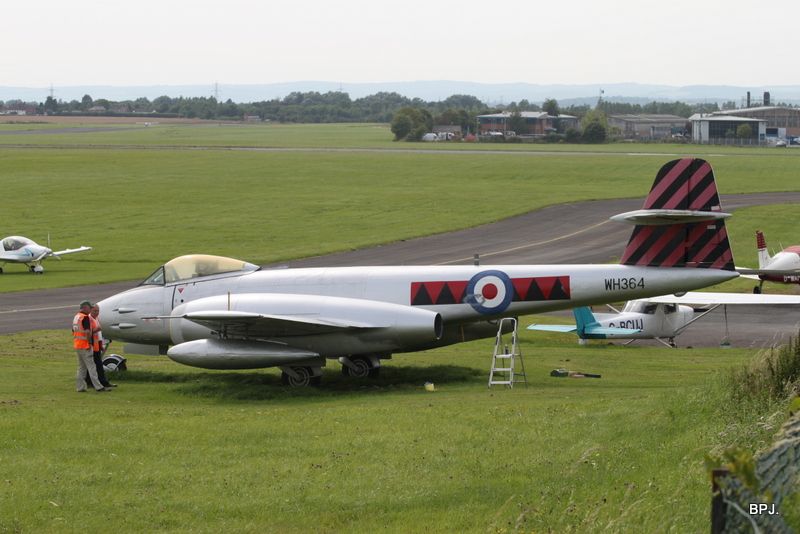
Talked briefly with the two guys there, who were very appreciative of the answers that had been provided by members of this forum in response to ‘Big Dan’s’ questions. They feel they now have the information to be certain that they are doing a full and accurate job and thank all those who have helped out.
viscountThe reference to yellow fuselages makes me think back to a visit to Breighton May 2011, when three yellow ‘historics’ went off in formation to perform a flypast at a wedding.
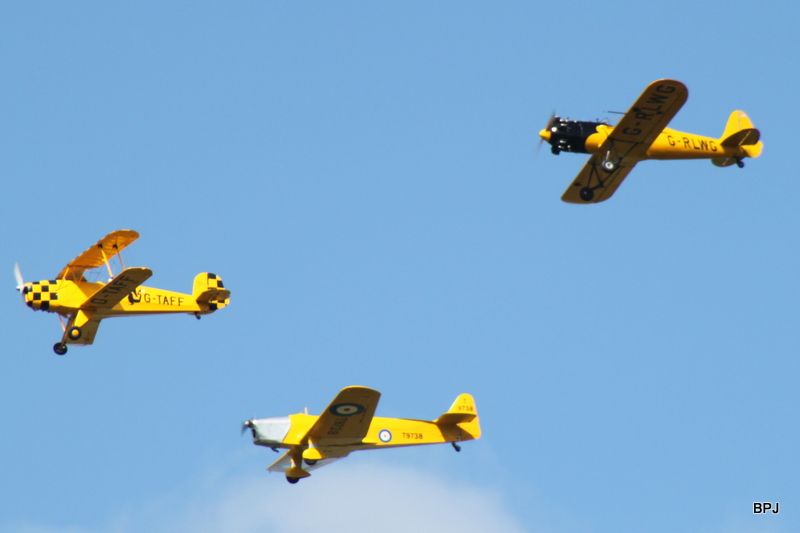
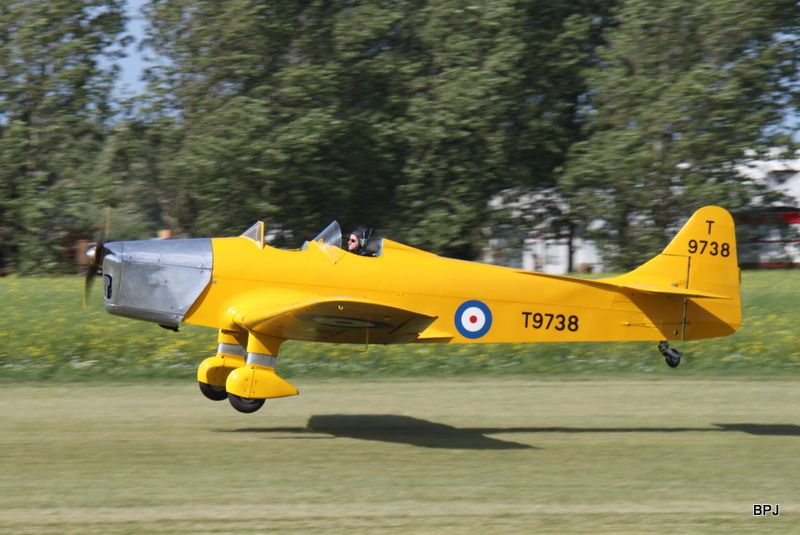
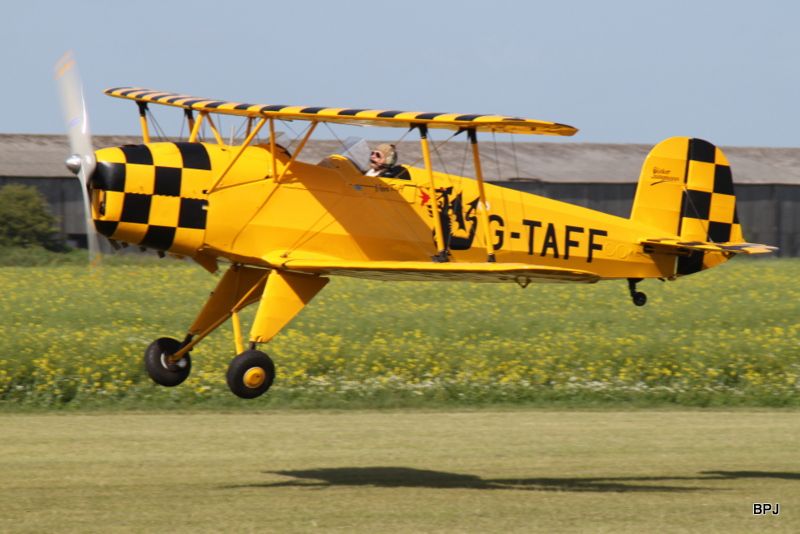
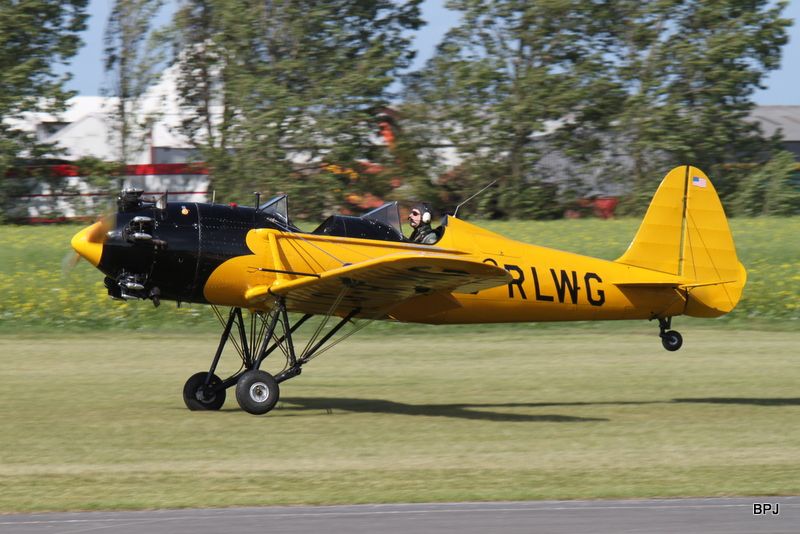
May well be the answer, may just be a ‘red herring’, surely someone looks at aircraft in Yorkshire apart from Jim! On further reflection, probably is not the answer as I am sure that Jim would identify a Magister or the Ryan at considerable distance!
viscountPrior to Jan 1968 all West German Air Force aircraft had no ‘permanent’ registration apart from the C/no or a previous military number. The ‘identity’ worn on the fuselage either side of the national insignia reflected the unit (two letters) and an identity within the unit (three numbers). Only a handful of Sabres were renumbered in 1968 into the new sequence.
Main reference I know of is Paul Jackson’s “German Military Aviation 1956-1976”, pub. by Midland Counties Publications, 1976. He lists by c/no: 75 Canadair CL-13B/F-86E/Sabre 5; 225 Canadair CL-13B/F-86E/Sabre 6 and 88 Fiat F-86K Sabres. By no means not all ‘identies’ are tied to a c/no, but a good number are listed. I have a copy, PM me if you wish to delve deeper into this source.
There may well be specialist books on the Sabre in WGAF service too.
The Sabre you quote, the first Sabre 6 aquired from new from Montreal, with airframe construction number identity ‘S6-1591’, first became serial YA+005 with ESt61 (military test unit Erprobungsstelle 61 at Manching), subequently saw service with at least serial BB+161 of WS-10 (Waffenschule 10 a flying training unit at Oldenburg), then in 1968 permanent serial 01+01 (01+ sequence allocated to test aircraft) with MBB and subsequently preserved at Manching. The majority of the Sabre 6s were operated with the identity codes BB+ WS-10, JA+ JG71 (Jagdgeschwader 71 at Ahlhorn), JB+ JG72 (at Leck), JC+ JG73 (at Oldenburg), with a few using test/delivery codes in the KE+ sequence.


 Sign In







