martinez
Exactly smooth stealth was always know and preferred, but given the computing power available at the time the RCS calculation were just a little challenging.
That is simply not true if you dive deep enough in world of early stealth.
Utter stealth fanboysm, dozens of prefabricated sketches and drawings, artist impressions from questionable “pocket” proposals with rumoured attempts to lower RCS signature, studies and projects which never got further than outline design stages, bcs of irrational design configurations, basically decreasing flight characteristics of an aircraft to zero, then contradicting informations about how it turned out to be a failure, literally fetishism in order to demonstrate achievements of the US stealth design in last half of the 20th century.:rolleyes:
I bet one month wage I earn repairing old military aircrafts that the buzzword “stealth” as you know it today disappears within next 100 years, when considering technological progress over last 100 years in aviation. Otherwise we`re doomed….:diablo:
martinezhas anyone ever seen a real photo of the Mig-29 with added hoods to create the impression of lateral air intakes when parked on a Zhukovsky ramp and to imitate Mig-25.
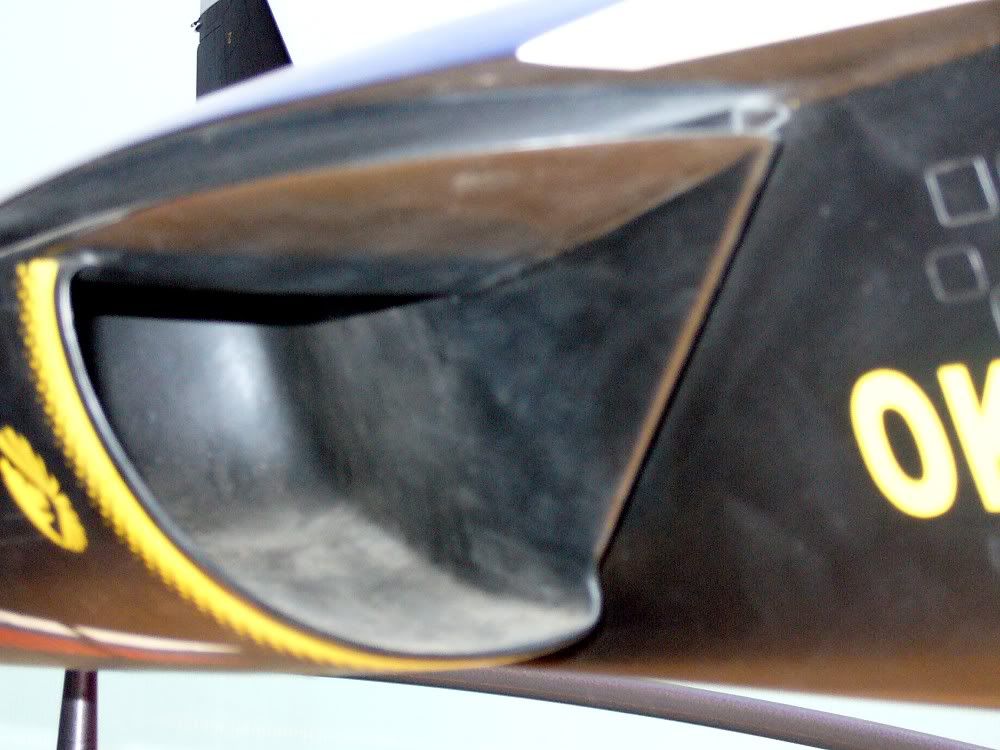
martinezI have found this detail of the Berkut’s intake which shows that Sukhoi has been elaborating on the S-duct topic for quite a time. I, too, would love to hear as to why they have decided to abandon this concept on the T-50 as I find it extremely unlikely that they would pursue a solution which doesn’t offer at least comparable LO characteristics.
Do not be angry with me but this could be faked picture(it certainly looks to me), probably some 1:X scaled model of S-37 taken on MAKS show with a real tail to add credibility. Please prove me wrong with a better picture…;)
About the S-duct, why bother anyway? When F-117 came out with flat, angled surfaces, no one would say that with smooth, rounded surfaces you can achieve the same result.:) The same parallelism, only narrow-minded fools say that there is no other solution than S-duct to achieve the same results.preriod.
P.S. a question, would like to know the procedure how to change a single blade showing unacceptable damage bcs of FOD on the so called BLISK low-pressure compressor where blades are welded to disk structure. Thanks
martinezSo the variable/fixed nose cone is a thing of M-3 vs M-4 version, not single-seater vs twin-seater?
Correct, I found this to back up my words, the single seater M-3 was capable of M2.1.
martinezThe answer to your question. It shows 4 men in India and “multirole” of a wing-fence. Not untypical and several fighter carry AAMs in the wing-tip position to boost the own aerodynamic or some other stores.
Nothing new, see the BAe Lightning from the 60s about that.
http://img.planespotters.net/photo/093000/original/53-686-Royal-Saudi-Air-Force-English-Electric-Lightning_PlanespottersNet_093597.jpg
Thanks, those pics are worth saving, installing missile above the wing cant be seen every day :eek:. Was right, only Brits could come with this craziness, BAe Lightning, another kind of weird aircraft:rolleyes:
martinezWhy is there such a technical difference between the single and 2 seaters (you’d think it would be the other way around at least)?:confused:
I like the photo, something of the F-105F Wild weasel about it.
You`re comparing two generations of Su-17 aircraft, the Su-22M4(Su-17M4) variant was equipped with the digital CVM-20-22 mission computer and the PrNK-54 weapon system with RSDN navigation (TACAN-equivalent), what reduced pilot workload and improved navigational and weapons delivery accuracy. Not sure whether the more advanced avionics demanded to save space or weight in the nose of the fuselage, but the`ve decided to get rid of the variable nose cone and optimalizing it for high speed, low level penetration. The auxiliary intake doors behind the fixed nose cone are opened inward only.
The Su-22UM-3K double seaters were based on the Su-22M3 single-seat version lacking all that above. The variable nose cone remained from the M3 variant. The auxiliary intake doors on the both sides of nose section are opened outward/inward automatically in response to pressure in the duct. For example above speeds M1.7 the auxiliary doors are opened outward, releasing air pressure within the shock wave inside the duct and with the variable nose cone, it is capable of M2.1.
At last as wrongly assumed by colleague MSphere both single seat Su-17M4 and the double seater UM-3K feature the KLEN-PS laser rangefinder/ designator.
martinezAnd don’t forget the fact that the A-7 was in service a good 10 years before the other 2 aircraft.
Question on the Su-17/22.
Is the main engine inlet in the nose fully variable (like the MiG-21’s)?If so, why? After all, it’s usually not required for a ground attack type, the A-7 and Jaguar don’t have it, and even the fast Su-24 has simple holes for inlets?
Single-seater M4 version has the inlet cone fixed, max.speed 1.7M. The older UM3K double seater has it variable, max.speed Mach 2,1.
Cant agree with statement that Fitters are ugly, quite the opposite, cool looking aircafts compared to A-7, Jaguar for instance.
martinezThe Jaguar was a mini-Phantom in my book. I loved the French application of Magic on an overwing pylon!
Anyone knows the procedure of installing missile on the overwing pylon in the regular Jaguar field unit, what support tooling, carts, how many men? Comparing that to the procedure of hanging missile under wing, this seems to be the awkwardest solution ever (I suppose it came from Brits) , not to mention that it destroyed lift characteristics of the wing even more, hence it was never adopted by other aircraft designers.
martinezhttp://russianplanes.net/id80798
Su-35 with 3 types of AAMs.
what is the point of flying with dummy missiles anyway?
martinezthat’s because the two seat Fulcrum is nearly as LONG as the F-15, being shy of a few feet and weighs as much as the F-15A
kidding, right?
martinezA rather unusual angle on the subject!
I hope you enjoy
thanks hushkit, an interesting comparison and insight…;) Nice to see our camo on the first place. Below is the 0619 above clouds.
martinezAs most know, several years ago the entire Russian MiG-29 fleet was grounded and checked for weakened tails; the troubled airframes received a patch to fix the issue and returned to service.
Apparently Ukraine followed suite, and discovered similar issues. At least some of the birds (the recently overhauled ones) received basically an identical “patch”.
http://vif2ne.ru/nvk/forum/files/Stukalin/%28120627152634%29_00-kil1.jpg
Not only Ukraine, but all users were instructed via RSK to inspect the Mig-29 fleet tails by NDT methods, where the CFRP upper section is attached to lower metal one. They`ve discovered corrosion and cracks reducing strength of tails leading to the crash of russian AF Mig-29 in 2009. Carbon fiber containing structures are conductive and when attached to aluminum materials(when not properly insulated) results in electrolytic reaction/corrosion between them. Probably something they hardly know about in 70ies when designing Mig-29 structures and pioneering with the materials of the future, e.g. CFRP. The tail patch is not applied on all aircrafts, just on those found with tails attacked by corrosion. Worth noting when looking at the polish AF Mig-29, the strengthening flange installed on tail seems to be slightly different shape than original RSK solution, what shows that Poles are doing that on their own and not trusting RSK technical support at all.
martinezWas the Su-17M4 ever KAB-500Kr capable? Any photos?.
more likely no capability for the Su-17M4.
http://www.ausairpower.net/APA-Rus-GBU.html
Kh-29 photos
http://www.eskadra.net/galeria/h_25_40elt.htm
Vyuga photos


 ň
ň

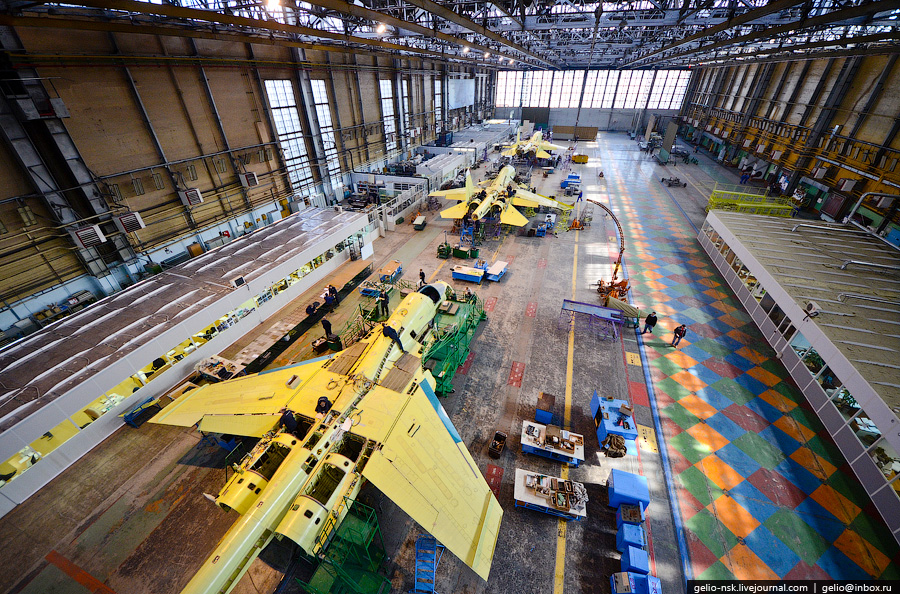
martinezSu-34 assembly.
gents, was wondering why are those inner slat sections of the wing leading edge already painted, any clues?
martinezCongrats ….. 😮 😮 😮 😮
looks like a brutal touch down….:D nice, thanks


 Sign In