 martinez
You twist the reality in your way to stay polite. 😮
The correct way is to say, sorry I was wrong about that. 😉
It is your personal claim that the book says “it was used to power the Ye-266M record aircraft only”, which I marked in bold letters. :diablo:
Belyakov did claim experimental versions. Even by my limited English, that are more than one. :rolleyes:
You twist the reality as well. As you said before the R-15BF-2-300 were used for record examples only as the Ye-266M what is a pure lie, now suddenly became experimental aircrafts in general.
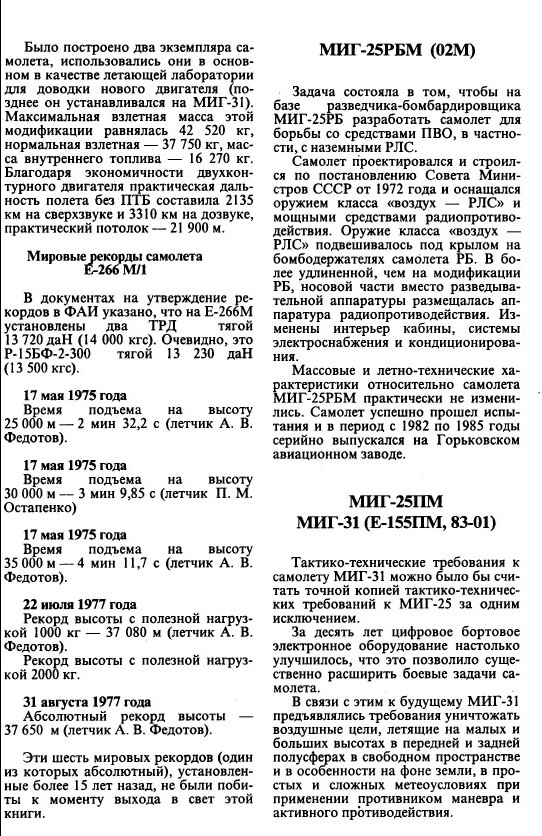
So stop acting like a dickhead, and show where Marmain and Belyakov say about those several Mig-25RB aircrafts equipped with R-15BF2-300 engines, actually one of them flew real combat missions.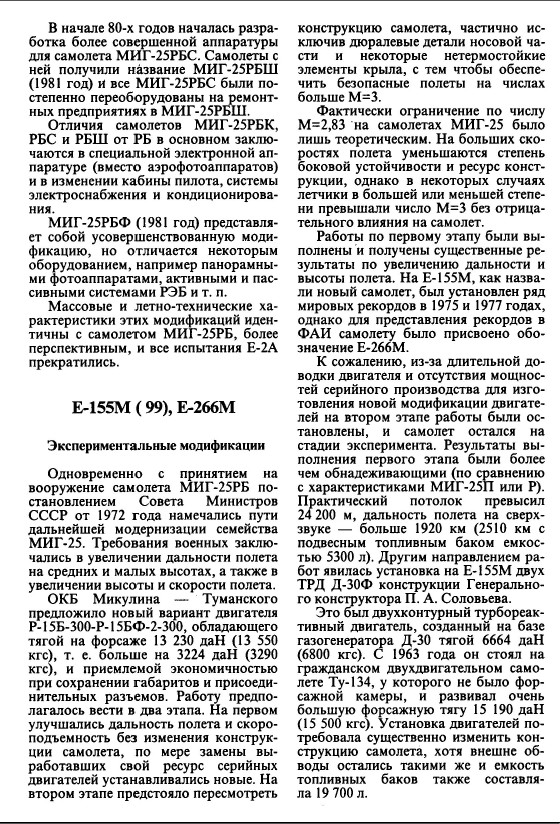
martinezMarmain is a French aviation author. He was basically the editor and translator working with Belyakov as the book was originally published in French before it was picked up in the US and translated to English by the Naval Institute Press. While the book is lacking in respect to newer variants of the MiG-29 and the MiG-31M (the latter still being relatively secretive when the book was written, although it is mentioned and a photo is included), not to mention the MFI, it is a very accurate and interesting volume. What better source could you ask for than the general designer of the OKB?
In respect of the date of its origin in the early nineties the book was written to expose general information about all MIG aircrafts. The whole Mig-25 aircraft familly is described on approximately 15 pages of text (I have the russian edition “Самолеты “МиГ” 1939 – 1995: Беляков, Мармен: Авико Пресс 1996″) in a general manner. For example when discussing specific details like the use of R-15BF2-300 engine, the book says it was used to power the Ye-266M record aircraft only what is not the whole truth. I’m actually not blaming Marmain nor Belyakov, the book was not ment to be a detailed analysis of each type. Therefore I mostly prefer books covering one aircraft type.
martinezJust a side note for an informed reader. R. A. Belyakov wrote about the aircraft and not about the engines when exceeding Mach 3!
Be so kind and read below what question was answered when you wrote …“By the way, my data are from the official MiG publication”.
What about the fact that while capable of M3.2, this destroys the engines as they’re exceeding their redline,
Where is this “fact” from?
:rolleyes: then who is behaving like a small child?
My source is: ‘MiG’ from R. A. Belyakov, J. Marmain,……To our “child” and his knowledge from a magazine written by journalists.
Finally, revealing the superlative source of your knowledge about the aircraft MIG, a 15 year old book. How could someone have better official source from MIG than you have in the French and English book. Be it as you wish :diablo:
BTW. but who is Jacques Marmain, a MIG designer?
The R-15BF-2-300 were used for record examples only..
is your initial statement correct then?
link
First the range and rate of climb would be enhanced without structural modifications. (= no rise in speed limits !)
When installing more powerfull engines to the very same aircraft, almost 35KN more thrust per each, it surely will rise the top speed at all altitudes, despite the fact that this is not explicitly mentioned in the 15 year old book. Anyway, how would they achieve those higher rates of climb and range then? 😀
The aircraft would be reengined after their operational life expired – a sure way to grow younger
a bit messed up translation…..“Engines would be replaced after their operational life expired”. How often were Migs-25 reengined during their service, what was the lifetime of the R-15B-300 engine anyway?
The MiG’s never exceed Mach number (Mne) of 2.83 was in fact somewhat theoretical: the lateral stability margin..
Anyway, do you have a clue what it means “bokovaya ustoychivost”? :rolleyes:
link….
martinezmy data are from the official MiG publication. 😉
acting like a small children..:) What is the official MIG publication, please?
I got my info from Aviacia Vremia magazine, 2004/05, article about Mig-25 describes about R15BF2-300 as well. Read it and, as you say also “For the benefit of the others” 🙂
About those destroyed mig-25 engines after Mach 3 flights over Israel , some ex-soviet pilots e.g. Bondarenko, Bezhevets deployed to Egypt in October 1971, claim the contrary….huh :confused:
martinezAt high speed most of the air gets diverted around the turbine in the J-58. Not so with the Mig’s engine. Like I said, it’s more like a J-93 in concept.
you right, the “rammed” air gets diverted, but the flow behind the inlet cone remains subsonic for the J-58 as well as for the R-15B-300 at high supersonic cruise speeds. The high compression ratio is created with the terminal (normal) shockwave with both inlet systems. The difference between them is that subsonic “rammed” flow then by-passes the J-58 engine core (through ducts) and is led to the afterburner section. The Mig-25 inlet forms similar three oblique and one normal shock wave with the variable ramp system, but the rammed air passes through engine core(compressor, combustion chamber, turbine) and is burned in the afterburner section as well. The reason why it is not diverted around the engine core is because of its dedicated design. The R-15-300 was designed in 50-ies for the high altitude and supersonic reconnaissance drones Tu-123. The air inlet was used to ram the air into the engine, not the compressor, thus it was equipped with simplier 5-stage compressor with very low compression ratio with no complex regulation to ensure reliable operation and one single stage turbine. The rammed air passes through the R-15 compressor with considerably lower pressure ratio losses when compared to the J-58 compressor. In the end it means easier design with less problems with mastering the ramjet into the turbojet integration, then also cheaper for mass production.
martinezNothing in the engine changes between subsonic and supersonic speeds.
Hmmm,… what do you mean by that? The combustion occurs at supersonic speeds in the J-58?? How the cycle changes?
The intended BF never made it into service, just in the record books in experimental version.
.
The intended BF2-300 even saw combat action with the RB version. Throw your YG book out the window…:D
What about the fact that while capable of M3.2, this destroys the engines as they’re exceeding their redline, .
.
Where is this “fact” from? 🙂
martinezTechnically it’s not a “turboramjet” as all of the air goes through the turbine. It’s just a low pressure engine with compression due to the intakes. That doesn’t make it a “turboramjet”. Nor does it magically gift it with longer range just because you say so.
Technically speaking :), the turboramjet system means combined engine cycle. period, the ramjet provides better thrust/weight effectiveness beyond mach2, while the turbojet losses thrust as the Mach number increases due to reduction of flow and compression ratio. Therefore the combined engine cycle is biased toward ramjet operation.
When sticking to your definition what is turboramjet and what is not, then R15B-300 is even better than the turboramjet in some respects, bcs instead of desirable high degree of integration between both ramjet and turbojet, it combines 2 engine cycles in 1 turbojet engine. The R15B-300 itself simply acts as a ramjet when flying high supersonic due to the fact of compressor with very low compresion ratio and single stage turbine.
Just for comparison, each Mig-25 engine produces 170KN of thrust at speed M2.35 whereas the turbofan Al-31 only 120KN at an altitude of 11km. Data taken from the Practical aerodynamics of Mig-25RB with R15B-300 engine manual.
Later engine series installed with the Migs-25P, PD, RB designated as R15BF2-300 provided even more thrust (supposeldly 195KN each at M2.35), better ergonomics compared to initial series R15B-300 and enhanced Mig-25 speed, range and altitude of intercepts as well as flight duration.
martinezIt’s an interceptor, not a fighter, and as such did not require the ability to maneuver to any greater degree. Even with a massive turn radius at Mach 3, the reattack time against an incoming bomber formation was shorter than that of the F-106. I guess the F-106 was also unsuitable as an interceptor then, right? And all of the ideas of placing R-33 batteries on Tu-160P airframes were also stupid?
I agree with him on this, an interceptor has to provide within five minutes readiness “24/7”. Thats the reason why F-12B failed in the role of interceptor, bcs it wasnt built for that purpose even if it was ahead of its time in some respects. With that in mind, the Foxbat was the Interceptor with QRA capability and few minutes dash time at M2.8, enough to attack US Mach3 bomber or reccon aircrafts. Probably, Secretary of Defense Robert McNamara knew the F-12B is waste of money.
martinezWhen Hungary was announced as a Gripen customer, the image to the right accompanied a number of press releases / news covering that.
IIRC the same image was shown with Czech high-vis roundels, but can’t find it right now.
There have been a lot of faked pictures (czech aviation magazines) depicting Czech gripens, before they received them. IIRC also F-16, F-18 got Czech insignias 😀
http://www.gamaholding.sk/test/grip.jpg
martinezI don’t see the reason for your rant.
Where did I trash “him and his whole work”?“Yefim Gordon even included the PS image in one of his works, adding the real construction number, as if that would provide credibility to the picture :rolleyes:”
is this an attempt to express admiration or appreciation in Romania? 😀
yet they were spared from your acid comments. :p
Uhh, maybe bcs I missed the thread….:eek:
martinezFollowing Arthur’s suggestion here:
http://forum.keypublishing.co.uk/showpost.php?p=1279016&postcount=36
I decided to start this thread with pictures photoshopped to represent another air force.– the infamous PLAAF MiG-29 (in fact a Romanian bird); Yefim Gordon even included the PS image in one of his works, adding the real construction number, as if that would provide credibility to the picture :rolleyes:
Ahh, one faked picture from several hundreds in his book and you start trashing of him and his whole work. What about text inside the book, level of description of every aspect of the aircraft, what else he screwed up there? Those are things I buy books like that not only for gaining irrelevant pictures like “PLAAF Mig-29”, obviously faked.
P.S. It is always easier to criticize someone else’s work than actually produce something yourself.
martinezHIGH LARK IV yes, but not the first model!
What the hell is HIGH LARK IV, what is russian designation?. The doppler LD/SD system was mounted to the Mig-23M for the first time afaik.
martinezLet us compare your claims with OKB MiG.
The prototype I-310 (S-01). Roll-out Nov27,1947 and maiden flight Dec30,1947 with test pilot V.N. Yuganov. Just three month later compared to the XP-86.
.
…or better you had to say “let us compare your claims with Yefim Gordon” :).
Well, not claims but the most complete story about creating Mig-15 published in Czech magazine PKR in nineties I have ever seen.
The author “Zdenek Krejcirik” says there were two modifications of the first prototype I-310. The first one the I-310(S-1) made its first flight on 30 July 1947 with longer fuselage (exhaust pipe), horizontal surfaces were mounted to the top of the tail, swept wing lacking fences and had instead something like slots installed. It went back to shop for small redesign because of problems they discovered during the first flight. The slightly modiefied I-310(S-01) rolled out 27 Nov 1947 and flew 30 Dec 1947 with test pilot V.N. Yuganov with added fences to wings, horizontal surfaces moved down a bit to the correct location on the tail and shortened exhaust pipe as well.
see picture below….
How about sorry Sens?.
I;m trying to verify his information(source OKB MIG, not Yefim Gordon), so do not say sorry Martinez yet.:D
The Russians did decide to built a single type in mass production, when the other countries did several radar equipped fighters. By the way, the ‘Izumrud’ were not as capable as stand-alone systems, they had to be supported by CGI to close in the last miles by the ‘Izumrud’.
You cant be serious. So, the F-86-A6 and A7 modifications were equiped with radars with search range 60miles, not dependent on GCI?
The radial engine was perfect for the MiG-15 as interceptor. Nearly developed fully at that time scale, just two shortcomings left. Fuel-consumption, except high up and thrust-growth. The diameter was a limiting factor for fast flight too. (What did prevent the MiG-17F to become a supersonic fighter f.e.).
geez…where you read this? The diameter was never a limiting factor.
anyway Mig-15bis flight endurance
internal fuel, 10km altitude… 2h 16min
with 2x260l external , 10km altitude….2h 57min
with 2x300l external ,10km altitude….3h 9min
with 2x600l external , 10km altitude…3h 52 min
wish our thirsty migs-29 had such a flight endurance ….:D
martinez(discounting depressed angle systems like HIGH LARK that can’t deal with ground clutter)
Uhhh, what a nonsense!!:eek::eek:
HIGH LARK was a doppler LD/SD system, not sure if first one.
martinezThe MiG-15 did appear after the F-86. 😉
.
The first prototype XP-86 first flew on 1 October 1947
The first P-86A flew on 20 May 1948, serial production started in late December 1948, service since 1949
The first prototype I-310(S-01), what later became Mig-15 flew 30 July 1947.
The first serial produced Mig-15 flew 30.12.1948, service since 1949
Then which one appeared first?. :confused: When comparing first prototype flights, then F-86 appeared after Mig-15.:rolleyes:
No transonic capability through lower wing sweep and thickness to chord ratio..
First Mig-15 series were Mach0,88 limited, after solving manufacturing tolerances on swept wings and with aileron boosters, allowed speed grew to Mach1,03 in a shallow dive! Have you ever heard of this?
Radial engine was a dead-ends technology, when it comes to supersonic flight…
Why you see it as a problem? Requirements were to build a mach 0.9 fighter and radial compressor had advantages over axial as well. AFAIK the F-86 with axial engine was not supersonic either!!
it had no radar…how in the world was it …groundbreaking?
Mig-15bis P (SP-1) flew with Toriy radar since 20 May 1950, later changed Toriy A and later to Izumrud RP-1M radar, state trials ended 25 November 1951.
Mig-15UTI P with Izumrud RP-1 and RP-5 radars, the same as installed in Mig-17PF.
P.S. I have to admit that everything groundbreaking in aviation over past 50 years started during WWII in Nazi Germany!!


 Sign In








