f-35pwiii
@ EE , F35pwiii (and others)
When I said about Spectra : (sorry for quoting myself) :
I meant interferrometry , it goes without saying I suppose .
DASS can only give you a bearing and I ‘m not even sure it can give you an azimuth , but it doesn ‘t give you a range . That alone makes a huge difference for real time mapping of the various enemy threats and it gives the pilot(s) the possibility to engage . Think about it .F35pwwii : “on the fly” means in real time . DASS does it too (like any RWR suite) but that ‘s not the point .
Regarding the “threat library” , it can be handled in many ways , depending on the ECM suite . Recording the adverse EM emissions is one thing , using them with intelligence is another . To do that , one needs a clever hardware , a “super-dooper” software and a couple of brilliant engineers/coders .
One also needs some pin-point accurate Aesa jammers tailored to wide-band jamming able to match whatever frequency used by the adverse radar . I say “pin-point accuracy” because one doesn ‘t want to wake up every adverse radar(s) out there while jamming .Spectra detection and identification range is twice the range of DASS (200km vs 100km) .
Spectra also has the unique capability to lower the RCS of Rafale through clever stealth jamming which was highlighted by the pilots themselves when they said that Lybian radars tried for hours to get a lock on the fighter , without luck . Thalès is talking about “active cancellation” since the end of the 90s and I am sure that they did some progresses in its field .
On this matter , it seems that Thalès did respond to a late UAE demand about a Spectra update which is all but innocent . Thalès said that they formed a new engineers block by recruiting in each of their departments to fulfill the request . They obviously need some more brain power to “polish” the ECM suite capabilities to a new standard .DASS can be fitted on any aircraft and it will do the job . Spectra is a different kind of fish and is tailored for Rafale and Rafale only because it has been designed to work with Rafale ‘s RCS from day one .
I say again , this was a matter of goal and design and it has a lot to do with the task of delivering Nuclear warhead over enemy territory . You don ‘t mess around with that . You get the best “brains” you can and you pour millions into the program . Nothing magic bare the “French flair” .Cheers .
:eek::eek::eek:
How far is your head up your own ****?!
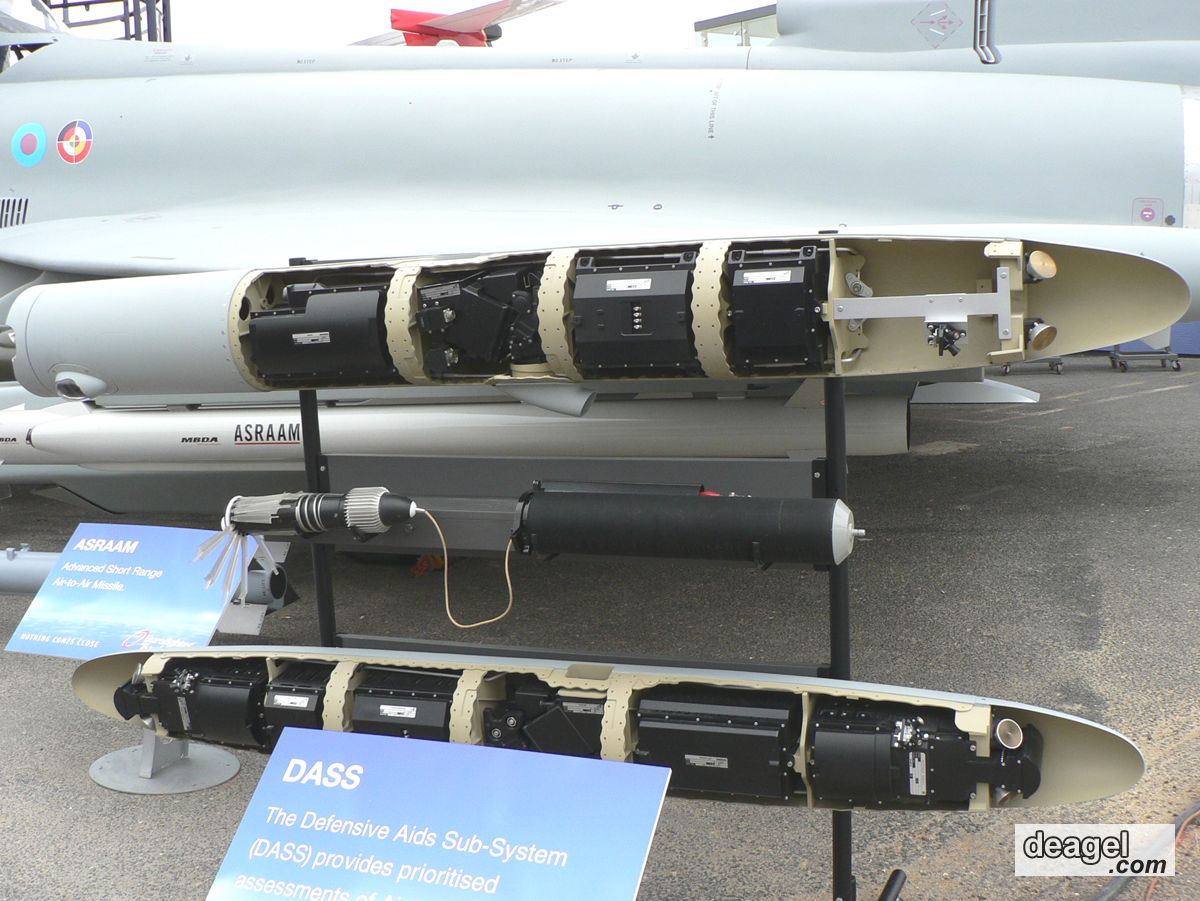
‘Designed specifically for the Typhoon, the Praetorian DASS’
http://www.defenseworld.net/go/defensenews.jsp?catid=3&id=4994&h=SELEX%…
Its only your overblown Self-belief that thinks its ‘French flair’.
Read page 19 of this;
https://docs.google.com/viewer?a=v&q=cache:GgHLEp–FoMJ:www.dtic.mil/cgi-bin/GetTRDoc?AD%3DADA404660+rwr+sequential+triangulation&hl=en&gl=uk&pid=bl&srcid=ADGEEShKD385pXJal3s4zSbShO20DC9-fALOEn3w2x_EODuMprpE7rti6KtofzfxbqYe5tURsaOUyDcl-lrk3ynOu1h9OXKfXJY6vuoCLg332Qq0FBWRwXIpdVIRFC8jQu5WSl8jE5kQ&sig=AHIEtbRJ9NjbOJY5_r6n78P1mx5r3vShcw
It shows you that Interferometry is not the only mehod of ranging, DASS uses Triangulation conducted in sequence. Also which aircraft has the most widely spaced antennas? It isnt SPECTRA!
http://media.photobucket.com/image/eurofighter%20esm%20pods/Theg777/17.png?1309298731
http://media.photobucket.com/image/eurofighter%20esm%20pods/Theg777/17.png?1309298731
https://www.myaoc.org/eweb/images/aoc_library/Events/2002/102802_CONV/02CONV_Proceedings/Day2/Track2/Bacchelli.pdf
‘A DRFM based techniques generator, incorporating also circuits for passive emitter tracking’.
The range is not 100km, it is at least 100 km.
Something posted by Scorpion a while ago quoted from an Selex-Galileo official:’DASS monitors and responds to threats over an area the size of Belgium’.
f-35pwiiiEE :
I am sorry if you don ‘t fully get the ins and outs of what I am talking about EE , but it ‘s not my fault 😎
You seem to understand few things wrong , from my post you beleive that I am saying :
– the people behind Spectra is better than the people behind DASS
– the components used by Thalès are better than the components used by the others
– —> the rafale is the better aircraftThis is NOT what I am saying EE , not what I am saying . Ok ? 😉
It is about what solution a group of enginerers can find for the task at hand , with a clear goal part of the original design , a good deal of money and intelligence to spare . It is not a secret that Spectra cost an harm , a leg and an eye and at the time of Rafale F1 , the price of the system was already a good few percent of the aircraft . Now and from the top of my head , Spectra is for more than 10% of the aircraft ‘s price .
Thalès didn ‘t made it because they are more clever than others (maybe they are) but because they had to , so they had to dig deep into new grounds to build a system where the absolute priority was twofold , long range detection with pinpoint accuracy for :
– EM mapping of the zone on the fly (to know what ‘s going on)
– EM recognition of the adverse systems (for instant or futur use)
The secondary goal was also twofold :
– medium range stand-off jamming (to hide within the EM fog of war)
– short range self defenseComparing DASS and Spectra is like comparing apples and oranges .
Overall , Spectra is a better system but I am not thumping my chest because I know that the design (the desired goal) was higher with Spectra .
DASS is a system designed primarely with two things in mind :
– to warn the crew of a possible threat from far away
– short self defense (Xeye+towed decoys)I did my homework on DASS a long time ago and I still do because I have a great interest in electronic means to get an edge against an adverse system . DASS is a very clever piece of work and against today ‘s RF missiles , it should do the job with panache , better than what the USA actualy have in the front line bare the F-22 . I can ‘t rate the Russian or Chinese fighters as I do not speak , read , Russian or Chinese and it doesn ‘t help :o:mad:
Jacko , let ‘s say that we are in mid summer , july the 12th 2015 .
What is the Typhoon ? What can it do ? What ‘s the radar , the ammo ?If I want to buy one , what do I get in front of my door ?
Cheers .
:rolleyes:
Electromagnetic of the zone of fly?
Electromagnetic recognition of adverse systems? (Do you mean a threat libary?)
DASS strangley can do all of the tasks you showed unique to spectra.
DASS isn’t just for what you said (smoking RafaleFanboyismGrass ?)
Please explain further how SPECTRA IS unique and then we will compare.:rolleyes:
Your homework dosen’t seem to be well….. accurate ;
‘The signals received by the the sensors are analyzed, are categorized, identifies, localizes priorisiert and on distances until to over 100km with an accuracy better than 1°. In addition these information is forwarded identified at the THAT headquarters computer (defensive Aids computer / DAC) where by means of stored libraries, with several thousand signal examples (probably 10.000+), the DAC the type of the transmitter, assesses is in which mode it is , around which weapon system it acts itself and carries out a Priority assessment corresponding to the dangerousness.’
http://eurofighter.airpower.at/sensorik-dass.htm
‘The DASS is billed as being so sensitive it can pick out “more than enough” targeting information during a SEAD mission without recourse to a dedicated emission-location platform or an onboard antiradiation missile targeting system.’
http://home.exetel.com.au/jwcook65/Resource/Dass%20JDW.jpg
‘The EuroDASS displays situational awareness information to the pilot which includes radar and SAM sites while enhancing survivability during military missions.’
http://www.deagel.com/Aircraft-Protection-Systems/EuroDASS_a001493001.aspx
http://www.selexgalileo.com/EN/Common/files/SELEX_Galileo/Products/Praetorian.pdf
Oh and by 2015 mid-year Typhoon should be equiped with meteor, some should to be fitted with AESA and DASS should be up to Step 5(It adds targeting of airborne emitters) in capability.
@ EELightning I complatley agree.:diablo:
f-35pwiiiNO!
This is basic physics, angular resolution is dictated by the antenna type and you cannot get <1° accuracy using the wideband spiral antennas installed in the DASS.
Or that Typhoon’s current use of classic wideband antennas in its DASS mean that it can never reach <1° resolution and do passive EM range/speed/heading estimation.
Also just found this:
http://www.dtic.mil/cgi-bin/GetTRDoc?AD=ADA404660
Go to page 19, it will tell you differrent DF techniques.
DASS uses triangulation conducted in sequence, also which aircraft features the most widely spaced antennas? It isn’t Rafale.:D
f-35pwiiiWhich antennas are we talking about? I was under the impression that the DASS was being upgraded with new antennas under the P1E program. No difference?
Yes, P1E includes new dual-polarized antennas.
f-35pwiiiNO!
This is basic physics, angular resolution is dictated by the antenna type and you cannot get <1° accuracy using the wideband spiral antennas installed in the DASS.
A digital receiver is not used to increase accuracy (though it may marginally if it improves SNR a bit), its purpose is increased spectrum capture, you get to listen to more signals at the same time and can use more advanced signal processing techniques. The Holy Grail of RWR would be a full digital system with enough processing to capture the whole 0-20GHz spectrum (we’re not there yet but should be by the end of the decade).
We have high resolution pictures of the antennas, they can’t be mistaken for interferometric arrays. What more do you want?
So I suppose that all these discussion about Typhhon having the best radar because it has a larger dish are now pointless.
Double standards anyone?
Funny thing is, IMO it’s a perfectly valid point to claim that Typhhon larger radar area gives its designers the potential for a much longer range.
Or that Typhoon’s current use of classic wideband antennas in its DASS mean that it can never reach <1° resolution and do passive EM range/speed/heading estimation.
Or that Typhoon’s engine & variable inlets give it superior supersonic performance.
Or that Typhoon’s canard position give it greater nose authority at the cost of increased landing speed (as a close-coupled canard provides extra lift at high angle of attack).
Basic physic at work.
A weird analogy given that food critique is a very subjective matter with opinions based on little hard facts.
In more serious matters (science, finance, geopolitics), journalists are usually the people who have no training in the field they “specialize” into and repeat whatever they think they understand (and thanks to the Dunner-Kruger effect, most of them never realize that it’s mostly nonsense).
Confirmed in Grandclaudon’s interviews.
It’s obvious that Typhoon won’t be able to do EM passive targeting as long at it uses the same antenna type for DASS.
Of course they will, during strike or recon missions.
Anyone with a brain would understand that passive tactics are primarily for operation over the enemy territory where switching your radar on means warning every SAM & air patrol in the area. Passive targeting allows you to locate enemy forces and anticipate their trajectories, letting your strike package slip through, relay coordinate estimates to your escorts and be ready for self-defense in case you’re detected.
Obviously if you’re trying to deny enemy access to your own airspace, you need some radar coverage.
Which is why DASS performance is perfectly fine for the missions where the Typhoon excels, and PIRATE performance gives it an edge to intercet stealth platforms. For missions where EM listening performance is really needed like deep strike, recon, SEAD… the UK will have the F-35 (which, incedently has interferometric arrays and will surely be able to do passive targeting, the F-22 already can).
Using IRST mean that you’re already close to the target. You’re also limited in the number of targets you can track.
EM-solution lets you estimate (within 5-20%) the location of hostiles hundreds of km away and can quickly map the whole battlefield.
http://media.photobucket.com/image/eurofighter%20esm%20antenna/Theg777/Antennaarray.png?1309298674
Its all yours to speculate….:D
Q: How is the high accuracy ESM DF capability achieved?
A: High Accuracy DF capability is achieved using the ECM Array in the forward location of the port pod. This LRI has the capability of operating in receive and transmit modes.
f-35pwiiiYou don’t understand what I said. I stated that:
1) SEER most likely uses the same digital RWR as the proposed DASS upgrade (as shown by the effort to already market it to the Saudi). Any suggestion that it’s not a top-notch system is just ranting from a delusionnal journalist.
2) DASS and SEER use similar (not identical) technologies in terms of angle detection.Now as I also said, Typhoon has more antennas than the plane illustrated in the SEER brochure so in favorable conditions a target should be covered by two pairs of antenna, bringing the accuracy to ~7° (similar to what BOW achieves by uses a 4 antenna array for the higher frequency band).
Depending mostly on the number of antennas.
Look, I don’t care if DASS has an accuracy of 3° or 10°, what matters is that such values are simply not good enough to do passive targetting, convergence becomes very slow and residual errors are huge.
See http://yayan.mysite.syr.edu/yan_Fusion2011.pdf for some simulations, a 0.015 rad st. deviation (<2° “accuracy”) will already make convergence very slow and result in >15% error in range (but they improve quadratically with bearing accuracy).
Simply put, speculation like this is completly unsubstantial.The upgrade gives targeting support, a system of ~10 in azimuth can’t do this but a system of <1 can. The new digital reciever increases reseloution of signals to allow for targeting. This shows that the current antennas/reciever can give a precise emitter location of <1 in azimuth but only with an increase in reseloution will add weapons employement. Again, note that its hard to draw conclusions as most details on the antennas are classified.
f-35pwiii….
Some of the radomes appear to be flat !
I bet Dare 2 wouldn’t be happy with that :diablo:
f-35pwiiiThe SEER system made by the same company and using the same arangement (dual wide-band antenna per sector) is quoted as 10° RMS by its maker.
http://www.selexgalileo.com/EN/Common/files/SELEX_Galileo/Products/SEER-Fighter_dsh298.pdf
(one should notice that this “digital” RWR is quite similar to the proposed upgrade for Typhoon)
Look, there are pictures of the system available on the internet.
Notice the two spiral (wideband) antenna at the ends of each pod? These are the RWR antenna, just ask any sepcialist and I’m positive he’ll confirm it.
These are NOT interferometry arrays but “classic” pairs of antenna, an interferometry array requires at least four (but usually five) antennas deplayed in a planar configuration (in a cross although mathematically and dispotistion that isn’t simply linear works).
Unless the laws of physics have changed, fitting a TRX creates a significant blind spot. It also prevents the use of cross-eye jamming for that hemisphere.
So it’s not like TRD is a no-brainer, it has a significant impact on the plane ECM capabilities (lose some, win some, as always it’s a compromise).
Once again, look at the picture, there are no antenna arrays anywhere.
Is it that hard to get? Don’t you think the the Eurofighter consortium would communicate publicly on such a feature? Dassault did for the Mirage 2k and Rafale, Saab did it for the Gripen upgrades, Boeing for the F-18 Growler, Lockheed for the F-16 Blck60 and the F-35.
The silence from EADS is deafening…
By the time an IRST is able to give you a firing solution by tracking only, you’re already at the merge (not that you were very far at the beginning given the range of an IRST).
Reported by whom?
Captor is a single, narrow-band, antenna, it’s even worse than a dedicated RWR as far as positioning is concerned, this idea is just ridiculous.
Invalid comparison. SPECTRA was designed by Thales which sub-contracted the chaff and flare dispensers to MBDA. Both ESM and ECM functions were designed by the same teams. The same company also designed the modular avionics that make the SIGINT/ELINT function possible.
DASS ECM was designed in Italy and the ESM in the UK by different companies. And a third one did the avionics, one whose concept of sensor fusion is apparently limited to the elimination of duplicate tracks when displaying the tactical situation to the pilot (that didn’t really impress the Swiss if we go by their evalution, sensor fusion was specifically quoted as a weak point).
h
The upgrade for DASS’s ESM allows emisson detection below noise level and for the imrovement of the reseloution of signals to allow for targetting. This clearly shows that the DF accuracy is high enough for precise emitter location and with the improvement of reseloution further targeting.
f-35pwiiiBTW DASS features 16 antenna assemblies hidden behind 10 radoms. Three of these antennas account for the MAWS, the rest for the ESM/ECM sub-system.
Source ?!?! I thought the ESM/ECM subsystem contained only three working in the T/R modes ?!:eek:
f-35pwiii[QUOTE=Scorpion82;1871911]Some DASS components are still based on analogue systems. P1E will increase the digital content of DASS, but only the 5th step of the DASS roadmap will see the installation of a digital ESM receiver. The ESM sub system is just one of many parts of the DASS. That’s all about it.[/QUOUTE]
It would be intresting to know how they plan on implementing it, but sadly there is no information currently released, perhaps in the future they will come to an agreement on how.
f-35pwiiiScorpion, Ihave found a few posts made by someone on a spanish forum :
http://translate.google.co.uk/translate?hl=en&sl=es&tl=en&u=http%3A%2F%2Fwww.zonamilitar.com.ar%2Fforos%2Fthreads%2Ftodo-sobre-el-eurofigther-typhoon.399%2Fpage-11&anno=2
I translated something he said about P1E;
‘T2 capabilities also will be delivered progressively and will improve with Future Capabilities Programme Phase 1 (Phase 1 Programme Future Enhancements-FEP) (Note: also called P1E, Phase 1 Enhancements) hired last April (2007) and that must be completed in 2012 (NOTE: this improvement is to start soon (2011) applying in all T2 delivered and delivered.) And as you see a rapid improvement applies to many fighters in a short time, then simple (must rely heavily on ‘simple’ software changes fleet.) Eg the new weapons and pod are already integrated by Eurofighter. ((only need to add the change in the operating software of the plane)). T2 capabilities will also be progressively and improve program capabilities future phase 1 (Future Enhancements Programme Phase 1-EFF) (Note: also called P1E, Phase 1 Enhancements) hired last April (2007) and should be completed in 2012 (Note: this improvement will begin to implement in the near future (2011) in all the given T2 and deliver.) And as you can see is a rapid improvement (applies to many fighters in a short time), then simple (must be much ‘simple’ software changes.) E.g. the new weapons and pod are already integrated by Eurofighter. ((Only you need add the change in the operating software of the aircraft)).’
He then listed a few things that P1E contained including this:
,DASS (digitization)
I wouldn’t know what this could imply so this is why im asking you.
But then after that he goes on to write in the best translation possible :
‘Enhancement 1: replace the antennas ESM by others that would allow dual polarization in reception, both in low band as in the high band. Thus is achieved the detection of circularly polarized signals to left and right hand, plus any linearly polarized signal. This allows for the detection of circularly polarized signals go right to left, in addition to any signal of linear polarization.
Enhancement 2: Extending the range of low-band radio frequency (up to the band G) towed decoy and increasing their effective radiated power. Enhancement 2: Extension of the RF range in low band (until the band G) of the towed decoy and increase its effective radiated power.
Enhancement 3: Improvement of DRFM (Digital Radio Frequency Memory) subsystem ECM ‘on board’ with increase in its effective radiated power, spurious reduction and refining techniques disruption and deception. Enhancement 3: Improved the DRFM (Digital Radio Frequency Memory) subsystem of the ECM “on board”, with an increase in its effective radiated power, reduction of spurious and refining the techniques of disturbance and deception.
Those already signed up here (to be applied in the P1E, as stated below). Up to here the already signed (to be applied in the P1E, as said below). And now the possible future: and now the possible future:
Enhancement 4: Extending the range of RF subsystem ESM in low band (up to the band C). Enhancement 4: Extension of the radio range of the ESM subsystem in its low band (up to C-band).
Enhancement 5: Replacing the current ESM receiver with a digital receiver to improve the detection capability (to detect signals below the noise level), improve the resolution of ambiguities and add the ability to locate which has been (support for ‘targeting’. Enhancement 5: Replacing the current ESM receiver by a digital receiver to improve the detection capability (allows you to detect signals below the noise level), to improve the resolution of ambiguities and add the ability to location of issuers (support for the “targeting”
Enhancement 6: Provision for extending the frequency range of ECM subsystem ‘on board’ in the low band. Enhancement 6: Provision for the extension of the radio range of the subsystem ECM “on board” in its low band.
Enhancement7: Extension of the range of RF subsystem ECM ‘on board’ in low band. Enhancement 7: Extension of the radio range of the subsystem ECM “on board” in its low band.
Of these seven improvements, the first three will be implemented in 2011, with the first enhancement package for aircraft of Tranche 2 (P1Ea) (Note: applies to all T2 between 2011 and 2013). Seven of these improvements, the first three will be implemented in 2011, with the first package of improvements for the Tranche 2 aircraft (P1Ea) (NOTE: applies to all the T2 between 2011 and 2013).
Improvements 4 and 5 are scheduled for 2014, as part of option package currently being negotiated for the Tranche 3 (P2Ea). The improvements 4 and 5 are planned for the year 2014, as part of a package of options currently being negotiated for the Tranche 3 (P2Ea).
Spain has rejected the improvements 6 and 7 due to lack of maturity in its development, risk of delay associated since their implementation would require the use of an external pod (about the size of the antennas), mortgaging weapon stations. Spain has been deprecated improvements 6 and 7 due to the lack of maturity in its development, risk of delay associated because the implementation of the same would require the use of an external pod (by the size of the aerials), mortgaging weapon stations.’
Could you possibly tell me what he means by ‘Digitization of DASS’ ? And then why he says that the digital reciever will with P2Ea but also with P1E?
I know this is alot to ask its just I have seen how much you have posted about DASS and your wiki like knowledge of it.:confused:
f-35pwiiiScorpion and EElightning, accordding to wiki scramble the Eurofighter gets the new ESM in Block 9: http://wiki.scramble.nl/index.php/Eurofighter_Typhoon#Block_9
‘improved DASS (new ESM/ECM, maybe improved TRD’
Does this mean that aircraft flying with SRP 5.1 have the new ESM ?
Any reply would be helpfull.:o
f-35pwiiiFuture upgrades will be managed by smaller incremental upgrades rather than large block upgrades with comprehensive packages. The technologies/capabilities originally proposed for the P2E may still find their way into the Typhoon sooner or latter. The new approach may accelerate some capabilities, while others might need longer, but there haven’t been any serious information about what P2E was meant to include. The DASS upgrades are everything which has been published separetly, spare the associations with some new weapons which will come with new SRP releases.
In your opinion and through what you know about DASS would you think the digital ESM would be implemented onto DASS before 2015 e.g. through ‘Austere’ type upgrades , or are the partner nations neither willing to pay for targeting support through ESM?
f-35pwiiiCould someone possibly tell me what happened to P2E ? Its just I noticed that there was to be a new ESM with targeting support to be implemented with it, or is it that the new ESM wil likely be on Tranche 3’s DASS?
f-35pwiiiIt’s unlikely. Tranche 3A aircraft currently on contract for the 4 partner nations are largely similar to the tranche 2 examples including the upcoming Phase 1 Enhancements upgrade. They’ll also accommodate some design changes to eliminate expected obsolescences in computer technology and additional provisions for future growth including upgraded generators, a fuel dump, plumps for CFTs, full provisions for the AESA radar and provisions for future growth of DASS. The remaining tranche 3B is unlikely to be ordered by the partner nations, thus far all partners insist that they won’t buy additional aircraft, but a follow on tranche may emerge when export orders are secured. Industry still offers a number of options including TVC and if a customer requires it it may find its way on the Typhoon at some point in time, it’s also retrofit-able to existing aircraft. As of now no customer is interested in the TVC as other capabilities are more critical and relevant.
The Typhoon proposed to India does have 3DTVC, do you think that if India were to choose this variant of the Typhoon that maybe it might cause more intrest in implementing 3DTVC into the Tranche 3 deal with Indian funding ?


 Sign In