 Spacepope
The B2 will carry a pair of these, right. I wonder how it would do against something built like the NORAD complex under Cheyenne Mountain? Would it even make a dent?:confused:
Looking out my den window now at Cheyenne Mountain. I guess it really depends where it hits, but you have a good 2000 feet of rock (granite: lots of hard quartz and feldspar) above most of the complex. Hitting lower on the sides at an angle, and you’re sacrificing kinetic energy for penetration. I’d assume this thing comes down more or less vertically.
SpacepopeWeather baloon?
And if nothing else, swamp gas… you ask too many questions. Please go with the nice men knocking on your door.
SpacepopeThe shaped charges cut the casing and ignite the propellant along the whole booster, so it all burns off pretty tamely. I think if they put it on the stand and just lit them off, you’d have a really small risk of the booster ending up in the next county. That risk assesment probably took 15 years.
Spacepope1) Can operate from real world tanker airfields, with full fuel – the KC-767 can’t.
2) Is a better, more capacious transport for the men and equipment it will need to carry when supporting expeditionary operations.
3) Has more fuel to give away, further from base.
4) The cost differential is negligible, but the capability advantage offered by the KC-30 is massive.
Too many errors in this to let slide. To address these points
1) You’re still quoting the figures for the 767-200ERF, not the -200LRF that was proposed in this RFP
2) Doesn’t even matter. Unlike a lot of Euro forces, the US usually charters airliners for troop movements. Equipment is generally moved by C-17/C5, which is what these proposed tankers are intended to support, not replace
3) It better well do that. The -LRF derivative means that the 330 based tanker would have to be based at larger bases further from where they are needed. Their larger size also means that they will have to refuel more aircraft per mission, since they will be available in fewer numbers due to ramp space concerns.
4) Since cost is no object, and you seek massive increases in performance, why not propose a CK version of the 777. It is just slightly larger than a 330, negligably more expensive, and offers capabilites an order of magnitude greater than the EADS product.
You seem to be forgetting here that this is a competition to replace the KC-10, which is the tanker that currently is tasked with dragging fighters across the ocean on deployments. The KC-135 may carry half the gas as a 330, however two KC-135s have twice the number of booms, and can refuel twice the number of aircraft in the same amount of time. An extra 50,000 pounds of fuel will do you no good when the one tanker you can get on station is refuelling F-15E number 4, as #8 in the strike package falls into the ocean for fuel starvation…
SpacepopeAIM-9X wasn’t even a paper design in GW1 :rolleyes:
Yes I’m awarew of that. The Warthog probably was armed with AIM-9L or something similar.
I guess what I was inferring, and what wasn’t picked up on, is that some of the issues with low flying/slow moving targets weren’t resolves with the X evolution of the AIM-9 family.
SpacepopeIIRC, there was a GW1 incident where an A-10 was having a tough time getting a lock on an Iraqi helicopter with an AIM-9. Could be that the -X model still hasn’t totally solved the slow moving/low signature target problem yet. Purely speculation though.
SpacepopeIf reports are accurate, the Python 5 has already been certified on the F-16.. it shot down a Hizbollah UAV a couple of months ago.. my guess is the USAF wants to get to evaluate the weapon to better know how to beat it
Almost exactly what I was thinking. I’m certain that the UAV kills got the USAF’s attention. Perhaps the evaluation is not on how to beat it, but perhaps to see if it is more effective against UAV type targets than AIM-9 series weapons.
Heck, it could even be an attempt to integrate it on USAF UAVs, robots hunting robots!
SpacepopeDear Jack,
Love the way you begin each of your replies, very classy!
Comparing a 500lb HE bomb to the MOP is an apples to oranges analogy. Detonating an HE bomb causes destruction of the entire thing. Dinging the MOP… Well let’s just say I’m viewing it from the standpoint that it is a high amount of fast moving mass… The inertia of the round will mean it retains its effectiveness, though the CEP may substantially increase.
SpacepopeThere’s something fishy about this picture here:

It’s in cruise with the main gear door open. There is obvious photoshop marks in front and behind the left wing, and above and to the rear of the cockpit (look at the mountain gullies… perfectly repeated)
Did they photoshop out the landing gear and stores.. What is the original photograph lke before alteration. Something isn’t right.
SpacepopeHere we go…
Been up all night with various stuff and wouldn’t let myself go to sleep till this was done, its 13:54 and I’m off to bed… Night all 😉
Nice work. Love the comparison between the F-105 and B-58
Things that you might want to look into- You have a C-141A in there, adding a B version (stretched) between the A and C-17
Also, somethings wrong with the tail of the UH-60…
SpacepopeMost systems actually tend to use HE to engage targets. The intention is to set off the incoming missiles warhead rather than punch holes in it. The Soviets, whom arguably have the most experience with highly supersonic Anti Ship missiles use a mix of 30mm in HE-Frag and light guided missiles. Muzzle velocities are not huge… in fact range between 860 and 960m/s, compared to the Phalanx at something like 1,200m/s.
Phalanx system actually uses a 20mm sabot round, where the projectile is substantially smaller than the calibre of the cannon. This is needed as many current anti-ship missiles have an armored bulkhead in the forward part of the missile. Though doubtful that the sabot projectile can punch through it at long ranges, penetration is likely at medium and shorter ranges (high projectile velocity plus missile closing velocity).
SpacepopeIf you can make the conventional missiles discernable from nuclear ones, this is a really great idea I think.
The problem comes in later then… You have a launch signature that is supposed to say “not nuke”, but really, how do you verify that? You’d end up just having to trust that it’s conventionally armed untill impact. Still it is coparable to the risks when launching CALCMs today, but it’s also just another opportunity to decieve.
SpacepopeOooh, finally something I might be able to give useful advice on!
I use air abrasion units at work all the time. They’re essential for cleaning dinosaur bones. A bit older than this part, but the same concept. A few notes:
DO NOT USE aluminum oxide on Al parts. It will chew right on through any soft material. For basic/general use, Bicarb is fine (we use Armex electronics formula, 35 pound bucket). Dolomite is the next step up in hardness, though I doubt you’d ever need anything besides bicarb. Don’t ever use glass beads on Al either.
As for the blaster, we use a Comco brand blaster with a pressure control (bicarb behaves differently at 30psi vs 140psi) and a powder control. Crystal Mark also makes a unit. You can set them to be as gentle or as aggresive as you want. On large saurpopd bones (5 foot long femora) we have even used the blasters that normally strip paint from bridges and buildings (with bicarb as the blast medium). Saves a lot of work, but only on a VERY solid surface. In our case, everything important was secured with cyannoacrylate adhesives and polyvinyl acetate.
A quick example:
Working on a plesiosaur recently. The bones are encrusted in selenite, a gypsum crystal. This won’t be too far off from your situation, as basically we’re dealing with a matrix that is softer than the substrate, so no significant problems.
Befire air abrasion: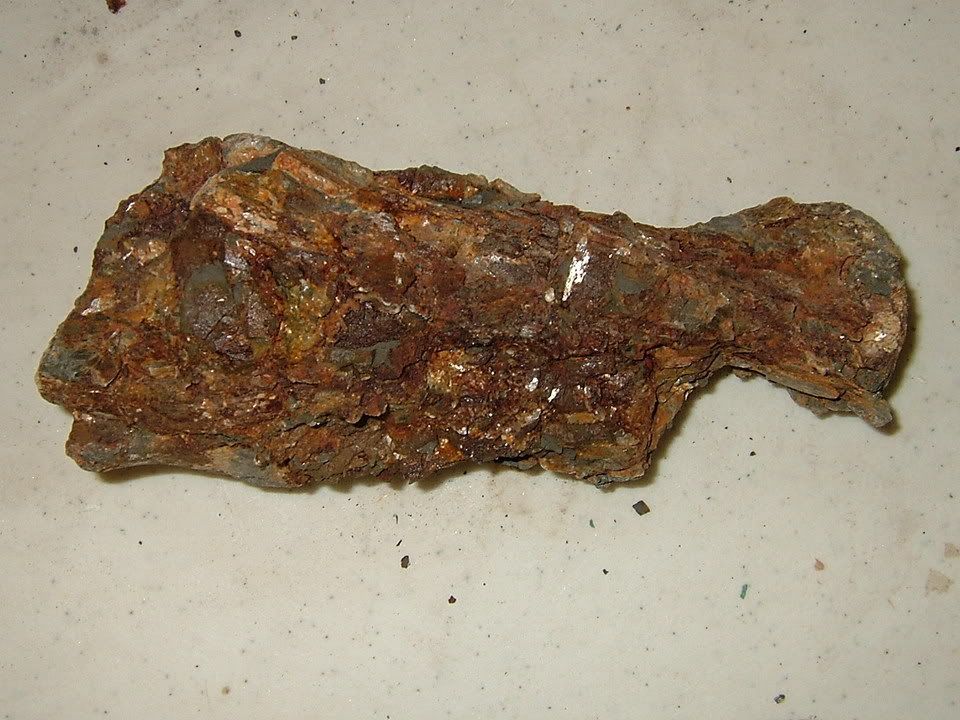
And after the process. We cover them in Vinac (polyvinyl acetate beads dissolved in acetone) but you can use whatever is best for metal.
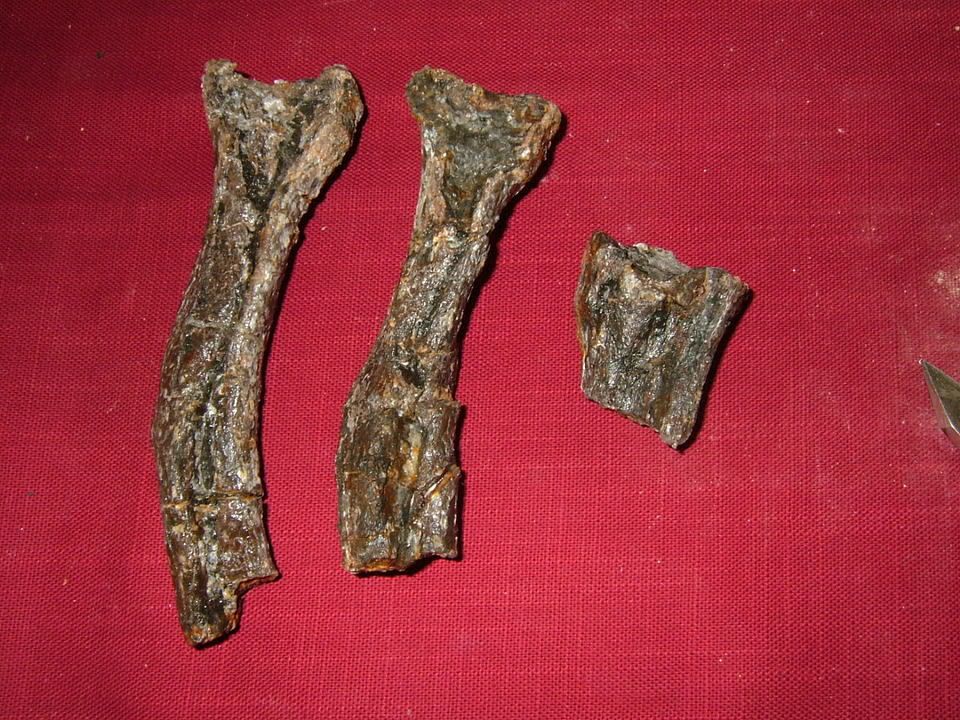
SpacepopeNot really…remember the 367-80 (aka 707 prototype) was designed and built with company funds. A staggering $16 million.
Massive orders for the KC-135 came later. Those orders no doubt helped Boeing cash-wise and I understand helped pay for tooling, but it was hardly a government program.
Remember too, the 135 and 707 don’t share a common fuselage (the 135 is narrower…thats why the USAF 707 passenger jets..all 5 of them…were designated C-137s).
To be really anal, the -80 had a narrower fuselage diameter than the C-135 too. C-135s and 707s also had a different wing and tailplane (untill the -D/E/R mods gave the C-135s the tails from retired civil 707s). So in the end, it seems like the only common parts between them were the engines and landing gears!
SpacepopeThere is no way a B-61 nuclear bunker buster weapon use in Iran would go well with the internatioal community.
I completely agree with you on that one.


 Sign In








