 H_K
H_KI’m quite happy to acknowledge that I view all of the AdlA Rafale deployments to Afghanistan as having been motivated MORE by politics and marketing than by actual operational needs or requirements, though the value of such deployments as part of an OEU type process should not be under-stated.
(…)
I just don’t see either as demonstrating the operational relevance or applicability to Afghan ops at the moment, and maintain the belief that if you were narrowly focused on what was needed on the ground, in Afghanistan, you’d just send more Mirage 2000Ds or more Tornado GR4s/Harrier GR9s.
(…)
Thus, in the Afghan context, Rafale’s inability to autonomously deliver the ‘bread and butter’ weapon of choice for that mission is more significant than its ability to deliver AASM.
The Mirage F1CR cannot self-designate either, so I guess its regular deployments to Afghanistan must also be politically/marketing driven, not to mention operationally irrelevant? :diablo:
The fact is that there are plenty of good operational reasons to deploy the Rafale to Afghanistan. First, without a gun, the Mirage 2000D cannot perform CAS alone in Afghanistan. That’s why it is typically paired up with the Mirage F1CR, of which there are only 40 left to cover both Afghan & African operations (4 permanently stationed in Chad). So cycling in the Rafale (as well as the Super Etendard) is a good way to relieve the F1CR.
Second, why not spread the CAS experience across more A2G squadrons?
Third, a Rafale + Mirage 2000D pair carries double the bomb load compared to any other combo available to the French. Not to mention better endurance & hot & high performance than a F1CR or SEM. Rafale’s inability to self-designate is completely irrelevant, since it’s replacing the F1CR, not the 2000D.
Finally, Rafale allows for all-weather strikes using the AASM.
Indeed, Rafale has flown ~3,000hrs over Afghanistan, roughly 8% of its total flying hours since entering operational service (2,000hrs at Doushanbe/Kandahar in 2007, 2008 & 2009, plus 1,000hrs off CdG in 2006 & 2007). That’s a lot more than needed for a token political or marketing gesture and is clearly driven by operational decisions. 😉
H_KNo responses. I must be the only person interested in the turboprop vs. turbojet debate… :p
I’ll just keep going then. 😉 After reading up on the difference between horsepower and thrust, I realized that I overestimated the performance advantage of turboprops at higher speeds. I thought that there was a constant relationship between HP and thrust (about 2.6lb per HP), but as it turns out turbojet thrust decreases with speed. So the ratio of 2.6lb/HP is only true at 185km/h. In fact, at dogfighting speeds of 600km/h, it’ll be closer to 1lb/HP.
I reran the turboprop vs. turbojet comparison at 600km/h, and the turboprop advantage disappears. However, the Mamba + Nene combo is still competitive versus the Sabre’s J65.
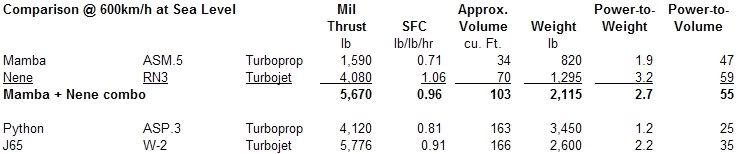
The thrust-to-weight ratios now make a lot more sense and are more aligned with each aircraft’s climb rates. The Vultur’s thrust-to-weight at 600kmh is pretty good, and only gets better at lower speeds (i.e. as fighters bleed energy in a dogfight), so it should be able to compete in a dogfight with jets if it can survive the initial high speed pass.
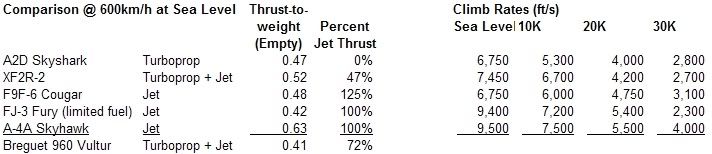
H_KIMHO, a turboprop+turbojet combo actually doesn’t seem so bad for a low altitude strike aircraft. I ran some numbers and the results were interesting. 😀
* First, turboprops have 3-4 times lower specific fuel consumption. So by relying on a turboprop for cruise, with the turbojet off or on a low thrust setting, you can design a smaller/lighter fighter bomber with less internal fuel. Or you can fly farther/longer. Both are good for a naval aircraft.
* Second, turboprops have much better thrust response, especially at slow speeds (they use blade pitch), so that is useful in a dogfight, as well as for carrier approaches.
* Third, turboprops offer more power density relative to their size & volume, and in the 1950s smaller engines were generally more efficient, so it makes sense to use a small turboprop + small turbojet combo rather than a large turbojet or a large turboprop.
Of course, turboprop performance trails off at high speed/high altitudes due to lower propeller efficiency, but that shouldn’t be a problem for most dogfights under 20,000ft, which is where you’d expect a fighter-bomber to operate.
Here are some comparisons, assuming a conversion factor of 2.6lb thrust to 1 SHP (used in Flight International at the time, and probably accurate for dogfight conditions at low altitudes when the prop is at high efficiency). The first table is a snapshot of engine technology in 1953, showing how a turboprop+turbojet combo was better than either a big turboprop (e.g. Westland Wyvern) or a big turbojet (FJ-3 Fury).
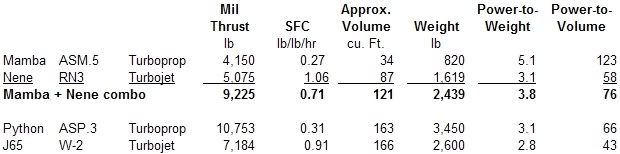
The second table shows how aircraft with turboprops or turboprop+turbojet combos had very respectable climb rates. This is actually a bit of an unfair comparison, sincee the F9F-6 Cougar and FJ-3 Fury were swept wing fighters/interceptors, and the best naval fighters of the mid-1950s. But I’m intentionally setting the bar high. 😉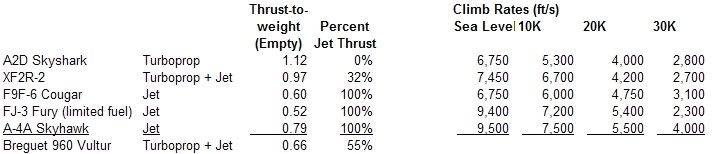
Compared to the A2D Skyshark and XF2R-2, the Breguet 960 Vultur was heavier and more attack oriented, with a lower thrust-to-weight ratio. However, IMHO its fighter performance should have been at least as good. It had a lower drag design, thanks to a smaller, more compact turboprop and slightly swept, high-lift wing. Also, the Vultur relied more on jet thrust, so performance would have dropped off less at high speeds or altitude. This superior performance is anecdotaly confirmed by the fact that the Vultur had a higher top speed of 900km vs. the low 800s.
So IMHO until the A-4 Skyhawk, Scimitar and more angled deck carriers came along , I think this was a pretty good solution. :diablo:
H_KPioneer,
I don’t think the Alize is missed in the ASW role, any more than other fixed-wing types such as the Tracker, Viking and Gannet. This is because helicopters have improved tremendously since the 1950s/1960s in terms of sensors, speed and endurance. Plus now every escort is helicopter capable, so helicopters can operate closer to where they’re needed. And finally, helicopters carry dipping sonar, which seems to be a crucial piece of kit.
For the AEW role, the Hawkeye is much better, and for the ASuW role modern fighters such as the Rafale or F/A-18 can now do the job quite well thanks to their better sensors and endurance compared to older fighters.
For more info on the Alizee, look here: http://frenchnavy.free.fr/aircraft/alize/alize.htm
There’s a nice cutaway which shows the internal volume nicely (my guess is that the Alizee was more limited by the size of its engine than by internal volume).
H_KThe Vultur may have been a dead end concept, but then again so were all prop-driven aircraft at that time, and that didn’t stop the F4U Corsair and A-1 Skyraider from providing sterling service into the 1960s. 😉
Here’s some quotes I found on the Vultur:
On the power of both engines, the second Vultur attained a maximum speed of 559 mph, and 248 mph on the power of the Mamba alone, and more than met the requirements of the specification but owing to the rapid increase in performance of the fighters by which the Vultur was likely to be opposed, the French Navy abandoned its requirement for a strike aircraft.
The Breguet 960-02 later completed a series of dummy deck landings and catapult-assisted take-offs at Farnborough, and proved fully capable of completing its designed role. As is so often the case, this role was then abandoned, because of the rapid increase in performance of opposing fighters”
The window of opportunity for the Vultur was 1954-1958, before most of the Colossus/Majestic carriers were reequipped with angled decks and before superior jet-engined fighter-bombers such as the Scimitar and Skyhawk entered service. Even after 1958, it wouldn’t have been completely obsolete, since it would have been a good choice for navies that soldiered on with the slower Skyraider and Corsair.
As for the Sea Venom, it was clearly a better fighter, but a rather limited fighter-bomber, carrying only guns & eight rockets. Also, it didn’t have the low speed CAS ability and carrier landing caracteristics of prop-driven aircraft, so not a perfect comparison.
H_KI did not go to the lengths of including the likes of the the French Alize and Britain’s own short lived Seamew, due to a couple of reasons –
Firstly the French Breguet Br-1050 Alize, was an adoption of a failed Breguet Br-960 Vultur turboprop/turbojet-powered carrier-based attack aircraft, and so was not a specialized design and built for the role of specialized ASW role!
Secondly as much as it used American-based ASW equipment, the French priority and experience in airborne ASW aircraft was not on a par with their British/American counter parts (in my opinion!!).
Interesting comparison. But I think your reasons for excluding the Alize are rather arbitrary. 😉
First, the Alize definitely counts as a dedicated ASW design and shares precious little in common with the Vultur: new fuselage, new wing, new undercarriage, new turboprop engine, no jet engine, new avionics! Isn’t that enough to consider it a new aircraft? :p
Secondly, the Alize was quite equal in ASW terms to the Gannet. Alize actually had slightly better patrol endurance (5h15 vs. 4hr50) and much better range (2,000km+ vs. 1,600km) due to cleaner aerodynamics and large internal fuel capacity. It carried more sonobuoys (14 vs. 10), and its acoustic processors and sonobuoys were upgraded at least twice (mid-1960s and late 1970s), while the Gannet ASW was never upgraded. The Gannet’s only edge was its smaller deck footprint, and more importantly its larger bomb bay (two torpedoes vs. one).
All in all, the Alize was a good design, thanks to the combo of French aerodynamics and a British engine… 😉
H_KDo keep up. The prototype first flew on 27th May 2008.
Yes, but until recently Gripen Demo was merely an aerodynamics demonstrator and engine test bed, not a real prototype. Only since November has it started to look like a real prototype, after several months upgrading to fit some of the planned electronics such as the AESA radar and EWS.
You can’t have your cake and it eat it too. The Gripen NG is either a low risk, mature prototype. Or it’s a very early stage prototype with lots of development remaining for Brazil to share in. It can’t be both…
(I’d argue it’s the latter, since flights to date as of November are only ~80, which sounds small as a % of a full test program).
H_KHere’s the summary in real English. :p
[*] Rafale beat Typhoon 4-0 the first time, then 3-1 the second time. Missile performance was artificially limited on the French side, more so the second time.
[*] Rafale lost only once to the F-22, out of “several fights”.
[*] Rafale was also able to detect SAM sites that F-16CJs had missed
[*] Rafale launched 3 AAMs and 6 AASM bombs within less than a minute, with a UAE pilot in the backseat 😉
[*] Overall, Rafale’s reputation was much enhanced among UAE pilots
Source: French Rafale pilot. This French journo is actually one of the more credible in France, since he is unofficially blacklisted by the French MOD due to his reports on French weaknesses in Afghanistan.
Following up on the previous translation, here’s the confirmation from another French journo. He names the source as Col. Fabrice Glandclaudron, CO of the Rafale squadron 1/7 Provence.
[*] Rafale’s participation in ATLC was a “complete success”. “We scored a homerun.”
[*] Rafale “hammered” Typhoon during 4-on-4 exercises. He confirms the 4-0 and 3-1 scores.
[*] Rafale and F-22s fought 6 times, during which F-22s only got one kill.
[*] Rafale’s availability was “exemplar”.
[*] OSF allows visual identification at ranges of up to 30/40km.
[*] Regarding the 6 AASM + 3 MICA (simulated) firings in one minute, the ground targets were located at standoff ranges of 20-40km.
http://secretdefense.blogs.liberation.fr/defense/2009/12/carton-plein-pour-le-rafale-lors-dexercices-aux-emirats.html
(Someone posted this on the Rafale thread, but I think it’s more relevant here)
H_K“Typhoon’s performance and radar performance do give it a massive edge over F-15 in certain areas, but the lack of an operational helmet, limitations with PIRATE, and some other areas relating to equipment maturity mean that Typhoon in service may not quite match Typhoon as modelled in JOUST, though it’s still good enough that it’s plainly a bit better than F-15C overall, and will be much better. Some of these shortcomings will finally be addressed with the next software ‘drop’ and with other improvements planned to hit the frontline in 2010 – eg the helmet.
As to Rafale, it lags F-15 in performance, and radar performance, has no helmet, and has similar (though less severe) maturity issues to Typhoon. A judgement that Rafale (as it is today, with the current PESA, with no Gerfaut, with no TRD, with the current M88) is “basically no better in A2A than an F-15C” is harsh, and is somewhat simplistic and over-generalised, but not unduly so.
Remember that with no helmet, any advantage that you might have in low speed agility (an area where Rafale of course dominates F-15, with certain provisos as to excess thrust) is largely thrown away.
Regarding the substance of your argument, HME, it’s all very pretty but no facts to back it up, so rather full of hot air.
[*] If you actually bother to calculate T/W ratios, you’ll find only a 5% difference between Rafale and Typhoon. Hard to see how it’s possible to claim a “massive edge” for the Typhoon over the F-15, while at the same claiming that the Rafale “lags the F-15 in performance.”
[*] Your fixation on helmet displays is stange. HMDs aren’t relevant for BVR combat, as proven by the fact that the F-22 doesn’t carry one. Why is this not an issue for the F-22 but an issue for Typhoon/Rafale?
[*] Towed decoys don’t mix well with passive stealth, which is why neither the F-22 nor F-35 have them. The fact that the Rafale doesn’t either isn’t necessarily a weakness – it indicates a different concept of operations. We can’t tell whether the Spectra + OSF + Mica IR combo work less well than Captor + Pirate + Amraam.
H_K*So the USAF is saying the 22 was unbeatable (probably referring to the main exercise)
*The british “source” was saying the Rafale lost badly against the 22 and the EF and Rafale did not meet
*The frenchies are saying they actually won against the 22 and typhoonAsides the rules of engagement , is funny how different are the “facts” regarding the source
Actually, the British source didn’t say that at all, so the facts aren’t so inconsistent. Jackonicko said “I don’t know which side has said no, but I’m told that Rafale and Typhoon will not go beyond the merge.” So it’s possible that they did engage in BVR combat, which is consistent with the French talk of limiting their missiles’ performance.
Jackonicko aslo said on Nov. 20 “The Typhoon blokes seemed to be particularly pleased with themselves, walking tall having “kicked ass and taken names…”. However ATLC kept going until Nov. 27, and it’s quite possible that the Rafale vs. Typhoon exercises happened towards the end, once everyone was nice and comfortable with each other…
Regarding F-22 vs. Rafale, my interpretation is a stalemate in guns only, with the F-22 getting in only one kill.
H_KNot all performances are computed at the thropopause expecially not that of aircraft not designed to fly that high and if you had bothered reading you’d had figured that the 11.000 m are the altitude at which the SEM is designed to fly at M 1.3.
Instead of trying to pass yourself for someone who knows better than the users themself (USAF/Marine Nationale) you’d be far better off starting to learn your basics right the hell now.
Dare2, your arguments are tiresome. 😡
The SEM’s max speed of Mach 1.3 is IN A DIVE. Max level speed is Mach 1 at 30k feet. Don’t tell me you didn’t know, since this comes straight from your beloved OFFICIAL sources. Any true fan of the SEM has known this for years. You’re a fraud – you don’t care about French planes, only about your ego.
IXARM: http://www.ixarm.com/Fiche-technique,10829
Aganpanthe press briefing: http://www.defense.gouv.fr/content/download/59814/564984/version/2/file/DOSSIER%2BDE%2BPRESSE%2BAGAPANTHE%2Bdraft.pdf
H_KConsidering that the F-22 was undefeated, the Rafale didn’t beat it in any engagement. The fact that it was only in the crosshairs(i.e. WVR) once means that the other kills were likely BVR.
Several French sources have confirmed that the USAF didn’t want to do BVR since that would reveal F-22’s performance. Apparently it was all WVR (guns only), at least with the French. Don’t know if they F-22s did things differently with the UAE.
H_KSo what was the outcome of the other engagements then ? …
Don’t know. 😉
The other, bigger, question in my mind is what were the rules of engagement between Rafale & Typhoon. 4-0 seems too lopsided – the ROEs must have been restricted on the Typhoon side too. (e.g. maybe they required visual identification without use of Pirate, to simulate a 4th generation fighter, or limited the fight to IR AAMs only on both sides, which would favor MICA over ASRAAM. Just guesses).
Edit: Stephen Trimble mentions a French MOD press conference on this issue this morning. That could be where the Rafale pilot spoke. http://www.flightglobal.com/blogs/the-dewline/2009/12/f-22-undefeated-at-al-dhafra-2.html
H_KHere’s the summary in real English. :p
[*] Rafale beat Typhoon 4-0 the first time, then 3-1 the second time. Missile performance was artificially limited on the French side, more so the second time.
[*] Rafale lost only once to the F-22, out of “several fights”.
[*] Rafale was also able to detect SAM sites that F-16CJs had missed
[*] Rafale launched 3 AAMs and 6 AASM bombs within less than a minute, with a UAE pilot in the backseat 😉
[*] Overall, Rafale’s reputation was much enhanced among UAE pilots
Source: French Rafale pilot. This French journo is actually one of the more credible in France, since he is unofficially blacklisted by the French MOD due to his reports on French weaknesses in Afghanistan.
H_KHME, your post is exactly spot on in describing Dare/Fonk/Thunder behavior, and he was banned because of that. However, if you actually go back and read other French posters’ comments, you’re going to have a hard time finding a “hysterical torrent of abuse” or any lack of “basic politeness”… 😉
Scorpion82 and other Typhoon fans are in fact very well respected, and many of the French posters will openly admit to Typhoon’s strengths and Rafales flaws. In most cases, they are not arguing for Rafale’s superiority, but only for a more balanced view than the one that has been prevailing on this forum and others ever since the infamous JOUST simulation claimed that Rafale was basically no better in A2A than an F-15C…
Edit: Misnamed another poster, sorry!


 Sign In







