 H_K
H_KWhat is (don’t know)?
It’s an Alkan chaff/flare dispenser, installed on 2 dedicated pylons added to the SEM Standard 4 aircraft a couple of years ago. This was supposed to free the 2 outboard pylons, but I’ve never seen any picture of a SEM using both sets of pylons at once, so I’m not sure what the point was. (Bombs and fuel tanks are always carried on the same inboard pylon, which is a bad tradeoff).
H_KThere are about 13,000 personnel under military command based in the Indian Ocean and Pacific. This includes 25 planes, 25 helicopters, 9 naval ships above 1,000 tons, paramilitary and civil defense forces:
Djibouti
2,900 personnel, including:
– 1,500 infantry
– Air base with 10 fighters, 1 transport plane and 10 helicopters
– Naval detachment with 1 LST, 1 LCT and smaller amphibious craft
La Reunion (1,700km from African coast), Mayotte (500km from African Coast)
4,400 personnel, including:
– 750 infantry
– Aviation detachment with 2 transport planes and 2 helos
– Naval base with 1 replenishment/command ship, 2 light frigates, 3 OPVs, 1 LST and several patrol craft
– 1,150 Gendarmerie (paramilitary police)
– 1,000 civil defense volunteers (with 1 months military training – can join in humanitarian operations)
Abu Dhabi
500 personnel in brand new base. Will include personnel previously based in Djibouti, Indian Ocean and France
New Caledonia
2,700 personnel, including:
– 1,000 infantry
– Aviation detachment with 3 transport planes, 2 patrol planes and 5 helicopters
– Naval base with 1 light frigate, 2 OPVs, 1 LST and several patrol craft
– 800 Gendarmerie
– 300 civil defense volunteers
Polynesia
2,300 personnel, including:
– 700 infantry
– Aviation detachment with 2 transport planes, 3 patrol planes and 2 helicopters
– Naval base with 1 light frigate, 2 OPVs, 1 LST and several patrol craft
– 500 Gendarmerie
– 300 civil defense volunteers
H_KDoes anyone have any info on proposals for a similar NTU for the Perry class? I would have assumed that they would have been logical recipients (albeit somewhat limited in the upgrade stakes) for the SM-2MR, allowing the SM-1MR to be replaced.
Your wish is my command… 😉
There was a proposal to replace some of the Perrys’ hardware with COTS components that could emulate NTU and enable full integration of SM-2MR. However, it looks like that modernization has been abandoned. I don’t know why – it would make so much sense. Instead, it appears that the Australians have done a bare-bones integration of SM2-MR, requiring illumination before launch (no autopilot), which means SM2-MR should have no performance improvements over SM1-MR.
Here are the details, including a graphic of the proposed modernization. From Norman Friedman’s “The Naval Institute Guide to World Naval Weapons Systems, 1997-1998”
Vitro’s proposed modernization of the Perry-class CDS shows the effects of COTS technology and of modern buses. The objective was to minimize cost and and complexity, and to retain as much existing software as possible. VisiBridges are COTS boxes capable of emulating UYK-7s. 44EP is a single-board equivalent to a UYK-44. Vitro split the weapon-control element of the system in two to exploit WDS Mk 14 software it had written as part of the New Threat Upgrade program. In turn, it argued that providing NTU software to the frigate would make it easier to adapt the ship’s combat system to the SM-2 missile, in a form of NTU. Such adaptation would considerably increase the frigate’s firepower. Instead of leading search radar video through an RVP/ADT box, Vitro simply digitized it so that it could be sent along the system LAN. An automatic detector/tracker can pick video off the video bus, sending its output of target vectors onto the main system digital LAN (FDDI). The various consoles of the earlier system are all replaced by UYQ-70s. They are all interchangeable, offering the ship some insurance against system failure. In theory, the next step would be to abandon the the VisiBridges and the 44EP in favor of a fully distributed system. To do that, however, would require considerable entirely new software; the emulation approach is attractive precisely because it requires little new software, and therefore little retesting.
H_KHere’s confirmation that NTU includes SYS-2 IADT. From Norman Friedman’s “The Naval Institute Guide to World Naval Weapon Systems 2006”.
In US NTU ships, existing air search radars were replaced by SPS-48E and SPS-49(V)2, and a new SYS-2 IADT fed NTDS, which in turn fed a new WDS Mk 14. NTU sensor hardware and, possibly, software from stricken NTU cruisers were transferred to LHAs as they refitted.
The Terrier or SM-2 (ER) version of NTU is now extinct; the Tartar or SM-2(MR) version survives. In this version, NTU uses CW acquisition and tracking (CWAT) to improve performance against high-altitude, supersonic, steeply diving missiles.
As of late 2002, the Royal Australian Navy planned to buy SM-2 missiles, but only in a homing-all-the-way variant, and only because the US Navy is no longer supporting SM-1.
(Page 326)
New Threat Upgrade (NTU) WDS Mk 14
NTU is usually characterized as a “poor man’s Aegis,” in that it exploits the commandable autopilot of the SM-2 missile to increase firepower without requiring a precision radar. NTU was originally associated with weapons direction system Mk 14. Because there is no external indicator that NTU is present on board a ship, it is not entirely clear which ships have it. No US NTU ships survive.
Like Aegis, NTU entails target illumination only near the target; up to that point, the missile is intermittently command-guided on the basis of search radar (track-while-scan) data. The lack of precision in the ships’ main radars (compared with SPY-1) reduces firepower in two ways. First, command guidance is less precise, so the missile is not brought as close to the target before switching to semi-active guidance. Second, NTU ships cannot use the slaved illuminators of that system. Instead, illuminating radars have to search for and lock onto targets for terminal illumination. That increases the time per target and reduces overall firepower compared with Aegis. Even so, NTU drastically increases the efficacy of non-Aegis missile ships.
WDS Mk 14 incorporates two UYK-20A or -44 computers and two or three OJ-194(V)4 consoles to control one missile battery, including two trackers. The Korean KDX-II destroyers have a Mk 14 emulator card embedded in their non-NTDS combat direction system. Others, listed under NTU, presumably have similar emulators. It is interesting that accounts of the Royal Australian Navy decision to adopt SM-2 in place of the current SM-1 on board their Perry-class frigates seem to envisage new development to disable the autopilot on board the missile and clearly do not envisage an NTU-like system. Presumably, that is because the Australians do not plan to replace their UYK-7 computers, which lack the capacity for NTU.
Users: Canada (TRUMP); Italy (Luigi Durand De la Penne class); Korea (KDX-I/II); Japan (Takanami class); Taiwan (Kidd class). The Italian destroyers were presumably upgraded after a July 2000 request for SM-2 Block 3A missiles and Mk 74 Mod 15 missile fire control systems.
Page 121
And more information from the 1997 edition about why SM-2ER was abandoned on NTU ships:
One reason for the abandonment of the expensive NTU(ER) system was that the naval environment had changed drastically. Had the Cold War turned hot, the US Navy would have faced large-scale air attacks launched from a great range. The problem would have been to deal with saturation at long range. Launch rate would not have been as important as the ability to handle multiple targets per ship. In the post-Cold War world, it is far more likely that ships will be suddenly attacked at relatively short range, so reaction time is much more important. The two- stage ER missile could not be launched very quickly (it had to be manually finned just before being rammed onto the launcher). The single-stage MR missile needs no such preparation.
H_KDid the NTU include ANA/SYS-2 IADT?
Is ANA/SYS-2 IADT the same as plain vanilla SYS-2? If so, then the answer’s yes. This is according to Norman Friedman’s “US Destroyers: An Illustrated Design History” – Google Books is your friend.
The program was called New Threat Upgrade (NTU). In a Terrier ship, NTU was credited with at least doubling the number of engagements.
NTU was not quite equivalent to Aegis. The rotating search radars of other missile systems were not nearly as precise as the SPY- 1 of an Aegis system. They could not, then, control slaved illuminators. Instead, the illuminators of the modified systems had to be coached toward the target, for which they then had to search before locking on. That took some time, so a modified version of the earlier Tartar could not quite match Aegis firepower. Moreover, as the Soviets fielded faster lower-flying missiles such as SS-N-22 (Moskit), available reaction time shrank dramatically. The rotating search antenna of an NTU ship would get only a glimpse of such a missile as it approached, whereas the fixed, electronically scanned SPY-1 of an Aegis, which was staring at the horizon all the time, was much more likely to detect the weapon and then to track it precisely enough to engage. Aegis probably would not get multiple shots at such a target, but it had a much better chance of seeing it in the first place. Too, the tight integration of search and fire control functions in Aegis made for much faster reaction to a nearby target. However, in the 1980s, when the main threat was massive Soviet stand-off missile attacks, that distinction was not vital. That changed after the collapse of the Soviet Union, when the only remaining important antiship threats were sea-skimming missiles such as Exocet.
In a Terrier ship, NTU was coupled with a major refit, which was expected to extend the lives of the early nuclear cruisers (CGN 9, 25, and 35) to 40 years, and the life of conventional cruisers (Leahy and Belknap classes) to 35 years. Ships were fitted with improved radars (SPS-48E and auto- detecting SPS-49[V]5 with SYS-2 track management systems), and they could use the new Block II version of SM-2, which was intended to engage the new generation of fast steep-diving air to surface missiles. As of 1984, plans called for completing NTU installation in Terrier ships by the end of FY92.
The newer Tartar ships were also scheduled for NTU refits: Virginia- and California-class nuclear cruisers and Kidd-class destroyers. Presumably the Adams-class destroyers could not accommodate the necessary electronics; they never figured in lists of potential NTU ships.
The end of the Cold War interrupted this program. Of the nuclear Terrier cruisers, Long Beach was retired in 1994 instead of being refitted, as planned, in FY 93. Of the other nuclear cruisers, only Bainbridge and Truxtun were refitted. The Leahys were all refitted, beginning with CG 16, 17, and 19 in FY 87-88, the last being CG 23. So were the Belknaps, beginning with CG 34 (completed July 1987). Four Farragut- class destroyers (ex-DLGs) were considered for NTU refits.
Page 405
On Page 389, he also states that Aegis cost $50 to $100 million per ship more than NTU.
H_KWhat a beauty
If the “Top Gun” franchise is ever resurrected, the Super Etendard definitely deserves to play the agressor. Say one in Ocean Tiger stripes and one in Artic Tiger stripes. :diablo:
So much class… 😎
H_KTyphoon is having a fair run at the moment, a few exports and the AtoG coming along (still too slowly IMHO), its awaiting tranche 3 negotiation results and I hope news of that comes out at Farnborough airshow, along with some more good news.:)
In the medium run (next 10 years or so), Typhoon’s growth potential is the worst of the lot.
The reason is that the jury’s still out until the T3 specifications are confirmed. Honestly, even if CAESAR and conformal tanks are included in T3, it’s nothing to write home about. That would only keep Typhoon on par with the other Eurocanards, which are both further ahead in developing their AESAs and internal/external fuel carriage. We still need to wait until the Typhoon customer nations pay for integration of cruise missiles, reconnaissance pods and anti-ship missiles.
However, after 2020 or so, the larger number of customers and bigger fleet should mean that in theory Typhoon’s growth potential will surpass its competitors. I say “in theory”, because at that point many of the customers will have F-35s, and the money or will may no longer be there to invest in Typhoon, if it becomes seen as a “legacy” platform.
H_KBeautiful Super Etendard pics
The Super Etendard sure carries its Tiger stripes well… 😎
From Ocean Tiger 2008:


And from Arctic Tiger 2007:


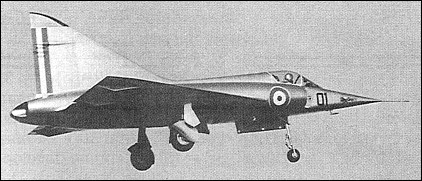
H_KThe Mirage I prototype was probably Dassault’s worst design. Look at that tail and that undercarriage… 😮 Luckily, they seem to have found their inspiration soon afterwards for the classic Mirage III.
H_KThe EAU is not looking for Uk’s EFA Typhoon??? :confused:
Remember, only 37.5% of Typhoon is from the UK… :p
UAE were always near the top of the list of potential Rafale customers – much more so than Saudi Arabia. There are several reasons that could have immediately disqualified Typhoon compared to Rafale. In descending order of likelihood:
Reconnaissance Capability
UAE needs to replace its 20 year old Mirage 2000RADs, but Typhoon has no planned reconnaissance capability. Rafale’s reconnaissance capability has been qualified and will be operational by the end of the year.
Longtime Dassault customer
UAE has operated 3 generations of Dassault fighters – the Mirage III, the Mirage 2000 and Mirage 2000-9. It has decades of experience with Rafale’s suppliers – SNECMA, Thales etc. It has MICA and SCALP missiles in its inventory. The only UAE aircraft bought from the Eurofighter nations are a small number of trainers and small transport planes.
Stategic Defense Partnership
The UAE has two main defense partners and suppliers: the USA (F-16s, helicopters) and France (Mirage 2000s, Leclerc MBTs, corvettes, military base).
Additional Capabilities
The UAE needs to replace/enhance the cruise missile capability on its Mirage 2000-9s. But no one knows when cruise missiles will be integrated on Typhoon (not before 2014 at the earliest – currently not budgeted). Even after they’re integrated, Typhoon’s useful range will be a lot less than Rafale’s – not enough to hit Tehran, for example.
Typhoon has no planned anti-ship capability, which could be very useful in the Gulf. Exocet has been qualified on Rafale and will be operational by end of year.
Neighbours
Saudi Arabia already uses Typhoons, so pride may require a different fighter. (Less sure about this one – how close are Saudi Arabia & UAE?)
H_KHere are my guesstimates for a 90min CAP (very roughly ;)):
Typhoon: 90min CAP @ 375nm with 8 AAMs + 3500l in 3 tanks
(Based on 60min CAP @ 500nm, 120min CAP @ 250nm)
Gripen N: 90min CAP @ 620nm with 4 AAMs + 5670l in 4 tanks
Mirage 2000-5: 90min CAP @ 300nm with 6 AAMs + 6000l in 3 tanks
(Based on 150min CAP @ 80nm with 6AAMs)
Rafale: 90min CAP @ 600-650nm with 6 AAMs + 6000l in 3 tanks
(Based on 950nm combat radius with 8 AAMs + 6000l in 3 tanks)
So basically the Gripen N has a similar combat radius to the Rafale, which is very impressive.
I noticed that too..
Where are you getting the 3500 litres for the Typhoon?, AIUI it was 3000 litres, as the supersonic fuel tanks only come in 1000 litre.
There were 1500 litre tanks but I’m not sure there being used now, and they are defiantly subsonic only.I think the Typhoon would need conformals to match the Gripen N range in this configuration, I really hope this is on in tranche 3.
what about the Gripen N’s has new 450US Gallon external tanks.. that = 1702litres so it could be a possible 6806 litres???
Cheers
Manufacturers typically calculate maximum CAP endurance using maximum external fuel, unless the result is a ferry configuration completely inappropriate for a combat mission (for example, 5 external tanks on Rafale). Otherwise, they would just be giving away free points to their competitors. So I assumed that the Typhoon numbers are with a 1500l centerline tank. But I made a mistake – the 1500l tank is underwing, so the correct number should be 4000l in 3 tanks (2x 1500l + 1x1000l).
The fact that some of the tanks is subsonic-only isn’t a big deal. They can be jettisoned at any time, and will be emptied early on during the mission.
The Gripen N documentation states that the 1,700l (450 gal) tanks are underwing only. Anyway, the Gripen N would exceed MTOW with 6,800l in 4x1700l tanks.
External Fuel Load = MTOW – Empty weight – Internal Fuel – Weapons – External Tank Weights – Pilot – Expendables
So External Fuel Load = 16,000kg – 3,200kg (~40% more than normal Gripen) – 550kg (2 BVRAAMs + 2 SRAAMs) – 450kg (~3 tanks) – 100kg – 100kg = 4,500kg
That’s about 5,600l. Which exactly matches 2x1700l tanks underwing and 2x 1135l tanks underfuselage. Looks like I made a mistake in my previous post – the Gripen CAP numbers are most likely with 4 external tanks and 5,670l. That might explain why they’re so much better than Eurofighter’s.
H_KWell from what I gather its in the public domain and is available, it shouldn’t be a problem for those used to ‘googling’.
It does show some interesting rangeloadoutspeeds for the Typhoon including supercruise and even quotes the F-22 fuel fraction as .30.
Cheers
That’s just shameless teasing. 😉
Here’s the link for the 2 Typhoon presentations:
http://www.mil.no/multimedia/archive/00089/2_Eurofighter_capabi_89302a.pdf
http://www.solakonferansen.no/jacobsen2007.pdf
Same presentations for Gripen:
http://www.mil.no/multimedia/archive/00089/3_Gripen_Capability_89303a.pdf
http://www.ntva.no/seminarer/manus/eddy-270207.pdf
Especially interesting is how Gripen N can fly 30min longer on CAP, 120nm farther out from its base compared to Typhoon, but with only 2 BVRAAMs instead of 6. Of course, Gripen N would be close to max take-off weight, so no extra margin for 2 extra BVRAAMs on the planned twin pylons. Still, it would have much longer legs than Typhoon. Impressive… 😎
Typhoon: 60min CAP @500nm, with 6 BVRAAMs, 2 SRAAMs and 3 external tanks (probably 4000l: 2x1500l + 1x1000l)
Gripen N: 90min CAP @ 620nm, with 2 BVRAAMs, 2 SRAAMs and external tanks (probably 5670l: 2x1700l + 2x1135l)
Edit 1: Gripen N’s numbers imply a combat endurance of ~4.5 hours, which sounds impossible. By comparison, the similarly sized Mirage 2000-5 has a combat endurance of about 3 hours with 6000l in 3 external tanks (2.5 hours CAP @ 80nm), with only a slightly less efficient engine
Edit 2: Corrected the fuel numbers for Typhoon & Gripen
H_KI guess the Mirage F.1 excelled by being the best compromise between capability and cost (at its time). It was supersonic, moderately agile, small, had a useful radar, could be used for ground attack. Compared to its American counterparts at that time (F-4, F-5) it was either clearly less expensive or clearly more capable.
It was no match for the F-16A.
I once made a similar comment to a French Mirage F1 pilot, and you should have seen him laugh! Turns out, F16As were no match for Mirage F1s, even as recently as the early-1990s…
Why? Because electronics and weapons systems are usually more important than raw performance in air combat. And before the MLU/ADF update, F16As had no BVR capability. Meanwhile, the Mirage F1 had Matra Super 530Fs (comparable to AIM-7s). Additionally, he told me that in exercises the Mirage F1’s ECM systems (presumably he was talking about the offboard Barax) would greatly disrupt Belgian F-16s, which rarely carried ECM systems.
So even though the F-16A had the better engine and FBW, it was often at a significant disadvantage. Don’t believe the “conventional wisdom”…
H_KBy my count 39 Tigers have been deliveried to date:
13 to France (cn 2001-2021, with some gaps in between serial numbers due to some Tigers being redirected to Spain)
10 to Australia (cn 4001-4010)
10 to Germany (cn 1001-1010)
6 to Spain (ET-701- ET-706)
Another ~4 Tigers are flying according to sources below, but not yet delivered (cn 4011, 4012 and 4013 for Australia, and cn 5001/ET-707 for Spain which is the first HAD variant and will be extensively tested prior to delivery in 2010).
Some links on serial numbers:
http://www.alat.fr/page136.html
http://www.adf-serials.com/3a38.shtml
H_KI took the following data from the aerospaceweb links you provided:
RAFALE
Internal 1,405 gal + External 1,745 gal = 3,150 gal * 6.7 = 21,105 lb fuel
EW 19,975 + Fuel 21,105 + Payload 17,635 = 58,715 (11,300 over MTOW)
With only internal fuel (1405 * 6.7 = 9,413)
EW 19,975 + Fuel 9,413 + Payload 17635 = 47,023 (400 lbs under MTOW)SUPER HORNET
Internal 14,400 lb + External 9,780 lb = 24,180 lb fuel
EW 30,600 + Fuel 24,180 + Payload 17,750 = 72,530 (6,500 over MTOW)
With only internal fuel
EW 30,600 + Fuel 14,400 + Payload 17,750 = 62,750 (3,200 under MTOW)It looks to me like the SH can carry the same payload as a Rafale, and also 4,000 lbs more fuel and still be 3,200 under MTOW. If the numbers are correct, Rafale cannot carry ANY external fuel with max payload.
External payload includes external fuel. There’s also a calculation mistake for the SH, and the weights are a bit low across the board. Here’s based on the numbers I have:
RAFALE
EW 22,000lb + Internal Fuel 10,450lb + External Load 20,900lb = 53,350lb (400lb under MTOW)
Total internal + external payload = 31,350lb
SUPER HORNET (data from: http://www.ndia.org/Content/ContentGroups/Divisions1/International/4202_Wallace.ppt)
EW 31,500lb + Internal Fuel 14,950lb + External Load 18,730lb = 65,180lb (800lb under MTOW)
Total internal + external payload = 33,670lb
Net advantage for SH: 2,300lb, which all goes for more internal fuel to keep the plane in the air, hence lower external payload and lower payload/range performance than the Rafale


 Sign In








