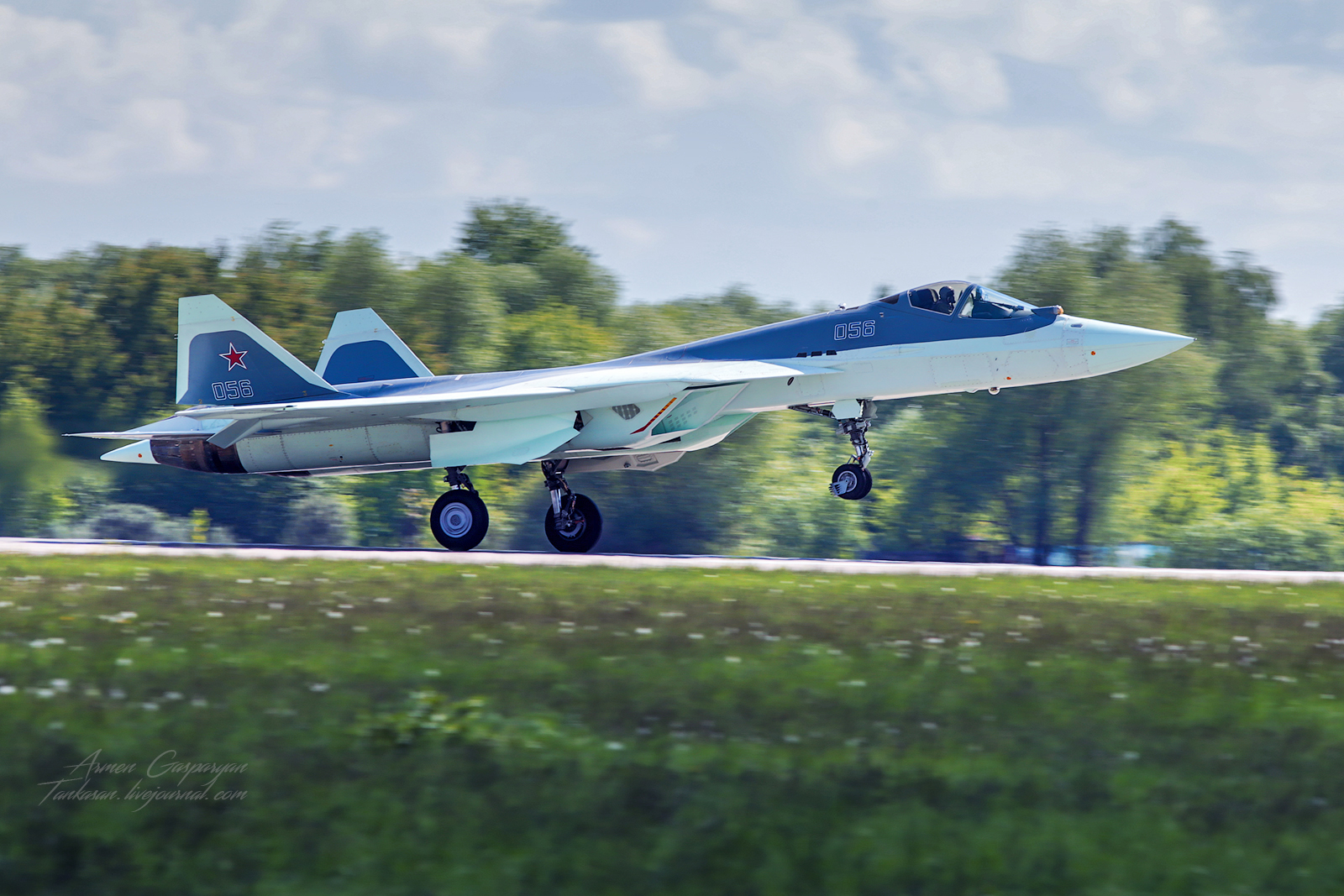
Thx for the pic, Berkut.
Looks like the shape of weapon-bay doors and, possibly, nose cone – were changed.
^^ouch…
UPD: Here is the same photo in higher res.
That sucks if true. 🙁 Reminds Taliban’s attack on Camp Bastion in A-stan, 2012.
In terms of aerodynamic configuration, T-50 and F-22 both are relatively traditional designs. While T-50 is an ideological successor of late Flanker’s configuration – an integral triplane with air-intakes under the carrying fuselage, F-22 is a successor of F-15 – an integral monoplane with side air-intakes.
Widow is a different story – a monoplane with symmetrical delta-wing and tail control surfaces mutated into the pair of large, all moving stabilizers with a high angle of incline. IMO, Widow is the most unusual design among all three.
But of course, in terms of technology and flight/tactical characteristics, each design has its own advantages and disadvantages.
No , the gold coating act as the reflection layer but the absorbing panel already included the reflection layer (ITB010 ) and absorbing layer (ITB0390) in it , in other words the 60% transmissivity of the glass panel is with both reflective layer , absorbing layer and the Polycarbonate
Ah, so this is an optical transmissvity of the whole panel. Now i see it in TDK doc. Thx for correction.
all we know is that F-22 canopy used a thin layer of indium tin oxide, no official information about what used on F-35 or B-2 or PAK-FA , or J-20 canopy or what kind of RAS they have ..etc , but that quite normal that there are classified aspect when it come to military equipment.All we can do now is speculate
Actually, at VIAM webpage i posted earlier, there is a mention of RAS polycarbon glass. But PAK FA canopy is made of silicate glass. I wonder, is there any sort of RAS layer in its stucture?

The canopy with 90 % transmissitivity is the one without gold coating
As soon as you add a reflective gold layer , the canopy don’t have 90% transmissivity anymore
Now add this gold coating to material with 60% base transmissivity. Even worse.
the panel with transmissivity of > 60% was designed to absorb electromagnetic wave with frequency of 5.8 Ghz , since the glass is a 1/4 wavelength absorber , it will be alot thinner if it was designed to absorb radar frequency of 8-12 Ghz ,thus will have higher transsmissivity
the main component are indiumn oxide and Polycarbonate which is actually what used on fighter canopy , it is also shock resistantce , i see little reason why it cant be used on fighter
So, there is no facts of its existence in F-22 and F-35?
70% transmissivity is very good , not poor at all , the transmissivity of Have glass on F-16 isnot any better , the main component of this commercial radar absorbed glass are indium tin oxide and Polycarbonate which are actually quite common on fighter canopy
I dunno what about US made canopy glass, but Russian polycarbon glass used for canopy glass production has 90% optical transmissivity.
http://viam.ru/optical_glass
While TDK ITB RAM has “over 60%”. https://product.tdk.com/info/en/catalog/datasheets/e9e_bdj_003.pdf
It’s a horrible number, not speaking about other mechanical characteristics which are unclear and may be not sufficient to by used for canopy production.
So, i wouldn’t be so sure that F-22 and F-35 canopy glass has such RAM layer. At least – there is no any mention of it in the literature i ever read.
Iam quite sure they do , given that transparent RAM available commercially and these are billions dollars weapon programs
Ermm…this commercial RAM has very poor optical transmissivity and unclear mechanical and thermal characteristics. Not every material is suitable for such thing as canopy glass.
No, the RAM is placed between the canopy normal frame and the inner gold coating , you can imagine it like this , the canopy have several layer , the outer most layer is Acrylic then come Polycarbonate , after that is the RAM coating , then the inner most layer is a thin layer of gold to prevent the radar wave from entering the cockpit .
Does F-22 or F-35 canopy contain such a RAM layer?
Canopy can be coated with internal transparent RAM layer too
Inetrnal RAM?! Sounds strange. Who would need the RAM behind the reflecting coating?
Yes.. I have seen it in a lab, with test equipment worth thousands. It is possible.
Didn’t get it. What you saw in a lab?
BTW, does anyone seriously believe to those “insects”, “pin heads” and “balls” analogies? This kind of statements smells more like an advertising slogan, than a technical term. When there is a huge metallized(i.e. ideally reflecting in RF) canopy, after all – who will care about some tiny IRST station?!
Why the turrets look like this is beyond me..
IMO, the answer is very simple. In engineering(at least in Russian one 😎 ), if something doesn’t affect overall characteristic significantly then no one bother. In other words, if the RCS of these turrets isn’t significant in comparison to overall airframe RCS, then no one bother.
Why shouldn’t he be?