 duotiga
DATE:21/09/07
SOURCE:Flightglobal.com
USA seeks new gun for tiltrotor
By Stephen Trimble
A Bell Boeing V-22 Osprey may soon be equipped with a gun within the cabin that can fire on targets at all angles relative to the aircraft’s position.
US Special Operations Command (SOCOM) has disclosed that it is seeking a vendor to provide an “interim all-quadrant defensive weapon system” for its CV-22 tiltrotors. SOCOM would require flight testing to begin within 120 days of a contract award, according to a solicitation document posted on 14 September.
The notice may be a signal that SOCOM believes it needs greater self-protection on the CV-22 than currently available on the aircraft. As an interim measure, the US Marine Corps has installed a .50-calibre gun on the tail ramp of its MV-22 fleet, which is now making its combat debut in Iraq.
“Anything that the services want to pursue to get them to a weapon system that works for their needs we want to support,” says Naval Air Systems Command.
But proposals for an all-quadrant gun have been shelved for several years due to a lack of funds. The V-22 programme office is seeking to obtain $82 million in supplemental defence spending for fiscal year 2008 to launch development of such a weapon, but the SOCOM initiative would move even faster.
Previous studies on installing an internal gun have focused on the aircraft’s nose, but SOCOM’s solicitation would require placing the weapon inside the cabin. The most obvious location would be in the so-called “hell-hole” in the cabin floor.
Both the USMC and SOCOM are considering a range of weapon types, from a 7.62mm minigun to a .50-calibre machine gun to a grenade launcher.
http://www.flightglobal.com/articles/2007/09/21/216899/usa-seeks-new-gun-for-tiltrotor.html
duotigaDATE:17/09/07
SOURCE:Flightglobal.com
Saudi Arabia signs UK deal for 72 Eurofighter Typhoons
By Graham Warwick
Saudi Arabia has signed an agreement with the UK government covering the supply 72 Eurofighter Typhoons, worth a reported $8.8 billion.
The agreement marks the start of Project Salam, a new Saudi-UK defence cooperation programme that will include aircraft, training, support and development of Saudi industrial capabilities.
The Typhoons will replace Panavia Tornado ADV air-defence fighters supplied to the Saudis under the Al Yamamah arms pact that dates back to 1985.
BAE Systems welcomed the signing of the government-to-government agreement as an “important milestone” in its strategy to develop Saudi Arabia “as a key home market with substantial employment and investment in future in-Kingdom industrial capability”.
It is believed the first 24 Typhoons will be produced in the UK, with the first aircraft already in final assembly at BAE’s Warton plant, while the remaining 48 will be assembled in Saudi Arabia.
“Negotiations relating to the principal terms of the agreement have been successfully concluded and the signed agreement is expected to become effectiuve in due course,” says BAE.
The aircraft acquisition will be supported by “substantial logistical and training packages”, says the UK Ministry of Defence, “including the opportunity for Royal Air Force and Royal Saudi Air Force aircrews and ground technicians to train alongside each other in the UK”.
Saudi Tornado IDS strike aircraft completed their first joint exercise in the UK early in September, operating alongside RAF Tornados from Lossiemouth in Scotland.
duotigaIndia reveals stealthy unmanned combat air vehicle plans
By Radhakrishna Rao
India’s state-owned Defence Research and Development Organisation (DRDO) has announced plans to develop a stealthy demonstrator intended to prove “the technical feasibility, military utility and operational value of a networked system of high performance, weaponised unmanned combat air vehicles” (ACAV).
The DRDO’s chief controller of research and development for aeronautics and material sciences Dr Dipankar Banerjee says the Bangalore-based Aeronautical Development Establishment will lead development work on the UCAV, which will have a swept wing and use composite materials.
“Stealth, which is an important feature of the proposed UCAV, would require the powerplant to be internally mounted and of a non-afterburning turbofan type,” he says. Details of the air vehicle’s payload and endurance have yet to be finalised.
Separately, the DRDO also hopes to attract a private sector partner to participate in its medium-altitude long-endurance unmanned air vehicle project, which is expected to deliver a surveillance system with a 24h endurance at altitudes up to 35,000ft (10,700m).
Banerjee says the single piston-engine-powered UAV – due to fly in 2010 – will feature autonomous take-off and landing, and could pave the way for India’s development of a high-altitude long-endurance UAV.
duotigaDATE:29/08/07
SOURCE:Flight International
US Air Force may extend Fairchild A-10 life beyond 2028
By Stephen Trimble
The US Air Force may seek to retain and continuously upgrade its Fairchild A-10 fleet far beyond its currently planned retirement date of 2028. “There are bigger numbers throwing around that are much [later] than that,” Air Combat Command chief of requirements Lt Col Ralph Hansen told Flight International on 21 August.
Armed with a nose-mounted 30mm cannon, the A-10 was first deployed in 1976 to destroy enemy tanks, but its mission has been expanded since the end of the Cold War to also include close air support duties and co-operating with special forces for combat search and rescue purposes.
The programme has in the past faced sceptics within the air force’s leadership, with then-Maj Gen David Deptula reportedly having asked a subordinate to draft a memorandum justifying the retirement of the A-10 fleet in April 2003, with the invasion of Iraq still in progress. This effort was dropped after a highly publicised backlash and in 2004 the service announced a new plan to re-engine the A-10 fleet and upgrade the aircraft to use precision-guided weapons.
The so-called “Super Hog” plan fell apart a year later when the air force killed funds for the re-engining plan, but a separate precision engagement programme was awarded to Lockheed Martin to upgrade all 356 A-10s with digital weapon stores, multifunction displays, the situational awareness datalink and smart weapons such as Boeing’s GBU-38 JDAM. The first redesignated A-10Cs will make their combat debut in September, following a crash effort to accelerate the precision engagement programme by 18 months.
The air force also plans to replace the thin-skin wings on about 250 A-10s with a more robust wing structure, and awarded a $2 billion contract to Boeing in July to complete the modifications. A wide range of additional upgrades may also still be in store for the A-10, ranging from new networks, additional weapons and reviving the engine upgrade proposal.
Roger Il Grande, Lockheed’s precision engagement programme manager, believes integrating new networks tops the priorities list, with the Link 16 and Tactical Targeting Networking Technology considered candidates.
The programme also is reviewing options for installing the Lockheed AGM-114 Hellfire air-to-surface missile, says Hansen. The air force has meanwhile proposed reviving production of Raytheon’s laser-guided AGM-65E Maverick missile, as A-10 squadrons have been forced to acquire the missiles from the US Navy for operational needs.
Hansen says the Air Combat Command will also reconsider inserting funds for the General Electric TF-34 engine upgrade kit in the next five-year spending plan starting in fiscal year 2010.
duotigaCan anybody post the actual specification in the RFP ??
http://www.flightglobal.com/articles/2007/08/31/216398/india-fighter-competition-gets-under-way.html
DATE:31/08/07
SOURCE:Flight International
India fighter competition gets under way
By Siva Govindasamy
One of the most eagerly awaited fighter jet competitions is now under way, with India requesting for proposals from six manufacturers for its 126 multirole combat aircraft requirement.
“We’ve got the ball rolling,” says the Indian defence ministry, which expects technical responses to the 211-page RFP by 3 March 2008. The Indian air force will then evaluate the bids and conduct field trials over the next few years. Commercial bids will then be opened and after the negotiations, India’s cabinet must approve the $10.2 billion deal.
The Boeing F/A-18E/F, Lockheed Martin F-16, Eurofighter Typhoon, RSK MiG-35, Dassault Rafale and Saab Gripen will be evaluated, as expected. Eighteen aircraft must be delivered in fly-away condition and 108 licence-produced by Hindustan Aeronautics over 10 years. India will retain an option for another 64 fighters. As the biggest tender outside the USA, this is a crucial order for the manufacturers, which are increasingly dependent on exports.
The ministry hopes that the first aircraft will be in service by 2012, but it adds: “We cannot compress the selection process for the sake of it. We must have a thorough evaluation to choose an aircraft that best suits our needs.”
Observers believe that the first aircraft will be delivered after 2012. A New Delhi-based industry official says: “It’s taken six years to get from the request for information to this stage. A shortlist will be issued after the evaluations and further tests conducted. There are price negotiations and nobody knows how long that will take. Delays can be expected.”
Under India’s offsets policy, 50% of the value of the contract must be reinvested in the country. The final cost will include the infrastructure needed for domestic production, subassembly contracts, weapons packages, spares, training and simulators. The aircraft are to be in service for 40 years or a flying time of 6,000h, and “life-cycle costs” will be taken into account. The final price tag could reach $13-15 billion, say observers.
The aircraft are required to perform defence, ground attack, and reconnaissance duties, and have mid-air refuelling capability. They will replace the air force’s MiG-21 interceptors and operate beneath its Sukhoi Su-30MKI fighters. With air force squadron numbers at a low of 30, well below the recommended figure of around 39, they are urgently needed.
Given that Russia has met 75% of India’s defence needs and sold around $35 billion worth of equipment since the 1960s, the MiG-35 will be a front-runner. Indo-Russian defence relations, however, have been rocky recently due to cost overruns and delays in the delivery of equipment. The reliability of Russian equipment has also been questioned, given the high number of crashes involving Indian air force MiG fighters.
Buoyant Indo-US relations, given the imminent signing of a civil nuclear deal and Washington’s perception that India is a strategic regional ally, mean that the US fighters could provide the stiffest competition. Boeing’s F/A-18 could have an edge as Pakistan already operates F-16s. Lockheed, however, is offering India newer variants of its fighter and possibly future access to the F-35 Joint Strike Fighter programme.
Indian defence minister A K Antony, who will be lobbied hard by US, European and Russian officials, says: “We are not against anybody or pro-anybody. At every stage, the procurement process will be transparent. We must get the best out of the bargain.”
duotigaDATE:28/08/07
SOURCE:Flightglobal.com
India launches contest for 126 new fighters with RFP release
By Craig Hoyle
India has at last issued its eagerly awaited request for proposals for a new fleet of 126 lightweight fighters, launching a battle between the Boeing F/A-18E/F Super Hornet, Dassault Rafale, Eurofighter Typhoon, Lockheed Martin F-16, RSK MiG-35 and Saab Gripen.
Weighing in at 211 pages, the long-delayed document was issued to potential bidders in New Delhi on 28 August, and outlines requirements in areas including technology transfer, licenced manufacturing and through-life support arrangements. Further details of the project, such as its delivery schedule, have not been publicly released by the Indian defence ministry.
India’s defence acquisition council in late June approved the medium multi-role combat aircraft RFP for release, but the latest development has nonetheless caught manufacturers by surprise. New Delhi’s expected $10.2 billion contest has been in the planning phase for the last few years, and several previous RFP release targets have passed without event. Bidders are to submit technical responses by 3 March 2008, and New Delhi will issue a shortlist after conducting extensive technical and field evaluations of the candidate aircraft.
Required to replace the Indian air force’s MiG-21 interceptors, the new multirole aircraft will operate beneath the service’s Sukhoi Su-30MKI fighters. Full details of the new requirement are expected to emerge within the next few days, but these are known to include an initial batch of 18 aircraft to be built abroad, with the remainder to be manufactured in partnership with India’s Hindustan Aeronautics as part of a 50% offset deal to be linked to the purchase.
Described by manufacturers as the key fighter contest for the next few years, the Indian requirement could yet take on even greater importance, with recent unconfirmed reports having suggested that lengthy delays to the MiG-21 replacement effort could lead New Delhi to eventually expand the size of its fleet to around 200 aircraft.
duotigaIs not always the case for my country…..there is no news on upgrades for the current fleet of F-16C/D nor F-5S/T …..
duotigaNow with video:
http://www.defense.gouv.fr/marine/base/mediatheque/videos/rafale_sur_uss_enterprise
The Actual News
http://www.flightglobal.com/articles/2007/07/26/215776/pictures-rafales-land-on-uss-enterprise.html
DATE:26/07/07
SOURCE:Flightglobal.com
PICTURES: Rafales land on USS Enterprise
By Michael Targett
Two French Navy Rafale M aircraft have landed on a US aircraft carrier for the first time.
The Rafales arrived on the USS Enterprise in the Mediterranean Sea on 23 July, 2007.
US Ambassador to France Craig Stapleton commented on the significance of the occassion.
“Being that this is the first time a US aircraft carrier has been in France in six years it’s important, and also I believe it’s the first time French fighter pilots have been able to land onboard the deck of an American aircraft carrier, this is an important moment in US history,” said Stapleton.
Following the Rafales’ visit, the aircraft were launched from the USS Enterprise and returned to their base.
During a Multi-National Maritime Exercise, back in May 2005, a Rafale M performed a touch down on the USS Eisenhower but did not perform a full “trapped” landing.
duotigaAny more photos of F-15K Slam Eagle? 😀
duotigaSyria signs for eight MiG-31 interceptors
Syria signs for eight MiG-31 interceptors
By Vladimir Karnozov
Details emerged at the show of a Syrian order for an undisclosed number of RSK MiG-series fighters to be delivered within the next two years. The first of eight MiG-31 interceptors will be handed over soon, with the sale representing the first export order for the type, which is already in use with the Russian air force and has been inherited by Kazakhstan. The aircraft will be drawn from stocks of semi-completed airframes held at the NAZ Sokol factory.
Vladimir Barkovsky, head of RSK MiG’s Mikoyan Engineering Centre, says an earlier offer for MiG-25 operators to trade in their aircraft for MiG-31s remains open, with negotiations continuing with users including Algeria, Libya and Syria.
Syria is also to take delivery of a squadron’s worth of MiG-29SMT, MiG-29M1 and M2 fighters under the new deal, with this potentially to act as an interim step until the possible availability of Sukhoi Su-30s and Yakvolev Yak-130 trainers.
duotigais catching up…..for Super Hornet
——————————————————————–
IRST on test for Super Hornet
Lockheed Martin has been selected to supply the infrared search and track (IRST) sensor for the Boeing F/A-18E/F Block 2 Super Hornet. The long-wave IR sensor will be mounted in the nose of the aircraft’s 1,820 litre centre-line fuel tank, reducing capacity to 1,250l but providing passive detection and tracking of airborne targets at long range without taking up an external stores station. A proof-of-concept demonstrator will fly later this year. The US Navy plans to buy 150 IRST sensors for its Super Hornets, with the system scheduled to become operational in 2012-13.
http://www.flightglobal.com/articles/2007/06/19/214838/irst-on-test-for-super-hornet.html
duotigaFormidable! Rafale roars into the show
http://www.flightglobal.com/articles/2007/06/18/214753/formidable-rafale-roars-into-the-show.html
Formidable! Rafale roars into the show
Jon Lake reports on the aircraft widely expected to be one of the highlights of Le Bourget
For many French visitors to Le Bourget, there will be no doubt about the star of this year’s Paris Air Show. The Rafale is now in full front-line service, flying operational missions over Afghanistan even as the show continues, and is regarded by many as being the towering achievement of the French aerospace industry.
The aircraft has proved itself in numerous exercises, and has already gained a formidable reputation among those who have encountered it.
Already an extremely effective multi-role tactical fighter, development work is continuing apace to exploit more and more of the aircraft’s planned capabilities, and to add new ones. As a result, a good aircraft looks set to become even better, and closer to fulfilling Dassault’s ambitious claim that the aircraft is an omni-role fighter – an aircraft capable of conducting air-to-air and air-to-ground tasks during the same mission.
Ambition
Today’s Rafale is still short of that lofty ambition, with the bulk of the Aéronavale’s single-seat Rafale M aircraft still to the original F1 avionics standard, limiting them to air-to-air and tanker duties, and with the Armée de l’Air concentrating on the air-to-ground role for its F2-standard two-seat Rafale Bs and for its handful of single-seat Rafale Cs.
But the aircraft are extremely capable in the air-to-air role, though many configurations involving mixed loads of air-to-air and air-to-ground weapons are still being cleared. During the recent Tactical Leadership Programme exercise in Belgium, the participating Rafales operated in the air-to-ground role – though this did not stop them scoring enough air-to-air kills to emerge with the second best kill:loss ratio in the exercise. And it is widely expected that true multi-role capability will be incorporated soon.
For the time being, Rafale orders stand at 120, of a total French requirement for 294. There were 13 F1 standard aircraft (one C, two Bs and ten Ms), 48 F2 standard aircraft (25 Bs, seven Cs and 16 Ms) and 59 F3 standard aircraft (11 Bs, 36 Cs and 12 Ms). Forty-eight production aircraft have been delivered: two F1 standard Rafale Bs, a single F1 standard Rafale C, ten F1 standard Rafale Ms, 24 F2 standard Rafale Bs, seven F2 standard Rafale Cs and four F2 standard Rafale Cs.
The original F1 standard provided a basic air-to-air capability, with Magic 2, and Mica EM air-to-air missiles and the internal cannon (an interim LF1 standard was briefly limited to Magic only). Some 17 aircraft were delivered to F2.1 standard, adding the AASM boosted guided bomb and air-to-ground functionality to the aircraft.
By the time the first Armée de l’Air unit stood up in June 2006, all air force aircraft had been upgraded to the full F2.2 standard, with new modes for the Spectra EW system, and with full compatability with the Scalp stand off missile (though problems with the mission planning software reportedly prevented its full operational employment).
Positive
On a more positive note, the emitter location capability of Spectra, combined with the reach and accuracy of AASM already promise to give the aircraft a useful SEAD capability.
Four development aircraft are now flying in the definitive F3 standard, and production deliveries are expected later this year. The F3 has further radar and Spectra improvements, with a lower false return rate in the terrain following mode, and will allow Rafale to carry the AM39 Exocet anti-ship missile, the ASMP nuclear cruise missile, and the Reco NG reconnaissance pod. The F3 is also expected to be cleared to use the 2,000-lb GBU-24 Paveway III LGB, and the dual mode Enhanced Paveway.
The F3 standard aircraft will not be delivered with the Rafale’s innovative OSF (Optronique Secteur Frontal) system, though this will be able to be fitted if swapped from an F2 standard aircraft, and nor will their Spectra defensive system have the DDM Infrared Missile Detector system.
Though delivered to different standards, there are already plans in place to upgrade early aircraft to the full F3 avionics standard.
Smaller step
To bring the Aéronavale Rafale M F1s to F3 standards would require modifications to, or replacement of ‘seven major sub-systems’, and a technical solution has been proposed, with a new Modular Data Processing Unit replacing several existing LRUs, and with some changes to the ‘back end electronics’ of some equipment and sensors.
Bringing F2 aircraft to the F3 standard is viewed as being a much smaller step – 90-95% of the required changes being achieved via new software.
After the next 59 Rafales are delivered, subsequent aircraft will incorporate further improvements and modifications. The (unofficial) F4 designation once commonly used to describe these aircraft has now fallen out of favour, and the English term ‘Roadmap’ (sometimes translated as feuille de route) is used instead.
duotigaRadar and Optronics will define future Rafale
Radar and Optronics will define future Rafale
The DGA announced plans for a ‘post-F3’ standard, to follow the aircraft now on order, in January 2006. These would be required for service after 2012, when the last eight F3 models are now expected to be delivered. Key features of the new standard were to include a self-designated LGB capability using the Damocles laser designator pod, an Active Electronically Scanned Array (AESA) radar, modernisation of the Optronique Secteur Frontal (front sector optronics, or OSF), and improvements to the Spectra self-protection system.
Though part of the ‘Roadmap’ contract, the Damocles pod will be integrated early, and is expected to be in use by F3 standard Rafales after 2008.
The AESA radar will be based on the DRAAMA testbed, currently expected to fly next year, which will add an active array to the existing RBE2 radar’s ‘back end’. The new radar is expected to fly in Falcon and Rafale testbeds from 2008, leading to qualification in 2009 and evaluation in 2010, and with the first serial production radar to be delivered in 2011, in time for the first ‘Roadmap Rafale’.
The upgraded optronics package, known as OSF-IT, will address known obsolescence issues with the original OSF and will have performance and capability improvements, and an increase in wavelength coverage.
Targeting pod
Some reports suggest that the new OSF-IT will not have an IR channel at all, meaning that Rafale would lose its onboard IRST and FLIR capabilities, relying on the Damocles targeting pod to provide any IR picture. There has been speculation that the loss of the IR is required to make space for the larger AESA radar boxes. Because the OSF-IT and the new radar will be validated together (to save duplication in the flight test effort), the new OSF will not be incorporated until the ‘Roadmap’ aircraft, though it could have been made available much earlier.
The ‘Roadmap’ Rafale will also have a new DDM-NG new generation missile warning system. This is a “form, fit, and function” replacement for the original DDM, and is based on a staring array sensor with a long range, a very large field of view and with sufficiently high angular accuracy to be compatible with DIRCM systems. Advanced algorithms will ensure a very low false alarm rate.
Development of the new radar, OSF and other systems is being funded by deferring the delivery of, and therefore the payment for, eight of the F3 standard Rafales.
There are no plans for the new standard to incorporate conformal fuel tanks as was once expected, nor is a more powerful engine expected. Despite this, the ‘Roadmap’ promises to address some of the shortcomings that were perceived to have counted against the aircraft in the evaluations in Singapore and Korea, and may help the aircraft in future export campaigns.
Dassault will not talk about reported interest from Morocco, but company sources admit to having made an unsolicited bid for 40 aircraft to India in February, and list Greece and Switzerland as prospects.
duotigamore pic




duotigaDATE:05/06/07
SOURCE:Flight International
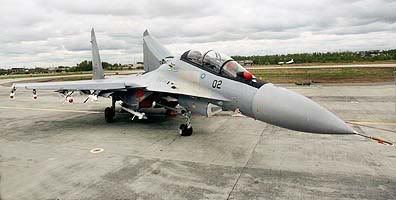
Malaysian air force goes multirole with new Su-30s
By Vladimir Karnozov
Malaysia has accepted its first two of 18 Sukhoi Su-30MKM multirole fighters at NPK Irkut’s aviation plant in Irkutsk, Siberia. Six aircraft will be shipped to the country during June and July, says Irkut president Oleg Demchenko, with another six to follow in October and November and the final batch to be delivered in the second half of 2008.
Acquired under a $900 million-plus deal, the aircraft are based on the Indian air force’s Su-30MKI, but use French and Russian-sourced avionics, targeting and electronic warfare equipment in place of Indian and Israeli technology. Malaysia is considering buying Thales’s TopSight helmet-mounted display and MBDA’s Mica medium-range air-to-air missile to equip its new aircraft, but will initially use Russian-supplied equipment.


 Sign In







