PLAMC
PLAMCUS, Russia, China in fierce battle to sell fighter jets in Asia
US, Russia, China in fierce battle to sell fighter jets in Asia
by P. Parameswaran
40 minutes ago
WASHINGTON (AFP) – The United States is bracing for tough competition from Russia and China as cash-flush Asian economies look up to the trio for a new breed of fighter jets to beef up their air forces, experts say.
ADVERTISEMENT
Japan, India, Australia and South Korea are keen to have the most modern, fifth generation, jet fighters while Southeast Asian nations such as Malaysia and Indonesia are reportedly eyeing fourth generation fighters from China.
With Asia powering ahead with military modernization and capability growth, the United States wants to maintain leadership in defense sales in the region attracted by low cost offerings from Russia and China, experts said.
“The Americans and Russians are competing hard for the Asian fighter aircraft market, but everybody is also watching to see how aggressively the Chinese will be entering this market,” Richard Fisher, an expert with the Washington-based International Assessment and Strategy Center, told AFP.
The tight competition comes as Asian economies move ahead “much more aggressively” to upgrade their air defense capabilities, he said.
“It’s not quite right to say an arms race, but there is an arms jog in Asia,” Fisher said.
The United States is currently the sole producer of fifth generation fighters — the F-22s and F-35s. Export of F-22s is barred by law while the lower cost F35s have just started flight testing ahead of deployment around 2012.
Russia and China’s fifth generation fighter offerings could well be on the market between 2015 and 2020, a time frame experts say is not very far away in terms of defense planning.
“I don’t want to get into the numbers because they were given to me in confidence but the price the Russians are estimating for their fifth generation fighter is substantially less than the Joint Strike Fighter (F-35) and substantially less than F-22,” US aviation expert Reuben Johnson told a Washington forum last week on “challenges to the Asian air power balance.”
He said the Russian arms industry was grappling with high production costs.
Russian weapon exports to China have also plunged as Beijing became more wary over Moscow’s sales of its most advanced weaponry to neighbor India, Johnson said.
“What is really the challenge is we have two very large countries, China and India, whose economies are booming and who are buying lots of hardware and we are looking at a situation down the road where they are going to have very, very sophisticated air forces,” he said.
Russia had already teamed up with India to co-develop and co-produce a version of Moscow’s fifth generation fighter, but Fisher said that given the Indian preference of diversifying its weapons sources, it was possible New Delhi could purchase a US fifth generation fighter at some point.
The United States is also vying with Russia and others for a 12-billion-dollar contract to sell 126 fourth generation fighter jets to the Indian air force.
The competition from Russia could prod the Americans to lift an export ban on F-22s, eyed by Australia and Japan, top US allies in the region, experts said.
US Defense Secretary Robert Gates hinted during a recent Australian visit that Congress may be asked to reconsider the ban.
“It is imperative that the United States consider selling some version of the F-22 to maintain a strong deterrent posture in Asia,” Fisher said.
“I would say categorically that Japan requires a capability of the level of the F-22 in order to sustain a sufficient position to deter China,” he said.
Japan and another key US ally, South Korea, have indigenous fifth generation fighter programs but their transition to full scale development is uncertain.
Australia is also in the midst of a debate over the future of its fighter force.
Canberra recently said it would go ahead with the previous government’s decision to acquire 24 US F/A-18 fighter jets for 5.6 billion dollars.
It also may review whether to purchase all of the F-35s the previous government committed to, or include F-22s in the package as well, experts said.
“There is a considerable private lobby and even some bipartisan interest in trying to purchase the F-22 because of fear of Russian sales to Southeast Asia and China’s looming challenge,” Fischer said.
Singapore, with one of the most powerful air forces in the region, is seen as probably a good potential customer for the F-35s.
The US-Russia competition for the fourth generation fighters is expected to be intense — but China is emerging as a wild card.
“I would say within the next five years, China will be quite competitive at the low cost end of the fourth generation market,” Fisher said.
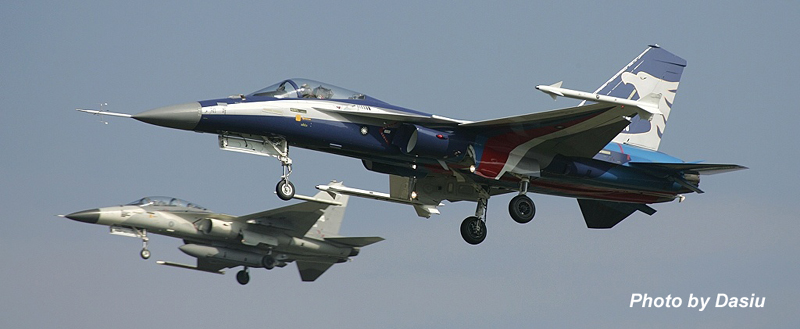
Pakistan, for example, is co-developing a very low cost fourth generation FC-1 fighter with China and is very likely going to be the first export customer for China’s larger J-10 fighter as well, experts said.
China is expected to “market aggressively” to Malaysia, Indonesia and Myanmar the same two fighters as well as the KJ-200 AWACS aircraft to the Southast Asian region, Fisher said.
Malaysia and Indonesia have purchased a relatively small number of advanced Russian Sukhoi fighters.
PLAMCYears ago KnAAPO proposed and upgraded Su-27 – the Su-27SMK (not to be confused with the new SKM) – a sort of ‘poor man’s’ Su-35.
What is the difference between a Su-27SMK and a Su-27SKM? I thought it was the same.
PLAMCY-9 debut slips into 2007
By Leithen Francis
China’s Shaanxi Aircraft has delayed until next year the first flight of its Y-9 transport, which boasts several improvements over its current Y-8 turboprop. “Originally we planned to have the first flight by the end of this year, but now we are making some small changes so the first flight has been delayed,” says a company source. Shaanxi says the stretched Y-9 will have new avionics, Chinese-built Wojiang WJ-6 engines, a 20t payload and a range of up to 5,800km (3,130nm).
http://www.flightglobal.com/Articles/2006/11/14/Navigation/190/210555/Y-9+debut+slips+into+2007.html
PLAMCBecause, sacking them doesn’t solve the problem.
PLAMCIt must be appreciated that time line of LCA and FC-1 is almost similar.
China started studies on improvement of its Mig-21 clones in late seventies and early eighties and an agreement was signed with US in 1986 for Super-7 (?). LCA was approved in 1983 with lot of western help expected and given. When USA withdrew help in eighties then Russian help was sought by China.
Now FC-7 has a foreign engine and avionics which is similar situation to LCA. There are around 3 FC-7 flying less than 4 LCA. Some important changes means that only one prototype which is near final version is flying. LCA continues to work out its FBW very slowly.
FC-1, LSP production is supposed to start in 2006 which is again same as LCA. In 2006-2007 around 4-5 LCA will be delivered. In 2007-8 around 9-10 LCA to be followed by full scale production.
Though I believe LCA is way more advanced than FC-7
On paper, I agree with you, that the LCA is more advanced than the FC-1. But in reality, I disagree, the LCA’s actual performance doesn’t really match what it state, it is definitely not much superior to the FC-1.
PLAMCThen how do you think the FCK-1/2 compares to the PLAAF’s J-8H? Superior or comparable?
PLAMCThe prototype of IDF ‘s improvement.
Just by looking at the IDF improvement or should I say FCK-2 fighter, it looks like the air-intakes is designed to be more inside the wings compared with the FCK-1 (which is on edge of wings).
PLAMCThis not a simply licensed production where Russia grants you the right to build certain number of Flankers but no more.
Really? So China can’t make more than the 200 licensed production J-11s? Even if the J-11 can be fully indigenized.
PLAMCWill these result in more FC-1 or J-10 procure from China?
I think it will result in acceleration of FC-1 development and even evolvement…
If the PAF loses faith in the F-16s, due to not having EW capabilities. I think the PAF for more J-10s and FC-1s. I think they will get more J-10s than FC-1s, because the PAF considers the J-10A/B and F-16C/D in the high fighter class level with the FC-1 and F-16A/B MLU in the low tier, and the F-7PG as support fighters in its future fighter structure.
If the PAF cancels the F-16s, then it would be more J-10s and FC-1s to fill in the gap.
PLAMCI’d much rathe rsave the money and have more J-10s rather than the JF-17. If you really want to replace the J-7 in the point defense role with a comparable platform that doesn’t cost what a J-10 does, a radar-equipped single-seat L-15 with 4-6 AAMs is a much more cost-effective solution offering pretty much the same level of capability that you’d find with the JF-17 when performing the same role (range would be shorter, but the J-7 in the point defense role doesn’t require longer range, so neither should it’s replacement, doctrinally speaking).
JF-17: an aircraft without a real mission in the PLAAF, and relying on the continued existance of one single export customer. Not a good equation when I look at it.
I agree along the lines with Sean, its highly unconvincing the PLAAF or PLAN would buy the FC-1 in mass numbers. The FC-1 has limited potential to replace the J-7E/G and J-8II, apart from the quantity factor.
I strongly believe the PLAAF/PLAN will replace those aircraft with J-10A/B (and to some extent the J-11B/Su-30MKK2) as the J-10 represents a true multirole platform with multiple capabilities such as air to air and strike roles with sufficient range and payload requirements, or though, Beijing cannot replace them on a 1:1 basis, replacing them on a 2:1 or 3:2 (ie. every 2 J-7E to 1 J-10 or every 3 J-7E to 2 J-10 basis) is good enough.
The FC-1 though multirole as well, is very limited esp. with payload and range. For a decent FC-1, you either have a FC-1 with 2 PL-8, 2 PL-12 missiles and 3 fuel tanks with an acceptable range only good for air to air roles or you can have a FC-1 with 2 PL-8 missiles and maybe 4 smaller type (ie. 250kg) LGBs on duel racks for the other 2 inner pylons with 3 fuel tanks, then you lack the BVR ability. If you deduct 2 fuel tanks for weapons (only having one fuel tank), then you lack the range.
Bear in mind the FC-1 only has about 1,300 kg of internal fuel capacity and the J-10A/B has 4,500 kg internal fuel capacity. In addition, you capable the size of the J-10 and FC-1, the J-10 is significantly much larger.
If a Pakistani claims that if China choses the “more expensive” J-10 to replace ageing jet fighters, then China will have a shortfall of aircraft. Think about it, China’s military doctine has change from Mao Zedong’s mass number war doctine to Jiang Zemin’s local war under high-tech conditions. This already emphasises on the effort for quality rather than quantity, so China would be willing sacrifice a 3 J-7E to 2 J-10 policy, given China’s large defence budget with an annual double digit growth (I can’t see why China cannot afford the J-10 in numbers), which is unlike Pakistan’s limited defence budget.
Especially, much of China’s military efforts is focused on Taiwan and if the US intervenes, not a border patrol policy. So China’s military doctine heavily differs that to Pakistan’s.
I’m not saying that you will definitely not see the FC-1 in the PLAAF. But I’m highly convince the PLAAF/PLAN will not buy any FC-1 at all or maybe it will acquire a very small number (ie. around 80) but to be deployed in remote areas like Xinjiang or Inner Mongolia for border defence. Whereas the J-10s will be heavily concentrated in the coastal areas from North to South to Southwest where Chengdu and Yunnan are.
PLAMCNice shot of the J-7D. We have not seen recent photos of them for a while. It looks like they’re still in service and in good condition.
Nanjing MR officers and air base commander getting kicked, I wonder how that will affect the induction of the J-10 in those areas.
I wonder if these J-7D would be given MLU? possible add in BVR capabilities as a interim solution before they get replaced by the J-10A.
PLAMCHowever, at least six Chinese companies have abandoned large government projects in Zimbabwe this year because they have not been paid.
Sounds like the Zimbabwean regime is bankrupted, no more money, would mean possibly no more Chinese assistence, otherwise diamonds, oil, and other natural resources can be traded for military hardware.
PLAMCROC Army seeks MH-60M Black Hawks
Army plans to buy Sikorsky MH-60M Blackhawks: report
By Jimmy Chuang
STAFF REPORTER
Tuesday, Jul 25, 2006,Page 2Advertising A Chinese-language newspaper reported yesterday that the army would seek to replace its remaining Bell AH-1W Super Cobras with Sikorsky MH-60M Blackhawk helicopters, but the military refused to comment on the story.
“Let me say it one more time. This idea is in the concept stage only,” Ministry of National Defense Spokesman Rear Admiral Wu Chi-fang (吳季方) said. “Currently, `no comment’ is the only response you will get from the ministry.”It was the second time that Wu had been approached for comment regarding the army’s plan to purchase new helicopters.
Defense News reported last week that the military was planning to purchase 30 attack helicopters from the US to replace its 62 remaining AH-1Ws, which were purchased in 1993. Bell AH-1Z Cobras, Boeing AH-64D Apache Block IIIs and Sikorsky MH-60M helicopters were all being considered, according to Defense News.
Yesterday, the China Times newspaper reported that the MH-60M was now favored by the army.
The report acknowledged that all military purchases were dependent on the annual budget, and that the purchase was still in the planning stage. Furthermore, the paper said, the budget proposal for the next fiscal year was not yet complete.
In addition to replacing its AH-1Ws, the army is also likely to retire its remaining Bell UH-1H Iroquois, which are more than 30 years old.
Because parts for the UH-1H are no longer manufactured, it has become extremely difficult for the army to maintain these helicopters.
http://www.taipeitimes.com/News/taiwan/archives/2006/07/25/2003320292
PLAMCRussia desparately promotes the Mi-26T to China
For both military and civilian use (eg. fire fighting).
PLAMCInteresting old article: on JL-9
China Set To Mass Produce New Generation Of Fighter Jet Trainers
The JL-9, also known as FTC-2000 Mountain Eagle (Shanying), is an tandem two-seater, single-engine advanced training aircraft developed by Guizhou Aviation Industry Group, the manufacturer of the JJ-7 fighter-trainer currently in use with the PLAAF.
Beijing (AFP) Jun 21, 2005
China is preparing the mass production of a third-generation jet fighter training plane and could roll out up to 10 of the JL-9 Mountain Eagles next year, state press reported Tuesday.
The plane would be manufactured by the Guizhou Aviation Industry Group, but it was still unclear if the Chinese airforce had signed contracts to buy the trainer, the China Daily reported.A model of the aircraft made its maiden flight in December 2003, with reports at that time saying mass production would begin in 2005.
The plane, whose NATO-designation is FTC-2000, is expected to train fighter pilots flying third-generation craft like the Russian Sukhoi Su-27s and Su-30s, the most advanced fighters in China’s air force.
The planes can also be fitted as fighter aircraft and sold to developing markets, the report said.
“Our goal is to see to it that a number of the new trainers go to the military in 2006,” Zhang Shangdao, vice president of the Guizhou manufacturer, was quoted as saying.
“Since it is both a fighter and trainer, some small countries, lacking a large fleet of fighter planes, could use the Mountain Eagle to train their fighter pilots in peace time, arming it for use as a fighter in war time.”
The Guizhou factory, which is part of the China Aviation Industry Corp I, has manufactured some 1,100 planes for the Chinese military since it was set up in 1964.
The JL-9 is powered by a domestically-made WP-13 turbojet engine, can reach a maximum speed of Mach 1.6 (1.6 times the speed of sound) and can carry two pilots.
All rights reserved. © 2004 Agence France-Presse. Sections of the information displayed on this page (dispatches, photographs, logos) are protected by intellectual property rights owned by Agence France-Presse. As a consequence, you may not copy, reproduce, modify, transmit, publish, display or in any way commercially exploit any of the content of this section without the prior written consent of Agence France-Presse.
I guess this article back sinodefence’s claim on the first 10 intial production JL-9. Still needs to be confirmed by more reliable sources.


 Sign In