Nick_76
you keep talking about the S-300PMU as if India had almost completed evaluations and was negotiating for it. Provide the source for that. AFAIK, India was considering other options too, Patriot included.
India evaluated the S-300V for sure, and found it wanting in the ATBM role.
The same problem with the PAC series- too limited against targets with very short warning time.
Nick_76DRDO interweb:
CCR&Ds, DRDO HQrs
Dr Vijay Kumar Saraswat, Distinguished Scientist has been appointed CC R&D (M&SS) w.e.f. 1 November 2005. Born in 1949, he started his career in DRDO in 1972 with development of India’s first Liquid Propulsion Engine, DEVIL. Having a Doctorate in Propulsion Engineering, he established facilities for design, production and testing of engines and the RCS technologies for the missile applications.
As Project Director, he steered the design, development, production and induction of first indigenous surface-to-surface missile system Prithvi into the Armed Forces. The successful testing of Dhanush missile on-board a moving ship with very high terminal accuracy brought new dimensions in the national defence scenario.
Under the able leadership of Dr Saraswat, India has embarked on a challenging, futuristic Air Defence Programme encompassing development of complex anti ballistic missile systems, radars, C-41 systems and integration of battle management resources into a national authority. As Programme Director , he has spearheaded the concept of theatre defence systems and integration of national Air Defence elements. As Director, Research Centre Imarat (RCI), Hyderabad, he conceptualised and established facilities for development of Micro and Nano Sensors for future avionics.
Dr Saraswat is fellow of National Academy of Engineering, Aeronautical Society of India, Astronautical Society of India, and Institution of Engineers. He is a member of governing council of SAMEER and member of Board of Research of AICTE, CSIR labs, and board of studies of Osmania University. He is Chairman, Combustion Institute (Indian Section), and Aeronautical Society of India (Hyderabad Branch).
Dr Saraswat is the recipient of DRDO Scientist of the Year Award-1987, National Aeronautical Prize-1993, DRDO Technology Transfer Award-1996 and Performance Excellence Award-1999. For his outstanding contributions to the nation, he has been conferred with Padma Shri in 1998.
Post test interview with Saraswat:
Interview: Vijay Kumar Saraswat
Chief Controller of Research and Development, India’s DRDOKnown in India as the father of the anti-ballistic air defense missile system, Vijay Kumar Saraswat began his career at the state-owned Defence Research and Development Organisation (DRDO) with the development of India’s first liquid-propulsion engine for the Prithvi missile.
Saraswat, who specializes in rocket propulsion, missile technologies, and project and technology management, today is the DRDO’s chief controller for research and development. His future assignments include development of India’s anti-ballistic missile systems, radars, C4I systems and integration of battle management resources into a national authority. For his outstanding contribution to India, Saraswat was conferred with the Padma Shri Award, the country’s fourth-highest civilian award, in 1998.
Q. Please describe the homegrown ballistic missile defense system. How many missiles will it have for different layers of threats?
A. Our missile configuration is a three-layered missile defense configuration. We are planning to engage ballistic missiles at the exo-atmospheric layer, i.e., the layer where it enters the atmosphere, and the endo-atmospheric layer, where there is a thermally sensitive atmospheric layer. This configuration gives us the best probability of killing a ballistic missile coming to us. To increase hit probability, we can plan to launch two to three missiles each for exo- and endo-atmospheric.The missile that demonstrates our capability to intercept ballistic missiles at exo-atmospheric altitudes is called PAD. It is a two-stage missile. The first stage is liquid, and the second is a solid rocket motor with many additional features, which are leading to an interception or engaging the ballistic missiles. For example, it has seeker guidance, divert thruster which can generate a lateral acceleration at more than 5 Gs at 50 kilometers altitude.
Q. How many missiles in the system?
A. There are two layers. At each battery there is a multiple launcher with multiple missiles.Q. What is the configuration of BMD?
A. In a typical battery, you have the long-range radars, missile launchers, mission control center and other ground systems.The complete network of radars, launch batteries, missile control centers, launch control centers. These are geographically distributed and are connected to a very potent secure communications network.
The radar is looking at a particular elevation and detects incoming ballistic missiles. This information is sent to the mission control center(MCC), which then decides whether it is a missile interceptor or a satellite or any other projectile, and it does target classification within a few seconds. When the target is classified, the MCC also calculates where the impact point of the target is likely to be and where it is going to fall.
After the target is classified, the MCC also finds out the trajectory profile and the speed it is going to travel. Based on that, it assigns a target to a particular battery. This is called target assignment.
Once the target is assigned, the data goes to a particular battery, then control goes to the launch control center (LCC). LCC keeps on getting data from radar directly, and then it decides when to launch the interceptor. This is decided based on the data received from radar, on the speed of target, altitude, flight path. A ground guidance computation is done. It’s a very complex computation from ground computation when to launch the interceptor. All this is done in an autonomous fashion.
Q. Can you tell me the timeframe?
A. For the 600-kilometer class of system, if a radar has spotted a target, the interceptor will be launched within about 180 seconds. It will be different for 200-kilometer and 300-kilometer missiles.Q. What is the speed of the air defense missile?
A. It is between 4.5 and 5 Mach. The same system has the capability to engage 300-kilometer to 2,000-kilometer classes of ballistic missiles.Q. How efficient is it?
A. Depending upon the area of threat, radars are deployed in that direction. We deploy the radar in such a way that a threat coming from that direction is detected. Once the target missile is detected at a point, a number of batteries are deployed. If a missile is passing through the zone of influence of one battery, that battery will be activated.Q. Is this Swordfish radar?
A. No, it is Long-Range Tracking Radar. It has the capability to track 200 targets at a range of about 600 kilometers.It can track the target and the interceptor also. So in this radar, we developed the complete software for doing the tracking and engagement of ballistic missiles.
Complete software for signal processing transmitter receiver modules, central processing units and complete ground segment — like cooling units, power supplies and the communication network — have been indigenously developed and integrated. Today, we have full capability to manufacture this radar in our country.
Q. How many radars have you developed in this class? When did this development begin?
A. We started working on this in late 1999, beginning of 2000, and we completed it in 2004. It has taken almost five years. We had also developed radar for the endo-atmospheric layer. It is called multifunction control radar. This is also a phased array radar. It also has the capability to beat the interceptor guidance, if required.Q. How does the MCC work?
A. MCC is completely a software-intensive system for BMD, and this works on about 10 computers simultaneously. It receives information about the target from different sources. It could be ground-based radars, satellites or our own technical intelligence system. MCC is connected to all the elements of the weapon system through a wide area communication network. It does target classification, target assignment and kill assessment.In addition, planning for deployment of radar and other weapon system elements is also done by MCC. It can also simulate all the types of track profiles and also simulates the interception using our interceptors, and then select whether interception will take place or not. It can also indicate how many missiles should be launched to intercept an incoming threat to give an assured kill probability. It acts as a decision support system for the commander.
Q. What is LCC?
A. It is the basic hub for launch of the interceptor. After a target has been assigned to a particular battery, LCC starts computing when to launch the interceptor based upon the information received from the radars, about the target. It carries out the checking of the health of the missile. It prepares the missile for launch in real time, carries out ground guidance computation.After an interceptor is launched, the interceptor is provided information about the target through an uplink. The target real time data is transmitted through a very robust communication network.
Q. When will the BMD testing be complete?
A. It will take more than three years to complete our developmental activities.Q. What is Phase II?
A. The same missile interceptors cannot cover all threats. Threat targets of longer ranges — 2,000 kilometers — will make our phase-II development.During Phase I: Endo-atmospheric interceptor is AAD. This interceptor will engage targets at 25 kilometers. AAD is superior in terms of coverage area compared to PAC-3, which is 15 kilometers. You can see the difference. AAD’s equivalent is the Israeli Arrow, which intercepts at 40 kilometers. PAD is 50 to 80 kilometers. America is building a missile, THAAD — Terminal High Altitude Area Defense — that intercepts out to 120 kilometers, but it is still in development. However, a lot of failures have taken place during THAAD development.
Q. How many missile batteries would you deploy?
A. Nobody will give information on how many and where we will deploy them.Q. Who will be the production agency for this?
A. We have participation of 30 private and public industries for various subsystems of this missile and weapon system.Q. Who will build the radar eventually?
A. Radar will be made by a consortium of Bharat Electronics and many other private industries, facilitating private-public partnership, with DRDO as technology giver.Q. And what about missiles?
A. Missiles and subsystems are also being made by many private industries. It could be government-owned Bharat Dynamics Ltd. — the preferred agency — or any other agency.Q. What is involved in the development of a missile system?
A. A lot of different technologies are involved. For example, take the PAD missile. We started developing in the year 2000, and in six to seven years we have launched the missiles — whereas the Integrated Guided Missile Development Program started in 1983 and the first launch of Prithvi was in 1988, Agni in 1989, and we have developed other missiles like Akash and Nag also. One needs to work on various technologies for different systems in propulsion, control, guidance, aerodynamics, structures, power systems, launchers and other supporting ground systems.Q. What does this mean?
A. We have reached the stage of technology development where we have technical maturity and technological qualification leading to subsystem production at identified production agencies. This is a very long, long process.Q. What is the effect of the Missile Technology Control Regime (MTCR)?
A. When we launched Prithvi and Agni, it had affected the launch of all the missiles and subsystems. The MTCR was a major reason for delay in the 1990s in the development of our missiles.Q. How did you overcome?
A. We launched a program called “Combating MTCR,” and because of that program, we developed all the unavailable materials, components and subsystems indigenously.When you do such work, you have to depend on your country’s industries and scientific institutions. When the scientific institutions give support but industries lack the technological base to support this type of program, then we have to develop required integrated circuits, etc. We have to have set up like that and we have to spend money, and it takes time. That way, development of the Integrated Guided Missile Development Program, we were involved in development of integrated circuits, material, irradiating elements. We spent a lot of money and effort doing that.
In 1996, the first Prithvi system was delivered. Despite MTCR, Agni-1 and -2 have been done. Akash flight trials were conducted successfully. The Nag imaging infrared seeker has been built. So it is to the credit of the Indian scientific community.
Now, the Akash air defense system is going to lead to production because this year, we are going for induction of Akash after a few user trials.
Q. What about the Nag anti-tank missile?
A. This year, we are going to conduct the user trials of Nag.Q. What about the Trishul quick-reaction missile?
A. Development is completed. We are looking for more variants.Q. What about the Dhanush ship-launched missile and Astra beyond-visual-range missile?
A. Dhanush we have already completed successfully. Astra is an air-to-air beyond-visual-range missile. Ballistic trials of the missile have been completed. Now, we are on to control and guidance flight-trial mode. We expect that by June, control guidance flights will commence. Now it is going per schedule and all the various technological requirements of Astra are being met.Q. What are the spinoffs?
A. Once Phase-II interceptors are developed, these can be used as long-range interceptors of aircraft at ranges of 120 kilometers.You see the question which you asked that it has taken 20 years to develop. Now you see it is not taking more than 5 years – 6 years. Even Americans also take time. Their missile program with industrial infrastructure, the cost is very high and they take six to seven years before a missile is launched. This is also time taken for development of PAD and AAD.
By Vivek Raghuvanshi in New Delhi.
Nick_76http://www.hindu.com/2007/07/08/stories/2007070857860200.htm
DRDO scientists bag awards
HYDERABAD: Vijay Kumar Saraswat, distinguished scientist and Chief Controller (R&D), received on Saturday the DRDO’s Award for path-breaking research and outstanding technology development from Prime Minister Manmohan Singh at a function held in DRDO Bhavan, New Delhi.
The award was conferred on Dr. Saraswat and his team of scientists for developing the area defence system for defence against ballistic missile attacks on vulnerable areas and successfully intercepting an incoming missile using a missile at exo-atmospheric region.
India is the only country other than the US to have achieved a direct hit in the exo-atmospheric region. G. Satheesh Reddy, Director, Inertial Systems of Research Centre Imarat, DRDO was another person to also receive the ‘Agni Award for excellence in self-reliance’ from Dr. Singh. It was conferred on him as a team leader for indigenous development of world class and higly accurate ‘Ring Laser Gyro (RLG)-based Inertial navigation and Global Positioning System (RINS).’ The system is first of its kind to be developed in the country with position accuracy of one nautical mile per hour.
Nick_76The troll may require antacids, but quite frankly- who cares.
http://www.domain-b.com/aero/july/2007/20070711_hypersonic.htm
Israel and India working on hypersonic technology demonstrator vehicle
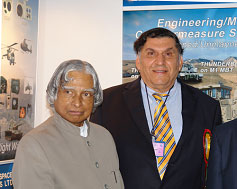
11 July 2007The President of India, Dr APJ Abdul Kalam (left), and IAI’s President & CEO, Itzhak Nissan (right), at the conference
Hyderabad: The Israel Aerospace Industries (IAI) and India’s Defence Research and Development Organisation are working together on a hypersonic technology demonstrator vehicle (HSTDV). The work is moving apace with the intention of conducting a test flight sometime in 2008.
DRDO is developing the HSTDV to demonstrate a kerosene-fuelled scramjet engine capable of powering air-breathing vehicles to a speed of Mach 6.5-7. It is the stated aim of the project to reduce the cost of putting payloads into orbit by a factor of 100, i.e. to $200/kg ($90/lb). Some of the wind tunnel testing for the project is being performed by the IAI.
India is already conducting extensive research on special materials for thermal protection of the HSTDV, including carbon-carbon composites, nickel-based superalloys, niobium alloys and high thermal conducting copper alloy.
Indo-Israeli RAM/SCRAMJET cooperation
Meanwhile, at a prestigious scientific conference dealing with “High speed trans-atmospheric air and space transportation” conducted in the Indian city of Hyderabad from June 29-30 and inaugurated by the Indian president, and distinguished aerospace scientist Dr APJ Abdul Kalam, some hints were dropped about the Indo-Israeli cooperation in this area.The Israel Aerospace Industries (IAI)’s president & CEO, Itzhak Nissan, was invited as a guest of honor at the event in deference to his personal activities in India, where he leads a number of advanced technological projects.
Speaking on the occasion, Dr Kalam mentioned that Ram/Scramjet engine technology had already been designed and tested by both Russia and the US since the 1960s and most recently by the US through the Flight Technology Demonstrator, X-43. The president also mentioned that India too had “…designed and tested scramjet engines, both kerosene fueled and hydrogen fueled, on ground test facilities.
In his speech, the President of India, Dr APJ Abdul Kalam, praised the growing cooperation between India and Israel at large and the cooperation with IAI in particular.
In his lecture, IAI’s president & CEO, Itzhak Nissan, said “IAI, the leading aerospace industry in Israel, is partner for a wide range of commercial and military projects in India. In these projects, we manage to express the capabilities that are mutual to both countries. We are proud to be partners with the superb capabilities demonstrated by the Indian development and manufacturing teams working on some of the most advanced projects in the world.”
Mr. Nissan added that: “IAI expresses profound appreciation for the high level of scientific level and motivation that can be found at India’s research institutions and aerospace industry.”
During the conference, VK Saraswat, the chief controller (R&D), DRDO and chairman of the Aeronautical Society of India, made a presentation on the commercial Hyper Sonic Technology Demonstrator Vehicle. The ground test for HTDV scramjet propulsion system using kerosene as fuel has been conducted by DRDO scientists at a high speed material testing laboratory abroad and the results have been encouraging, he told reporters at the event.
This would be a reference to the wind tunnel and other experiments being carried out by the IAI.
‘Speed up work on passenger aircraft’
Hyderabad, June 30: President A.P.J Abdul Kalam on Friday called for accelerating the aeronautical community’s plan to build a 150-seater civilian aircraft in a public-private partnership mode in view of the growing air traffic in the country.Inaugurating a two-day international conference on “High speed transatmospheric air & space transportation” organised by the Aeronautical and Astronautical Societies of India, he said the aeronautical community was ready with a roadmap for the aircraft. He said the R&D and infrastructure build-up for the same has to start right away.
He said that in the next two decades, he visualised the integration of multiple technologies of supersonic aircraft, missiles and spacecraft to transform into an unmanned supersonic long-range aircraft.
Scientific Advisor to Defence Minister, M. Natarajan, said the DRDO was investing heavily to the tune of Rs.30,000 crores in the 11th and 12th Five Year Plans for developing new generation tactical and strategic missiles as also aerospace products.
Dr. Kalam also called for global cooperation to develop affordable reusable space launch vehicles with very high payload efficiencies for launching multi-purpose missions, including space solar power stations.
He said the real value of future societal space missions, like energy from space and seawater desalination using space solar power could taken place only when mankind builds fully reusable space transportation systems with very high payload.
Pointing out that space development was constrained by the large costs of access to space, he said the payload fraction of current generation expendable launch vehicles does not exceed one per cent to two per cent of the launch weight.
Dr .Kalam said that while he visualised, in another 50 to 75 years, an industrial complex on the moon and a human habitat at Mars emerging, one of the major driving factors would be the low cost access to space. He said there was definitely a need for all the countries to work together to develop reusable launch vehicles which could bring down the cost of the launch from the present US $ 20,000 per kg to US $ 200 per kg.
Atomic Energy Chairman Anil Kakodkar said that expertise was available at Indira Gandhi Centre for Atomic Research at Kalpakkam in fabricating high-temperature material and thermal design and offered the same for aerospace applications.
President and CEO, Israel Aerospace Industry (IAI) Limited, Itzhak Nissan, said IAI was involved in major Indian defence programmes.V. K. Saraswat, Chief Controller (R&D), DRDO and Chairman of the Aeronautical Society of India, city chapter, welcomed the gathering.
30,000 crores in the 11 th (2007-12) and 12 th (2012-2017) plan periods to develop new gen missiles (tactical and strategic) and aerospace items.
30,000 crores at present exchange rates is equal to 7412.88 Million $. Ie approx 7.4 Billion $.
Nick_76But why assume that Indian engineers are only in Israel to work on Indian funded programs?
Unless you have gone blind, it might be worth remarking that the Haaretz report clearly states that these scientists have come from the Indian Govt and have been accompanied by consular officials with a degree of effort to avoid notice. And the other reports corroborate that Indian scientists will be deputed from the RCI and DRDL to Israel. One would have thought that would be clear enough, but keep digging, keep digging, and perhaps you might emerge from the hole on the other side of the world…
Nick_76Matt and Ankush I would take the 150 kms range with pinch of salt, nothing other than PTI report should be taken as granted, I can already see full of misinformation from reports by other news agencies where are they are already mixing up Akash with Barak ER with a 5x difference in range between them.
You have to learn how to sift the wheat from the chaff.
There is no need to take any PTI report for granted either. PTI can range from ok to abysmal. In this case, the media is clearly confused between the Barak-NG and this new Barak-ER or whatever you call it. But a 120 to 150 km range is quite credible. One of the aims of the system is to be superior to the PAC-series of missiles, and its no wonder that this system goes upto 150 km, thanks to the Harpoon series being at the 100-120 km benchmark. There is a clear intent to navalize this system in the long term as well.
Nick_76So there are delayed domestic missile programs and foriegn systems which have been purchased to make up balance.
No, I didnt write that. What I wrote is quite clear, if you need a course in the English language, so that you stop misrepresenting what others write, tell me, and I will help you. I can quite make out that writing in English stresses you out, and the spelling & grammatical mistakes start creeping up…but hey, still doesnt excuse you from misrepresentation.
What I wrote was clear. That the IAF has changed its plans and asked the DRDO to codevelop a LRSAM for some of its squadrons while implementing the Akash for the rest.
Where does the new Indian ABM fit into this equation? Foriegn or domestic?
First grow up, stop being a troll and then perhaps people might decide to spend their time responding to a sane person as compared to an uncouth lout who spouts racist rubbish.
Nick_76has something been changed in this report? When i first saw it, i am sure it say DRDO would be “prime contractor” not “prime developer”
Prime contractor, prime developer…semantics..since thats what the Indian media reduces them to, using these very different terms interchangeably without a care.
Basically India is driving this project, though Israel may pick up some if it can afford it, and it decides to spend the US funds earmarked for PAC-3 on something else.
And I correct my previous post- India purchased 60 Pechora firing units (radars, missiles, command post per firing unit) from the 1970’s to 1990, not 50.
These equip some 32 squadrons of Pechoras.
These are to be replaced by Akash firing units – each firing unit has one Rajendra and upto 4 launchers of Akash SAMs with 3 missiles each, plus a command center with additional 3D CAR radars/ 2D BSRs- for long range surveillance.
The IAF is ordering 18 of these new long range SAMs …the rest will be Akash SAMs.
So thats 18 firing units of these new Long range SAMs, and 42 Akash units.
There are 8 OSA-AKM squadrons as well. These will be replaced by 15 Spyders, plus the new DRDO-MBDA LLQRM project, plus a handful of Trishuls.
In the interim, the Pechoras and OSA-AKMs will see upgrade & overhaul respectively.
Nick_76Shheeeesh! 😡 Where are the mods? :confused: 😡
And, The Prime Minister, a very clever, very well respected gentleman is also from another minority correct? 😎
Yup. Prime Minister Manmohan Singh is from the Sikh community, some 2-3% of India’s population. His party head is Sonia Maino Gandhi, a Catholic Christian..Christians are currently at the same % India wide.
India’s defence minister is another Christian- AK Antony.
Indias Air Chief is Fali Homi Major – a Parsi, whose population in India is below the tenths of % of percentage points. Parsis, a community who fled extinction in what is today Iran, and have become well integrated into the Indian mainstream and are responsible for so many firsts.
Indias Army Chief is another Sikh- JJ Singh.
Indias president is a Muslim, the father of Indias IGMDP Missile program- APJ Abdul Kalam.
Indias richest or some say second richest man is Muslim, the owner of Wipro- Asim Premji and Muslim/ Christian/Minority magnates are all too common.
Indias most well respected business house- the house of TATA is again Parsi.
One of India’s largest engineering conglomerates- Larsen & Toubro, was started by two Danes, and India was their adopted home. India honored and remembered them. Some of Indias most popular film stars are Muslim- including the Khans.
This in a country which is 80% plus Hindu.
Heck, India’s tech sector is chock full of people from all over India- minorities, majorities, whatever- it blurs all distinction. All that matters is whether you can get the job done.
Truth be told, Tin Wing is the biggest racist twit on this forum (and an IP check should reveal who he is, the same gent as “The Truth” I’d bet, with his past soliloquies on dark Indians ..), and its bloody predictable by now that any topic on India has his piles get botherable and off he comes sputtering and raving. Shameless sod.
Nick_76So it appears the $2.5B order is for the development of Barak-NG. What are the specs and range of this system and how does it differ from Akash?
This is not Barak-NG, but a follow on to the Barak-8/NG/LRSAM.
The Barak-NG is a SAM being developed by the Indian Navy, DRDO and IAI for the Indian and Israeli Navies. It has a range of approximately 70 Kms.
The Barak-ER or whatever project name is given above to this new project, is a project to develop a brand new area air defence system.
This missile will have a range of 120 km plus. Some reports state 150 Km.
The IAF has some thirty squadrons of Pechoras or fifty “firing units”. Each firing unit comprises of the associated radars and missiles and command and control shelter. These were to be replaced by Akash firing units.
Now the IAF was offered the PAC-3 and was evaluating various other M-SAM options to quickly induct while the Akash got ready. So it decided to split the orders between Akash and the 18 M-SAMs.
Instead of these M-SAMs, now the IAF will be procuring this brand new Area defence system, which is a brilliant step.
The IN will be getting the Barak-NG. The IAF the Akash & Barak-ER/whatchamacall it. For Low Level air defence, it will have Spyders, a few Trishuls plus the new DRDO-MBDA JV to develop a Trishul follow on.
For last ditch defence, it will have IGLA-S to be license produced by the BDL, Hyderabad.
Along with this, theres the corresponding overhaul of the IAF’s AD network with dozens of brand new radars.
Nick_76This is excellent news.
India currently has in development/order
Trishul – finally ready – closest in performance to Barak1+ Flycatcher ..a few units to be acquired by IAF
Akash- penultimate user trials this year w/AF- some 32 firing units worth to be ordered—->32 firing units.
The BarakNG for Navy—>4-6 ships at the very minimum..
The Barak-ER above—> 18 firing units
The Maitri LLQRM to follow on from the Trishul with MBDA—> 8 Squadrons of OSA-AKM to be replaced
Program Air Defence and Axo Atmospheric Air defence, ATBM project
Spyder—> 15 Units being procured
By the end of these programs India would have a massive state of the art GBAD system, not to mention the spin off technologies from Active phased array radars of various types, to a plethora of missiles and C3I gear.
Good show.
Nick_76Those were Su-30 MKs not Su-30 MKIs. Basically Ks with A2G capability.
The reports were: (Air and Cosmos, as I remember)
The Sukhoi needs to be “overpowered” in the first pass otherwise its too much of a handful for the Mirage.
The RDY-2 radar is equal to the task of detecting the K at good ranges and = or better than the Ks radar (not a surprise, really)
IAF demonstrated a very high degree of professionalism and has mastered NATO eqvt procedures in IFR and other areas, which the French regarded as credit worthy.
Nick_76Yeah, but those were dirty inferior Indians no doubt.
For heck, why are folks replying to this troll twit TinWing…search under his posts wrt India and you get a clear sense of where hes coming from, so as to speak. Of course being a smart chap, he always shoots and scoots.
Nick_76Joey, while i agree with ur statement regarding external loads and their effects on overall RCS, having a powerful radar and its frequent use also denies the platform the opportunity of surprise which is of utmost importance in BVR engagements.
In a true battle, both the MKI and EF would keep the Bars and Captor switched off till the last moment and rely on AWACS feed. The Bars & Captor would be put on, only to guide the missile in! And both the Bars and Captor can do that vs the EF or MKI respectively.
Tactics, tactics, tactics and tactics. Thats what counts between fighters of a similar class and performance pros and cons which tend to even out. 😎
Nick_76And how stealty is steahlt against a bistatic or passiv Radar?;)
And how many bistatic radars are in service worldwide? 😉


 Sign In