 St. John
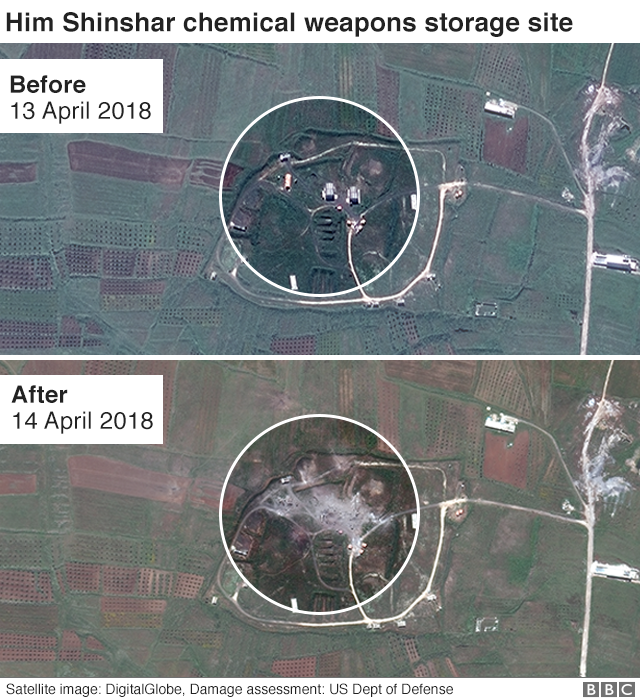
I see lots of dark round circles amidst the grey rubble that I would assume to be holes. Additionally the grey rubble area measures roughly 200mx100m on Google Earth, or about 4 football pitches in area.
St. JohnTake a closer look at your pictures, in a better definition…no “deep holes to destroy underground facilities”, only surface damages that evidently blow up storage hangars (or “bunkers” if you prefer). Many missiles for sure, …but not 22 impacts, sorry.
Where is this better definition you speak of? Ever seen a mole hole?
You could fit over 100 4-bed detached properties of a residential neighbourhood on the area flattened at either of those sites.
Look at Aleppo after years of bombing. It looks more upright and these are residential properties.

St. JohnThose Ashms were developed from 1960s and there likely role is to light up ship radars for eventual saturated attack from smaller combined attack of Antiship/Anti radiation missiles. ships does not need to sunk just disable so it need tugs to rescue and create even bigger target for second wave of attack. even Ka-52K is designed for smaller long range antiship missile. you refuse to admit that airpower has more flexibility in time and place of choosing a strike and can greatly reduced time of reloading. ship does not travel more than 30knots an hour. few hours travel it cannot escape from second volley of missiles from airpower.
This is on paper myth of Damascus/Homs heavily defended. for proper airdefence with tall and big radars with proper electric/fuel supply. you need 30 to 40km of safe area around it. just look at it in Latakia. Untill recently insurgents could easily shell mortors into Russian embassy. now they may have slightly upgraded the airdefence as areas are cleaned up but it is still fundamentally 1980s tech at best and completely lack density.
The P-800 was developed in the 1960s? Ground targets don’t move at all, what’s your point?
You can look on Google Earth at the defences. Green = SA-6, Red = SA-2, Cyan = SA-3, Pink = SA-5, Blue = EW site.

Are these the same defences that someone breached using recreational drones bought off Amazon to bomb an airbase that shot down 76 cruise missiles?
St. JohnAnd there are various ways it can be dispersed but they did not say how it was dispersed in this case, other than being applied to a door handle. It’s also important to note that Novichok is a series of chemical variants, not just one.
I don’t know about the Syria incident but the OPCW were blocked from accessing the incident site and the sites targeted in air strikes for alleged ‘security reasons’.
St. JohnExactly. 22 missiles aimed at underground facilities that still did enough surface damage to blot out 200m of land. How many holes are there?
St. JohnDid you not watch your own video? The ‘building’ is obviously a dummy target made from wood/plywood or whatever located on a bombing range. Did you not see the panels flying into the air – obviously not a reinforced concrete building.
And it’s very small.
The bunker complex wiped out elsewhere is 200m across.

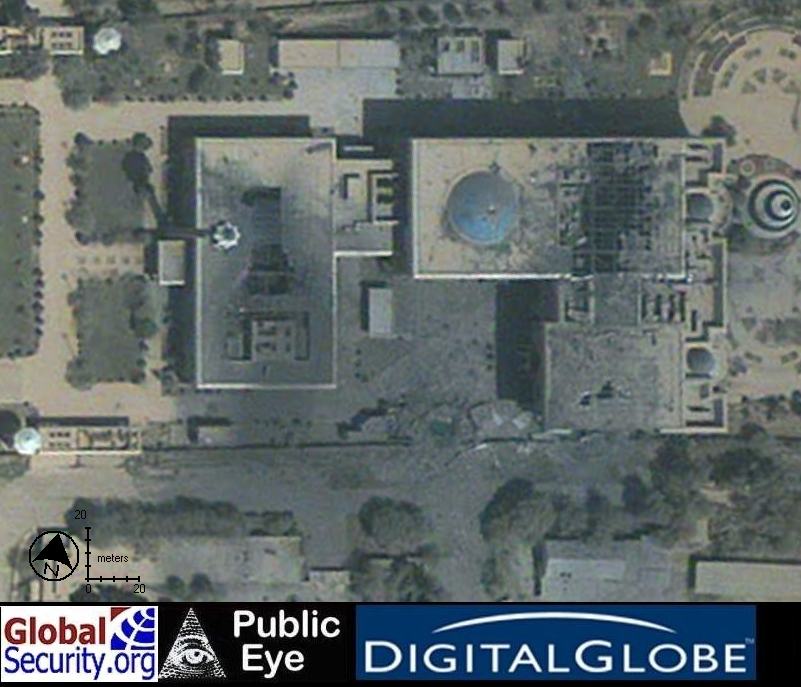
St. JohnWell here’s the problem with your assumption. The 1,000lb bombs dropped in the F-22 strike would have done similar damage if the building were the same. Clearly this building has been hit by 1 missile but it has not blown apart and you can see reinforcement wires hanging off the left side.
Were the missiles intended to explode on impact, or inside the complex, or underground?
There are places the Syrian Army and Russians have been bombing and shelling for years that aren’t as flat as that place.
See also.
https://www.globalsecurity.org/military/world/iraq/dg-bda11.htm
St. JohnThe six flor building near those three objects is intact, you could see it on your own picture and this building in satelite image before strike have longer shadow than those three objects, so those objects have two to three flors. They are usual buildings, not reinforced bunkers with thick hardened concrete walls. On yoour own Picture you could see, that the sides of objects are still standing as they are made harder because of steps, but the middle colapsed as flors are supported by thin concrete pilars. For such damage one missile in the middle of building is enough. This damage was done by 10 missiles max.
Look at the F-22 strike, if I were to say that building was hit by 4 bombs, people would probably deny it without the video.
St. JohnThose 3 buildings mostly like empty as no secondory explosions or chemicals or any humans there. so they may not even be defended fully .
Air launched Ashms are far smaller in size and fly too low on sea surface as there is no natural barriers. while on ground you have mounatain, high electric poles, trees, high rise buildings that make the larger size cruise missiles fly higher so easy to track from distance. plus ground based AWACS, fighters are far larger in size to provide situational awareness to incoming missiles. infact putting 300 to 400 people in frigate size ship against fighters or bomber with maximum two pilots is uneven contest.
Many AShM’s are actually larger. E.g. P-800, P-750, P-500, Kh-22 and the others aren’t much smaller. Cruise missile also fly very low and can skim over flat desert.
The whole of Damascus and Homs are heavily defended, probably the most heavily defended locations in the whole Middle East as regards air defence.
St. JohnI think it’s indisputable that this building has been hit by 4 1,000lb bombs and still looks more intact than anything on that large site. Now picture a dozen of these buildings all turned to rubble. How many missiles required?
St. JohnYou call that still intact? If that building is still intact then so is Joan Collins’s virginity.
And you can see the reinforcement wires hanging off the left side.
St. JohnSo 3 targets got hit with many many missiles and other targets somehow blocked every missile. Hmm… If this were really the case, it would render all AShMs obsolete, since a destroyer or missile cruiser and fleet are infinitely better protected and have a clearer line of sight than any of Syria’s land targets.
St. JohnThen you have the claims surrounding the airbases targeted. Dozens of missiles claimed shot down and none hit. So in a year, the Syrian air defences have suddenly gone from 3rd world crap, to the most unbelievably efficient air defences on the planet. Hmmm… don’t buy it. I also suspect the ground would be littered with Israeli jets if that were the case.
St. JohnAt the end of the day 3 targets targeted, 3 targets rubble. Objective achieved.
St. JohnI would say some missiles probably didn’t make it but 76 shot down is a whopping lie. I haven’t seen evidence of anywhere near than many being shot down and how many cruise missile parts get left over after an actual hit? When a plane crashes, usually the parts of the jet engine remain intact, the engine is at the rear of cruise missiles and missiles like the Storm Shadow/SCALP BROACH warhead explode forwards.

So how many of these parts are actually from hits and how many parts aren’t even cruise missile parts at all? Where are all the crash sites? Where is the footage of cruise missiles being intercepted at low altitude? What is the size/scale of these sites? That research establishments looks to be about a quarter mile wide based on lorry size in some shots.


In the Raptor strike video in Syria, we also saw two munitions put down one hole and many of these targets were underground.


 Sign In







