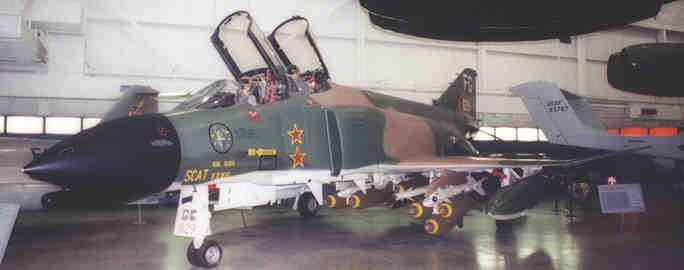
I guess it would have to be the F-14, which could be modified for bomb loads. Although excluding the F-15 for the sake of 9 days is painful, but the Su-27 would barely even qualify for the 1980s under those rules.
How many F-100 airframes had been delivered to foreign customers by August 1955?
Another observation would be that these HTK missiles with ‘no warhead’ actually do have a warhead.
http://www.f-16.net/forum/viewtopic.php?f=54&t=53723&start=15
A third observation would be that missiles with no warhead might not lead to aircraft destruction and could lead to missile copying, as with the AIM-9B that hit a MiG-17 over the Taiwan Straight in 1958.
There’s some confusion in these ranges. Spyder-MR has two distinct variants – a Python 5 + booster and Derby + booster. The 50km seems a very generic statement that can’t apply to both, since the missiles minus booster have very different A2A ranges. Meanwhile the Barak-8 there has a range of 90km. Dubious figures. The speed figure is especially dubious. I.e. speed of Aster 30 – M4.5, speed of 48N6E3 – M6.6, range 250km. Meanwhile Rafael’s own website has absolutely no mention of range for the Sling. I basically think target capabilities are being confused with missile capabilities a lot here.
http://www.rafael.co.il/5618-694-en/Marketing.aspx
If we were to work with the figures, 50-160km for SAM should also work out to 50-160km for A2A minus booster but I think the figures are misleading. It’s difficult to believe that range for a missile that size.

Well the recorded ISD is 1954 for both and there were 4 active squadrons of Swifts in the RAF until 1967 and many Hunter squadrons. And if you were to refer to operational history, you’d see there were several overseas customers in the 1950s, who signed contracts as early as 1954, with planes operational in the Swedish AF by August 1955.
https://en.wikipedia.org/wiki/Hawker_Hunter#Operational_history
I’m confused here. The ground-launched Stunner was assumed to have a speed of Mach 7.5 and a range of 250-300km with the booster motor, however it later turned out to be 160km and the Mach 7.5 and 300km figures referred to maximum target speed and range, making it more of an Aster 30 type missile.
https://fas.org/sgp/crs/mideast/RL33222.pdf
The air-launched version will not have the booster stage, and seems to have similar proportions to the Derby (3.6m, 160mm diameter). How that’s going to exceed 100km is a mystery, let alone 200km.
Hunter and Swift were both introduced in 1954.
I-Derby-ER is a poor man AMRAAM whereas Stunner is the world’s first air to air missile with AESA radar sensor and EO sensor and kinematic rival that of Meteor.
Surely Japanese AAM-4B holds that title and I doubt it can approach Meteor’s range with any solid rocket motor, unless much larger. In the pictures it appears smaller than an AMRAAM.
thanks for the clarification.
yeah I also have some questions about the AESA seeker as the radome looks unique. (also any explanation to why its asymmetrical)?
According to some sources it’s AESA and IIR dual mode.
P.376.;)
Has to be in service, not just first flight. First flight of the EE Lightning was 1954 for instance, but ISD was 1959.
Closer to multipurpose than the F-4?


F-105 – Whilst it theoretically had a high top speed, those pilots who tried flying supersonic on combat missions in Vietnam ended up short on fuel and having to ditch. On the issue of defending itself, it got some kills (27.5) but overall lost 100+ A2A and 320 in combat in total.
It worked in testing anyway.:)
Gloster Javelin.
T/W – 0.79
Wing Loading – 34lb/sq.ft
Armament – 4 x 30mm Aden and 4 De Havilland Firestreak AAMs
Few more years and pick would be F-8.
TOW/Leo2: I would have to say that may be more to do with where it hit than the armour.