 anatolijanatolij
2merkle:
My friend is restoring some panels and cockpits but as far as I know he’s not planning to make Su-7 – maybe it’s not easy to get spare parts or simply there aren’t any. But I will ask him or will give you his mail. His current projects: http://vhtm.valka.cz/projekty.htm. Su-7 is a pretty unique piece (many of them were scrapped after their service life expired, also documentation was destroyed).
Maybe you can contact also museum in Praha – Kbely.
http://www.vhu.cz/en/stranka/vhu-praha/kontakty/
They have at least two Su-7s hidden in deposit, decomposing on rain and snow …
http://maps.google.com/maps?f=q&source=s_q&hl=cs&geocode=&q=kbely&sll=47.989922,19.160156&sspn=43.224179,76.640625&ie=UTF8&hq=&hnear=Praha,+%C4%8Cesk%C3%A1+republika&ll=50.124421,14.534381&spn=0.00063,0.001169&t=h&z=20
anatolijSome photos from Czech AF.
http://www.leteckemotory.cz/pilot/
Articles are currently undergoing translation to English, finishing date unknown.
anatolijOkay, thanks…. so just to sum it up:
what precisely is stopping a flanker or f15 to use its afterburner for 20 or 30 minutes at a time, going over mach 2.0 at high altitude the whole time? They seem to have enough fuel, so it must be something else.
I don’t know what is the technical reason – probably overstressing by heat and pressure, thus decrease of reliability and durability. Some interesting numbers for AL-31F (probably earlier series) from Su-27.
Time before first revision … 100h (up to 30h on maximal/afterburner)
Total maximal engine time at M>2.0 … up to 15 h
Total maximal engine time at M>2.2 … up to 5 h
Continuous operation, dry or wet in the air … unlimited till revision or end of life
Continuous operation, dry and on ground … unlimited till revision or end of life
Continuous operation, wet and on ground … up to 20 seconds
Manual mentions no limit for continuous flight with afterburner. But engine is limited in total accumulated time at M>2.0 and M>2.2, which can’t exceed 15 and 5 hours. I think longtime operation on afterburner and high Mach number is possible with such engines, but is it worth the shortage of lifetime and possible decrease of reliability? Such engines and planes are not ment to operate in this regimes and engines surely suffer in some way (turbine overheating and damage etc.). I’m not sure now but i think that top speed (M=2.35) of AL-31F at high altitude is limited by engine inlet temperature which can’t exceed some 185°C. Higher Mach number means higher inlet temperature (it grows fast at that speed), some engine components don’t like it for more than a few seconds/minutes (turbine, combustor and others).
TW ratio maybe points to massivity of some D-30F6 components able to sustain longtime stress. TW for D-30F6 is around 6,4 compared to 8,2 for AL-31F while D-30F6 is not significantly older that AL-31F.
Short look in history.
R-11F-300 from MiG-21F. Time limits on ground/in air.
afterburner … 15s/10min
maximal … 15s/10min
nominal … unlimited
cruise … unlimited
idle … 10min/unlimited
R-13F-300 from MiG-21MF. Time limits on ground/in air
afterburner (2nd regime, switches on at M=1,5) … ???
afterburner (1st regime) … 15s/15s ?
minimal afterburner … 15s/unlimited ?
maximal … 15s/unlimited ?
nominal, cruise … unlimited
idle … 10min/unlimited
AL-7F from Su-7. I’m not sure the right version, maybe some of AL-7F-150/200/250 with total lifetime of 150, 200 or 250h.
total maximal regime with afterburner time … 60h within given lifetime
total maximal regime without afterburner time … 45h within given lifetime
total nominal and cruise time … unlimited within given lifetime
continuous afterburner … <15s on ground, <15min at H<8km, <20min at H>8km
continuous maximal regime … <15min at H<8km, <20min at H>8km
continuous nominal and cruise regime … unlimited within given lifetime
continuous idle regime … <10min
anatolijNothing. Put 16.5t of fuel into F15 and it’ll fly M2.3 for half an hour too.
Or does it not need as much fuel to be mixed into the exhaust?? If so, why not?
….
The more oxygen (air) you have in a mixture the better the fuel efficiency and more complete the burning is and you have higher thrust for the same amount of fuel. Obviously, one can’t go over certain percentage efficiency though and need to resort to other engineering mechanisms (airflow icrease, pressure difference, etc…).
Uninstalled full afterburner thrust graph of AL-31F gives for H=20km M=2,3 consumption of 7400 kg/h/engine, let’s say 16 tons for two AL-31F installed in plane per hour. Ok, installed D-30F6 will have different numbers but not dramatically, it also flies a bit higher I guess … so something near 20 tons per hour? Or even less, because noone says it has to run on full afterburner. If MiG has 16,5 tons of fuel, circa 12 tons of fuel for cruise at M=2,3 is than a bit above 1500km … nothing incredible. As you say F-15 can do the same with that amount of fuel and if its engines allow longtime afterburner.
About intake and exhaust thrust. Data for MiG-25RB says that the intake and exhaust nozzle changes the overall thrust at M=2,3 to 95-125% against the uninstalled thrust, depending on the flight regime. Not very significant to ruin MiG-31 calculations above 🙂
anatolijI have done some calculations to find supercruise mach numbers of various fighter aircraft. My resultant numbers seem way wrong, but I’ll let the rest of you pick apart my quick calculations.:)
…
Well, as others said, your simple formula is useless. To get not so far from real performance you need to take at least a few other things in account.
* dependency of thrust on speed and altitude such as this http://www.mzak.cz/motory/al-31/al31f_char.gif
* difference between installed and uninstalled thrust
* dependency of form drag coefficient on speed (http://www.mzak.cz/teorie/pics/supercruise_big2.png) and also depencencies of other types of drag on speed, weight also etc.
When you take it all together you will find that for example jets like Su-27 have top dry speed somewhere near M=0,95 and not M=1,83.
anatolijStatic testing power
Well I did not mentione in last post that those values 75/200 kg.kN-1.h-1 and 80/180 respectively are basic SLS values. Real values used in calculation were appropriately adjusted for the right speed and flight altitude (based on data from some 4th gen engines manuals).
anatolijI translated one part of it http://www.mzak.cz/teorie/supercruise.php?en
Sorry for bad English, no time to write it better.
How about a basic verification. The best sfc is reached at a given power setting, which is close to max dry.
The best values are given for each engine always. 😉
What sfc was used for that calculation?
SFC used for 4th gen engine is 75/200 kg.kN-1.h-1, for 5th gen engine is 80/180 kg.kN-1.h-1. I can’t remember now but I guess I used a bit lower sfc for regimes when the engines were not running on max dry. Neverthenless the sfc for economical power setting is not significantly lower – it’s something near 90% of max dry sfc.
When in the subsonic range high up, drag is no main issue lower power-settings despite worse sfc can give more range.
Are the data for each engine?
Both hypothetical planes have two engines. Graph titles and comments say whether the numbers are for one or two engines.
Every fighter-typ has a different basic drag, just to remember about that.
Naturally, that’s obvious. We have no such data for 5th gen fighters, we can only presume what the drag is on some basic knowledges – new modelling and simulation techniques very probably drop drag coefficients against older designs etc.
anatolijHi,
interesting thread, maybe I should contribute too. I didn’t read the whole thread and i don’t know what’s its last topic but I have a link with some speculations about supercruise on 5th gen fighter with 5th gen engines.
http://www.mzak.cz/teorie/supercruise.php
And its google translation (I will make a translation on my own one day).
http://translate.google.com/translat…upercruise.php
It’s only in czech language for now but I’m sure you will understand at least those graphs. Paragraphs under “Hypothetical AIRPLANE” title compare 4th/5th gen fighter with 4th/5th gen engines. Please acknowledge that data for 4th gen fighter and engine are mostly taken from real manuals (Su-27, AL-31F), data for 5th gen fighter and engine are only !!!speculations!!! based on a few presumptions – for example new engines have lower bypass-ratio, thus better performance on higher Mach number; advanced airframe modeling lowered drag coefficients etc. However I belive the computed data are quite near to the real ones.
A few results it gave me for H=13km and engine not using afterburner (43kft):
4th-G fighter with 4th-G engine with external AAMs consumes 2380 kg for 1000km at M=0,85 (the top speed is M<0.95 with consumption 3500kg)
5th-G fighter with 5th-G engine with external AAMs consumes 2060 kg for 1000km at M=0,85
5th-G fighter with 5th-G engine with internal AAMs consumes 4710 kg for 1000km at M=1,65 (the top speed is M<1,9 with consumption 5450kg)
1lb = 0,45359kg
1nm = 1,852km
anatolijI’m looking for Su-17m drawings/plans and other materials. Do you know publications/websites etc. about Su-17m? I know that some drawings are here: http://www.airwar.ru/other/draw_fn.html
and in ‘Zlinek’ magazine 1993, but I can’t find it anywhere. Im going to design model of this aircraft so I need as much materials as it’s possible.
I think I’ll have something for you. I’ll have a look and let you know via PM.
anatolijI have a website http://www.leteckemotory.cz about jet engines, but now it’s mostly in Czech language. Some translations are under preparation. For now you’ll be maybe interested in this page http://www.leteckemotory.cz/teorie/srovnani2.php?en
anatolijSomeone mentioned Czech’s Vyskov airfield and it’s highway runway. Vyskov’s runway is 2400m long. There is at least another one runway in Czech rep. Military excercises carried out on another these runways in 80s and maybe also in 70s.
Another well known highway runway Merin (near Velke Mezirici) with 2500m long rwy. First time operation from Merin carried out between 19.9. and 3.10.1980. There were 12 MiG-21MF, 12 MiG-21MF/MA from another squadron, 6 MiG-23BN and also 26 Su-7 took part in this excercise (I’m not sure whether they also operated from this “airport”.) Next time, in 1985, also new Su-25K took part.
1973, not a runway but regular highway near Brno city (thx Jirka Kallash)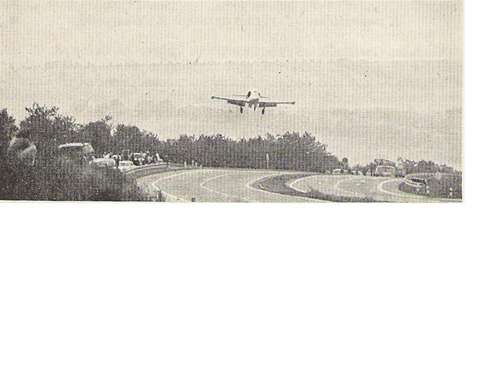
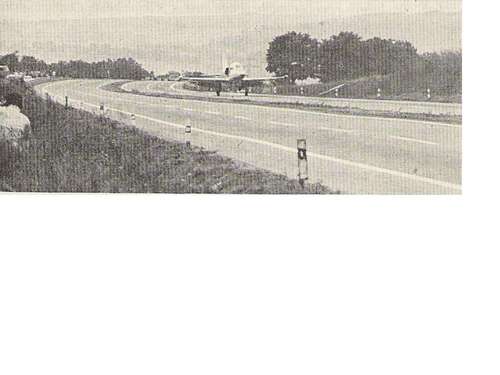
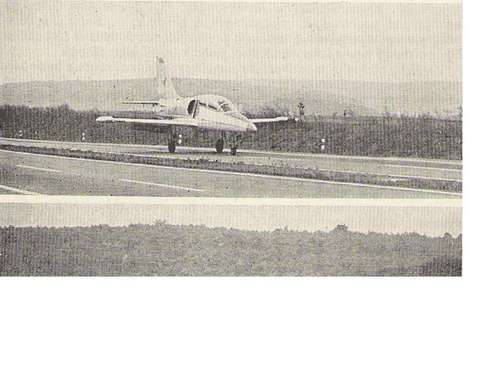
Also regular highway, somewhere near Mlada Boleslav city. (thx Venca Placek)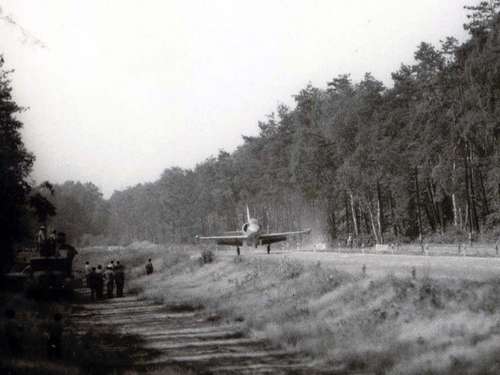
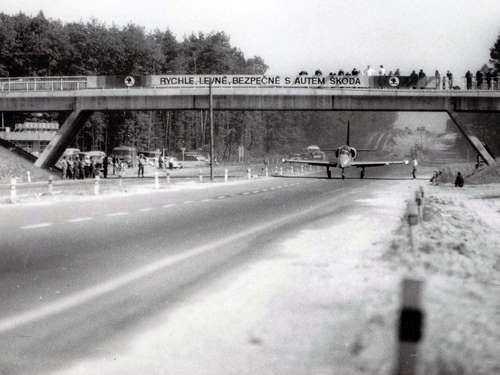
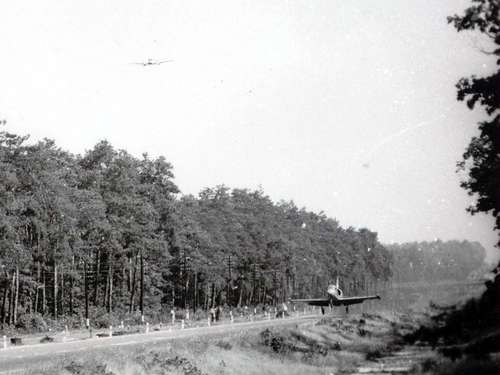
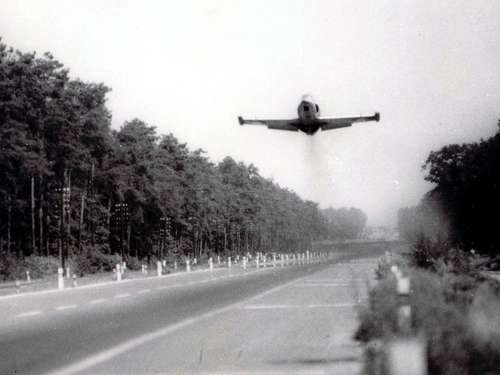
Highway strip near Merin (thx Michal Krechowski)

There are at least 3 runways in Slovakia also.
anatolijoh, sorry, my English’s not so good
better say “in return”? 😉


 Sign In







