 Kovy
KovySome corrections
2. Four of them have been crashed (M22, M24, M25, and M18) since 2009.
3. Ten of them (M1 to M10, Rafale M F1 configuration) are being upgraded to F3 standard as we speak. The M1 will be the last one to get the upgrade .
KovyI personally am very surprised how self-assured the Raptor fans seem to be about superiority of the F-22 concept. I personally see quite huge holes in there. The claimed superiority only takes place when radar emisions are involved – if the opponent is wise enough and turns his radar off, the the F-22 has a tiny chance to spot anything without revealing its own position by pinging the location with the APG-77 (yes, I am aware of the LPI, so are the makers of the digital RWRs). Face it, Raptor quite urgently needs IRST and better IR guided missiles than AIM-9M..
The real advandage of the F-22 occurs in “many vs many” scenario with third party radar tracking.
Aflight of F-22 will see most of its target with accurate tracking data with only one raptor revealing its presence through radar scaning/tracking
On the other hand, a flight of 4+ gen aircrafts will only be aware of one raptor (the one using its radar to feed the others) beyond the IRST usable range.
That’s a significant SA gap in favor of the F22 team.
KovyTMor,
It sounds as though JG74 did significantly better against the Raptor on Distant Frontier than EC7 did at ATLC.
That may down to be the pilots, of course, as JG74 are a highly experienced and very capable bunch of air-to-air operators.
Nicholas10,
A journo is likely to be more balanced and even-handed than a company representative, whether from Dassault or from EF GmbH or one of the EPCs.
In any case, we’re reporting Colonel Andreas Pfeiffer, the CO of JG74, not a journo, nor an EF rep, and what he said was backed up by Lt Colonel Marc Gruene and Major Marco Gumbrecht, among others.
Some of the German pilots had interesting things to say about Rafale, too.
Yet, I notice that you spend as much energy to emphasize this story as you did to downplay the Rafale success at ATLC.
It appears that you are less critical when the typhoon win.
KovyOn the other hand, the IRST being passive, you only depend on your sensitivity and the contrast (not size) between the target and its background, reduced by the diffusion due to environment.
in ideal conditions, say, over sahara at night, an irst may probably detect an afterburner against the cold background, be it desert sand or the sky at 1000km, providing you are high enough so that your target isn’t below the horizon… how useful that may be is another question 😉
The contrast is also a function of the angular size of the target.
And the contrast drops down to 0 fast for spatial frequencies above nyquist.
In short your IIR sensor won’t see a sh.t when the image of your target will be less than a pixel² lost in the sensor noise.
KovyI somewhat tend to disagree. Multirole insists the ability to perform multiple missions that’s correct. Swing role means you are able to swing roles in flight seemlessly. Omnirole is merely am extension by cocering “all” roles. A sei grole capable aircraft might not be able to cover all roles, but different roles. Different variants of a single aircraft type don’t count as multirole per se. Multirole already implies that one aircraft type is performing different missions. Typically multirole and swingrole are more or less tied to each other these days. All mOdern combat aircraft can be employed in different roles and can swings those in flight. You can’t hope to perform all of them within a single flight and that’s first and foremost owed to payload constraints.
I fear that we are going nowhere with this kind of discussions because different Air Forces or constructors tend to use different definitions for each concept.
So instead of trying to agree on the definitions of each term (which is IMHO impossible) we should concentrate on the actual capabilities without necessarily qualifying them as multi/swing/omni/whatever….
For example, monitoring the sky while mapping the group and being able to engage ground and air target without the need to switch your weapon system mode is a valuable capability (Allow better SA and better response time to threats).
On a vanilla F-16C/F15E/SU-27 you can’t do that: you have to choose ground OR Air mode as the weapon system can’t handle both simultaneously. So that doesn’t fit the swing role capability nor the omnirole one (according to Opit. Yet it is far more important over the battlefield that knowing that your aircraft could potentially perform an antiship mission while you are doing CAS.
KovyDassault own definition of an omnirole fighter is twofold :
Being able to perform all the roles of specialized navy or air force fighters
+
Being able to perform several roles during the same sortie
As Dassault is the inventor of this maketing concept, this is what omnirole means whether we like it or not.
Now, as it is only a marketing concept, there is no need to spend 10 pages on that.
KovyObligatory :
Low level flight depends mostly on 2 factors :
-1) The enemy air-defenses
-2) The landscape
Cheers .
-3) The ability of your A2G stand off, weapons to
3.1) be fired at very low level and high speed
3.2) gain altitude by themselves to improve range and fly over natural obstacles (AASM, scalp, ASMP-A…)
3.2) be fired at high off bore-sight angles so that you don’t have to fly over or toward the target, allowing high flexibility in the penetration axis choice.
3.4) be fully autonomous after launch (GPS, INS guidance) while keeping high striking accuracy (fully automatic IIR acquisition)
-4) the ability of your aircraft to perform zero visibility, low level automatic terrain following and A2A monitoring at the same time.
-5) A low IR signature and a robust automatic missile detection and decoying system to deal with manpads.
No doubt, The Rafale system is tailored for that kind of high risk missions.
KovyPolitical pressure apart the Rafale was also not found that impressive
Say who ? Jon Lake ?
Singapore dismissed the Typhoon, Super Hornet and Su-35 but down selected the Rafale because it was not that impressive ?
Come on, be logical.
They assessed each fighter as a whole and the Rafale system was impressive enough to be the only fighter allowed to compete with the most powerfull F-15 ever built. twisted reality spread by a British journalist shall not be seen as fact.
remember, this is not as well-developed as the current Rafale, which is improved gradually.
Yet it was down selected and it was not just to please the French ego.
The F-15T had a much better radar (hugely powerful + more mature AESA) and a terrific bomb payload and fuel load.
Indeed, but the Rafale also had some serious pros, like a much smaller RCS, far better agility, a weapon system designed around sensor fusion, lower operating costs…
What makes you think that the Typhoon is slow to get airborne? It was developed as an interceptor.
QRA mark is quite low..
And weapon range does allow some sort of ‘first shoot’ advantage, while hugely better radar range and azimuth allow broader and more flexible detection and attack patterns – with less dependence on AWACS radar planes. On the minus side it makes the aircraft more detectable.
Lets compare the actual space volume scanned within a given time weighted by the the RCS and ECM efficiency and then decide which system is better for what kind of A2A scenario. That what the Swiss did. and their conclusion is that the Rafale system is better.
I said “engagement” is where the Typhoon did better, not the larger and more demanding category of air policing. But engagement of BVR targets is a crucial point as well.
And I say that we don’t know what the engagement ranking are, in A2A tasks other than air policing.
And as stated by me, the Rafale’s scores are a revelation and the jet is a league above the Typhoon as an overall mutlmission fighter.
obviously.
No, that would be “inability”. If you look at the case of the IAF, they want to spend billions buying Honeywell engines for their Jaguars. For decades these guys have worked the Adour standard powerplants, but all of a sudden they decided it was underpowered and wanted new American engines along with avionics upgrades. It’s a subjective assessment based off what is based on expert judgment rather than mission criteria.
Moreover you have to set the criteria to decide what power settings work well for you. If you want the Rafale to supercruise at Mach 1.4, then it is underpowered for that.
exactly my point.
“underpowered” is relative to the aircraft itself and the tasks you want it to perform, it is not relative to other aircrafts.
You can say that the Rafale is underpowered to do something specific :
Supercruising at mach 1.4 with 3 tanks for instance
or performing a double immelman with 8 tons of loads
But just saying that it is underpowered is meaningless. Or else every single fighter is underpowered.
KovyBottom line is also that the Rafale lost as well – to an F-15, whose vintage is from circa 1973, albeit with improvements.
Indeed, but the final round of the contest was not about technical merit anymore (as in India). Political pressures from the US had to be hudge to overcome the advandage gained by the Rafale during the tech eval.
I suspect that “engagement” did not mean any form of interception to you. There are several phases to intercepting an aircraft and the Rafale had some advantages, but in the end, the “engagement” score went to the Typhoon.
The purpose of an Air policing mission is to id and intercept the target as fast as possible.
When you take all the different stages of the mission into account, The Swiss eval states that the Rafale does that slightly better than the Typhoon.
Again, in an Air policing mission, flying faster and having longer rage missiles is of little relevance if you need twice the time to get airborne in the first place.
I looked at the score for engagement and A/C perf. The former deals with attacking jets in the air. The Typhoon got an 8 if I recall and the Rafale got a 7 or around there.
This is related to Air policing only. We don’t have the detailed results for the far more demanding DCA and OCA type of missions where the Rafale scored significantly higher than the typhoon.
Yes, as an overall multirole jet it is a league above. In interception, it has serious competition from the Typhoon. If you wanted to purchase a jet with the main focus on BVR warfare, the Typhoon has a chance to dominate as long as they integrate their radar being tested.
The Typhoon was supposed to be 2 leagues above the Rafale in all A2A scenario.
The Swiss eval demonstrates that they are more or less equal for Air Policing and that the Rafale is a league above for DCA/OCA A2A missions.
And I mentioned very clearly it was doing great for aerial engagement, where it scored the highest in the Swiss assessment and did so well in Singapore testing. But all that flew by you…
where it scored the highest in the Swiss AIR POLICING assessment
Who cares what you call underpowered engines? What do the test results say?
(a) The Swiss specifically listed A/C performance, and the Typhoon got a perfect score, while the Rafale was quite a bit below.
AIR POLICING Aircraft performances
So power is relative. If you flew a Jaguar the Rafale would look like a mile ahead, but if you flew a Typhoon it would look like a hundred yards below.
underpowered is an absolute qualification and implies that the aircraft is unable to reach required specification or to fulfil its tasks because of a lack of power.
That’s definitely not the case of the Rafale.
The Rafale is less powered than the Typhoon or the F22, indeed, but is not underpowered, far from it.
KovyI’m eager to see Rafale fly with bigger than 250kg bombs…
Well to start with,
the current AASM-250 weights something like 340 kg (I know the AASM is not a bomb :p)
then you have the GBU-24 which is flying on the Rafale for trial since quite a long time now.
http://rafalenews.blogspot.fr/2011/05/new-weapons-for-rafale.html
The A2G weapon integration really starts to be impressive :
In operational service at the end of 2012 (Air Force and Navy) :
DEFA M791 AA/AG
MK82
GBU-12
GBU-22
GBU-24 A/B
GBU-49
SBU-38 (GPS/INS)
SBU-54 (GPS/INS/IIR)
Scalp-EG
AM-39 bkII
Damocles MP
AREOS
ASMP-A
Planed after 2012
SBU-64 (GPS/INS/laser) (2013)
AASM 125 / brimstones / guided rockets (at least one among those 3)
AASM 1000 (>2015)
Damocles NG (2015-2016)
KovyHow was EF linked to Tornado ?
UK payed the old SAAF tornado F3 back to SA.
KovyWRONG.
I understand. You clearly don’t. You can’t engage until you’ve acquired. Engagement is the physical fight (WVR and BVR) and it follows detection (ooh there’s something over there!), identification (oh dear, it’s hostile!), acquisition (it’s exactly there, I can see it with my sensors (or eyes) and I’m going to engage it).
Engagement can be BVR, WVR, with missiles or gun.
I hope you also understand that engagement for an Air Policing mission does not imply the same qualities as for other more demanding A2A missions like OCA/DCA. In those missions, the effectiveness gap in favour of the Rafale was twice wider (1 point) than for Air policing (0.5 point) :
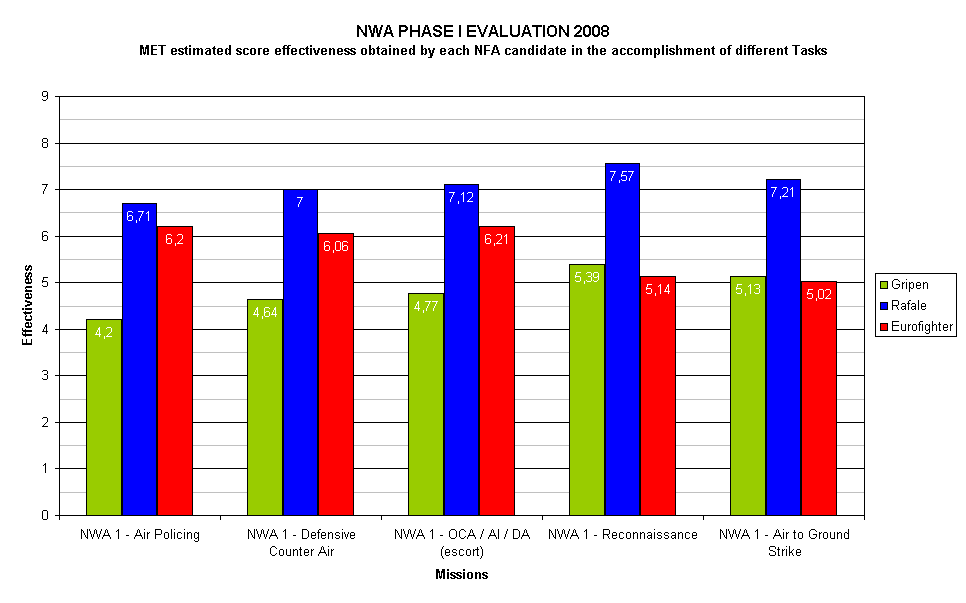
KovyMy corrections
1) Korea –
FACT: Typhoon was rejected after the technical eval. Rafale and F-15 were downselected for the final round. F-15 won after heavy US political pressure.
Advantage Rafale.
2) Netherlands. Rafale was evaluated in flight, F-35 was evaluated on paper, Typhoon evaluation still uncertain. Rafale was rated 2/100 below F-35, Typhoon much lower.
Meaningless, but Advantage Rafale.
3) Singapore –
FACT: Typhoon was rejected after the technical eval. Rafale and F-15 were downselected for the final round. F-15 won after heavy US political pressure.
SUPPOSITION: Jon lake thinks that Typhoon won on technical grounds and F-15 was preferred politically but as he has no proof, this is meaningless.
Advantage Rafale.
4) Saudi Arabia –
FACT: Typhoon selected. RSAF offered Rafale and rejected it. Not a competition so meaningless.
SUPPOSITION: Contract linked to previous tornado contract which was under massive bribery suspicion. Possibly the sale was agreed in exchange of closing the Tornado bribery case for good.
Meaningless but a not so clean Advantage for Typhoon.
5) Brazil –
FACT: Typhoon eliminated and not shortlisted.
Advantage Rafale.
6) Switzerland –
FACT: Rafale and Typhoon both lost to Gripen. Rafale won on technical grounds but Gripen preferred politically and economically.
Evaluation report executive summary as well as partial technical results leaked proving Rafale technical overall superiority in A2A and A2G missions. Swiss Air Force officers criticizing the Gripen choice and pushing for the Rafale.
Advantage Rafale.
7) UAE –
FACT: Rafale selection humiliatingly postponed because of price issues after having been the sole aircraft under consideration …. leading to Eurofighter AND F-18E RFI/RFP
SUPPOSITION: Resuming of price negotiation on the Rafale indicates that the typhoon offer might not be that attractive after all.
Advantage Rafale.
8) India –
FACT: Rafale won after being selected as L1 bidder. Rafale and Typhoon previously downselected on technical merit after an extensive technical eval.
SUPPOSITION: Rafale was the prefered aircraft of the IAF after the technical eval as reported by serious Indian journalists with first hand insight from the Indian MoD .
As usual, Jon Lake thinks that the typhoon won the technical evaluation but he has no proof for that so it is meaningless.
Advantage Rafale.
KovyI am sorry but to me the most disconcerting thing about the Swiss evaluation is how little edge both the modern Rafale and Typhoon got, compared to the old, old Hornet…!!!
What a sad state of affair in Europe…
Swiss hornet are top notch since their “upgrade 25” MLU : HMD, AIM-9x, ATFLIR and the RWR system of the super bug are today’s technology…
main BVR missiles are alike.
Still the Rafale stands clearly above in all missions tested by the SAF.
Despite what you say, this is actually a discovery for many american people who were dismissing any edge of the French fighter over the vanilla F-16 and F-18.
Now, where do you think the Super Hornet would stand in this evaluation ? Probably not higher than the eurocanards.
The real surprises of this eval were the really weak scores of the Gripen and the inability of the Typhoon to surpass the Rafale in its advertised domain of expertise (A2A) despite longer range BVR missiles and better “a/c performances” for Air policing.
That tells us how good and consistent the weapon system of the Rafale is, with no noticeable weakness over the whole range of missions and all this, despite the lack of HMD, puny radar, short leg BVR missiles, underpowered engines, obsolete IRST, French (ie terrible) MMI, inability to supercruise…etc.
KovyThe FSO is better for visual ID in daytime conditions and a new IRST channel (still coming….) will improve day/night detection and tracking for firing solutions. The IRST is an absolute must for the Rafale’s FSO to equalize against the PIRATE.
You don’t seem aware that OSF-IT currently entering French Air Force validation phase has an extended IR capability for night ID


 Sign In







