Kovy
KovyThere is no need to argu, if the french air force is still using low altitude penetration it means they still consider it effective.
This will be more survivable against modern ground based radars that are now able to detect so called LO aircrafts at very long ranges, not even talking about other anti stealth detection means.
Anyway, it is not a black and white issue and it depends on many factors
capability of your fighters and their weapons.
capability of your intelligence network.
capability of other strike assets (Air, sea and ground) that you might have.
The Rafale is consistent with the french Military forces doctrine and budget.
The F-35 is consistant with the US Military forces doctrine and budget.
KovyThe saddest part about this thread is you can buy a 5th generation fighter for under the price of a Rafael. You can stay at med to high alt, and do the mission 10 times more efficiently. Your still trying to sell us axes and arrows in an era of chainsaws and rifles.
Or maybe you are trying to convince us that Windows Vista is so much better than windows XP while in fact the former is full of bugs and the latter is still working just fine.
Smart customers like to wait for a product to prove its value rather than to swallow PR promises.
KovyThe. Age of low level is over, here are a few lessons learned.
You have 2 ways to deal with failure :
either you quit and try another job.
Or you address your drawbacks and improve your skills to have the job done.
1. Iraq used cell phone spotters, and AA traps during GW2 to mission kill deep penetrating Apache strikes.
While French tigers and gazelle were extremely succesfull over Libya (with no loss)… so what to conclude ?
Yet I would agree, that helicopters are more vulnerable than fast jet due to their low speed.
2. Package Q in GW 1 showed all you need to do to mission kill a strike package, is force it to dump a weapons load maneuvering.
errr yes, so what ? it is the same for all strike packages regardless of their altitude.
3. Low level suffers a range penalty.
granted. That’s why you need a platform that can carry a lot of fuel without compromising weapon load, and weapons with range booster kits like our little fellow below 🙂 :

4. Tor-m1 and other point defense systems make lo level a death sentence.
Not if you don’t have to fly over the targets and can shoot at high speed from stand off range while maneuvering.
Not if your weapons are fully fire and forget, don’t need lock before launch and can gain altitude to flight over terrain obscales between the aicraft and the target
Not with a fused ECM/ESM allowing good SA to avoid threat zones as much as possible and automatic detection/decoying of incoming missiles.
Not with good mission planing taking the 3 points above into account.
Note that I don’t claim that point defence systems are not dangerous nor efficient against low flighing aircrafts, I just say that with the right tools and tactics they can be dealt with, even at low altitude.
5. Look down fighters and awacs.
That’s why you need good passive detection systems to avoid them as much as possible.
Detection of very low flying aircraft is still more difficul for ennemy fighters/awacs than high altitude bogeys.
You can also have escort aircrats to occupy them.
6. In deserts and oceans you dont have terrain to. Hide behind Google British Tornado losses Gw1
Yet, flying low over the sea or desert reduce dramaticly detection and engagement range of SAM sites simply because of horizon masking.
British Tornado losses during desert storm were due to the fact that they had to fly too close to their target and thus enter the kill zone of Anti-Air defences.
The whole point of Rafale low level penetration profiles are precisely NOT to do that thanks to appropriate mission planing, weapons, fused EW and auto decoying systems.
The low level strikes that the Rafale can perform today have nothing to do with what a tornado could do 25 years ago.
KovyIt’s a matter of habits, to be fair I’m used to both (in France, metric system is emloyed in gliders).
However imperial (nautical miles/knots) are very practical for navigation purposes.
As Swerve said, nautical miles and knots are not imperial units as they are directly defined relativly to the meter by the BIPM.
KovyI never said ability to do low level deep strike wasn’t a valid ability to maintain. Most existing fighters can do it even if odds of them doing so is close to zero these days. You may well end up somehow in in the unlikely position where that is your only choice.
And no rafale is not developed around low level penetration it is like all post gulf war fighter built around medium level with ability to stil do legacy low level penetration.
The combo Rafale + AASM allows long range/automatic very low altitude/high speed penetration to perform stand off/off boresight/over obstacle/all weather/multi-targets strikes.
I’m sorry to say so, but right now, this is quite unique in the business.
This unique capability combined with an advanced ECM sytem like spectra allows far better efficiency and survivability of low level strikes than in the past.
That being said, if the anti Air threat level is low enough, it will, of course, always be preferable to fligh high for obvious reasons.
KovyGuys, it is pointless to argue about the relevance of a single sensor engagement when the point of new generation aircraft is their ability to smartly exploit multiple sensor chanels at the same time and fuse their data to get the best firing solution with the less possible EM emissions.
Passive detection and tracking with short radar or laser pulses in a precise direction with adequate power and timing is the key for discretion and accuracy.
KovyDDM(-ng), Mica IR and Damocles are fused. Are you sure for the FSO IR channel ?
AFAIK, in 2010, they decided not to fuse it, maybe my information was wrong.
errr, I will have to check that.
KovyYes but the OSF modules are not of a common standard. All Rafales delivered after 2008 were without an IRST. So, the specific software fusing IR feeds would have to be written for what… 50 odd aircraft, less than a quarter of the 287 planned (at the time). Even the F1s wouldn’t have been upgraded with the MDPU until 2014-17.
No OSF if dedicated to a particular Rafale. There are 40+ OSF with IRST in service that can be fitted on any Rafale, depending on the Mission.
BTW, the OSF is not the only optronic system available. You also have the DDM-NG which is also fused.
KovyIf we go by the advertised ranges of modern radars (150-180km against 3 sq. m. target for RBE-2AA), most loaded fighters are detectable at ranges well exceeding 100km, while the corresponding figure for a VLO fighter like the F-35 will be at extreme WVR ranges (if not lower). The sheer scale of the tactical advantage that confers cannot be understated.
That is if you assume that the F-35 will be tracked and targeted by RF seekers only. Actualy, Its VLO feature apply to a limited range of the EM spectrum. It surely helps but it also impacts negatively other aspects of the aircraft (agility, maintenance costs).
But all this has already been discussed to death in the appropriate topic…
KovyOld facts are no longer facts since Captor-E and upgraded DASS will be operational before 2017
Let the Swiss Air Force check your “facts” in 2017 then.
KovyRandom, groundless assertion. The UK manages fine.
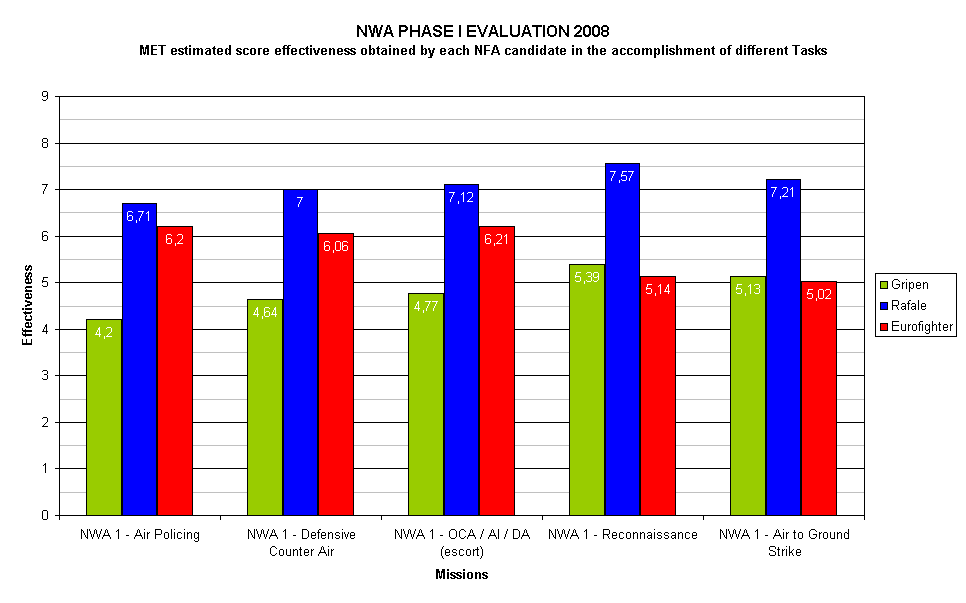
See QRA ranking in the Swiss eval…
The last defence of the Rafale protagonist when confronted with facts… dismiss the facts.
Here are the facts that we know of :
[ATTACH=CONFIG]237111[/ATTACH]
The rest is whishfull thinking until proven relevant and useful by another independant eval. :dev2:
When this will happen, I will be glad to aknowledge any Typhoon superiority.
KovyAnd this is undoubtedly the nation’s greatest security asset, much as Australia’s isolation is its greatest security asset, and the English channel Britain’s. But this does not alter the reality that the nations bordering Switzerland are more readily able to project power against it than those that don’t. Nor does it alter the reality that larger nations are more threatening than smaller ones. Hence France, Germany, and Italy must rank higher on Switzerland’s threat table than Sweden.
Who knows, The Vikings may return. :very_drunk:*
[ATTACH=CONFIG]237094[/ATTACH]
KovyDude, give it up. No European nation is going to invade Switzerland. NATO, the UN and the rest of the EU simply wouldn’t stand for it, or indeed any transgression from outside Europe. As such the main function of the Swiss AF is to intercept unidentified planes quickly. You’ve got to at least be realistic here.
Swiss didn’t evaluate it based on Captor-E, Meteor and upgraded DASS. If they did, and still found the Rafale better, they need their head re-wired. In the small stretch of airspace they have to cover, the Typhoon is the only one that can get to M1.6 at 36,000ft in under 2.5 minutes and sustain Mach >6g at M1.6 at that altitude. Larger radar than Rafale, swash-plate mounted, therefore better for RCS reduction and maintaining track of targets after disengaging and has a 2-way datalink for Meteor, providing better feedback as to whether targets were destroyed. Recessed BVRAAM carriage, lower RCS and drag…. bottom-mounted intakes better for climb…. ramped intakes better for supersonic acceleration…. better supercruise ability…. higher service ceiling…. smaller canard span, better for RCS/drag reduction…. better performance at typical intercept altitude…. longer range IRST for passive detection of aircraft…. the list goes on. Omnirole applications, argue away that Rafale may be better, but for interception the Rafale doesn’t have a patch on the Typhoon.
Hope that was enough special sauces for you. Basically, with Captor-E, Meteor and upgraded DASS, everything puts it in a different league. Given the size of the patrolled airspace, the Typhoon can shoot up to M1.6 at 36,000ft from brakes off in <2.5 minutes and then supercruise with a missile-only fit (no tanks) at M1.5, gain the earliest detection of intruder/unidentified aircraft with the longest range AESA radar of the 3 (F-35 excluded) and also passively detect from the longest range, with the longest range IRST (out to 80nm). In a hostile encounter, it can attain the most kinematically advantageous position prior to taking action, or merging.
Once again, that’s PR brochure stuff. We had the same kind of rethoric back in 2008…
exemples :
What the point of being able to get to mach1.6/36Kft in 2.5 min if you need 5 more minutes than the competitors to get ready for take off in the first place ?
What the point of talking about canard/radar/missile RCS when it’s the total RCS that counts ?
What the point of talking about a better DASS if you don’t know the relative capabilities of the competitor’s current ECM systems ? (BTW, previous DASS was quoted as a Typhoon weak point during the 2008-2009 eval)
What the point of a longer range IRST if you can’t identify and engage passively in BVR ?
Shiny data don’t necessarely make a system consistent.
KovyAs above. Given the intended duties of the aircraft, Typhoon is probably the best aircraft in the world for that role. And I can see why Gripen would be considered on the cost basis. But I don’t understand how Rafale even gets a look in here (it is no doubt a superb aircraft, but not as suited to Switzerland’s needs as Typhoon), and the Super Bug even more so. Surely F15 or f16 would be more suited?
That’s the theory based on PR brochures.
Now, when you actually test the aircrafts in real life, like Switzerland did in 2008, results might be quite suprising for some people…
KovyAre you confusing the mounting angle of most US fighter AESAs with that of the Typhoon?
The Typhoon AESA has a movable mount. It is NOT mounted tilted upward.
I am a bit confused by the article though,
It seems to me that they discribe 2 possible functions of the swashplate that operates in 2 opposite ways :
The swashplate is supposed to enable wider scaning and tracking range by moving the antenna towards the target but it is now also supposed to enable lower RCS by moving it away from the target.
Isn’t that a bit contradictory ?
BTW, couldn’t a fixed antenna aircraft achieve the same lower RCS trick by managing the aspect angle of the engagement ?


 Sign In