Hello Rob,
I’ll PM you details of the company…not cheap mind you. They do all marks, and supply BBMF.
Thanks Sopwith, I agree! Expect to hear sounds of a Merlin III over Leicestershire in the next few years, and then nobodu can say there’s not a Mk1 flying in the UK!
Here’s the front screen and main canopy. Rear screen is on its way. I managed to get a correct Mk1 frame section last year, (front frame of rear canopy), so we have a good template to work from, but equally, I know how tricky this job will be.
Here’s another little up-date on our project. We’ve just launched a dedicated website, which brings together all of the information (or will eventually, as I keep thinking of other things we’ve not yet added!). Address is:
Also, I was interviewed on Thursday by BBC Radio Leicester about our progress, if anyone is interested, it can be found here, click to about 1hr 10 mins:
http://www.bbc.co.uk/programmes/p031c14w
Finally, we managed to secure out canopy and screens. Correct Mk1a flat-sided with knock-out panel for the canopy, and wrap-around front screen. Now for the headache of making the frames…and not damaging these expensive parts. They are airworthy condition, and absolutely stunning! I’ll attach an image in a min.
Many thanks Gerry, that is a very generous offer. I’ve emailed you.
Dom
And here is our most recent purchase:
Whilst we know that P9503 was fitted with a resin seat, we have to be realistic and say that the chances of getting one are ultra slim, but this metal one is of the correct type for early Spits, so suits our build perfectly. P9374 has the same seat, and that as we know is a very accurate Mk1 of the same period.
On Wednesday 11th March 2015, we welcomed a number of guests from the Leicester branch of the Royal Air Forces Association, (RAFA) amongst which the guest of honour was WWII Spitfire pilot, Jeff ‘Dicky’ Bird. The group had come to see our project and the progress we had been making. Dicky had heard about the project some time ago, and had been keen to visit, but it wasn’t until now that mutual times could be arranged. Dicky and our visitors were very impressed with the Spitfire as she stands currently, and were also interested in the original parts we have from P9503. He has already expressed an interest in returning for one of our Sunday workshops so that he can meet the boys, and watch them at work on it.
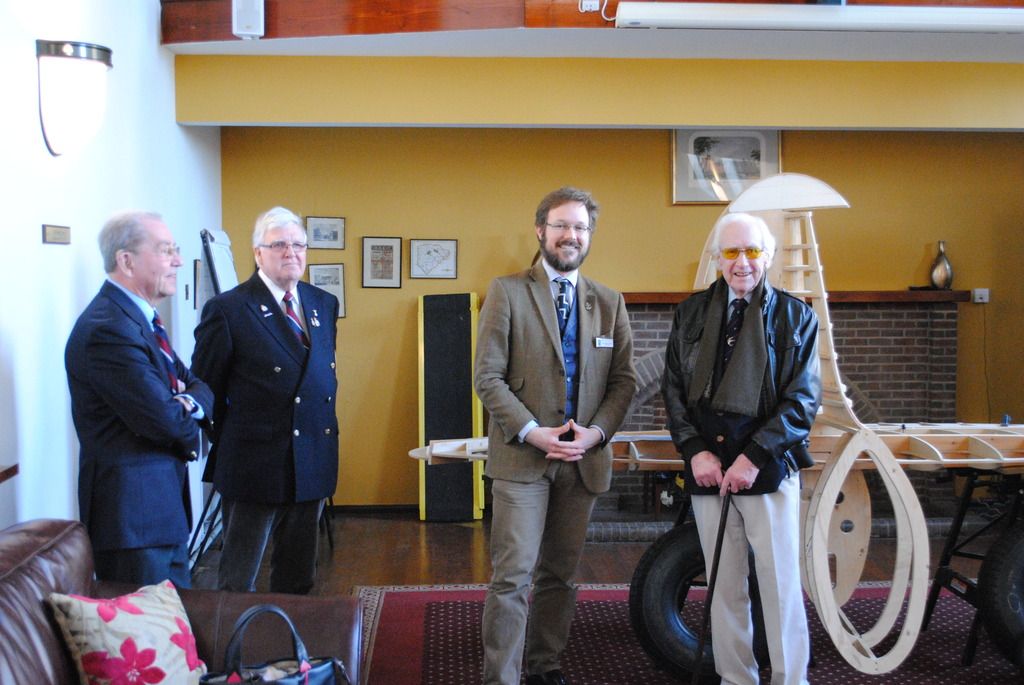
Dicky signed up for the RAF in 1939 following the outbreak of the war, and was sent to South Africa for his advanced training. I asked him how he had spent his time whilst on board the ship heading south for five weeks, to which he replied that he had passed the time earning lots of money! It transpired that Dicky had got to know an Australian professional Bridge player who taught him, and as a pair they cleaned the ship of their competition, disembarking in the southern hemisphere with their pockets bulging with £10 notes! In many ways Dicky was fortunate to do his training in South Africa, the weather was certainly more favourable than Canada which was another place where large concentrations of commonwealth pilots received their training. Following his training, where he accrued some 300 hours on Spitfires, he prepared to be sent into battle. The troopship prior to his was torpedoed on its journey north, with the loss of man y trained pilots, so Dicky elected to head to the front across land. At one point he found himself on board a train where the only form of exercise was, in the morning, to make ones way to the front carriage just behind the locomotive and jumping down, run alongside the train. It was of course moving at a faster pace than a running man, but as long as you grabbed the last carriage before the whole thing passed you by, you were alright! Dicky was posted to join 72 Squadron and fought in Tunisia, Malta, Sicily and was on the Italian mainland at the war’s end. At 95 years old Dicky still manages to captivate his audience, and I could happily sit and listen to his stories all day long.

That’s exactly what it is – a boost gauge adaptor plate.
Thanks Whitley, the orientation and screw heads tells me that it must therefor be front-mounted over the old aperture. That makes it a square plate over a round hole. If you look at the first picture I posted, it is actually on its side, with the base being to the right. that lower corner is definitely square. Just loking for confirmation. We do have the Boost gauge face as well, which is cool, even if slightly mashed, it nonetheless confirms the small +8 Boost
This is absolutely wonderful! Having read right through and seen the progress over such a short amount of time, I’m very impressed!! I wish I’d gone to your school.
Thank you! I wish I thought ti hadn’t taken too long either, I’m impatient to really get it moving along.
Thanks Ian, that seems like a good suggestion to me, I’ll investigate further and post my findings.
Dom
Thank you OldSpitty, I think that is going to be our route…finding a mould, or making one is another matter all together.
We’ve been looking at the paint remains in an attempt to discover whatever we can about what she was wearing on the day she crashed. We’ve got plenty of exterior dark green, and exterior light brown, so will get them scanned and tins made up. This is something I’d rather do sooner as the colours have been preserved out of the light for 74 years,and before they change it would be nice to get accurate scans. Have also been looking at the many ammunition cover catches, lots in both of those colours too. The ones from the underside are clearly in pale duck egg blue…but very exciting to see very clearly that some have black underneath and others white, which in my mind tells me that P9503 originally had the early black and white underside. Very cool discovery! I was hoping to find that she was in B&W when she crashed simply because it is a more unusual scheme, and we will definitely be making our replica as exacting as we can discover on the day Paul Baillon bailed out of her.







