 RadDisconnect
Curiously, -220 engined F-15E can do M2.4, but -229 engined ones can only do M2.3. Though it would have improved kinematics of F-15C very much.
Indeed, the -229 even has lower bypass ratio of 0.36 compared to the -220’s 0.63. Not entirely sure why the max speed is slightly lower, perhaps lower bypass ratio means dry exhaust stochiometric ratio affects afterburning thrust? Even so, I’d take the -229 any day. Better acceleration and overall performance trumps a 0.1 Mach difference in dash speed.
Speaking of engines, this is a pretty unique shot of the T-50. Looks like a rocket.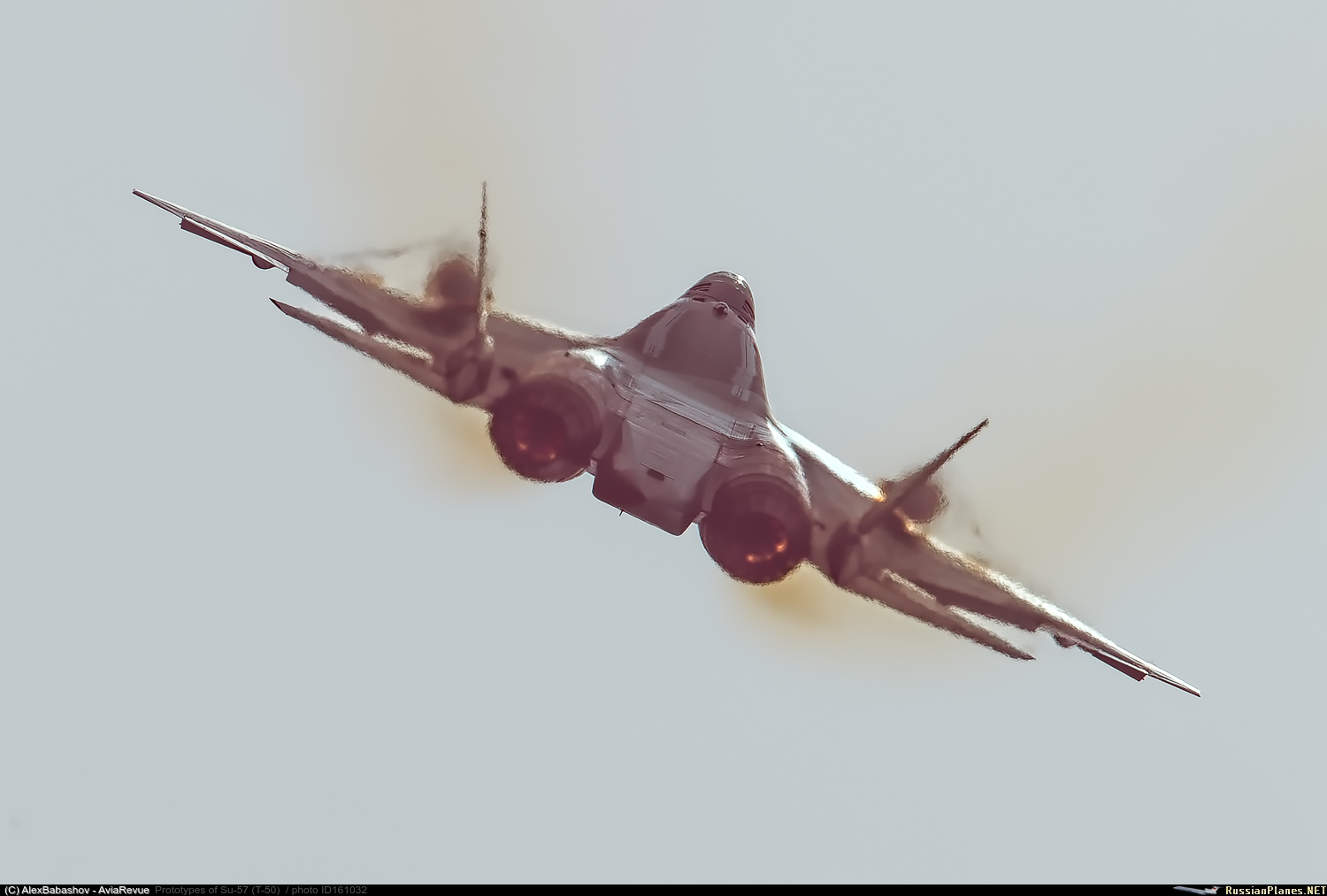
RadDisconnectAndraxxus, you’re making hasty conclusions because you’re basing everything on the original -100 engines. The F-15C with -220s will do Mach 2.45 at 40,000 ft (1,620 mph) on a standard day, and Mach 2.35 with launchers. So the F-15 with -220 engines in the mid 80s is faster than the MiG-29. Envelope pictures below.


By the way, the F-15C can accommodate the -229, but USAF chose not to install them. Performance would be pretty scary.
Paul Metz has flown F-22 at 1600+mph,
Berkut, I think his line is “it’ll [F-22] do 1,600 mph” and I think this was from a TV interview in the early to mid 2000s. It’s difficult to track down since it was before the days of youtube. From this line we don’t know if it’s a predicted speed based on calculations or actual test flight results.
As I’ve said, two sources I consider reliable, Jay Miller and F-22 program manager Jeff Babione, point to max speed of Mach 2.2. Again, with supercruise of Mach 1.8 the F-22’s max speed frankly doesn’t really matter, and the same applies for the T-50.
RadDisconnectDoes the Internal Bay of PAK-FA and JSF designed to carry the same weapons payload or do they vary in some ways , in terms of weight of payload and numbers , length etc
It’s fairly well known by now. The T-50’s internal bays are about 4.6 m long and 1 m wide, and each bay can hold up to two 700 kg (1,540 lb) UVKU-50U ejectors. So as it currently is the two main bays can theoretically hold a total of 2,800 kg (6,170 lb) of payload.
For comparison, each F-35A/C bay has a bomb rack rated for 2,500 lb and a missile launcher on the bay door for a 350 lb missile, so total internal payload on the F-35 is something like 5,700 lb. On the F-35B, the 2,500 lb stations are 1,500 lb instead, which makes for 3,700 lb internal payload.
Because you throw a random Mach 2.35 number for typhoon. I want to know how you came to this number & at what altiude. thats why i ask.
http://www.baesystems.com/article/BAES_159814/typhoon
Here you go. 1,520 mph at altitude is roughly Mach 2.3. But your slow head completely missed the point, so let me spell it out to you. The Typhoon with its large composite usage is limited below Mach 2.35, and operationally around Mach 2. Coincidentally, Sukhoi’s paper arrived at the conclusion that Mach 2.35 is the practical limit for extensive and affordable composite use. It was for structural reason the PAK FA max speed was relaxed from Mach 2.35. Is this clear enough?
why do you think they increase the fuel capacity of Su-35 by 2 tons. (they could have reduce the fuel capacity and make the plane lighter)
it is to give it sustain top speed. EF has very draggier design like F-16 with that raise canopy and small fuel tanks relative to its weight and size.
And this has absolutely no relevance to speed performance. You’re a master of non sequitur.
I did provide evidence .Export Su-35 has 2500 Km/hr speed. Its reasonable to assume that Ruaf Su-35 are faster than that number. PAK-FA has twice the supersonic range of Su-35 and Su-35 by itself has huge supersonic range.
You call this solid evidence? There’s a difference between export Su-35 performance? That is your speculation. You evidently don’t know what evidence is. And in case you misheard, the T-50 has twice the supersonic range of the Su-27, no comparison was made to the Su-35.
You still stand by your Mach 3 PAK FA delusions?
RadDisconnectT-50 need to operate at 2600 km/h at 24000m+ altitude to break envelope of Patriot PAC3 MIM-104F altitude 79500 feet (24200 m).
:stupid: So you’re saying the T-50 will operate at an altitude beyond its life support and crew escape system limitation of 23 km? And 23 km doesn’t even mean the aircraft will operate that high, due to design safety margins that should be built into crew escape systems. I can point to a random system on the F-15 that works 65,000+ feet, and that means the aircraft can operate that high?
EDIT: Do I need to mention how idiotic it would be to assume safety above 79,500 ft when the PAC-2 and SM-6s fly much higher? :stupid:
EF carries limited internal fuel. it cant even sustain Mach 2 let alone Mach 2.35. Show me official link of EF top speed and Altitude?
MIG-31 replacment is Mach 4.3 class fighter not Mach 3 PAK-FA.
Wow… So why did you ask about the Typhoon’s max speed then? Because I presume that since it uses considerable amounts of composites you’re interested in knowing its max speed for comparison, then you totally change topic to something completely unrelated and said “NOPE limited internal fuel on Typhoon. So Mach 3 PAK FA”. You haven’t provided a shred of solid evidence. Are you even listening to your drivel? How does that have any logic?
I’m about to report both JSR and Isengard for sheer stupidity. I’ve seen ignorance and delusion before, but rarely of such magnitude.
RadDisconnectT-50 uses alot more powerfull engines. and T-50 using far more composites in body than Su-35.
what is top speed of Typhoon since it use composites.
Typhoon is operationally limited to under Mach 2.35. Still nothing to support your Mach 3+ T-50 fantasy.
I was about to say that if the russians went into all this trouble of putting all that staff on the plane and risk having to solve the problem of a partially exposed engine facet and it is still only marginally faster than its direct competitor, the raptor, then all this was for what?
I think it’s for weight and usable volume. The T-50’s layout allows for much larger weapons than the F-22 and more fuel too. It seems that unlike the USAF, the RuAF chose to put more emphasis on range and payload rather than all out stealth. Max speed is not the only thing that drives wing sweep, look at the Typhoon or Rafale for example.
RadDisconnectWell, the Su-35S has a 6% larger airintakes.. i might have an impact on top speed, it might not..
I was simply replying to JSR’s ridiculous “logic.”
Su-27 is much lighter (less avionics, no OBOGS, no TVC,) and much shorter life span fighter. Su-35 can fire 5 long range cruise missiles. Su-35 specification are likely for export. T-50 has much bigger design advantage over Su-35.
The T-50 will also be heavier than the Su-27. And none of what you said has any support for your fantasy of Mach 3+ PAK FA.
Then again in JSR world gun+TVC=AAM shootdown.
RadDisconnectIn the report i’m referring to that was withdrawn, that imposed a limit on F-22 to mach 1.82 or 1.92,
it stated stress on the vertical tails due to heat as the reason,
PAK-FA tails are on a single hinge, so that hinge will either be heavy or weak
IIRC one of the structural retrofits to the earlier F-22s was strengthened vertical tail attachments. That limit likely no longer exists for retrofitted and newer airframes.
T-50’s vertical tails are smaller, so buffeting as Jo Asakura pointed out would not be as severe.
RadDisconnectOne thing to keep in mind is that the PAK FA’s original RFP asked for a max speed of Mach 2.35, and this eventually dropped to Mach 2 due to materials in December 2004. Also note that the PAK FA’s configuration and shape was also decided around that time too. A Sukhoi paper from 2006 outright stated that Mach 2.35 is about the max practical speed for composite usage.
http://www.secretprojects.co.uk/forum/index.php/topic,15626.0/all.html?PHPSESSID=vmmeien6ttp0886kkk6sd6g4l7 From flateric
Front-line fighters have their own critical performance requirements for the use of composites in the design. In this case, the share of composites applications is most affected by the maximum airspeed – more precisely, a Mach number.
The largest share of composites application with a maximum weight effect can be realized in the design of the front-line fighter aircraft with a maximum flight speed of 2.1 M, as the range of temperatures of airframe skin surface lay within the range of operating temperatures of the existing composites.
However, in this case, there are areas with increased operating temperature, where the use of composites is practically impossible, like nacelles of powerplant based on augmented turbofans, especially in the afterburners area. Due to the large thrust-weight ratio of modern front-line fighter and dimension of modern powerplants the mass fraction of metallic nacelles in the airframe is quite large.
The absence of metal armor and less stringent requirements for repair in the field can significantly extend the use of composites in the construction of the front-line fighter in comparison to attack aircrafts, so composites can be widely used in the fuselage, wing and empennage.
Domestic front-line fighters are intended for operations from non-prepated runways, and that limits the application of composites
in the lower and side surfaces of the mid-fuselage and aft-fuselage, as well as lower part of horizontal tail. But forward fuselage, in contrast to attack aircrafts, can be built mainly from composites.Erosion problems with the leading edges of the wings and tail of the front-line fighters are as valid as the for the ground attack aircrafts. The difference in the sweep angle of the leading edges of the wing and tail is compensated by an increase of the maximum flight speed at sea level.
For front-line fighter with a maximum speed of flight M=2.1-2.35, there are additional restrictions on the use of existing composites in the area of air intakes and air duct of power plants due to deceleration of airflow to subsonic speeds with heating.
For supersonic interceptor with a maximum flight speed of M=2.35 use of existing composites in load-bearing structures is almost impossible, because their level of heat resistance does not cover the interceptor’s operating temperature range. Here composites
can be used successfully only in airframe parts, protected from aerodynamic heating, such as equipment bays, and crew cabin.Development of the new composites with high level of mechanical and thermal stability and higher performance than the metal alloys is a complex scientific and technical challenge, since the strength of composites more determined by the strength of the polymer matrix and the strength of its connection to the reinforcing filler, the mechanical properties of all polymers with increasing temperature faster fall than mechanical properties of the
metal alloys. Possible progress in heat resistance composite materials is associated with the use of metallic, ceramic and carbon matrix, but their mechanical properties close to those of metal alloys, price is excessively high, and manufacturability is lowered.
While it’s true that some composites like the BMI used in the F-22 can tolerate greater heat, but even then the F-22 is pretty close to its thermal limit, as there are pictures of the F-22’s leading edge paint being peeled and canopy chipped. The Sukhoi paper seems to say that the additional complexity and cost of going above Mach 2.35 isn’t worth it. It’s possible that they’ve raised the PAK FA max speed requirement again, but there’s been zero reliable evidence suggesting that, and quite honestly there’s no good reason when MiG-31BMs are being modernized, and the RuAF has plans for a dedicated interceptor to replace it.
As I said, when Metz said 1,600 mph for the F-22 I don’t know if that’s achieved in flight test or if it’s simply a value predicted through calculations and wind tunnels. Recent reliable sources generally indicate Mach 1.8 supercruise and Mach 2.2 max speed, based on F-22 program manager Jeff Babione. Also, Advanced Tactical Fighter to the F-22 by Aronstein, Hirschberg and Piccirillo (the definitive book on the ATF) stated that heat stress at Mach 2.5 is much worse than at Mach 2, which is the same conclusion as Sukhoi, and that may imply the ATF max speed was relaxed for the same reason the PAK FA’s max speed requirement was lowered.
http://www.flightglobal.com/features/Lockheed-Martin-F-22-Raptor-Special/the-last-f22/
its not hard to accept the innovative vertical rudders can only take so much pressure
I don’t know what your fixation with the vertical tails is, care to explain?
Did i say max speed is related to range?. Its the supersonic speed range that is double for T-50 compared to Flanker. not subsonic. Since T-50 is smaller plane than Flanker but more powerfull engines so it is reasonable that its top speed will be much higher than Flanker.
:stupid: Nice, so the Su-27 has max speed of Mach 2.35, while the Su-35S is the same size but with more powerful engines but with max speed of Mach 2.25. Care to explain that?
RadDisconnectYou’re so willing to take one pilot words for fact but ignore so many other good sources that never confirms it. :rolleyes: No reliable F-22 source give speed more than Mach 2.
AFM and Jay Miller’s book on the F-22 gives Mach 2.25 max speed and Mach 1.82 supercruise. There’s your source.
You like to cherry pick too. So Milhailov say Mach 2 max speed you believe, then when Bondarev and Zelin say more than Mach 2 you cry no. T-50 is more aerodynamic and sleeker than F-22 and will fly higher and faster. There is no way T-50 can be any slower than F-22 a 20 year old design. F-22 is also full of composites.
The last thing we need is yet another eyeball aerodynamicist. Tell me, what are your qualifications on aviation? For your information, the original PAK FA requirement was Mach 2.35 max speed, and this was dropped to Mach 2.15 and then to Mach 2.0 due to materials considerations.
Though honestly I’m a bit dubious of the F-22 making 1,600 mph, operationally anyways. Heat from supersonic flight is a known issue, and there are pictures of F-22’s leading edge paint peeled away and chipped canopy. Also I’m not sure if Metz said that speed based on actual flight testing results or calculated predicted performance. Reliable sources generally point to Mach 2.2 max speed and Mach 1.8 supercruise, based on F-22 program manager Jeff Babione.
this specification of export Su-35. I expect Ruaf Su-35 to surpass these figures. T-50 has twice supersonic range of Flanker. I am expecting its top speed above mach 3.
:stupid: Because max speed is somehow correlated with range? What’s the max speed of the Concorde then? :rolleyes:
RadDisconnectNo, There is no such thing as isentropy in real life. Even adiabatic process is a mere simplification for calculations and doesn’t exist in real life. Compression is compression, entropy and heat is both scalar and material properties, geometry itself has no effects on either of these. More you compress, more heat and entropy you will generate this is not avoidable.
Range = not range, a point.
Only efficiency you can speak of is frictional losses in flow. From rectengular cross section to circular, compared to paralelogram cross section to circular plus S-ducts. Other than the improved CFD analysis F-22 potentially use, I see no reason F-22’s inlets should be more efficinent in that area too.
I’m speaking of an isentropic compression ramp, which is essentially a curved surface turning into the flow. This theoretically generates an infinite number of Mach waves based on the surface geometry, so the compression done by this ramp is isentropic. Again, this is ignoring viscous effects, so you’re right, isentropic process in real life is impossible. This is in contrast to a finite number of straight ramps at discrete angles, generating a finite number of oblique shocks.
Not directly. For such thing to work, You need bigger than needed inlet area, recover what you can and bleed the excess mass flow away. Maybe it will work for +/- M0,2 range at best. Does it sound efficent to you?
Seems like I misstated a few things. True, you need bigger than needed inlet area to account for the bleed, but most aircraft has a bleed air system, and evidently, this is the approach used by the F-22 and F-35 to trap the normal shock at the throat. At least on the F-35, the bleed air is used for ventilation and cooling. As for its efficiency, it was considered acceptable by Lockheed Martin, and keep in mind that the YF-23 and the prospective F-23 by Northrop would also have a fixed inlet. That said, I don’t have the pressure recovery charts, and I don’t claim that it’s the best approach simply because it’s used on the F-22 and F-35.
2D vs 3D analysis is not for making one better than the other. Ideal inlet is circular, and requires 2D analysis on cylindrical coordinates, as used by most early aircraft.
Rectangular inlets and analysis on cartesian coordinates born due to necessity, as it allowed multiple ramps to move independently to control multiple shocks, which was not possible with circular inlets.
Now 3D inlets came out of necessity as both circular and rectangular inlets are bad for stealth. Its not necessarily efficent, (and has great potential to be more inefficient, due to difficulties in design and implementation) its just another method. F-35’s inlets are also 3D design.
I believe 3D inlets give more options to control shock geometry. For instance, the XB-70 has 2D mixed compression inlet while the SR-71 has 3D mixed compression. But you’re right, 3D doesn’t necessarily mean more efficient.
According to my mk1 eyeball inspection, T-50’s inlets attempt to change geometry from trapezoid to 2D rectengular without disturbing airflow, then compress it 2 inlet ramps. Which brings the question, if F-22’s inlets are nearly as efficient as variable geometry ones (not even talking about “more efficient” claims), why Russians would go such lengths to put variable ramps on T-50?
It’s an interesting question, to be sure. In the end it may boil down to engineering tradeoffs. How much benefit would you get out of these ramps at typical operating speeds? The Chinese didn’t feel those ramps were necessary for the J-20, and it seems like Japan’s ATD-X also doesn’t have variable ramps.
RadDisconnectAndraxxus, I think you are oversimplifying the F-22’s inlet as a simple pitot inlet, when that really doesn’t seem to be the case based on my observation of its geometry. I’ll try to state why based on my admittedly limited understanding
The F-15 has your standard 2D four-shock variable geometry inlet, with 3 oblique shocks and 1 normal shock, and it appears to be a classical external compression inlet. This type of inlet is quite efficient, and similar to the F-14, Su-27, etc. It seems that these inlets have straight ramps at discrete angles based on Mach number, using your usual theta-beta-M relations. From what I can tell from the T-50 patent, it seems to adapt this but in 3D, though it might be mixed compression, I’m not entirely sure. On the other hand, the F-22 has a 3D inlet that seems to be two-shock, but between the two shocks it has a compression ramp. Maybe djcross can chime in and correct me, but I think the benefit of this is that a compression ramp can be isentropic, which makes it the most efficient system possible, but the downside is that since surface geometry fixed, the isentropic compression can only be achieved within a certain Mach range, and this range may be increased by using bleed vents to control the back pressure down the inlet. Again, since the F-22 inlets are 3D it’s more difficult to analyze via geometry compared to the more traditional ones like on the F-15. That said, since the T-50’s inlets are 3D there may also be things I’m not counting for. For instance, I don’t know if the T-50’s inlet also has compression ramps between its shocks, and I’m not entirely sure if the T-50’s inlets are external compression or mixed compression.
T-50’s inlet patent, for reference.
RadDisconnectin long range air combat, sure. it’s a matter of someone spotting the target (be it AWACS, satellite, forward aircraft…) and relaying the target data. then it comes down to pumping missiles at the target
really just the same principle of any SAM system or the F-22 and F-35: detect, engage, keep shooting until its down
and then UAVs and UCAVs have the natural advantage, because they’re cheaper and relatively expandableyou see the same thing with tanks: they keep getting better, but so do anti-tank weapons
so when a country spends years and millions to develop a new tank, a few years later another country brings out its latest infantry based RPG
to the point where well equiped infantry can destroy the latest multi-million Dollar tank with ease and at low cost
it becomes even worse when you look at IEDs blowing up expensive Humveesto compare that to fighter jets, if a cheap UCAV or UAV with optical missiles can sneak up on, or swarm a $150 million F-22 or F-35, they can perfectly well shoot them down
the UAV might not be much, but it’s just there to bring the missile within range
I’d bet the latest Python missile can already take out any stealth aircraft. what platform you launch it from becomes largely irrelevantan on AI, the F-22s hardware and software is already ancient compared to the F-35s
in the same way, the F-35s tech is already old compared to some of the latest stuff out there, because it’s based on 90’s tech
that’s like comparing the best 90’s phone to the latest 2015 smartphone. talk about emberassing
http://www.thedailybeast.com/articles/2014/12/26/newest-u-s-stealth-fighter-10-years-behind-older-jets.html
Geez, if these UCAVs are the ultimate answer then why is Russia investing in the T-50 and China in the J-20? Sorry, but “cheap” UCAVs aren’t the aerial analogues of IEDs, especially in a non-permissive environment.
RadDisconnectOnly Russia alone can afford and technical ability to built 5th or 6th generation (MIG-31 replacement ). China need Russia assistance just like it need it for heavy lift copter/Airliner and J-20 from engines to design influence of previous MIG-1.4X.
F-35 is not 5G fighter it cant supercruise at very high speed and altitude and it lacks TVC. Entire Ruaf will be built around TVC engine fighters with tactics built to fight from high altitude with big jamming pods.Israel can afford only 36 F-35 when it could afford 300 F-15/F-16 previously. so i doubt F-35 production rate will be that high. Plus Arab countries may not afford or buy EU/Russian weopons. so prospects of F-35 is not great there either.
the biggest issue is demographics and dysfunctional funding. Russia with 170m real population is much better position to fund a 6G fighter than US with 450m (latin control over food chain) and China with 1.4b.
There is big limitation coming in water/energy supply in less than 10 years for the later two.
Wow, this is the most asinine thing I’ve read in this thread so far. Thrust vectoring is not some magic bullet like you would believe. And Russia is pushing back the T-50, yet they’re somehow the only country that can afford 6th gen? Are you listening to yourself?
RadDisconnectInb4 JSR starts squawking excuses.
RadDisconnect@Andraxxus: i’m into numbers too, especially dry thrust, additionally, F-22 has better area distribution,
F-35 is a stable design
Stable? You should at least try to get facts correct, or you look utterly stupid.


 Sign In








