 RadDisconnect
Sorry for a delayed answer. Ok, since you have posted the schematic from patent itself, I’ve merged it with Su-27 schematic from SK manual. Its as official/valid as it gets:
Matching them at wings, PAK-FA’s engines protrude slightly at top, its fuselage is fatter but wings are thinner, Su-27’s nacelles and vertical fins/stabilizers occupy noticibly greater space than PAK-FA’s.
EDIT: Its also interesting to see T-50’s inlet area is curiously larger than Su-27s.
Make sure you use the correct wingspans. The T-50 is 13.95 m, I believe. Also, I’m pretty sure the T-50’s fuselage between the engines have bigger cross section compared to the Su-27 to accommodate the weapon bays and possibly fuel tanks. I think the T-50 in that drawing has a very slight nose-down attitude, though its attitude may change flight based on cruise condition.
Most of the people here are working the problem backwards. They have their desired conclusion, then they try to invent justifications that make it true.
You would think asserting that fighters require compromises wouldn’t be controversial, but for a few here it is a totally unacceptable where their favorite plane is concerned.
It’s not that people here think the T-50 is without compromises. Of course it does, but it’s still an excellent aircraft, and it’s not unreasonable to think that an airframe that was designed 14 years later can improve on the F-22’s performance while making fewer compromises (in aerodynamics, at least). We’re not arguing which aircraft is the overall more effective weapon, and while we can form our own opinions based on our observations of Russia’s development in various areas, we won’t really have an accurate answer with so much that’s classified.
Moreover, I don’t think people here are backing the stuff on the Paralay chart with claims like 4,300 km subsonic 2,000 km supersonic range. Discussing the merits of the T-50 doesn’t mean we’re supporting these fantastic claims.
RadDisconnectNo problemo, why don’t you just go back to F-16.net
Cause is nothing of the sort there..?
So you now try to use tu quoque? Good for you! :eagerness:
No need for you to get smart@ss with me.
The Flanker have those huge Vertical stabz, and those ventral strakes for directional stability. The T-50 smaller vertical stabz, no ventral strakes. but those SRAAM bay door are aligned in the forward direction. Hense it add to the forward directional stability.If you took the time to study the latest Flankers(Su-35S), doing display, it has hardpoint racks attatced to all stations on its wings. It help in directional stability, hense it helps the pilot a lot in controling the jet.
Those SRAAM bay door on T-50 do the same, sines they are longer vs those harpoint racks.
Oh my, so now you can eyeball the aircraft’s static margin, center of pressure, and center of mass now? Excellent! Teach me how I can gain your mastery, I can save a whole year of tuition. 😉
Sure i look at the bigger picture. But why can’t we debate the finer details as well? Or is this beoynd your comprehension studying aerospace engineering?
I made a valid point of those large R-33 under the Mig-31 belly, they do have an inpact on drag. Those SRAAM bay on PakFa might as well, but i’ll bet its very negiteble.
Sure T-50 and Mig-31 are different in size and weight. But they are both designed for supersonic flight, the airintakes on both are designed for supersonic flight. Different engines, but they are close in thrust parameters.
Compare an F-15 clean with an F-15 with 4 conformal AIM-7s. Not a big difference, but a difference all the same. As for your analogies between the T-50 and MiG-31, they are so lacking in rigor I don’t even know where to begin. But hey, I ought to trust your godly eyeball which shows that the semi-conformal carriage of R-33s on the MiG-31 has similar overall aerodynamic effect as the T-50’s SRAAM bays.
RadDisconnect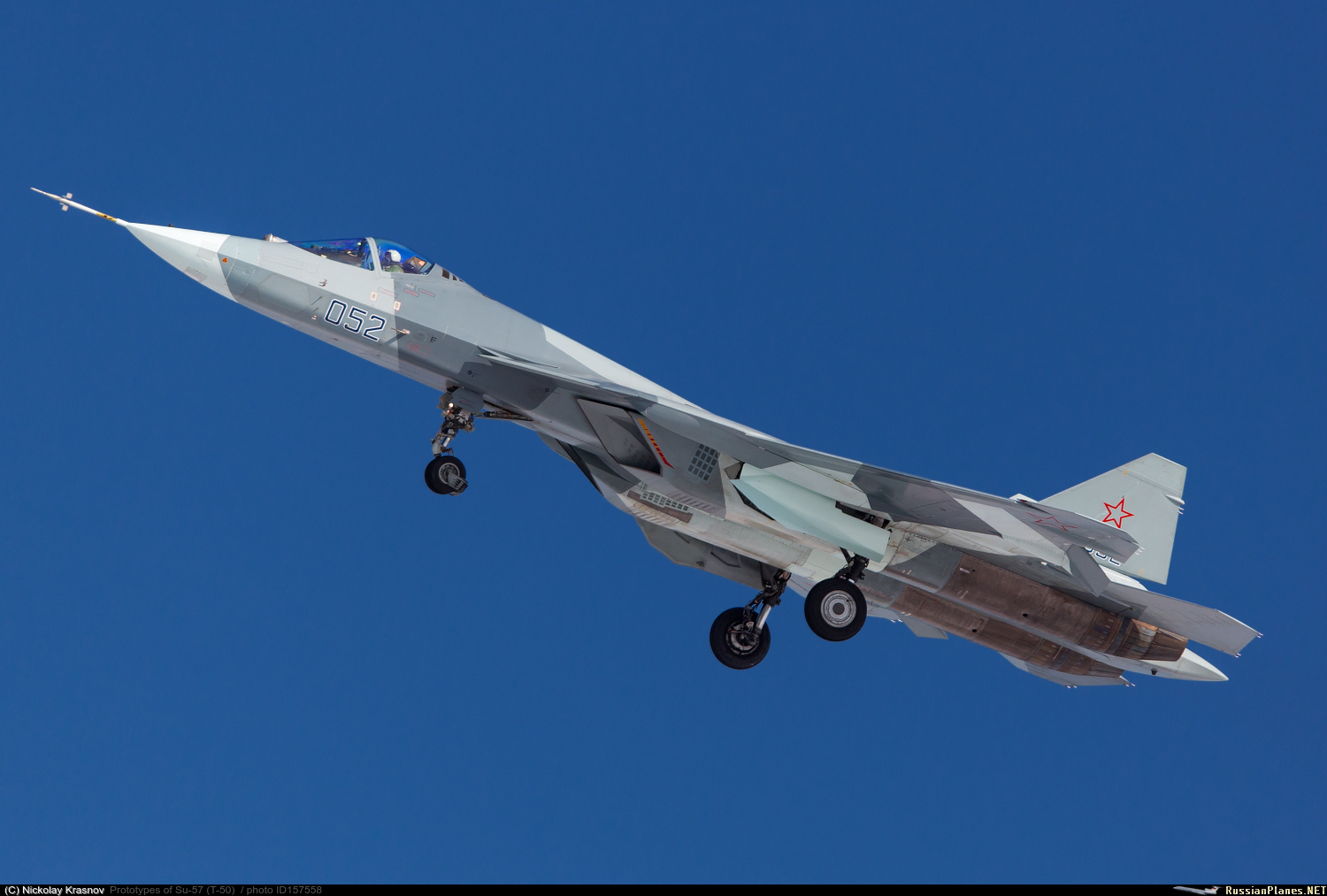

New MLG doors? Also, what is that tube on the side of the intake?
RadDisconnectTo be fair, this is hopsalot‘s underlying argument as well, just from the other direction, i.e. Lockheed Martin achieved perfection with the F-22 Raptor, therefore it is impossible for Russia to improve upon it in any way without sacrificing performance elsewhere.
I can’t stand these kinds of reasoning, no matter which side they’re coming from. And I see it so much here it’s not even funny.
When i said “dirty”, i meant do the SRAAM look like they cause drag in any way?
Care to share with us, since you are so talented at eyeballing those aerodynamic effects? Clearly I must be wasting my time studying aerospace engineering to not see such obvious things! :eagerness:
Come too think about it, the Mig-31 has those huge semi reccesed R-33 slung underneath the aitframe. Do they make any worth mention drag issue. Not much i take it..
You need step back and look at the big picture. And aircraft’s performance is determined by its overall aerodynamic shaping, inlet pressure recovery, and engine performance. Attempting to extrapolate an say that an aircraft has the advantage because of one or a few so-and-so features without looking at its overall effect is imprudent, to say the least. For example, the F-22’s SRAAM bays are fully recessed and tucked behind the intakes, so they present no additional frontal area and less surface area. But that bay space was made by the curving of the serpentine inlets in the fuselage, which adds additional cross section. It’s a design tradeoff, and I’ve already mentioned some of the potential tradeoffs of the T-50’s SRAAM bay. But it’s the total package that matters.
RadDisconnectDude, stating that “this and that” is an unqualified statement on these forum is just like handing out speeding tickets on a Formula1 race..
And it goes both ways, who are you to say otherwise.In terms of Russian Aerodynamic and wind tunnel reasearch, the history of aviation shows us the they sure know their stuff.
I dunno what promt you to cast this “fact” in doubt.
Does those SRAAM bays look so dirty to you?For the sake of this debate, lets us just asume Sukhoi know what they are doing, atleast when it comes to aerodynamics..
Here comes another unqualified statement from me:
Those SRAAM bay may even add to the directional stability of the T-50, the way they are designed.Another brilliant solution.
Your argument boils down to “because Sukhoi/Russia”. :rolleyes:
Let’s follow your train of thought. Fact: Sukhoi (and Russia) has considerable experience in aerodynamics, and is very capable in this field. (I agree) Thus: T-50’s SRAAM bays are a brilliant solution. I’ll let you ponder how solid that logic is.
Note that I am not doubting Russia’s or Sukhoi’s knowledge and experience in aerodynamics and aircraft design. History has shown that they are highly competent in these fields. I’m simply pointing out that differences between SRAAM configuration when it comes to weight and drag are not so easily quantified by just looking at it. But stating this means that I’m doubting Sukhoi’s competence in designing aircraft! :rolleyes: I also like how you put words in my mouth. I said that the T-50’s SRAAM bays may improve area ruling for wave drag but could also add interference drag and shockwaves, not that it “look so dirty”.
And for the record, I like the T-50 aerodynamic design and aesthetics…
RadDisconnectMk1 eyeball; Su-27 is considerably longer, wider, and higher. Su-27’s frontal and side area is considerably larger and its top area is slightly larger. No one can be 100% certain, but all these translates to greater volume to me.
That chart is wildly inaccurate, and produced before schematics of the T-50 from patents were released, or satellite photos of the J-20 were examined. The J-20 is nowhere near that large, since its length is revealed to be something like 20.5 meters long. Also, the T-50’s fuselage is more voluminous than the diagram suggests. Here’s an accurate frontal view of both the T-50 and F-22.
Be that as it may, its a way smarter solution vs the F-22 solution.
I’ll would say it’s only 50% empty hole of that we see on F-22, maybe even less. And i do not think the PakFa store fuel in that area anyway.
And the extra drag from this on the PakFa is very small.This design solution is a mean to increase the internal volume for fuel and larger MWB.
Clever indeed.
Dude, you are making way too many unqualified statements. “Smarter solution” is a meaningless term. You don’t know what the structure of those bays look like, and the net aerodynamic difference compared to F-22 SRAAM bays is difficult to quantify. For instance, placement of T-50’s SRAAM bays may help volume distribution for area ruling but may present additional sources of interference drag and shockwaves. But unless we have actual flight test or wind tunnel data, the overall effect is extremely difficult to calculate, much less eyeball. So just stop, unless you know all the design trade studies that Sukhoi performed.
Tandem main weapon bays aren’t even unique to the T-50. The prospective EMD F-23 would also have tandem bays, though arranged slightly differently.
RadDisconnectI am not entirely convinced these are weapon bays. At least I have never seen a single picture showing them open.
Though those bulges are rather small, that may be because the bays are semi-recessed (which would make another structural “hole”). The K-74M2 that will be carried in there apparently has reduced cross-section.
RadDisconnectPL10 is a copies Alenia Aspide missiles from Italy-based, with an infrared seeker, it is completely incapable LOAL, IIR seeker, all-aspect, the Chinese do not have access to this technology
You must have some damn good sources. :rolleyes:
RadDisconnectNot T-50 but Su-34;
Assuming T-50 positions internal bay towards the downside of the aircraft, there are actually no holes in T-50’s design.
IMHO, dealing with bending moments is easy, as long as there is seperation between weapon bays. However with change of AOA, pressure center also changes, and with only one area to strengthen the fuselage (space between weapon bays), it can also produce severe torsional forces spanwise. Sukhoi appearantly attempted to correct this by controlling pressure center (by levcons) and still unsatisfied so its improving structure for torsional stresses. Reasoning: Adding a top plate to connect longerons would have little affect in bending resistance, however it would wastly imrpove torsional stiffnes (so that wings front will not bend upwards together with the fuselage when pulling high Gs)
You may be right. Pictures of unpainted T-50-1, -2, and -4 shows spanwise reinforcement plates on both the top and bottom fuselage. I was under the assumption that they are for handling bending loads (especially since the bottom plates are rather short but have considerable span), but they may also be there to cope with stresses from torsion, since skin plates are generally for handling shear loads. In any case we don’t know the thickness of those plates. That said, the placement of the weapon bays as well as the launching mechanisms mean that fewer full depth spanwise bulkheads can run through the middle of the fuselage (has to run between the weapon bays). But the fuselage seems to be overall deeper than the Su-27, so it may not be as severe as I first thought, and as you’ve pointed out, the height between the engines for the Su-27 is also low. Also (correct me if I’m wrong), I believe the fuselage longerons were reinforced separately by additional plating down the aircraft’s spine behind the cockpit.

I must say that it’s quite a beautiful aircraft.
Disclosure: I’ve only taken an introductory aircraft structures course so far, so I’m still not proficient in the area. Perhaps my views will change as I get further along in my degree.
There is no physical way to form the shock with the desired angle, without moving the shock-forming geometry properly. Even if F-22 can generate multiple oblique shocks (Claims aside, I would bet some very good money that it cannot) such inlet simply can’t control them. Excluding the single design point, oblique shocks will either end up inside the inlet, out outside; reducing pressure recovery either way. Let them classify all they want, this is the nature of things.
A surface “turning into” the flow can act as a compression ramp and can generate multiple shocks, though without actively controlling the surface geometry the shock angle would be difficult to control. We don’t know the precise geometry of the inlets, though based on the particular diamond intake geometry I believe it would be external compression. But going by djcross’ posts, it would seem that the F-22’s inlets have some kind of mechanism that can limit spillage drag.
RadDisconnectT-50’s internal weapon bays can accommodate four Phoenix-class missiles. Quite impressive.
Also, while the T-50 may be more aerodynamically efficient, its engines are more optimized for supercruise, which would likely mean higher subsonic SFC. Probably explains why it has comparable subsonic range to the Su-27 despite carrying more fuel. On the other hand, its supersonic range is twice as far.
RadDisconnectI’m pretty indifferent about F-35’s appearance, but wow, this is a nice picture.

RadDisconnectIIRC, Sergei Bogdan said more fuel than the Su-27, not Su-35.
RadDisconnectThere we go… rationality. There is no question the F-22 can be improved on, but it won’t come without major compromises. (just as it did for the F-22)
I disagree with “major”. The T-50 is some 14 years newer than the F-22, and aircraft design has not stood still since then. Again, I’m not claiming that the T-50 is the overall superior aircraft (especially since they are designed for different missions), but it’s shortsighted to claim that you must make major compromises to improve on the F-22.
Here is his original claim:
I think the claim is that the T-50 is more efficient in terms of structures and volume usage compared to the Su-35. This means that it can carry more fuel than the Su-27 being lighter. The T-50 may very well have less volume than the Su-27/35 because it has smaller dimensions in all axes. But no one said that the T-50 has more fuel than the Su-35.
RadDisconnectDude, the T-50 has more fuel than the Su-27. We don’t know how its fuel compares to the Su-35. Compared to the Su-27, the T-50 does not have a dorsal airbrake, while also having greater wing area, so those are two potential sources of additional fuel volume.
RadDisconnectExplain? :rolleyes:
This is what I mentioned earlier as “hand waving about advanced aerodynamics.” Yes, the PAK FA is an innovative design, but that doesn’t come close to explaining how it could supposedly beat every other fighter’s best attributes all at once.
I am appealing to reason, a risky business around here.
Is it? Why don’t you share with us your measurements on the PAK FA’s performance.
No one here is claiming that the T-50 is superior across the board. And yes, haavarla’s hand-waving of aerodynamics and structures is not rigorous and demonstrates poor understanding, as I’ve said before, it’s perfectly reasonable for the T-50 to improve on certain aspects of the F-22’s design such as range and maneuverability on certain axes (while making certain tradeoffs in other parameters).


 Sign In







