RadDisconnect
Huh? The both of the cowlings look circular to me.
RadDisconnectNon-metallic nacelles will go a long way to reduce the RCS. Seems like there is extra metal across the middle of the fuselage. Probably integrated reinforcing structures to deal with bending loads?
RadDisconnectI think it will have a larger cold section diameter fan. But the question is how much.
Right from the AL-31F we have seen several increase in fan diameter. And it is the easiast way og producing more thrust.AL-31F => AL-31FM1 => 117S => 117 => idz 30
It’s unlikely that the izdeliye 30 will be large enough to require substantial structural modification. Also, increasing fan diameter alone would alone would increase bypass ratio, and that may not be optimal for a supercruise oriented engine. If anything, I’m expecting the izdeliye 30 to have roughly similar outer dimensions with the 117, but with better performing combustor and higher turbine inlet temperature to increase specific thrust.
RadDisconnectI don’t believe the fan diameter would change very much, as that would mean deeper structural changes. The T-50’s inlet is roughly the same size as the F-22’s, actually. T-50 drawing from patent, F-22 rendering from USAF.
[ATTACH=CONFIG]227832[/ATTACH]
RadDisconnectI don’t think it will be so simple. The diameter will probably be near identical, but the Type 30 will be shorter as it has 2 fewer HP compressor stages than the 117 and brand new materials with ‘clean sheet’ designs for the combustor and HP turbine, indicate more compact structures than the preceding generation.
This means the [S-]duct design may have to be slightly revised in shape and length with a recalibrated guide vane structure (downstream of the bend). Though I’d expect these ‘updates’ to be relatively straightforward.
Changes in Cg due to the Type 30 being significantly lighter will most likely be addressed by FCS software patches.
Ho-Ho-Ho, Tee-Hee!! Wishing a merry Christmas & happy, prosperous New Year to all fanboys & detractors of the PAK-FA!! …and also to those that fall in between (and even those extremists either side!!).
Regards,
JA.
Actually, I think the shorter length of the izdeliye 30 can be compensated by lengthening the augmenter/afterburner. IIRC, that’s what the F-14B/D did to accommodate the F110.
And of course, Merry Christmas everyone.
RadDisconnectAccording to some reports the izdeliye 30 is meant to be a drop in replacement for the 117, which presumably means that they’ll have roughly the same footprint.
RadDisconnectUntil you destroy the missiles the stealth jet fires at you… at which point the stealth jet either has to close to use its guns, or withdraw to cede airspace to you.
[Assuming both aircraft are suitably shielded against the low-powered initial versions of airborne lasers.]
IIRC, current DIRCM lasers are effective against MANPADS, but how much more powerful do they have to be to defeat an IR AAM? Also, DIRCM defeats missiles by targeting the guidance section, while high energy lasers on the YAL-1 target the rocket motor to cause structural failure. It seems to be a dangerous proposition to depend on airborne lasers to defeat incoming missiles. What would you do if the enemy fires multiple AIM-9X or R-74M2 class missiles at close range?
Which makes me wonder, can airborne lasers be used to disable aircraft IR sensors? And how effective would it be for the laser to target, say, the cockpit?
RadDisconnecta lot of afterburner use by F-22 for shows. big tails. big frontal. I highly doubt it has that much range advantage over F-15.
Typhoon slow sales and lack of interest in its upgrades clearly is failure that it sub par product despite political backing of 4 EU countries. think Airbus and Middleast airlines. and without that the raising the price of industrial supply chain for all its products including A400M/Typhoon.
You are talking completely out of your ass. Look at videos of the Su-35S and T-50 during MAKS 2013. Plenty of afterburner usage there. F-22’s and T-50’s frontal cross section are almost the same. And what does the F-22’s range have to do with its drag? There are other factors such as lower bypass ratio engines, which lowers SFC, and lower fuel fraction.
And really, the Typhoon is subpar and a failure? What are you talking about? It has sold over 400 units.
Its size is closer to MIG-29 than Flanker. No tall tails or canards. thin profile. much higher use of composites by weight.
Thin from the side, wide from the top and bottom. The T-50 is substantially larger than the Fulcrum, and most good estimates put it at roughly 18 metric tons. If anything, the J-31 is Fulcrum-sized.
RadDisconnectWhat engines does the Su-30SM use? AL-31FP or 117S?
RadDisconnectTold ya so a while ago 😉 Among the three non-US fifth-generation designs currently flying, the J-31 has by far and away the worst fit and finish. Matt paint strikes again – that’s the ONLY reason it wasn’t so obvious until now. I seem to recall somebody here even thought it was better than the J-20 (quite glossy) in that regard? Boy, is it ever worse!
Which of the non-US fifth-gen fighters do you think have the best fit and finish?
Compared to Typhoon? Based on what?
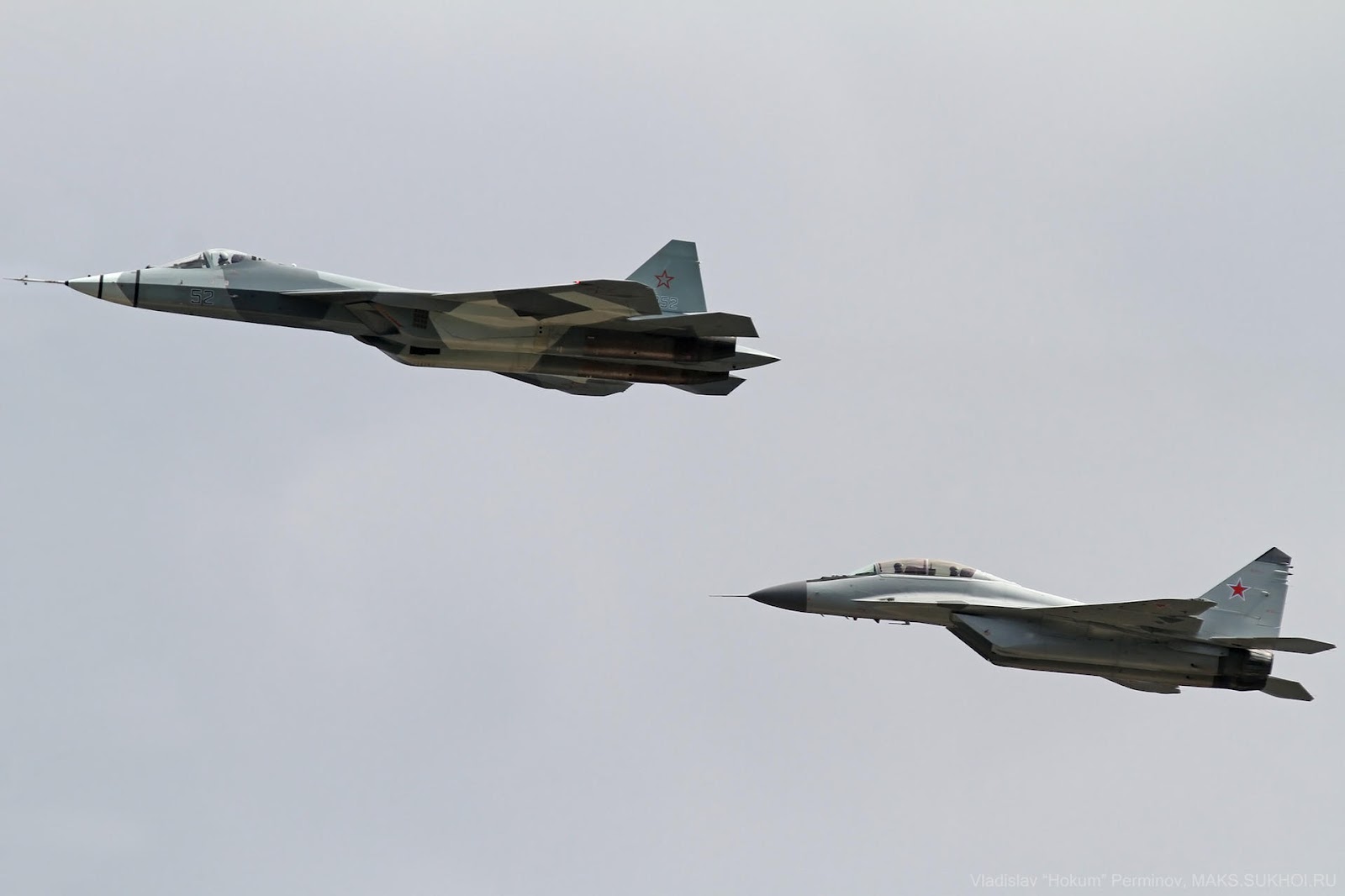
A clean Typhoon is quite an aerodynamic monster, and can give the F-22 some serious competition in certain conditio. While the T-50 is aerodynamically excellent, it will be underpowered compared to those two until it gets the izdeliye 30 engines.
RadDisconnectF-22 is a lot draggier and built with 30 year old materials and manufacturing.
Typhoon is much lower class fighter. more comparable to J-10. Even in Arab world Typhoon has very slow sales despite backed by 4 EU countries.I don’t think PAK-FA is much heaver than MIG-29M. it has twice the supersonic range of Flanker.
F-22 is much draggier? At what speeds? What conditions? And how do you know this? And how does the Typhoon’s sales have anything to do with its performance? Or is that just more unsubstantiated bullcrap you’re pulling out of your rear end?
And T-50 won’t be much heavier than a MiG-29M? What, based on a side picture? Do you even read your posts?
Back to the J-31, what are the planned thrust figures of the WS-13 engines? Are they even being seriously developed? Regarding the RD-93, is it this smokey when fitted on the JF-17?
RadDisconnectUnderpowered to final performance requirements maybe.
Underpowered compared to just about anything else out there? Nah.
Compared to Typhoon or F-22, the T-50 is currently underpowered.
RadDisconnectPlease go on.
Detailed explanation on how its underpowered.
There’s a reason the 117 is considered interim, and that the second stage izdeliye 30 engines are being developed.
RadDisconnectYou mean the removal of the pitot? Or did the spin chute housing get removed or changed?
RadDisconnectHere’s an apples to apples comparison
F-22 timeline:
1985: ATF RFP issued
1990: YF-22 first flight
1997: F-22 first flight
2005: IOC
F-35 timeline:
1996: JSF RFP issued
2000: X-35 first flight
2006: F-35 first flight
2015/2016: F-35 IOC
T-50 timeline:
2002: Design work started
2010: T-50 first flight
2016: First production aircraft delivered to VVS by 12/31
2018ish: IOC
F-22 and F-35 both took 20 years from design to operation, the T-50 will take probably 16 years or so. Keep in mind though, that the USAF required a technology demonstrator flyoff for the ATF and JSF, so even here the comparison isn’t direct.


 Sign In