http://www.dtic.mil/dtic/tr/fulltext/u2/a399988.pdf
Here’s a document that details the effects of making the aircraft suitable for shipborne operation. Wingspan constraint by STOVL, sure. Length, don’t think so. I think single-engine is also highly preferred by USAF, which is by far the largest customer.
Well, if we’re allowing relatively developed concepts, how about the A/F-X, the true successor of the F-14? The most developed A/F-X proposal is the Lockheed/Boeing design, the AFX-653, which derives a lot of its design from the Lockheed/Boeing/GD NATF proposal.
[ATTACH=CONFIG]228830[/ATTACH]
[ATTACH=CONFIG]228831[/ATTACH]
[ATTACH=CONFIG]228833[/ATTACH]
[ATTACH=CONFIG]228832[/ATTACH]
Getting back to the F-35, this little gem was in the news thread:
Why Can’t America’s Newest Stealth Jet Land Like It’s Supposed To?
Seems like a par for the course anti-F-35 article, and more than a little light on actual facts.
I’m frankly getting really tired of everyone blaming STOVL for just about everything. I believe CATOBAR and Navy requirements did more to degrade the F-35’s weight and performance more than STOVL.
I’m seriously hoping that USN’s F/A-XX and USAF’s Next Gen Tac Air will have separate airframes.
So does anyone have a rough date for when the PAK FA reaches operational service? And by that, I mean IOC, not simply having the first production aircraft delivered to the VVS. I understand that the first production aircraft is supposed to arrive by 2016, so perhaps IOC roughly two years after that?
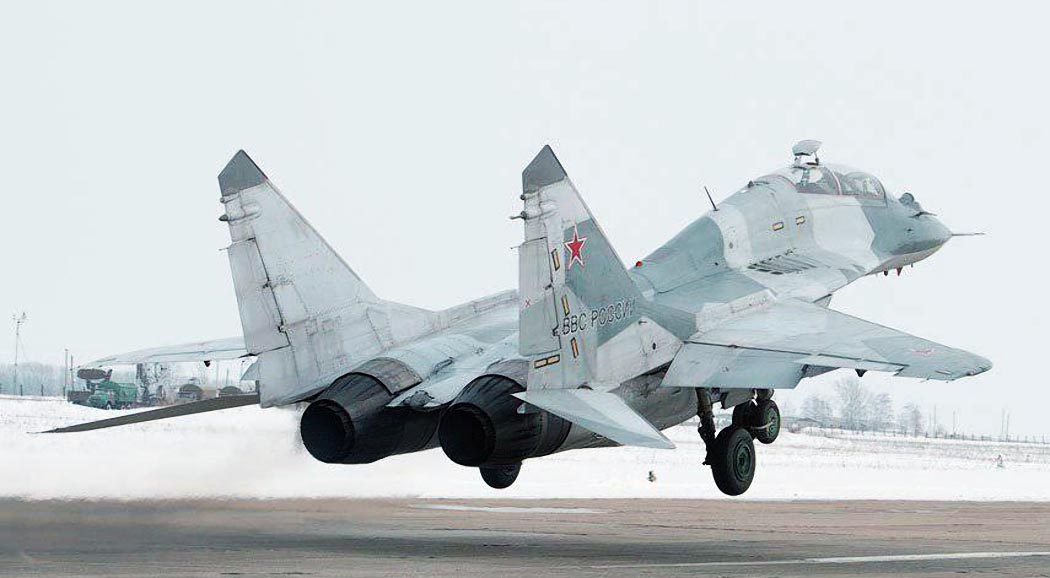
It’s got nothing on the MiG-29UBT.
Did this thing get spine cancer? It looks like a goddamn whale.
http://www.armstass.su/?page=article&aid=128095&cid=25
8 MiG-29SMT will be delivered in 2015 and 8 in 2016.
Good lord the SMTs are ugly with that hump in the back. Just like how the F-16’s looks got ruined with the spine and CFTs.
Okay, I’m frankly a bit confused about the VVS Flanker force structure. Disregarding the Su-34, there appears to be at least 7 Flanker variants being employed in various manners.
Su-27S/P – Vanilla Flankers that made up the bulk of Soviet and Russian Flanker force. Are these being phased out or being modernized to SM?
Su-27SM – Modernized Flankers rebuilt from Su-27S/P?
Su-27SM3 – Modernized Flankers with more upgrades? Are these new-build?
Su-27UB – Two-seat trainer for vanilla and modernized Flankers. Old ones are being repaired to be flyable.
Su-30M2 – New-build trainer for vanilla and modernized Flankers? Not sure what else it’s for.
Su-30SM – Trainer for the Su-35S. But what mission does this plane have other than that?
Su-35S – Heavily upgraded Flankers, similar to F-15C with AESA radars.
What the point of the Su-30SM is other than being a trainer for the Su-35S. What can the Su-30SM do that other VVS aircraft can’t? And can someone please elaborate on the whole Su-27SM and Su-27SM3 upgrade business? I really don’t trust the information on Wikipedia.
How likely are we going to see variable cycle for the upcoming Izdeliye 30 engines? I would hope Saturn and Salyut are pursuing that, because given how much the US is investing in the AETD and VCAT programs, there’s a very real possibility of variable cycle engine on F-35 and F-22 in the 2020s, pending funding.
As for air-to-air loadouts, it would seem like the T-50 is roughly comparable to the F-22, i.e. 6 medium range AAM and 2 short range AAM. Of course, it has the flexibility of carrying large long range AAM, but I don’t know how effective those would be against maneuverable fighter targets.
Thanks. That makes sense. The R-37 is old too now.
Is the 180 to be a ramjet missile?
Unfortunately, rumor from flateric is that the ramjet 180, or 180-PD, has been halted.
That’s interesting. Such as?
Izdeliye 810.
As far as I know, the PAK FA will be using mostly new weapons.
Medium range AAM is Izdeliye 180, which is improved R-77 with conventional rather than lattice fins. Claimed to be equivalent to AIM-120D. 2 per main bay, possibly 3 if staggered like in the F-22.
Long range AAM is Izdeliye 810, not sure how related it is to RVV-BD. 2 per main bay.
Short range AAM is Izdeliye 760, which is improved R-73/R-74. Claimed to be AIM-9X/ASRAAM equivalent. An all new missile Izdeliye 300 will come online further in the future. One in each wing root bay.
One rumor I heard is that the rear main bay is shallower than the front one.
Did I get it right berkut?
KH-58 is almost 16 feet (480 cm) long. Compare the length of the R-77 at 11.8 feet on the rails. According to Aviationweek the KH-58 fits. The front bays are at least that long then….
http://aviationweek.com/awin/t-50-details-emerge-moscow-air-show
No, the T-50 carries the Kh-58UShE, which is 13.75 feet (419 cm) long.
My vote: production F-23A. 3D model by Stuka over at Secret Projects


PAK FA looks great from the top, the F-22 looks great from many angles too.
RUSSIA STRONQ
Thanks for the message JSR.
I heard that unlike 054, 053 didn’t get the reinforcement plates at the wing roots. Is this still true?
Which is strange when you consider that if European nations were really feeling threatened by Russia, a dispersed Gripen force would be a far more sensible investment than a handful of F-35s waiting to be obliterated by Russian TBMs.
But then of course there’s the strategic angle (i.e. the US/NATO buddy club) to consider. F-35 is an inspiring program from any number of perspectives — it’s just a pity about the aircraft. (Observe the contrast with Typhoon, which suffers from the opposite problem.)
A Gripen force would be just as vulnerable to obliteration as an F-35 force, or any aircraft force for that matter.
And what exactly is so wrong with the aircraft? The aircraft is essentially aerodynamically equivalent to an F-16C with DI of 50 (i.e. 2 Sidewinders, and 4 AMRAAM pylons) with much more range, second-to-none sensors and avionics (both radar and IR), built-in LANTIRN pod, and VLO. Given how many air forces have shown interest in the aircraft, I don’t think it should be called a “pity.”
Yes, the program had more than its share of f*ck ups, and the aircraft is much more expensive than anticipated. But at this point the program has largely stabilized.