Very nice. Thanks for linking the blog, which indeed has some nice content.
I hope there’ll also be some HQ vids coming from the flight shows.
There are other many other threads you can read if you don’t like this one.
And you can create dozens others according to the topics you want to discuss.
So what was it you had to say about the RAF F-4M FGR Mk.2 versus the RAF EE F.6 Lightning contesting within the RoE of the original post?
Besides, it sounds like this had nothing to do with the planes. I don’t see how that really is an aviation or Rafale story, but more of a general data security issue concerning staff equipment.
Or as Nicolas10 correctly put it: “Holy misleading article title Batman!”
Why?
Training, experience, physical conditioning, and applied knowledge by the pilot was more important than technical specifications.
When they couldn’t use radar missiles, RAF Phantoms were usually clobbered by smaller, more maneuverable fighters because their ACM training was insufficient. They did not create an organized fighter weapons school to help their Phantom pilots in dissimilar air combats, and it showed.
Jackonicko seems to believe that the RAF did not require this type of training, apparently because they were British and because their feeling of sheer national superiority could always compensate for lack of experience.
You might have noticed that the thread title and OP contained nothing about RAF vs. USAF, or the respective importance of pilot training versus equipment capabilities, but was about two aircraft types (even with the F-4 in its British incarnation).
Please, reread the original post and get back on topic. All this childish “My AF can beat up your AF” talk from all sides is just tiresome.
You wasted everyone’s time with a barrage of vague statements that do not square with facts. The USAF invited the RAF to bring their best aircraft and pilots to RED FLAG. If they were as well trained as you claim, they would have proved it.
I thought this was about two different airframes, not two different services and their egos? Can we get back to the topic of the respective technical merits now?
So General Jumper, Major Moga, Paul Metz, John Beasley are questionable sources?
They aren’t questionable sources, but that’s exactly why their claims are questionable. 10 percent rule and all…
Very, very tough question indeed. Can that Mig-25 shoot down the Su-35 which can dodge any missile in 6 seconds though?
Yeah, but then again the Su-34 is completely immune to AAMs. Can’t decide which one I’d take into battle.
I’ve been wondering. The MiG-25 is perfect at shooting down other planes and it is perfect at not being shot down by other planes.
Then,
could one MiG-25 shoot down another MiG-25?
The mind boggles.
would be interesting if it turned out the F-35 could supercruise with internal weapons and a pair of external tanks. Before some shout “unpossible” remember it’s got as much dry thrust as a late model F-16 in full afterburner.
Taking into account that the Norwegian presentation showed an exemplary mission profile with a M0.9 cruise at height, I’m somewhat skeptical of the F-35’s supercruise capability, even more so with external tanks.
Is the price based on 25, 50, or 75 aircraft. Further, does that include spares, weapons, support. etc. etc.
In my post I already noted that it includes initial spares, support gear and (to some unspecified extent) training. Also, weapons were not noted in the report and are usually sold separately if I’m not mistaken or at least noted in such reports. Also, as the report spoke of all options costing $15.2 billion USD, I assume it means the full option of 75 planes. 🙂
I don’t think that’s a bad price, assuming it’ll have the planned performance parameters and comparing it to the international competition. But, even with generous pricing for the bells and whistles, it seems to be a bit off the promised price.
Well at least Israel look on track with their order for 25 F-35As plus an option for 50 F-35Bs. DSCA today details possible sale through FMS. Also details for the first time a price — US$15.2 billion.
http://www.dsca.mil/PressReleases/36-b/2008/Israel_08-83.pdf
So, with support and maintenance gear, initial spares and training it comes down to about $200m USD per plane. Interesting.
Not more so than with the F35, which is after all a new type too just like the Rafale.
As I’ve said in my follow-up to Sens: The F-35 at least would introduce an array of capabilities not provided by either Typhoon or Rafale that could make it worth it. The Rafale though is too similar to the Typhoon to be worth the trouble.
French MN pilots are trained in the US, and there is every reason to believe the RN pilots would be too for a CTOL Typhoon variant, as only in the US exists the infrastructure to do arrested landing and so on.
Which leaves everything else regarding logistics and infrastructure: training, spares, support and maintenance gear. Also, future upgrade paths would not be as easily decided using a foreign type or, in case of indigenous upgrades, resources would have to be split between two types.
In my opinion, if they want the carrier, they should go with the F-35 or Naval Typhoon.

Wrong assumption. Your called “overhead is on two carriers and nothing to share with RAF about that. D-level is done in France. When I remember well, both countries are in the NATO and in the EU. 😉
By overhead I meant exactly what I wrote, relating to the two types of aircraft, not the carrier itself. Having all pilots trained on the same type, gear for the same type, spares for the same type, logistics for the same type is just easier, more flexible and cheaper than having all those doubled on two types. The possibilities of interchange and resulting flexibility of going with a single type would be worth it IMO. The F-35 would introduce enough additional capability to offset the effort. The Rafale wouldn’t. It’s just too similar to the Typhoon.
But going with the Rafale would introduce much more overhead and not increase commonality.
Rafale: New training, new support gear, different spares, foreign production, no offsets
EF: Largely common training, common gear, common spares, own production, native offsets
I would definitely go with a navalized Typhoon over a Rafale.
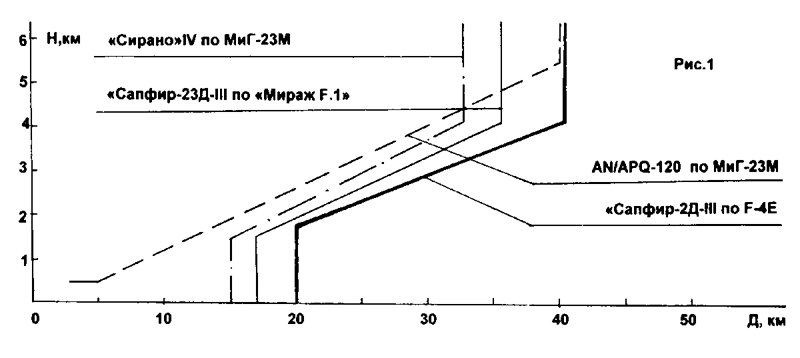
http://www.airwar.ru/image/idop/fighter/mig23m/mig23m-2.gifThis is a chart showing even the MiG-23M had a better radar
Could you explain that chart a bit? To me it seems like the F1 and F-4 both had better radars than the MiG-23M. Isn’t that radar reach vs. height? :confused: