 JFrazier
More…
The F22’s wing is called a delta wing…a delta wing is defined by an aerodynamicists as a wing with the presence of 3D flow rather than the typical 2D flow. The Su27’s main wing has 2D flow. If you understand that then you understand what a vortex is. The chin of the F22 is to generate the required vortex flow at high AoAs with the minimal amount of wetted area and weight. In fact the vortex flow from the chin acts as a virtual surface when coupled with the tail….which requires a very advanced flight control system. Give you a clue, the vortices coming off the chin and the highly swept chin are not steady! That’s how you can use it as a “virtual” surface.
The reason the engine stays on the MKI is because routine supersonic TVC manuevering is out of the question on the MKI.
I don’t think you understand my example of the advanced flight controls on the F22, or maybe i’m just not explaining it correctly. Sure, controlling multiple surfaces are not “advanced”, but what’s advanced is the coupling of all the surfaces to generate a high fidelity control in the spatial and temporal space. Ever wonder why the “pointability” of the F22 at high AoA is constantly mentioned…infact even the F2 and the F18E/F. That’s just one small part.
As to the F22, it’s a newer type of vortex dynamics using the chins. Much earlier aircraft also used this (so it’s not totally new in terms of there’s just happens to be vortices coming off of these thing that actually annoyed Kelly Johnson for a while), but it’s compatibility with LO may be too simplistic a reason. It is tailored also for “vortex dynamics”. In fact it minimized the use of wetted area to generate the same vortices at high AoA and at the same time stabilized the nose to reduce yaw instabilities.
Also, the tops of the engine intakes act as LERX in this design. If you’ve ever seen a Raptor pulling vapor, it forms over the top of the intakes like the LERX on the F/A-18, F-16, Su-27, and MiG-29.
JFrazierThe F-22 is not aerodynamicaly efficient at all, compared to modern fighters. It simply has a bad aerodynamics which is a consequence of compromise which had to be made in order to get a more stealthy design.
Remember that in aircraft design you can not have everything. To be more stealthy design, the F-22 have got some desigh features which are good for stealth but not so good for controllability at high AoA.
Design requirements for Stealth and for a good Lateral-Directional stability at high AoA are not the same.
It has less than optimum wing aspect ratio, its fuselage volume is too high, it has no LERX, etc, etc. All that, on the other hand, is required for stealth characteristics.
Wrong Firebar. Vortex already explained this in a post a few months ago. The F-22’s aerodynamics are very advanced, ahead of the Flanker and any other fighter today for that matter. Here is what he said.
Point by point i can tell you that you are simply wrong from the aerodynamicists perspective.
* The wing of the F22 is curved along the spanwise direction, reflecting a tailoring toward supersonic speeds by controlling the separated vortex in conjunction with the leading edge flaps. The Su27 is a simple tapered moderately swept wing. The F22’s wing is not only over a generation ahead of the baseline Su27, but a fully one generation ahead of the coupled canard/delta design (ie. the Rafale, Typhoon, and later Su27x. In fact this wing is so advanced (therefore so expensive), it wasn’t repeated in the lower cost F35. Although the X32 had a very advanced supersonic wing also.
* In terms of aerodynamics, the F22 does have a triplane like aerodynamics, except that the forward fuselage strake is aerodynamically more efficient than an explicit canard as found in the Su27 triplane derivatives.
* Instead of the 2D supersonic inlets (which traces back to the Vigilante if not earlier), the F22 has a 2-1/2D inlet where the cross flow situation is taken into acount.
* The fly by wire system of the F22 is the most advanced in the world where it take into acount of integrated flight manuevering using all the surfaces. Basically, instead of decoupled effectors (i.e., let’s use only rudders to generate yaw), all the control surfaces participate in flight manuevers. The only other known aircraft to have near this level of advanced flight control is the Japanese F2 (unfortunately, their avionics was claimed to be crap by some here).
* The aeroelasticity of the F22 takes into account the thrust vectoring requirements, making this the first and ONLY operational fighter plane out there designed with TVC in mind, instead of just add ons. If you claim it’s simply an add-on then you have absolutely no idea what it takes. A simple clue is why the YF22’s PIO accident caused such a pain to the firefighters. Just exactly which requirement that’s such a big deal? Supersonic TVC manuevering as part of routine. Just about every fighter plane can have a TVC upgrade, but most, if not all, won’t survive the way F22 uses it. Why is it so important how the F22 uses it? TVC has two distinct flight manuevering advantages. One at low speed and one at high speed (at intermediate speeds, high subsonics, it’s actually not as good as aero control surfaces). At low speeds it’s quite obvious, wings stall. At high speeds…the servo mechanisms for the aero surfaces became too weak. This also requires a high stiffness body mount for TVC operations. The way the Su27xx mounts it, the entire rear fuselage would buckle.
* Small increases in drag counts at high speeds is a BIG deal. Anybody who ever drives a car at drag limited speeds knows that, don’t even need to go to fighter plane speeds.
* The F22 is a more unstable aircraft than the Su27. Logically, what limits the ability to fly something more unstable is ultimately limited to the update rates of the flight computer. We all know where that’s going.
All the above IS aerodynamics. Just because someboy souped up their Pintos and drive at 150mph on the freeway doesn’t make it a sports car when a Ferrari is idling by at 60mph.
JFrazierAccording to this the MiG-31 is in the 80-90,000lb weight class on normal takeoff.
I find it hard to believe that a fighter that weighs 20K more pounds with the same dry thrust(unlikely) with missiles hanging off of it would supercruise at the same speeds as the F-22.
The interceptor is that size because it needs to carry a lot of fuel while flying in AB at supersonic speeds for long periods of time.
JFrazierLooks kind of ugly. I don’t think it looks nearly as good as the Viper or Hornet. Oh well…
JFrazierwhat a hypocritical answer who cares yeah yeah you know well who cared: the USAF and THE CIA,
Good for them, we don’t becuase it has nothing to do with the Raptor.
JFrazierYou gotta be kidding me. How many times have we been over this?
JFrazierHere’s a decent video of the F-22 Raptor:
That’s a pretty old one right there, so here’s another old one:
video
And yes, the production Raptors can do everything shown in the video.
JFrazierWhy should they fear? Raptor, Rafale or Typhoon all are using FCSs which provide carefree handling. That’s one of the new advantages of new generation fighters in contrast to the last generation.
I don’t think Firebar knows the meaning of carefree handling. That is one of the main reasons the Raptor can do the high-alpha loop.
JFrazierf22 -which itself dont have a steath design-
over G, you are quite the comedian. Please go do some research, come on….
JFrazierHeh, heh, heh… :diablo:
I don’t even want to know how much money and what crazy new technology they’ve got planned for this thing. I bet that it will make the B-2 look almost primitive.
Scary stuff, especially since it’s got money behind it.
JFrazierThe 60 degrees sustained AoA is too much for F-22.
Firebar, what you said above is not an opinion. That is why everyone is angry. You have no evidence to back up your claims and you take it as fact. Almost everyone in this thread has proved you wrong in some way.
Every single time the F-22 is brought up, you say something that just isn’t true without proof. We spend multiple pages trying to convince you and then the thread gets locked.
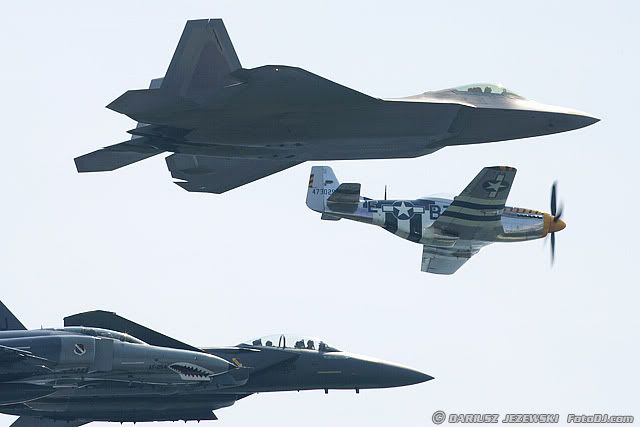
JFrazierThis is a picture of that exact Raptor from the Atlantc City airshow. Notice the FF tailcode. It’s production aircraft with a combat pilot. The pilots say they have no fear of the Raptor departing from flight.
JFrazierYou are too emotional. Be more tolerant to other opinions.
I only have said that we can not see, from video, that it is full fledged service aircraft.
May be it is, but it is not evident from video. That is all.
Firebar, there are pictures from this airshow showing that it is a production aircraft. The only planes flying in the airshows around the US are production aircraft as the prototypes are still at Nellis and Edwards. They have restricted envelopes compared to the production versions anyway.
You still have not proved why the Raptor isn’t as aeroynamically efficient as the Flanker or Fulcrum. Vortex has already explained why the Raptor’s airframe takes the performance of today’s fighter to another level.
Again, the Raptor has a carefree envelope. It will not depart from flight in almost any condition as explained by Kilcoo. You are not voicing an opinion. You are saying that the inability of the Raptor to have a high-AoA envelope is fact.
JFrazier.
We can not see that from the video.
Is there any source to confirm that ?
Abosolutely ridiculous. Firebar, I concede defeat to your stupidity.
JFrazierThat article was copied from the New York Times. I wouldn’t trust them on anything relating to military programs. The Raptor will not fly at 60,000 at Mach 2 on dry thrust. Dozer said that he reached 60,000 feet in full afterburner, that’s it.


 Sign In







