 Linrey
It had spent the last couple years on the ground in different locations around the airport. (Used to be up on poles)
It is no longer on the airport grounds. (Unless it’s in the unused hangar on the airport boundary.. in pieces..) No idea where it has gone, sorry.
LinreyThe Lancaster at the War Memorial in Canberra (Australia) has a Fraser Nash FN121 Rear Turret. (ok, maybe an FN120..)
But, what exactly is the turret on the Lancaster in Western Australia??
(I hope the photographers don’t mind me using their pictures?)
Boulton Paul Type D Turret, thanks to Mark Ansell’s website:
Fraser Nash FN82 Turret on Lancaster NX611 in UK: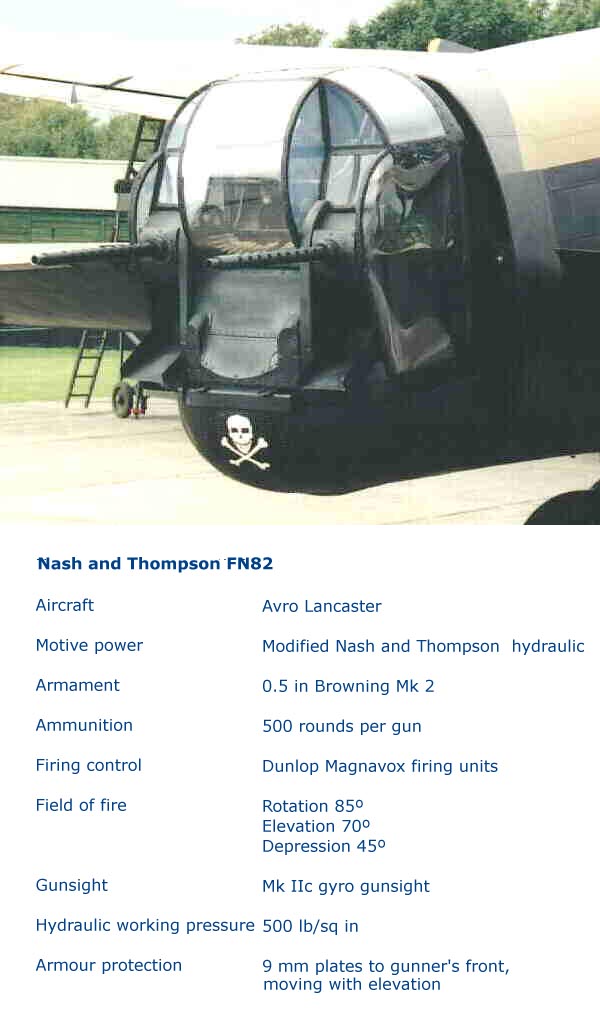
Rear Turret on Lancaster NX622 in Western Australia:
It seems the WA turret looks like a Boulton Paul Type D on top (upper cupola), BUT EXACTLY like the FN82 on the bottom (actual turret structure). I suggest it may be a modified FN82. Any other ideas?
LinreyMark, I got news from Down Under that the Albury DC2 is now for sale, most likely to be scrapped, saving the nose section. Who should be contacted in Albury to get the plans changed?
I believe the scrapping part was a proposal, and that a single vote in the council meeting saved the DC2 from that stupid idea.
From what I can tell, it’s in limbo at the moment. (Some reading might reveal more details of its future.. I just haven’t done that yet)
LinreyAnd one from Albury, NSW.
Looks like the DC-2 here is up for sale(?). Can you believe 1 vote saved it from being sawn up with a couple bits stuck to a wall as a “Contemporary Display” at the airport? Anyone got a lazy $300k?
LinreyWhere’s the Chinese Stirling? And the Russian one?
LinreyWhere’s the Chinese Stirling? And the Russian one?
LinreyAll sorts of misconceptions in here …
1. RAF Bombers flew at night because they got slaughtered in daylight – in part because of poor defensive armament, in part because unlike the USAAF the RAF didn’t persevere and figure out formation tactics etc., and in part because the aircraft were vulnerable (little or no armour, etc.)
Agreed. RAF realised quickly that daylight bombing wouldn’t work the way they were doing it. Take those planes, and put them up at night, and things worked a bit better.. Interestingly enough, they were happy to persevere with the .303 at night when introducing newer bombers and variants.
The job of an air gunner on a night bomber was less defensive, but more oberservational. A keen eyed gunner, combined with the corkscrew maneuver supposedly saved many a bomber crew… All that said, I would have preferred being in an FN82 or Rose Rice turret with a pair of 50 cals with their greater punch, just in case!
LinreyMost British bombers flew at night, so perhaps an enemy fighter wouldn’t have been seen at 50 cal range? Meaning for close range night fighting, .303 might have been a better option. A 4 gun turret could fire at upto 4600 rounds per minute, would this be better against a ‘flash before your eyes’ sighting of an attacking fighter?
LinreyRe: HMAS Otway
Sorry to deviate again… the HMAS Otway above is in Holbrook, NSW Australia. Sub theme to honour Commander (?) Holbrook, Australian WW1 Sub Captain.
The Otway is just what you see above ground. So, no, not the whole sub. Still, very big, and very cool!
LinreyJust on CG…
With more powerful Desktop PCs becoming cheaper all the time, and professional quality Animation software being reasonably cheap (or free, depending on your moral standpoint!….) You’ll find CG to be very likely in cheaper productions. Just depends on the skills of the animator.
Here’s a link to another, even smaller production, called “Iron Bird”. It seems to be one clip of several, but they’ve only released this one. (Done by an Australian group… students I think….??) There are some inaccuracies.. but the point is the CG. From flak bursts to the bomb drop. Some quite good CG.
http://www.youtube.com/watch?v=wMzxHs1o14U
Also this one if you haven’t seen it. A brilliantly done sequence involving Mosquitos and Spitfires, done by a Japanese guy…
LinreyIf you could get a small piece of Spitfire Crate on Ebay, it might be worth using it in a Reproduction / New Build Spitfire Crate. Did the crates have the aircraft’s serial number on it anywhere? What was Bader’s Spit’s serial again?….
LinreyPerhaps someone who knows could put things in perspective?
I’m certainly not one of those people, but lets make some guesses, and lets pick a Halifax in a lake for arguements sake.
And lets go best case scenario, a COMPLETE Halifax. And hey, lets say there’s even records showing that all crew are accounted for. No War Grave issues.
Ok. STEP 1 – A group able to make a proper search, and actually find and survey the site properly. (Include time and funds…) The site is likely mainland europe, destination UK. Insert years of RED-TAPE wrangling here —-> .
STEP 2 – How accessible is the site? How far to the nearest road? Likely to be far. Need to organise large helicopter. And pay for it. Also barge or some appropriate vessel large enough to do the job. Better hope that road isn’t THAT far… Need to pay for this too. Also a crew experienced in this sort of thing. Including divers to dismantle the wreck… etc etc. Expensive.
STEP 3 – Lets say all the pieces have been located and returned to land safely. Lets say theres no problem getting it all back to the UK. (Will steps will need to be taken to stop corrosion? Or is this more for salt water?)
STEP 4 – Perhaps now we’ve got a Halifax wreck. Sure it’s complete, but it’s likely bent. How airworthy are parts that have been underwater for 65 years? Will likely need to rebuild many parts. Especially the big, expensive structural parts. After already spending, what.. millions (?) of whatever currency to get the wreck, expect to spend several more to rebuild it. Structure, Sheeting, Electrical, Hydraulic, Fuel Systems, etc etc. Don’t forget the engines…. Not all aircraft / components etc. have plans available anymore.
STEP 5 – Who owns this thing? How many owners? How many different ideas for it’s eventual outcome? Could this get ugly?
STEP 6 – Lets say it was decided to rebuild to fly. Think Facilities, Large Staff, Crew, Insurance, etc. How much money is lost if it crashes? I understand a B-17, B-24 costs something like US$4000 per hour to run, factoring fuel, oil, maintenance, insurance, etc. This isn’t a way to make money either. You’ll need a bottomless pit of funds.
Anyway, that’s just my guess… Im sure I’ve missed a lot. I just wanted to try put a little perspective on the issue.
LinreyWhat Stirling bits are left, anyway? Im sure it’s more “bits” than “Stirling”… but was just wondering…
LinreyHi Tom H,
I’d be amazed and grateful if you DID have some info in your dad’s logs!
I have seen the elshamwolds website before, thanks anyway! Great site, but no extra info there.. I’ll have to try contact them again…
You may have read it already, but if not, “No Moon Tonight” by Don Charlwood might interest you. It’s an account about Mr Charlwood’s time at Elsham Wolds with 103 Sqn, just before 576 Sqn was created (1942/43). Very sobering reading.
Hi avro683,
Thanks for the planned route info, had not seen that before! I was hoping that the route might help determine whether the crew were flying towards, or away from target. Can’t tell unfortunately. Seems they were WAY off-course, to be crashing near monchengladbach (near Dusseldorf).
Anyone know if there was much flak activity around Dusseldorf?
I’ve looked at the ‘Tony Wood’s Combat Claims & Casualties Lists’, and there are no claims anywhere near the crash site. And there were 41 claims for 40 actual losses! (37 confirmed though…)
LinreyAnd this one:-

A B-24, err.. B-17… uh…..


 Sign In







