maurobaggio
As I recall the F 4D/E Phantom II from Iran and MiG 25 PDS Interceptor fighter from Iraq had been meeting several times during the war, which resulted in shoot-down of F 4 Phantom II by the MiG 25 PDS Foxbat , and this were even recognized by the Iranian sources .
Regarding MiG 25RB Reconnaissance/Strike fighter had been operating at maximum altitude and speed, in fact they were out of range of the F 4D/E Phantom II from Iran with its missiles air-air BVR (Beyond Visual Range) AIM 7E Sparrow. Like the MiG-25RB aircraft would be out of range for the F 14A Tomcat II if they do not have the long-range air -air missiles AIM 54A Phoenix.
If Iran had been ran out the AIM 54 Phoenix, the MiG 25 PDS with long range missiles AA 6 Acrid from Iraq would have overwhelmed the F 14A Tomcat II only equipped with AIM 7E Sparrow.
Over the Lebanon in 1981 the F 15A/B/C/D Eagle from Israel managed to impose against the MiG 25PDS from Syria since Israel F-15 were equipped with AIM 7F Sparrow, who indeed the “F” should be described as new missile in respect to missile AIM 7E , when it came the range the “F” had twice the range of “E”.
Although Iran had ordered the AIM 7F these were not delivered because of the revolution in Iran in 1979, among many other items, the best known the order of Iran for 200( two hundred!) F 16A/B which were canceled after the revolution. The total of 714 missiles AIM 54A Phoenix had been ordered by Iran that received only 284, since that after the revolution was suspended the delivery of those missiles the same way as all other items of U.S. origin.
When I said about the Iran to risk everything in a quick victory I was referring to the strategy to use everything that could be in hands, including the reserves, in order to achieve victory, since most would not risk everything to be defeated quickly.
As an example I could mention the strategy of Israel in 1973 during the Yom Kippur War or October, since it employed all they could had into a counter attack, however contrary to Iran in 1980, Israel had U.S. support through the sending ammunition and new weapons with the operation Nickel Glass.
In rough numbers in the Yom Kippur War or October 1973 all the countries involved in this lost something like 600 aircraft about more than 25,000 combat missions in what appears to be a number greater than the losses of aircraft Iran and Iraq together according to various sources. However there are a huge difference between the Yom Kippur War against the Iran / Iraq War, since in the Yom Kippur War or October 1973 occurred in just over three weeks, while the Iran / Iraq lasted almost 8 years or something like
416 weeks!
I do not know how to do math 😮 , so I wish that someone would make the math in order to demonstrate the rate of aircraft losses from Iraq and Iran in relation to missions undertaken throughout the entire war. As I do not know how to do math, I can only guess that numbers would be very interesting.:o
maurobaggioAlthough I am an idiot:stupid:, I had the feeling that in this thread here I was the only one who read the book in the link, and I’m curious to know if the same that put the link already did read the book.
As I know no one will read this my comment here, in fact the Iran / Iraq War has always aroused controversy of opinions even in many serious person who studied the war between Iran/Iraq, so I don’t any problem to write this because none will see:
An important but almost often not mentioned reason was that the Iran Military Forces ( Air Force, Army and Navy) had been equipped during the 70’s with high advanced weapons and large quantity of those by U.S. and its Allies with the purpose of Iran could be prepared to enter into combat not in a local war, but even with the Soviet Union.
An important but almost often not mentioned reason was that the Iran Military Forces ( Air Force, Army and Navy) had been equipped during the 70’s with high advanced weapons and large quantity of those by U.S. and its Allies with the purpose of Iran could be prepared to enter into combat not in a local war, but even with the Soviet Union.
In short of the short if a case of the World War III could happened it possible that same would start with the invasion of the Soviet Union in Iran, and once this it were occupied, the Soviet Union would close the Persian Gulf and prevent the access of Western nations to oil produced in this region, which would lead to the collapse of the Western economy.:sleeping:
With the Iran revolution in 1979 the new government of the Iran had promoted the U.S. from former ally to the new enemy, the Soviet Union that had extensive border with Iran invaded Afghanistan that was also neighbor of Iran and besides that all good news from Iranian Military Officers Saddam took power in Iraq even approaching the Iraq more with the Soviet Union.
Thus when Iraq started the war with Iran in 1980 it was in a military situation extremely worrying since it did not receive more support from the U.S. and other Western countries to maintain their high advanced weapons , as unlikely the U.S. would intervene in case the Soviet Union could gone in an active way alongside Iraq.:sleeping:
The new revolutionary government of Iran in 1979 could perhaps an unprecedented feat in the Defense Council of the UN during the Cold War, since Iran put all (U.S., USSR, China, United Kingdom, France) on the same side, from a way or another, to support Iraq in the war against Iran.
Of all the analyzes that I had knowledge about why Iran Air Force played a role would be lower than its capabilities during the war with Iraq, at least the beginning of it when it had not yet suffered great losses, in fact could be than to risk all their forces in a quick victory in Iraq, and even that could occurred certainly would be large losses, perhaps could be no time to celebrate the victory against Iraq, or else this would occur with a magnificent parade of the Red Army in Tehran, or according others with the parade of the Marines and the U.S. Army.:dev2:
maurobaggioIn the single link from the last post of the sheytanelkebir that I could actually open there are interesting information, especially when it says that the Iran Air Force should have a plan to attack Iraq even before the Iraq began the War on September 22, 1980 due to the attack in high scale from Iran on September 23, 1980.
Among the pages between 189 and 197 in the link were also commented on the counterattack from Iran with F 4 Phantom II on the afternoon of September 22 against Al-Shai’bah (Shoibah in other book) and Al Kut Iraq two hours after Iraq’s had started the offensive against Iran.
In fact when asked about air units from Soviet Union were in Iraq or participated in the
War that was totally denied by the former General. However the mention of a MiG 25 Foxbat of Iraq that made emergency landing in Emirates, and though it was not clear when this occurred, the same about a Mirage, since this part of the interview were made a reference to the end of 1980 when Iraq supposedly by U.S. source had a plan to disperse its Air Force in others countries such as Saudi Arabia to prevent their destruction in Iraq bases, which was also totally denied by the former Iraq General and even that such a plan had been prepared.
In the late 1980s both the MiG 25 Foxbat and Mirage F1 would not be operational in the Iraqi Air Force which only occur in late 1981, however there is mention in the book Iranian F 4 Phantom II in Combat that the Mirage 5 from Egypt could have participated in the War on the side of Iraq just like mercenaries French pilots flown in Mirage F1 from Iraq during the War Iran/Iraq.
However, the best known case is about the Super Entendard armed with anti ship missiles Exocet AM 39 that France lent to Iraq until the Mirage F1EQ5 able to launch anti ship missiles AM 39 Exocet could became operational. In this case there were always rumors that French pilots had engaged in combat missions, which has always been denied by France and Iraq.
In in my opinion about the book in the link this is very interesting, and about the relation to 22 and 23 September 1980, and the counterattack against Iraq Air Bases of the Al Shai’bah (Shoibah) in such versions of both Iran and Iraq are similar, or even attacks against nuclear power Osirak in 1980 and 1981.
I don’t expect to find any kind of confirmation about the MiG 25 from Soviet Union in Iraq during the war from some source of this countries, even such idiot as myself known that, especially from military officers who served the same for patriot reason and others not much polities.
However I found this very interesting the description in the page 195 of the former Iraq General about Iraq had considered the possibility of using a Air Base from Oman to launch an attack with Tu 22 Blinders against Iran, which did not happen due to the fact the runway was too short for the Tu 22 Blinder take off with full load.
If Iraq did not receive or even request the support from others nations as the Soviet Union then why ask to launch an attack of Oman and maybe put this country in war with Iran?
This would be my stupid :stupid: question that would like respectfully to made to the former Iraq General.
However I did not put the link of the book because I’m not sure if I will break the rules, so whoever is interested look for the link in the post from Sheytanelkebir.
Kevin M. Woods, Williamson Murray, Elizabeth A. Nathan, Laila Sabara, Ana M. Venegas. SADDAM’S GENERALS
Perspectives of the Iran-Iraq War
I mentioned earlier this book, and will not put the link to not break the rules, however anyone who has interest in reading the same I recommend to buy this, but if you prefer to take a test drive the Internet Search Engines would indicate the path.
Bishop F and Cooper T, 2003, Iranian F-4 Phantom II Units in Combat.
maurobaggioSomeone long ago about which I can remember the name made an observation that made history that would be something like this:” if you’re able to tell a lie 1000 times this lie would became a truth.”
On the other hand someone also already said a long time: “the lie is only able to survive in the absence of truth”.This is evident when observes that nations ruled by dictatorial regimes maintains full control over the media.
However discern what is true is that the lie is not easy task especially in wars, since in wars propaganda is an important weapon, and so all sides tend to emphasize what befits them, or even lie about the facts.
For those who had a great patience to read this so far, since I would not have this, in below there is the site with the book to read for free about the F 4 Phantom II in the Iran/Iraq War and would like “to dissect” more about it:
Bishop F and Cooper T, 2003, Iranian F-4 Phantom II Units in Combat.
*** removed by moderator – sorry, but it is copyrighted material ***
The fact that someone has written a book does not make the facts described in it as an unquestionable truth, even an idiot like me knows this, however this is at the least exposed to criticism as well as their arguments. :sleeping:
Warning: if someone want to dissect me in the future please shoot in my head first, since the living dead tend to wake up without warning, and as I always wake up in a bad mood for sure I have dinner the brain who would dissect me as dessert .
maurobaggioIt seems Iraq got a total of 42 MiG-25s of all variants from August 1981.
The first was sqn 87 with 12 PD at Habbaniyah/Al Taqaddum bolstered by further 10 PDS, when all were converted to PDS till 1983.
The second sqn 96 got 12 RB and the third sqn 97 got 8 PU. Of all MiG-25s a total of 7 was lost to all reasons till 1990.
The first opportunity of Iranian F-4s to run into MiG-25s was from August 1981 at first.
How I wish do not have to write all this!:angel:
After the start of the Iraq offensive against Iran Air Bases in September 22 of 1980, the Iran Air Force strike back two hours later with 04 F-4E Phantom II as its first target the Shoibiah Air Base from Iraq.
The Shoibiah AB according to journalist Tom Cooper would be under command from Soviet Union before the beginning of the war between Iran / Iraq, since this base would be used by Soviet Union in reconnaissance missions of the MiG-25RB across the Persian Gulf to cover the U.S. Navy Fleet, and officially those MiG-25RB should be from Iraq Air Force, since the presence of units of the Soviet Union would not officially recognized by the Soviet Union and Iraq.
In order to protect both Shoibiah AB as well the missions of the MiG-25RB , the Soviet Union would have positioned in this airfield a contingent of: 16 MiG-21MF, 20 MiG-23 and 24 MiG 25RB/PD.
The counterattack by Iran on September 22 against Shoibiah AB could not have been random, since the September 23 the Iran Air Force had launched the Operation Kamal 99, that were major air strike against strategic targets in Iraq.
This attack on September 23 were used probably almost 140 F 4 Phantom II supported by air tankers B707 and escorted by F 14A Tomcat, and again this day Shoibiah AB were again attacked as well several others targets, and thus the Soviet Union aircraft’s on Shoibiah AB could be the greatest threat against the Iran strike since on Shoibah AB should be positioned the MiG 25 PD Foxbat had been equipped with Sapfir 25 radars that would be more advanced in Iraq even after the Iraq received the MiG 25 PD equipped with older Smerch 1A radar.
Due to own war between Iran / Iraq, besides the fact that Shoibiah AB was next battlefield, the Soviet Union transferred its units to H 3 Main, once the plan conduct reconnaissance missions in the Persian Gulf by MiG 25 RB Soviet Union from Iraq were canceled since it would be a high risk that those missions could be intercepted by Iran, especially by F 14A Tomcat.
The war between Iran / Iraq began with both sides had been surprised by events and due to this had high intercepted, since Iran does not expect an invasion from Iraq Army and therefore the Iran was not prepared for it, just like Iraq did not expect a strong reaction Iran Air Force since this would be supposed to be knocked out even before they start the war because the revolution in Iran in 1978.
So it would be a chance that due to a possible reaction from Iran Air Force in case of war with Iraq, it last one had made an agreement with the Soviet Union that in case of war with Iran, the Soviet Union would support secretly Iraq with air units until the Iraq Air Force was fully empowered with new aircraft’s provided by the Soviet Union from 1979 to Iraq.
Thus in case of war Shoibiah AB should be placed out of service as soon as possible by Iran since on this airfield would be the most advanced fighters in Iraq, especially the MiG 25 PD.
The Operation Kamal 99 had not reached its goal that was to halt Iraq’s invasion of Iran, however this proved that Iran should have the same planned well in advance, since sources said Iran should have placed almost 200 aircraft in this operation and it reached several targets throughout Iraq.
The interesting point was that according to all sources of information about the Iran Air Force Force it should be out of combat, since most pilots had been shot by the new regime after the revolution in 1978, or those who had not been shot or had fled from Iran would be arrested.
However put on the air on the second day of the war such force of 200 aircraft as F 4E Phantom II, F 5E Tiger II, F 14A Tomcat and aircraft tankers B707, indeed would take many pilots and crews, as well as all officers and technicians that supported those aircraft’s, and would not be a easy task without the help from many “ghosts” or even the “dead walking’s” from military personnel from Iran Air Force.
As I have no idea what intelligence service had provided to Iraq such slightly misguided reports about the operational status of the Iran Air Force before the war, and I will not speculate about it, since I do not know what was the countries who had access the military officers who had defected from Iran after 1978.
maurobaggiomack8 politely NO TORNADO was lost during GW1 due to combat with a Mig-29, all seven (six RAF one AMI) were last to AAA, SAM or controlled flight into terrain. Please can you and anybody else stop peddling this myth, all the shoot downs were investigated after the war and there is no evidence of enemy fighter involvement. Continuing to push this uncredited myth that is unsupported by evidence is frankly disrespectful to the Tornado crew we lost in that war. 😡
I imagine that it would be almost impossible about the MiG 25 PD from Iraq could be able to intercept: the Tornado ID, F 111E / F, F 15E or even the F 16D equipped with LANTIRN pod from Coalition when they were flying at low altitude following the ground, since the MiG 25 PDS exported by Soviet Union had received the Smerch A radar that lacked the capability to distinguish targets flying at low altitudes.
After the defection of the pilot with a MiG 25P from Soviet Union in 1976 when it landed in Japan, the Soviet Union had replaced the Smerch A by the new SAPHIR 25 that would be able to tracks and attacks targets flying at low altitude as cruiser missiles . However the MiG 25PDS which were exported by the former Soviet Union had received the older Smerch A .
As I mentioned before according to the writer and journalist Tom Cooper that MiG 25 PDS from Soviet Union were based in Iraq since before the war with Iran, the presence of these would be a great threat to the tactic of terrain following at low altitude in attack missions.
As the Iraq had not received the MiG 25 PDS equipped with Sapfir 25 and the MiG 25PD from Soviet Union not long remain in Iraq after the invasion from Kuwait should be almost impossible that Tornado’s were shoot down by MiG 25PD from Iraq.
But in 1981 the MiG 25PDS from Soviet Union could be a high challenger for anyone that had planned an attack against the Osirak in Iraq, and that could explain what the Iran wasn’t capable destroy Osirak nuclear reactor once the Operation Sword in September 1980 had faille with the F 4E Phantom II .
maurobaggio“Upon reaching Iraqi airspace the squadron split up, with two of the F-15s forming close escort to the F-16 squadron, and the remaining F-15s dispersing into Iraqi airspace as a diversion and ready back-up. The attack squadron descended to 30 m over the Iraqi desert, attempting to fly under the radar of the Iraqi defences.[52]”
Source:^ a b c d e f Rafael Eitan, 2003. “The Raid on the Reactor from the Point of View of the Chief of Staff,” Israel’s Strike Against the Iraqi Nuclear Reactor 7 June 1981. Jerusalem: Menachem Begin Heritage Cente
http://en.wikipedia.org/wiki/Osirak
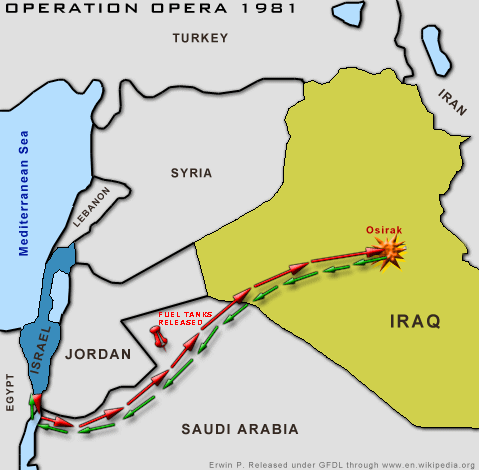
As I could understand it four F 15A had been dispersed in Iraq airspace from of the six F 15A that were escorting the eight F 16A , while two F 15A with eight F 16A had penetrated at low altitude until the target that was the Osirak reactor in order to avoid the detection by Iraq radars .
If there was radar coverage its four F 15A which would not be flying at low altitude on the route to the Osirak target next to H 3 should have alerted the Iraq Air defenses ?
Note: The Osirak reactor were at the 17 Km or 10 Miles from the Baghdad City, that had been surrounded by several airfields, once in 1981 the Iraq was in war against the Iran and those Air Bases should be in alert against any attack by Iran Air Force.
maurobaggioStrange that this time there was no question about my claim, or rather my question about something so unusual.
But my doubt about the H 3 attack by Iran in April 1981 and the attack on Iraq’s nuclear reactor in Osirak by Israel in June 1981 indeed had been planned jointly by Israel and Iran, once that claim has been found out in Wikipedia site.
In fact there are in the Wikipedia site a reference to a book in which Israel, Iran and the U.S. held secret meetings with the purpose of destroying the nuclear reactor in Osriak.
Trita Parsi, in the book Treacherous Alliance: The Secret Dealings of Israel, Iran, and the United States, writes that a senior Israeli official met with a representative of the Khomeini regime in France one month prior to the Israeli attack.[48] The source of the assertion is Ari Ben-Menashe, a former Israeli government employee. At the alleged meeting, the Iranians explained details of their 1980 attack on the site, and agreed to let Israeli planes land at an Iranian airfield in Tabriz in the case of an emergency.
http://en.wikipedia.org/wiki/Operation_Opera
Because I have not read the book so I asked about this issue in order that if someone read the book and this there are any mention of the H 3 attack by Iran, since the Iranian version of the attack destroyed two radar stations.
How the F 16A and F 15A had crossed the Iraq territory close from this three bases from the H 3, and because this could be possible that even some Iraqi military personnel from such airfields waved to the Israeli fighters by mistake imagining that they were Iraqis fighter, once in June could be one reasonable possibility that the radar stations close the H 3 were out of operation due to attack on April against H 3.

If there weren’t radar coverage in this sector defense from Iraq because the attack on H 3 in April that could allowed the Israel task force to penetrate the Iraqi territory practically at the center of Iraq in Osirak, since due to the war between Iran and Iraq, the defense sector in the region of H 3 was not a priority to be restored.
Instead I try to guess what happened, someone would be kind enough if you read the book to share their knowledge, since a joint operation between the U.S., Israel and Iran in 1981 would be almost impossible.
maurobaggioEven though the Soviet Union had not positioned its MiG 25RB/PD on H 3 Main , that Air Base would be ideal to receive MiG 25RB/PDS from Iraq in 1981, since these were delivered shortly before, and how the MiG 25 were considered extremely complex to operate, requiring a long training from the pilots, H 3 would be reasonable choice once its out of reach of the Iran Air Force with its F 14A Tomcat equipped with AIM 54A Phoenix missiles, at least the F 14A would refueled by air tanker B 707 from Iran in the middle of Iraqi territory, which would be nearly impossible due Iraq Air Force.
In cases of war were very common install training centers in locations distant from the battlefield, especially for flights units since squadrons in training are considered priority targets, since their elimination as they are not trained would be very more advantageous than after they are prepared for battle. If I’m not totally mistaken, the UK in the beginning of World War II transferred its training centers of new pilots for Canada.
As in 1980 Iraq were receiving large quantities of aircraft: 90 MiG 21, 104 MiG 23 , 48 Su-22M 3K and 24 MiG 25RB/PDS. Therefore the demand for training should be very high, however with the beginning of the Iran / Iraq War it would be quite logical that at least the of H 3 could has become an important training center , even without considering the reasonable hypothesis that the Soviet Union settled their own units in H 3.
If this should be extremely hypothetical, the attack against H 3 for the Iran in April 1981 against those bases of H 3 (Southwest, Main, Northwest) were not hypothetical, as is the fact that according to Iranian attack version with its F 4E Phantom II were supported by three air tankers B 707 that had been flying over Turkey before the rendezvous with F 4E Phantom II and a command aircraft B 747 all from Iran Air Force.
However as in fact the result of the attack can not be confirmed, since the Iran has never showed any image during the attack from the cameras of the F 4E Phantom II , as recalled SENS on your post, the version on the destruction caused by the attack has been very questionable.
However another attack that occurred a few months after the attack in 4 April 1981 against H 3, certainly has left no doubt about the damage inflicted, and this was not executed by Iran, since it had attacked with 4E Phantom II this same target in September 1980 without causing damage , but on 7 June 1981 the F 16A Falcon supported by F 15A Eagle from Israel Air Force reached the Osirak nuclear reactor in Iraq and destroyed its facility.
Could be the attack on H 3 an operation to divert attention and squads from Iraq Air Force to Northern border of the Iraq, with purpose that the Iraq Air Force should be intensified the patrols on their borders with Turkey and Syria, so this diversion could have open the way for Israel attack the Osirak nuclear reactor through the border with Jordanian and Saudi Arabian?
maurobaggio“26. According to one Soviet analyst, the bunker system which so effectively sheltered the Iraqi Air Force was built by the West. In “Shelters for Iraqi Air Force According to NATO Standards,” Izvestiya, 2 February 1991, B. Moskvichev writes that from 1984 to 1985 a series of underground air bases, including some 300 underground aircraft shelter, were built in Iraq to the same standards that are stipulated for NATO bases. Various French, Italian, German, and British firms took part in the construction of Iraqi underground air bases.“Take-offs can be executed right from the hangers, which transforms the concrete underground structure into a real fortress.”
By that claim there are many links from France, Italy, Germany and Great Britain at hand in the meanwhile about their former work in Iraq?! 😉
With the catastrophic defeat of the Iraq in 1991, basically all the old military suppliers from equipment and technology to Iraq were in an extremely delicate situation, and not because they could not be paid by Iraq after 1991, but mostly due to loss of credibility in the military world market because the high rates losses of the Iraq during the Gulf War in 1991.
Perhaps the most widespread example of this were the destruction of the surface HAS in Iraq Airfields, since the Coalition released lot of those images about the HAS had been hit by precision weapons. The Coalition informed at this time that Iraq Air Force had been destroyed inside of the HAS’s.
The Coalition had released the information that Iraq had 594 HAS before the Desert Storm campaign and than 375 HAS were destroyed during the air campaign.
My stupid question always was that the Coalition had been established air supremacy over Iraq, and it launched more than 3,000 missions against the Iraq airfields, why the Coalition could not destroyed all 594 HAS instead of only 375 HAS?
Perhaps the answer would be that others HAS would be empty, since 140 aircraft’s from Iraq had escaped to Iran.
However as those 140 aircraft could be taking off from airfields that were attacked day by day and night by night, and due to those airfields should be constantly damaged and the runways that were the main target from Coalition in the attacks against the airfields, and even how that 140 aircraft’s had managed to escape from the Coalition fighters in route to Iran, and therefore these 140 aircraft’s could not return to Iraq in the same HAS’s that were not destroyed and because this could become a threat to Coalition?
For every stupid question that I could prepare now there are a dozen of intelligent answers available and widely accessible. Perhaps because I’m not an intelligent person such intelligent answers not totally convince me. Although those answers could be true, however only through free inquiry is that the truth prevails.
Apparently some companies from the defense sector had to receive financial support from their countries, and some had even broken due to loss of orders and contracts, which in most cases were attributed to the end of the Cold War and not the Iraq defeat in 1991, but the end of the Cold War was due to own end of the Soviet Union which by coincidence was the main supplier of military equipment’s to Iraq before of 1991 …
maurobaggioIt seems that someone is just reading he is intrested in.
Christopher M. Centner wrote nothing about underground hangers. Even in red I just read “Buried and hardened airfield support components were scattered throughout each air base ..
Fuel-tanks f.e. are buried at many ABs.
The article in ACIG about Iraqi Superbases was from Tom Cooper and when the related claim is still from that book of 2003 before he has a real credibility problem about that.
202E (Tallil AB) was occupied by the US forces in 1991 and Cooper did not learn about that in time. After 2003 non serious did claim that claimed underground hangers in Iraq. Not even the Serbs did claim that. It seems that Cooper is in hope that most readers will not regcognise that questionable claim about that aircraft underground hangers. I never took it as granted and ignored it till today, when I had no problems about the semi-buried ones which were no uncommen in Egypt and the former GDR on Russian bases. Even the Israelis have something similar like Al Qadisiya AB as sheytanelkebir assumed about the hangars there. They they carved hangers into the limestone or transformed gullies into underground hangars since the 50s. Less for a main hardening purposes now than to prevent a line of sight for a direct attack. With GPS guided bombs even that can be overcome in the meanwhile when it is still usefull for enviromental protection and to hamper recce attempts.http://en.wikipedia.org/wiki/Nuclear_program_of_Iran
and North Korea are good reasons to have something like a GBU 57 MOP 😉
I have interpreted the article from Mr. Christopher M. Centner that describes the Hardened Airfields had been build in Iraq during the 80’s as an example for all Air Forces of the World.
So I do not believe that this was referring when he mentioned about the support components of the Air Bases as only fuel tanks, since at the corner of my house there is a fuel station and all tanks were placed in the underground, and this is the standard in the country not because of military reasons but only for a safety standard for vehicles.
In fact I’m reading what is interesting to me, however without putting words where they do not exist. In the desert it is called Mirage.
Underground shelters in airfields in fact are quite common, since many countries disposes of this, and even countries with scarce financial resources built those as: Albania, former Yugoslavia, North Korea. So with all the financial resources that Iraq had in the 80’s, if had it decided to build underground shelters for its airfields certainly it could have done the same without any problem.
However with a simple search on the internet you could find many quotes about underground shelters in Iraq airfields, and those sources of information are so diverse, however it were quoted is U.S. sources as the former Soviet Union.
So if the underground shelters Iraq airfields were fictions, both the U.S. and the Soviet Union were fooled, so I imagine that would be a credit to any writer that had achieved such goal.
I do not know if he would live long enough to celebrate this achievement.
1)FAS: FEDERATION OF AMERICAN SCIENTISTS
“MILITARY FACILITIES IN IRAQ:
LOCATIONS OF IRAQI AIR BASES AND AMMO/WEAPONS STORAGE FACILITIES
MUSOL – A LARGE AIRBASE AND AN ARMS STORAGE AREA
QAIYARA – AIRBASE
TIKRIT – A VERY LARGE AIRBASE
“H-3” – EXCEPT FOR THE AIRBASE IN BAGHDAD, H-3 IS THE
LARGEST AIRBASE IN IRAQ, HOUSING AS MANY AS 200 AIRCRAFT IN
UNDERGROUND HANGARS. OVER 12,000 ARMY TROOPS ARE LOCATED AT H-3.
IN THE
DESERT ABOUT 20 KILOMETERS FROM H-3 IS A LARGE UNDERGROUND BOMB
STORAGE AREA.”
http://www.fas.org/irp/gulf/cia/960531/62962_01.htm
2)DESERT STORM: The Soviet View
by Major Gilberto Villahermosa, U.S. Army
Introduction and Summary by Colonel David M. Glantz,
Foreign Military Studies Office
Fort Leavenworth, Kansas
“26. According to one Soviet analyst, the bunker system which so effectively sheltered the Iraqi Air Force was built by the West. In “Shelters for Iraqi Air Force According to NATO Standards,” Izvestiya, 2 February 1991, B. Moskvichev writes that from 1984 to 1985 a series of underground air bases, including some 300 underground aircraft shelter, were built in Iraq to the same standards that are stipulated for NATO bases. Various French, Italian, German, and British firms took part in the construction of Iraqi underground air bases.”Take-offs can be executed right from the hangers, which transforms the concrete underground structure into a real fortress.”
maurobaggioIn 2003 all Iraqi ABs were in US hands and none claimed that “Underground HAS”. Maybe you can give a present US source to bolster your claim. The US will not have missed the opportunity to show something like that to press.
At your first link of airpower .. 1992 you can find the original comment of “Lt Col Sergey Bezlyudnyy” and how it was reused at acig.org a decade later without mention the origin of that.
“9 The aerodynamic-looking HABs at the airfields were “superhardened,“.. was missing for example. Not a single word about the claimed Underground HAS from Bezlyudnyy like in the text above at ACIG.
The Source about Underground HAS:
1) Christopher M. Centner (BFA, Maryland Institute College of Art; MS, Defense Intelligence College) is an arms control negotiations adviser with the Department of Defense. He has also served as chief of the Combined Arms Branch and as a tactical threat analyst with the Air Force Intelligence Support Agency, Fort Belvoir, Virginia. Mr Centner was one of a select group of analysts who provided daily intelligence briefings to the Air Force chief of staff and the secretary of the Air Force during Operation Desert Storm.
“In Desert Storm, coalition air forces faced a formidable Iraqi air base network, the product of a massive hardening and survivability program that may be considered a model for air forces worldwide. For instance, the Iraqis had extended their air base network to include a ring of identical, hardened dispersal bases along their border. Each base in this network–known as Project 505 and begun during the Iran-Iraq war–contained 12 widely dispersed HABs with half-meter-thick concrete walls, eight fuel tanks, two power stations, and squadron operations facilities.4 Buried and hardened airfield support components were scattered throughout each air base, many of which covered 5,000 acres.5 Iraq also organized airfield-repair teams that were supplied with fast-setting concrete and other critical material.6 Almost 600 HABs built to NATO standards (or better) were constructed in Iraq by British, Belgian, French, and Yugoslavian contractors.7
At the heart of the Iraqi airfield network were three bases built for–and as–strategic assets. Planned as early as 1975 and code-named Project 202, these airfields were designed to function during chemical, biological, and even nuclear war and were dubbed “superbases” by the press. Construction of these bases for Iraq’s strategic strike aircraft apparently began in the mid-1980s.8 Every airfield component was protected by layers of thick concrete. “I will admit that this air base literally overwhelmed me,” declared Lt Col Sergey Bezlyudnyy, a former MiG-29 flight instructor stationed in Iraq. “I had never seen anything like it before, although while serving in the [Soviet] Union I had been in scores of garrisons. The equipment, shelters, and blast walls–everything was the last word in equipment and of outstanding quality.”9 The aerodynamic-looking HABs at the airfields were “superhardened,” built to withstand all conceivable threats. “As far as I could see,” said Colonel Bezlyudnyy, “it would have been virtually impossible to destroy this [HAB] with tactical weapons, even superaccurate ones, and probably only by using nuclear warheads.”10“
2)Tom Cooper
For more details see also “Iran-Iraq War in the Air, 1980-1988”, by T. Cooper & F. Bishop, Schiffer 2003, ISBN: 07643-1669-9, p. 248 & 249)
“The Project “Super-Base” was launched by Iraq in 1975, in response to the experiences from Arab-Israeli wars in 1967 and 1973. Originally, 13 airfields were re-built by British contractors, and on all of them also a number of hardened aircraft shelters was built. Subsequently companies from Yugoslavia – previously engaged in building bridges in Iraq – became involved. Due to their specific construction of these airfields – which included taxi-ways leading right out of hardened aircraft-shelters and laid diagonally to the runways – they became known as “Trapezoids” or “Yugos”.
In addition to 13 re-built airfields during the mid-1980s the Yugoslavs have built also five entirely new facilities, code-named 202A (H-1 New AB), 202B, 202C, 202D, and 202E (Tallil AB). The code-names for Samarah East, Balad, and al-Bakr remain unclear, but known is that each of these “super bases” covered an area of 21.5 square miles (40 square kilometers), and had one or two concrete runways, usually at least 2.800m long and 45m wide.
The facilities on the super-bases were divided into two categories: “surface” and “underground”. The “surface” facilities were actually the “softest”, and included maintenance hangars of metal construction, and HAS of concrete construction. In total, the Yugoslavs have built no less but 200 HAS on different airfields in Iraq during the 1980s. The protection of each HAS consisted of one meter thick concrete shells, reinforced by 30cm thick steel plates. There was only one entrance and this was covered by sliding doors, made of 50cm thick steel armoured plate and concrete. The HAS’ were usually built in small groups – seldom more than five, with each group sharing the same water and power supply, besides having own backup gasoline-powered electrical generator, and each HAS being equipped with a semi-automatic aircraft-refuelling system.
In addition to “surface” HAS, the Yugoslavs have also built 24 “semi-surface” HAS at H-1 New, and 12 at H-3 South West, positioned near the end of the runways, with enterance and exit on each side.
The third kind of structures on “Super-Bases” were underground facilities that could shelter between four and ten aircraft on average. In order to build these the Yugoslavs used equipment and construction techniques identical to that use in underground oil-storage depots, additionally conealing the extension and the true purpose of the whole project. The underground facilities were all hardened to withstand a direct hit by a tactical nuclear bomb, burried up to 50 meters bellow the ground and consisted of the main aircraft “hangar” (consisting of two floors in several cases, connected by 40ts hydraulic lifts), connected with operations, maintenance, and logistical facilities via a net of underground corridors.
A former Soviet MiG-29 flight-instructor in Iraq, Lt.Col. Sergey Bezlyudny, later said in an interview about the Iraqi super bases:
I will admit that this air base literally overwhelmed me. I had never seen anything like it before, although while serving in the [Soviet] Uniton I had been in scores of garrisons. The equipment, shelters, and blast walls – everything was the last word in equipment and of outstanding quality. As far as I could see, it would have been virtually impossible to destroy this [hardened aircraft) shelter with tactical weapons, even very precise ones, and probably only by using nuclear weapons.
The total cost of building these five “Super-Bases” was $4.3 billion, and the project was completed in 1987. “
After The Invasion of the Iraq in 2003:
In 2002, Northrop Grumman and Lockheed Martin were working on the development of a 30,000-lb (13,600 kg) earth-penetrating weapon, said to be known as “Big BLU”. But funding and technical difficulties resulted in the development work being abandoned. Following the 2003 invasion of Iraq, analysis of sites that had been targeted with bunker-buster bombs revealed poor penetration and inadequate levels of destruction.[citation needed] This renewed interest in the development of a super-large bunker-buster, and the MOP project was initiated by the Defense Threat Reduction Agency to fulfill a long-standing Air Force requirement.[3]
http://en.wikipedia.org/wiki/Massive_Ordnance_Penetrator

TIP:
The better question that SENS could have done would be that source I took the information that could be in H 3 Main had Underground HAS instead of generalizing to all Air Bases in Iraq.
However as the Sens did not not have read the entire text of the pages that I had cited, and that no one else did because if they had done would have posted this, now is that I will not reveal my source until finish this thread, but when I finish will reveal.
I know that reading is exhausting, even more what I write, because every time I finish I can not read what I just wrote.
maurobaggioThe reason that the GBU 57 is not a standoff weapon is due to the need for a steep dive angle to achieve a high impact velocity.
If you were to use some sort of standoff wing kit, you would need a rocket booster to gain the needed impact velocity when the GBU goes into its final dive.
As far as the IADS in the area, saturate it with EM from Growlers or throw in a bunch of MALDs and MALD-Js.
In fact I agree with your analysis, however not always the components of the SEAD( Suppression Enemy Air Defenses) work as expected, and for this reason the aircraft with STEALTH technology became reality, and yet something like the Stealth F 117A in 1999 over Serbia was shoot-down by an old system from 60’s as the SA 3 “Goa” , that could happen again, even it take 1.000.000 years to repeat, but still the F 117A were withdrawn from service.
The B 2A would be a generation ahead of the F 117A regarding Stealth technology, but the launch from its bomb bay the weapon as the GBU 57 MOP with a mass of 30,000 lb (14,000 kg), the B 2A would be exposed and its position and route would be known even for a short time, but this would occur over the enemy territory that could be positioned SAM or interceptors fighters, and how the B 2A Spirit are a heavy bombers, and not a supersonic fighter like the F/A 22 with high maneuverability this could be a problem.
To eliminate all underground facilities in North Korea would need perhaps several attacks which would increase the odds that the North Koreans could be in the wrong place and the wrong time for the B 2A Spirit or even to the B 52H.
As I mentioned earlier that the structure like any other as the underground facilities are vulnerable and can be destroyed, however require much more effort and with it the risk of loss is much greater on the side that attacks them, and this is exactly what is expected by those who built the underground facilities, once the enemy should be obliged concentrate on attacking the place chosen by the opponent.
maurobaggioAbout the description of the Underground HAS(Hardened Aircraft Shelters) in Iraq Air Bases there are a diversity of information sources asserting about its existence.
Among several articles at disposal this would be quite interesting from author Mr. Christopher M. Centner because of that summarize the challenge posed by Iraq Air Bases with underground Hardened Aircraft Shelters to the Coalition lead by U.S., and the site is: http://www.airpower.au.af.mil/airchronicles/apj/apj92/win92/centner.htm
The writer and journalist Mr. Tom Cooper also describes the Underground HAS in Iraq Air Bases and the article could be to find out in:
http://www.acig.org/artman/publish/article_377.shtml
maurobaggioDuring the first Gulf War in 1991 the U.S. had initiated an urgent program for the development and production of the GBU 28 “Bunker Buster” able to penetrate and destroy hardened underground facilities from Iraq.
In 2003 the analyzes conducted on the use of the GBU 28 after the invasion of Iraq had demonstrated limitations of the GBU 28 to destroy underground facilities that triggered the project to develop a new weapon even more powerful from GBU 28 that it resulted in the design of the GBU 57 MOP.
As North Korea must have several underground facilities, particularly their Air Bases that in case of a confrontation with South Korea and U.S. those facilities would be priority targets, and due to the limitations of the GBU 28 in destroying the most hardened targets, most likely would be necessary to use the GBU 57 MOP.
However the GBU 57 MOP has a slight disadvantage over the GBU 28, since the GBU 28 could be released from F 15E Eagle or F/A 18E/F Hornet but the GBU 57 could be employed only by heavy bomber as B 52H or B 2A Spirit since the GBU 57 has a mass of 30,000lb or 14,000kg.
How the GBU 57 is not stand off weapon it should be released next target could be protected by air defense as SAM systems.
In that case of the B 2A Spirit with its full Stealth capability this would not be a serious problem, however if the B 2A could be invisible to radar, the same does not apply to GBU 57 that after leaving the bomb bay would become a great signature on air defense radar and probably could reveal the position of the B 2A Spirit for SAM system or even the interceptor-fighter that could be in alert.
Although underground facilities are vulnerable to air strikes these require a lot of effort as well as adequate means to assure its destruction, thus ultimately creating large restrictions at the means aimed at their elimination.


 Sign In