maurobaggio
The F 4E Phantom II from Iran had been using an Air Base our even some airfield from Syria it would be an act of war against Iraq, and with all the problems that Syria had in Lebanon in 1981 with Israel I only imagine it would be very unlikely the Syria wage war against Iraq .
Besides than Syria and Iraq were close with Soviet Union and even if there were no aircraft’s and personnel from Soviet Union in one of this three bases of H 3 I can not believe that Soviet Union did not warn Iraq about any operation of F 4E Phantom II from Iran in Syria.
The Soviet Union would have no dividend with a conflict between Syria and Iraq, in fact it could even depart Iraq from the Soviet Union, however to discard the hypothesis that the F 4E Phantom II were refueled in any airfield from Syria, the other alternative would be Iran’s version about those F 4E Phantom II were refueled in the air by a tanker B 707 from Iran coming from Turkey which is a NATO member …
maurobaggioIn my opinion would be much more difficult, since the missile should receive information from the radar computer through of the datalink to update the trajectory of the target and the integration of the R 27 with an aircraft radar not assigned to the same would be impossible without the assistance of the radar aircraft manufacturer , or at least without access to the software source codes from aircraft radar at the missile manufacturer or them at the user that has an interest in this combination.
Perhaps to escape this situation the manufacturer of the head seeker from missile R 27 had developed a parallel system that could be used with a radar not configured to R 27 missile. But apparently there was no integration of R 27 missiles with some Western aircraft design.

Description:Micro-phased array radar installed in the ‘Adjutant’ system, designed to provide illumination and command guidance for the Russian-made R-27 and RVV-AE missiles for foreign aircraft or Russian aircraft with older radars. Complete system weighs 20kg. Antenna weighs just 5kg, and is also suggested for other applications such as embedding in wing roots to provide greater azimuth coverage for modern radars such as Osa.
http://aerospace.boopidoo.com/philez/Su-15TM%20PICTURES%20&%20DOCS/Overscan’s%20guide%20to%20Russian%20Military%20Avionics.htm
With respect to Iran would be much more likely that it has cloned through reverse engineering the AIM 54 Phoenix and from this will produce a more advanced version than buy a missile from another country like any version of the R 27 from Russia once the same should be integrate with F 14AM, since for it the Iranians would have to allow access to the software source codes from F 14AM radars that after so many years of embargo has been extensively modified from the original version of the AWG 9.
maurobaggioIn fact the attack of the F 4E Phantom II against the three bases H 3 ( Main, Southwest and Northwest) in 1981 became a patriotic Iranian movie which certainly should be considered more as propaganda than the likely as reality of the event. The attack on H 3 was confirmed by Iraq and on their version of the attack caused none significant damage to facilities or aircraft packed in this Air Base.
In a war of more than 8 years in which both countries have lost more than 1 million lives the H 3 attack in 1981 could have been forgotten, put to Iran this had a very important meaning.
Perhaps the question would be what the Iranians assumed that it would be very important to achieve with this attack against H 3 Air Bases that Iran did carry out an attack in which F 4E Phantom II had to fly over Turkey’s border with Iraq and using air refueling from B 707 that came from Turkey airspace and then penetrate the border of Syria with Iraq to attack H 3?
Despite not having understood a single word on Youtube there are an interview with the leader of the H 3 attack in 1981 during a ceremony on the celebration of the anniversary of the attack against H 3.
http://www.youtube.com/watch?v=iAWpOtcOAvA
maurobaggioWhy would someone who are intelligent, fearless and courageous would proposes a thread something like that: IDF/AF F 15I Ra’am Vs. IRIAF F 14AM Tomcat ?
If only I had one of these qualities so I would create this Thread, but …
:dev2:
maurobaggioThe North Korea had begun the production of SS 1 SCUD B during the 80’s, without the license of the Soviet Union, and the first missiles exported were destined at the Iran and used during the Iran / Iraq War.
About the information’s available the latest version in production in the North Korea would be based on the design of the SCUD-D that did not go into production in the Soviet Union during the 80’s once the more advanced SS 23 Oka were chosen to replace the SS 1 Scud.
However the SCUD D had several innovations like a head seeker with TV imaging capability that would use the image programmed from the target in order to increase the accuracy. The version of North Korea currently in production called Rodong-1 would have a range of 1000 km( 620 mile), but it doesn’t mention about the terminal head seeker.
Scud launcher of the Afghan National Army. This mobile launcher could be stored inside the Underground Facilities in the North Korea Air Bases , remain in its shelter until to left this to fire the missile, after that could return in matter of minutes to the Underground Facilities in truly tactic as “Shoot and Scoot”.
The SS 21 The Scarab Short-Range Ballistic Missile were also provided to North Korea through the Syrian, and this were copied by North Korea with the designation of KN 2. There are few details about the version of North Korea, however it has been estimated range of 120 Km ( 75 mile) at 140 Km (87 mile), however this version of North Korea could be more accurate than the version SS 21 Scarab B to incorporate a Geo-positioning system as GLONASS.
In an increasingly crowded sky with reconnaissance satellites, aircraft’s, UAVs and UCAVs , the availability of underground shelters would be an option to protect Mobile Launchers with Tactical Ballistic Missiles until the moment they would be used.
After the missile launch , both mobile launchers as the place where it was made to launch the missile can be easily detected by the thermal emission either by the ground where the shooting occurred or the vehicle, so the possibility that mobile launcher to hide in an underground shelter greatly increases the chance of this survive for a new launch.
Although the Underground Facilities in North Korea Air Bases could be destroyed, its elimination would be much more complex than the destruction of the mobile launcher in the open terrain.
maurobaggioImage of Sunchon AB from North Korea with UGF (Underground Facilities)

http://geimint.blogspot.com.br/2010/07/underground-airfields-dprk.html
The North Korea has been building and expanding its network of Air Bases with underground shelters since the early ’60s.
If the aircraft’s combat drom North Korea are obsolete and quantitatively small compared to that of South Korea and the U.S.
the same could not be said about the TBM (Tactical Ballistic Missiles), such as the versions produced of the SS 1 SCUD missile and
this could has been improved over the years by North Korea.
Article provided by analyst Sean O’ Connor from JANE’s has describes the Underground Shelters from North Korea.
http://geimint.blogspot.com.br/2010/07/underground-airfields-dprk.html
This underground shelters also aims to protect these mobile launchers of the ballistic missiles, that after had been launching its
tactical ballistic missiles from own Air Base it would return to underground shelter to be loaded with anthers missiles,
so there would be little time for them to be located and destroyed by tactical aircraft’s from South Korea and the U.S..
The problem should be not new as to destroy Underground Shelters by the U.S. since in the first Gulf War, Iraq had underground shelters
and SS 1 SCUD missiles that were neutralized by U.S. and Coalition, however in this war it was necessary to the development
and production of GBU 28 Bunker Buster and since then this has been the standard weapon available for this mission, however this fact has been
analyzing for 20 years by the potential countries that could be a target from this weapon.
maurobaggioThe questions are interesting however I would imagine the answer for that would be even more if it was introduced a disturbing question that perhaps not all MiG 25 that had been operated in Iraq were under orders or were piloted by Iraqis.
Because of this I imagine that would be an almost impossible mission to confirm how many MiG-25 Foxbat were supplied by the Soviet Union and how many indeed were lost by Iraq during the Iran / Iraq War.
It could be a high possibility that Soviet Union sent versions of the MiG 25RB/PD/BM had been keeping under the command from Soviet Union itself in Air Bases from Iraq during the Iran / Iraq War.
I will not use this thread to repeat what I put previously, though I imagine that there is still much to discover about the operations of the MiG 25 in Iraq, especially what actually had been occurred in the H 3 Air Base from Iraq, since this base were attacked by several F 4E Phantom II from Iran in 1981 in what were described as a daring mission performed by Iran Air Force.
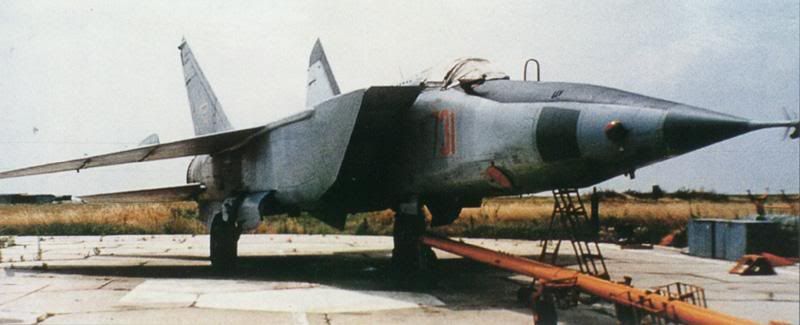
The H3 Main Air Base from Iraq, one of from three bases in the extreme West from Iraq. This base had been using by Soviet Union MiG 25 PD/RB during the 80’s and were considered strategic for the Iraq High Command even far way from the battles zones during the War Iran-Iraq.
Thread:http://forum.keypublishing.com/showpost.php?p=1996034&postcount=116
maurobaggioCairo West AB and H 3 AB – Part I
Cairo West AB and H 3 AB – Part I
The H3 Main Air Base from Iraq, one of from three bases in the extreme West from Iraq. This base had been using by Soviet Union MiG 25 PD/RB during the 80’s and wer considered strategic for the Iraq High Command even far way from the battles zones during the War Iran-Iraq.
[/SIZE]
The Cairo West Air Base from Egypt and H 3 Air Base from Iraq had much in common despite those airfields belong at different countries, since both bases had operated in different times the MiG 25 Foxbat RB from Soviet Union. Another fact in common about those bases were that actively participated in conflicts and thus both were priority targets for the opponents, in the case of Cairo West would be the Israel Air Force and H 3 by Iran Air Force during the almost eight years of war between Iran and Iraq.
The importance to comment about the of Underground Shelter for aircrafts in Cairo West were not due only to the protection of aircraft would be based on this air base, but the importance of this would keep in secret the aircraft types that were inside those bunkers as well the number of units of those aircrafts in the base, since in underground shelters air reconnaissance or even by images taken from spy satellites in low orbits could not determine easily.
However to better analyze Cairo West would be interesting to analyze first other air base as H 3 in the far west of Iraq, belonging to it, that during the 80’ at least had been used by the Soviet Union primarily as a base for MiG 25RB/PD Foxbat.
In fact the operations of the MiG 25RB/PD from Soviet Union in Iraq were initiated around 1980 in Shoaibah Air Base in southern Iraq, near the Persian Gulf, however with the of the outbreak from Iran-Iraq War, this Air Base was the first target had been attacked by F 4E Phantom II from Iran almost two hours after the offensive initiated from Iraq in September 22, 1980.
Because of this attack and the damages had been suffered in Shoaibah Air Base , the Soviet Union shifted its contingent, comprising of : 16 MiG-21MF, 20 MiG-23ML and 24 MiG 25RB/PD at H 3 Air Base in far western from Iraq, near the border with Syria and Turkey.
The H 3 Air Base was not only an airfield, but a cluster consisting of three airfields, two of which were considered satellites of the main, but all those airfields had been provided with HAS ( Hardened Aircraft Shelter) , but the H 3 Main were equipped with more HAS and another facilities. The others two satellites airfields were labeled as H 3 Northwest and H 3 Southwest, and near of this airfields could be possible use long strips of the Highway Amman-Baghdad as alternatives runways.
Another particularity of H 3 were that location away from urban centers or villages , since this Air Base was situated in a desert place, which provided the highest degree of secrecy about the operations had been carried out from this base.
Surface HAS( Hardened Aircraft Shelter) partially covered by sand: The image were edited to show the approach dimensions of this construction as well the aircraft probably a MiG 23/27 Flogger . its possible to see a few MiG 23/27 abandoned in the GoogleMaps images taken in 2013 around the base, in the time when this base were active the MiG 23 Flogger certainly had belong to this base and most of the time should be keep inside this HAS.
Surface HAS in H 3. Those Surface HAS near of the runways should be used by interceptor fighters as MiG 21MF, MiG 23MF or MiG 25PD. Those fighters had the primary mission to defend this base against any threat.
As H 3 was relatively far away from the border with Iran, and consequently the battle zones, so far that could diminished the risk of attack by Iran or even interceptions by this, especially in the case by the F 14A Tomcat equipped with long range air-air missiles as AIM 54A Phoenix against the MiG 25RB Foxbat when it had been approaching or taking off its base for reconnaissance missions.
The location of H3 would allow the MiG 25RB to accomplish reconnaissance missions of the border of Turkey’s as well as NATO facilities in this country, and even the Mediterranean Sea through Syria with it was allied with Soviet Union, besides Iran with benefit to access this country from east border, along the north border already covered because this border it was with Soviet Union.
Anyway the MiG 25RB based in H 3 could perform missions in the Gulf Persian by simply using some base in southern from Iraq to refuel, but the main problem for the MiG 25RB in reconnaissance missions in the Gulf still would remain as the threat of the F 14A Tomcat from Iran during the war Iran/Iraq.

Image edited from Google Maps::http://goo.gl/maps/DFc3C
This part of H 3 has widely paved area however for only four HAS. Those type of HAS in Iraq airfields has been described by some sources as “ Drive Thru” HAS, since it has an inlet and outlet for the aircraft which would decrease the time required to maneuver the aircraft to access the HAS. However the large paved area as taxiway appears to be out of proportion in size to only 04 HAS, and these distribution almost equidistant resembles an Air Carrier with their lifters to transport the aircraft’s to the below decks.
1.HAS: The dimensions are lower compared to the previous Surface HAS had been described, but if this structure its only destined to cover the lifter for the Underground facilities indeed that would be advantage since that should present a less detectable target;
2.MiG 23/27 Flogger: Those dimensions are only to give the scale when close of the HAS, and when compared with the previous Surface HAS its clear that HAS in the image above is smaller than the previous HAS and would be too restrictive for ground crew working on aircraft;
3. Access Ramp: It’s not clear what the purpose of this to the HAS, but if this ramp gives access at the underground levels, indeed to the Underground Shelter that would be a reason for this since could be used even by vehicles;
4. HAS Access: In all HAS of this dimensions appear that one of those entrances has less restriction than the other due to the presence of a small wall, so if this HAS would be a “Drive Thru” HAS there wasn’t reason for this asymmetry;
5. HAS Exit: Its possible see in the image a shadow had been created by a small wall, what certainly would create some problems to maneuver an aircraft at the HAS, but if this small wall were only a deflector jet for the aircraft inside the HAS when this get out from the same to avoid the exhaust of the jet engine create a cloud of dust and withdraws the aircraft for an enemy during attack against the airfield, once the aircraft could be maneuvered in the underground level to leave where it enters in the HAS.
Thanks at the Iran Air Force the US Navy Fleet didn’t receive many visits of the MiG 25 RB from Soviet Union in the Gulf, once the MiG 25RB from Iraq Air Bases should cross along the coast of the Iran and very close of the Iran Airfields ,in missions over the Persian Gulf.
The reason should be that the first part of the reconnaissance mission from MiG 25RB would be easy in the Gulf , without problems with Iran Air Force, but in the regress part of the mission, that would be funny part, when CAP of the F 14A Tomcat from Iran Air Force would be positioned over the Persian Gulf between the MiG 25 RB and its base to cut off his return to Iraq.
However among others possible reasons that the Soviet Union did relocate its staff to H 3 was surely the fact that Air Base had underground HAS , since it was away from the border of Iran, also meant that this was close to Israel, and how Israel and Iraq had a history of conflict, the presence of well protected underground HAS was very convenient to the Soviet Union.
The complex H 3 with its three bases were impressively by its scale as the complexity, besides those three bases H 3 ( Main, Southwest and Northwest) near of H 3 Main as large set of bunkers, which later in 1991 during the First Gulf War were extensively attacked in reason that facilities were identified by U.S. Intelligence as storage sites for Chemical Weapons.

Image edited from Google Maps::http://goo.gl/maps/DFc3C
Surface HAS: The dimensions of this type of surface HAS are larger than the supposed Underground HAS, since the visible part in the surface would only lift access to underground levels, whereas Surface HAS in the image above e should have dimensions suitable to allow the ground crews to work in the maintenance of the aircraft.
The H 3 Main should be two types of HAS, one its the surface type and the underground type. In Surface HAS that were build near of the runway would be intended to interceptor fighters that could defend the base, once alerted should take off quickly. While in Underground HAS would be crowded with aircraft for others missions such as reconnaissance and attack, or even interceptors as backup. The reason to keep the attack or reconnaissance aircraft in the Underground HAS instead of the Surface HAS could be described by the fact the attack or reconnaissance missions could be planned in in advance of hours or even days, since the interception missions in most cases its reaction from a threat that still hard even today to anticipate.
In the case of attack against base with these HAS, those fighters with interception mission take off to protect the base, leaving the Surface HAS empty , which even if those HAS were hit would not result in the destruction of aircraft since the same HAS were empty. While others aircraft would be in Underground HAS that would provide greater protection for the aircraft’s inside even if the base is heavily attacked.
Although Underground HAS and even Surface HAS are complex and extremely expensive to build, it would has had the purpose to avoid the installation of several systems of the SAM ( Surface Air Missiles) and AAA (Anti Air Artillery) to protect the airfield, once the SAM and AAA also are even expensive and vulnerable specially by attack aircrafts with mission to destroy or even jamming the air defense radars as SEAD (Suppression Enemy Air Defenses), since systems SAM and AAA could be more efficient when it would be moved to other locations and thereby obtain the element of surprise against an attack aircraft’s, instead of being kept in one location known as an airfields.
There are several sources that claim as many of the HAS were built by companies of the former Yugoslavia during the 80’s, and were basically of two types, surface and one underground type.

Surface HAS: Although the images has been taken by satellites at disposal not permit a correct measuring from the height of the HAS in H 3 , it only could be estimated that at least the dimensions of Surface HAS had a larger height as its width and length than compared to the suppose Underground HAS.

Underground HAS: When compared with the type of surface would be possible to estimate that the inner space of these types of HAS, would in fact too restrictive for ground crews, at least for the dimensions of the aircraft as MiG 25 Foxbat, but still the MiG 25 could use this to get to the underground once this restrictive HAS could be the elevator, where would be made all phases of operation and maintenance since this underground levels could be capacity to receive several fighters at the same time.
However the origin of the complex H 3 bases are older, since during the 70s these bases had been extensively enlarged and modernized, and received in this period its HAS well as other bases in Iraq.
The interesting fact about this period of the 70’s were that H 3 bases became known as Koreans Camps, since Koreans labors had been working in the construction of the Highway between Baghdad and Amman were housed near of these bases.
If those Koreans labors belong to the North Korea that could explained who and when de Underground HAS were built in H 3, because the North Korea has a long tradition of building underground facilities, especially underground HAS in its airfields, would be a very likely hypothesis that the H 3 underground facilities were built during the 70s by the North Koreans who were also building the highway which serve to hide the construction on H 3, and most likely under the guidance of the Soviet Union.

There is an interesting article on the Air Bases from North Korea that has underground shelters for aircrafts, in this case the link is: http://geimint.blogspot.com.br/2010/07/underground-airfields-dprk.html
With the presence of the Soviet Union in H 3, particularly the MiG 25 RB conducting reconnaissance missions over Iran during the Iran-Iraq War, and those missions of the MiG 25RB were a serious threat from Iran, since the details had been collected by all sensors that could be equipped in the MiG 25 RB certainly given to Iraq high advantage to conduct the war against the Iran. Probably because this reason H 3 were attacked in 1981 by Iran Air Force, on a daring mission performed by F 4E Phantom II.
Underground HAS: This part of H 3 also has four HAS has been distributed almost in a circle over a wide area of taxiway. However the dimensions are different between this HAS , which would indicate that at least one of these has been built to allow access to larger aircraft with less restriction. There are several sources that say the underground HAS in Iraq would be able to receive 04-12 aircraft at same time.
Underground HAS: Put 12 aircraft in the ‘basement’ that only could use a single elevator should be a problem due to the long time to return those aircraft at the surface, or even in case of the elevator broken or had been disabling after an attack against the base. So these underground HAS would be more logical that could has more of an elevator by Underground HAS , and the image above there are apparently two HAS side by side, as twined, and probably that could be two elevators for the underground facilities.
Underground HAS: Put two HAS together , or twin, it would not be interesting since the rule should be put those HAS so dispersed in order to make them less obvious as target. However if these are indeed twinned elevators to the ‘basement’ so that if one of these were damaged or even broken, the other could continue remain active and bring back at the surface the aircraft’s that were on the underground, even if only for 04 aircraft the capacity of this facility in the image above. As a say left 04 MiG 25 in the basement during the battle because the single elevator would be out of service certainly should be not desirable
The introduction of the MiG 25PD/RB in Iraq Air Force had been gradually occurring in 1981 since the MiG 25PD/RB demanded high training of the pilots to those fighters, despite this fact the MiG 25RB were very active in reconnaissance missions during 1981, which would indicate that those MiG 25 RB were in fact from Soviet Union, and from the H 3 Air Base.
Thus it would be possible that Iran High Command had planed this attack against H 3 with intention to obtain the same result when in 1980 after the attack of several F 4E Phantom II from Iran against Shoiabah Air Base, the Soviets withdrew from this base, and so by attacking H 3 in 1981 the Soviets could withdraw the MiG 25RB from Iraq once for all.

Placing together two HAS would not be a very logical choice, since this would allow the enemy more easily discern this target due to its dimensions, both in terms of visual contact or infrared imaging, as well as for detection by ground mapping radar from attack aircraft( F 111E/F, Tornado GR 1, B 1B Lancer ). However if this facility could access to lifts to an underground HAS, putting both so close could be due to limited space in underground which anyway would not possible disperse the surface structures.

As some of HAS twinned has different dimensions, which also would not be very logical if the goal is to reduce the visibility of it, since this way the logical thing would disperse them. One possibility is that these structures did not had internal wall to separate both, which would allow large fighters like the MiG 25 would be maneuvered more easily to the elevators.
However in H 3 with facilities as Underground HAS that were immune to Iran’s weapons at its disposal, once the Iran Air Force were equipped with precision weapons, as :GBU 10 Paveway II LGB ( Laser Guided Bomb) ,GBU 8 HOBOS and AGM 65A Maverick, that could be used by F 4E Phantom II against the Surface HAS , but against the Underground HAS those weapons would be useless. The Soviet Union remained in this base even after this attack of 1981, and had been continued even after the end of the war between Iran and Iraq.
The effectiveness of Underground HAS in H 3 to face an attack with high intensity, most likely based in the project of the Cairo West in Egypt , maybe had convinced the Iraq High Command to invest large sum of resources to build a large number of Surface and Underground HAS around others bases during the war between Iran and Iraq in the 80’s.
Even in the case of the Surface HAS built by the former Yugoslavs companies, known as trapezoidal form, most likely this could be resist all precision weapons from Iran Air Force, and the aircraft’s inside this could be protected against any surprise attack.
But certainly the Underground HAS would resist against those precision weapons and most of the others, even against a blast from nuclear warhead if it wasn’t a direct impact, because against a direct impact probably would be impossible for any bunker to resist. Maybe this last feature were required to face the nuclear capability from Israel or even about the probably advances in Iran nuclear program during the 80’s.

During the First Gulf War in order to destroy the hardened targets of the Iraq, the Tornados GR 1 armed with LGB Paveway III had launched its weapons from an altitude of 7.140m, which due to sophisticated ground mapping radar that could detect the HAS in any condition atmospheric at long range and altitude. With this target on the ground mapping radar and its inertial navigation system allowed the f computer from Tornados GR 1 to calculate the launch point from LGB Paveway III in order to put this weapons in a ballistic trajectory allowing turning the altitude and initial velocity input by the Tornado in high final velocity when the LGB reached the target. By increasing the velocity at impact by 25% would increase the Kinetic Energy of the LGB Paveway by almost 60%, which would penetrate deeper into the target before detonation, which would increase the damage caused by it LGB .
In the first Gulf War in 1991, those trapezoidal HAS built by former Yugoslav companies during the 80s were destroyed only after several attacks by several types of aircrafts as: F 111F, Tornado GR1 and F 15E that were armed with LGB Paveway III as BSU 109 with 2000 lb. / 907 kg .
Since after the first impact with this LGB, a second LGB were aimed to the same point left by the impact for the previous attack, and because the accuracy of Paveway III much better than the Paveway II which had Iran during the war against Iraq during the 80s, its second Paveway III had been practically impacting on the already point damaged and weakened of the structure of concrete from HAS, thereby allowing the second impact penetrate and destroy the HAS, as well as any aircraft that were within them.
The Coalition led by USA in the first Gulf War had conducted more than 3,000 missions against Air Bases from Iraq, which had resulted in the destruction of 375 HAS of the approximately 594 HAS that Iraq had at the beginning of the First Gulf War. To ensure that the HAS were destroyed, several mission were demanded with this purpose, which had demonstrated the strength thereof of those HAS and its bases.

If the purpose of the use of penetrating LGB before detonation, the best way of achieving this would hit the target perpendicular at the surface , which considerably decrease the thickness of the protection from the target, beyond which an impact at a smaller angle than 90 ° would cause a deviation in the trajectory LGB at impact, which could reduces greatly the capability to penetrate inside the target causing more superficial damages, which could mean that HAS were able to operate and maintain the aircraft protected inside. The LGB Paveway III had besides the laser head seeker another guidance system as inertial navigation kit that allowed the LGB to remain in the designated trajectory even hasn’t located the marked target with the laser emission. This feature allows the LGB Paveway III to control its dive angle toward the target, which could increase their effectiveness in penetrating a target, as in the case of BSU 109.

Despite of the capabilities had been demonstrate by Tornado GR 1 about locating the targets and attack them from high altitudes due to the sophistication of its ground mapping radars and inertial navigation systems, they were not capable of illuminating targets with laser beam to designate those for LGB Paveway during the Desert Storm in 1991 , since in most missions the targets were covered by layers of clouds at low altitudes or even by smoke due to fires even from oil wells. The aircraft that would designate targets for LGB had been launched altitude by Tornados GR 1 were the Blackburn Buccaneers which already flying close the target at a low altitude to locate and designate the targets below the layer of clouds and smoke in cases where the target had previously been attacked or even by the Buccaneer, thus allowing a second LGB hit the target area where were already damaged to increase the penetration of the LGB.

Thus the Buccaneers equipped with AN/AVQ-23E “Pave Spike” flying at low altitudes were responsible for designating targets, which had exposed the Buccaneers at AAA and short range SAM during the day, once the AVQ 23E pod hasn’t night capability , making the task much more dangerous than those held by the Tornados IDS at medium altitude.

The USAF had sophisticated pods as AVQ 26 Pave Tack and LANTIRN with Thermal imaging capability that allowed operate day and night in the: F 111F (AVQ 26), F 15E (LANTIRN) and F 16D( LANTIRN) to designate targets for LGB Paveways, what gave the Coalition the capability to operate around o’clock against all targets and even Iraq Air Bases. Yet many important targets as Iraq Air Bases had been entrusted by the High Command of the Coalition (USA Command) at the Buccaneer and Tornados GR 1 due to efficiency tactic adopted by them, releasing part of the fleet of: F 111F , F 15E and F 16D in the missions to hunt down the mobile launchers of SS 1 Scud tactical ballistic missiles using the Thermal Imaging Pods to detect those evasive targets.
However with respect to the destruction from Iraq HAS in the first Gulf War could be detected that has discrepancy about details and information, since while Surface HAS there are many images and information about the operations of destruction of the HAS, however regarding Underground HAS the availability from information’s and images apparently it were trapped in the underground.
Since the unpleasant surprise about the MiG 25 RB in West Cairo Air Base during the War of 1973,what led the F 14A Tomcat to Israel in secret to protect the air bridge (Operation Nickel Glass) between U.S. and Israel, the United States had begun to invest a lot of effort and resources to obtain the capabilities to nullify the benefits from constructing underground facilities as a means to protect the military assets from Warsaw Pact and even China.
So in 1990 the underground facilities as well as Air Bases from Iraq should not be an obstacle to liberation of Kuwait by U.S. and Coalition formed for this purpose, however in 1990 it became again!
maurobaggio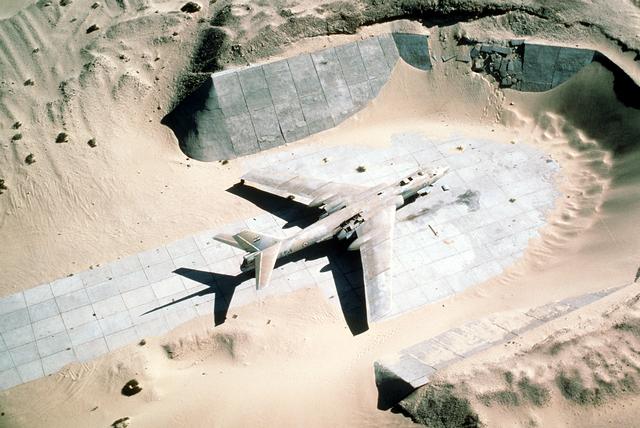
Not dug deep into the ground. That was done by several sandstorms rising dunes at Cairo-West every year. The Egyptians were just busy to keep the taxiway to the former hardstand free and rise the walls of that. 😉

1) I’m not a Engineer of the Constructions, but I imagine that the inclined wall was constructed to contain the hill, as the hill is higher than the wall, I can´t imagine that a dune would remain that way.
2) And even I’m not a Geologist and because this I do not imagine that’s has been show in the picture is formed around the wall only by sand from a dune, and as you said dune constantly change place, so how would it be possible to imagine the same place in 1970?
By topography in the picture I can not imagine that this was Tu 16 Badger in Cairo West Air Base because the terrain of this base is very flat, this photo is probably from some other Air Base from Egypt.
After the Six Day War in 1967 when the Israeli air force had been destroyed in one day being the 5th June more than 400 aircraft of Egypt, Syria, Jordan and Iraq, and almost all in the ground. After this had happened a deep change in the concept of the air bases, with the construction of high armored shelters( HAS) and scattered places in order to avoid what happened in 1967.
Only Egypt lost on June 5 and about 289 aircraft: 30 Tu -16, 27 IL-28, 12 Su-7, 80 MiG-15/17, 20 MiG-19, 90 MiG-21 and e.g.

Israel’s attack in 1967 dramatically changed the doctrine of air power, since even NATO and the Warsaw Pact had been increased greatly the defenses from air bases , especially with the construction of HAS and dispersal places for the aircraft’s on the ground.
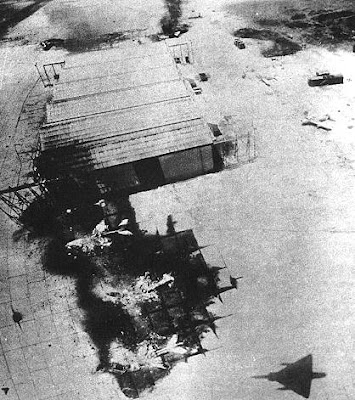
Thus Cairo West Air Base where the Soviet Union had built also underground shelters and reinforced armored in order to protect its MiG-25 R/RB in Egypt since due to all hostility between Egypt and Israel during the early 70 would be an invitation for an attack, so to keep fighters high expensive as the MiG 25 R/RB vulnerable to the open sky would be almost insanity, and sure enough when has been speaking of Israel Air Force there are two certainties:
1) This will always on the offensive in any conditions and against any adversary if necessary;
2) And this offensive will stop only when they win or when none one remain alive to fight;

By the way it is very good the picture of Cairo West Air Base with the MiG 25RB MiG in front of the hangar.
How about the fact that Cairo West Air Base had received underground shelters that was described by Mr. Yefim Gordon in his book MiG 25 & MiG 31, but at this time I don’t know if another source to confirm this and even to be able to deny it.
maurobaggioNot dug deep into the ground. That was done by several sandstorms rising dunes at Cairo-West every year. The Egyptians were just busy to keep the taxiway to the former hardstand free and rise the walls of that. 😉
1) I’m not a Engineer of the Constructions, but I imagine that the inclined wall was constructed to contain the hill, as the hill is higher than the wall, I can´t imagine that a dune would remain that way.
2) And even I’m not a Geologist and because this I do not imagine that’s has been show in the picture is formed around the wall only by sand from a dune, and as you said dune constantly change place, so how would it be possible to imagine the same place in 1970?
By topography in the picture I can not imagine that this was Tu 16 Badger in Cairo West Air Base because the terrain of this base is very flat, this photo is probably from some other Air Base from Egypt.
After the Six Day War in 1967 when the Israeli air force had been destroyed in one day being the 5th June more than 400 aircraft of Egypt, Syria, Jordan and Iraq, and almost all in the ground. After this had happened a deep change in the concept of the air bases, with the construction of high armored shelters( HAS) and scattered places in order to avoid what happened in 1967.
Only Egypt lost on June 5 and about 289 aircraft: 30 Tu -16, 27 IL-28, 12 Su-7, 80 MiG-15/17, 20 MiG-19, 90 MiG-21 and e.g.
Israel’s attack in 1967 dramatically changed the doctrine of air power, since even NATO and the Warsaw Pact had been increased greatly the defenses from air bases , especially with the construction of HAS and dispersal places for the aircraft’s on the ground.
Thus Cairo West Air Base where the Soviet Union had built also underground shelters and reinforced armored in order to protect its MiG-25 R/RB in Egypt since due to all hostility between Egypt and Israel during the early 70 would be an invitation for an attack, so to keep fighters high expensive as the MiG 25 R/RB vulnerable to the open sky would be almost insanity, and sure enough when has been speaking of Israel Air Force there are two certainties:
1) This will always on the offensive in any conditions and against any adversary if necessary;
2) And this offensive will stop only when they win or when none one remain alive to fight;
By the way it is very good the picture of Cairo West Air Base with the MiG 25RB MiG in front of the hangar.
How about the fact that Cairo West Air Base had received underground shelters that was described by Mr. Yefim Gordon in his book MiG 25 & MiG 31, but at this time I don’t know if another source to confirm this and even to be able to deny it.
maurobaggio4.4 – Battle Plan
“So of all the activities of the Three Armies, no relationship is more than close one has to spies; no reward is more generous than that given to spies, no business is more secret than those that pertain to spies.”
[RIGHT]General Sun Tzu [/RIGHT]
[RIGHT]The Art of War[/RIGHT]
When storing the MiG 25RB in chambers with inert gas atmosphere on the underground of the Cairo West Air Base, these MiG 25RB were protected from any effects of corrosion mainly in its electronic systems and had not demanded the action from support staff to keep them in fly conditions, which drastically reduced the Soviet personnel in the Cairo West Air Base to just keep it.
For that reason could be one explanation about the secret services from Israel and the U.S. did not detect the presence of MIG 25RB before the conflict started. As the MiG 25 RB had no refueling probe, and besides that the confidentiality and secrecy around these aircraft did not allow these were displaced by its own means in areas not covered by the Soviet system to control those aircraft in order to prevent any possibility that any MiG 25 would fall into the wrong hands.
So the only way to bring the MiG 25RB to Egypt would be by air transport inside the An 22 Antey during the war , and in these it would come apart, which would require considerable time to reassemble it and test all systems prior the mission . As the Soviets as well the MiG 25RB were supposed expelled from Egypt in 1972 , there would be little chance to keep the MiG 25RB in Egypt with all personnel without the secrets services from Israel and U.S. discovery its.
But with the chambers of inert gas to storage the MiG 25RB the high number and specialized personnel would no required to maintain the MiG 25RB , but only a small contingent of Soviet “civilian” contractors to maintain the facilities Soviet Cairo West Air Base that certainly would not seen suspicious.
The purpose for the MiG 25RB in the Yom Kippur War should be to keep as threat to the U.S. and its powerful air transport fleet with large cargo of new advanced weapons away from Israel until it was weakened by the losses as well as the depleted stocks of ammunition.
Despite all in the end Israel would be convinced by the U.S. to accept a ceasefire on terms favorable to Egypt and Syria. Once that Israel would use its nuclear arsenal, Egypt and Syria would receive nuclear weapons, such as the SS 1 SCUD from Soviet Union and would strike back against Israel.
For the Soviet Union this would be a great the political triumph to provide the means for Egypt and Syria to retake its occupied territories .
The MiG 25RB should remain secret in Egypt until the end of war if were not required for missions against Israel since the transport aircraft from U.S would not landed in Israel. So that would keep the fact that the victory from Egypt and Syria were obtained with the export standard of military equipment from Soviet Union.
The threat of MiG 25RB in Egypt in 1973 to prevent reinforcements in new weapons from U.S. through Operation Nickel Glass to Israel could bring another advantage for the Soviet Union, once this should be making the U.S. and NATO destined a major effort to expand its air defenses to protect the air bases and airports from UK against the supposed threat from MiG 25RB , that in case the war against de Warsaw Pact would receive the supplies and troops sent from the U.S. to reinforce the NATO.
However a problem arose in preparation for the offensive against Israel, since it was originally scheduled to begin in 1974, since many of the equipment provided for Egypt and Syria, in particular batteries of SAM, were still in training process with crews of these both countries .
But the offensive were anticipated for 1973 due to the fact that the Soviet secret service had been obtained information that the F 14A Tomcat could become operational in 1974.
Despite all the problems that have arisen in the program of the F 14A, which almost resulted in the cancellation of this, the Soviet Union did not expect these to become operational before 1975 or even 1976, due to problems with the development of radar AWG 9 and AIM 54 Phoenix missiles when under jamming by ECM.

Because of the MiG 25RB missions in Egypt between 1971 and 1972, the U.S. was able to accelerate the development of the F 14A Tomcat, especially the AWG 9 radar and AIM 54A Phoenix missiles, which despite had been working in its development from 1966 to TFX, the items were still critical of the F 14A Tomcat.
What the Soviet Union could not figure out was that in 1973 both the AWG 9 radar as the AAM 54A Phoenix missiles were already for its production with all of its development problems had been solved, even at work with prototypes and pre-production fighters.

The U.S. maintained a high degree of misinformation about the program YF 14A Tomcat, with the intent that if the Soviet Union again would the MiG 25RB to invade the air space of U.S. allied nations, as it did between 1971 and 1972 against Israel, the idea was to surprise the MiG 25RB in this invasions missions, presenting them to the F 14A Tomcat, before it officially becomes operational.
In the times of the Cold War to declare as operational some new military equipment were more a matter of formality than reality, and this most often occurred after the other side has to make sure that the new equipment was ready for use.
The biggest threat of MiG 25RB in attack missions would not be the free-fall bombs, these were what the Soviet Union had been leaked to classify the MiG 25RB also with the purpose of attack besides the reconnaissance, however it would only be of secondary weapon system, since the main weapon of MiG 25RB would not be free fall bombs, but …
Development and Testing Program of the F 14A Tomcat in Video
http://tomcatsforever.com/?p=350
http://tomcatsforever.com/
maurobaggioA recent decision from Russia in October 2012 to acquire the Surveillance Multibands Radar Systems as Nebo M RLM-DE with three different s bands( VHF band, L band, C/S band) has been not really a great news, about its inventory of legacy surveillance radars, once its NEBO M will come to replace other legacy radars in different bands(VHF band, L-band, S band), since from the time of the Soviet Union there were a large investment in surveillance radars operating in different bands as: VHF band, L-band, S-band. The really novelty about the NEBO M should be the publicly about the capability to fusion all data s from three different bands radars to process these in the same command post.
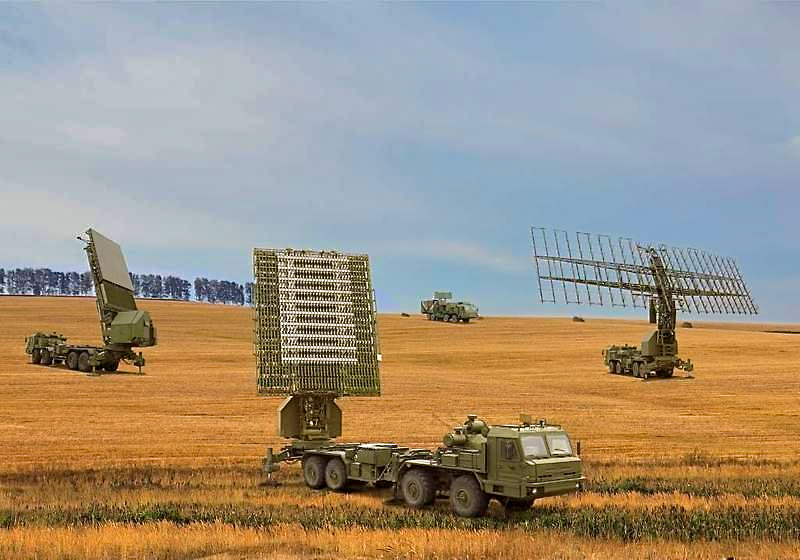
“Rendering of Almaz-Antey/NNIIRT 55Zh6ME Nebo ME deployed. The VHF-band component is at the right of the image, the S/C-band component is at the left of the image, the L-band component in the foreground, and the data fusion system, in the background. All components are carried on high mobility BZKT BAZ-6909 series vehicles. At least one hundred of these advanced systems will be acquired for the Russian Federation Air Defence Forces (NNIIRT image).”
See more about the Surveillance Radar in:Russian / PLA Low Band Surveillance Radars
http://www.ausairpower.net/APA-Rus-Low-Band-Radars.html
Although this acquisition to be related to a supposed ability to detect STEALTH to radar, however what really already has been proven that the radars operate in different bands can be much more difficult to be jamming by the adversary, once should be necessary to interfere in all bands at long-range simultaneously with powerful jamming stand off aircrafts, because would be difficult to the same jamming aircraft to load all electronic equipment to interfere in all bands radar.
Another problem for the adversary to defeat the multiband radar surveillance would be the engagement of the decoys, that could only be programmed to simulate a target in a specific band most of the times, while the others radar band should be standby or in reserve .While decoys could be are monitored by one radar band as VHF, the less expensive, against potential threats, some other radar with anthers bands( L, C/S) would be starts its operation, and the first sweep with another band should be confirmed by RCS that those threats could be actually decoys.
If STEALTH aircraft really can not be detected by surveillance radars, this does not apply about conventional aircraft that are supporting the operation of those STEALTH aircrafts at long distances as: AWACS, ELINT / SIGINT Aircrafts, Stand off Jamming Aircrafts, Air Refuelling Tankers, ASWU Aircraft’s, Transport Aircraft’s, eg.

The Long Range Surveillance radars could locate the adversary AWACS, even those would be operating in passive mode, its could be intercepted by air-air long range missiles, or even by long range SAM. The lost of the AWACS thus forcing the STEALTH aircraft to swift on its own radar to locate the targets, which would reveal the position of these, and therefore would be visible to the opponents with emitter locating system or advanced RWR, then the STEALTH aircraft will lose its biggest advantage.

With regard to the AWACS if the adversary could be equipped with STEALTH fighters or STEALTH UCAV, this threat should become the biggest concern for the AWACS, and might even prevent the use of AWACS. Thus surveillance radar systems operating in the land with different bands, and preferably that it could be re-positioned in the shortest time, certainly would be a great complement for the AWACS, preventing these to be kept in predictable routes for the opponent to knocks down them.
Another fact is that new surveillance radar with long range AESA technology in different bands has been incorporating other functions as: ELINT / SIGINT to capture the signals from enemies aircraft’s in passive mode, besides those radars possible can establish directional data links with friend aircrafts, which reduces the possibility of interference with aircraft or UAV and UCAV at long range.
The concept of multiband radar is not more exclusive from surveillance radar systems in land, since Russia has been incorporation a radar in the L band in addition to the main radar in X band. The new aircrafts with this concept will be the Su 35BM and PAK FA. Thus, these and other fighters like the Su 27SM and Su 30 in improved versions, could be appears in the coming years equipped with a multiband radar in X band and L band.
 maurobaggio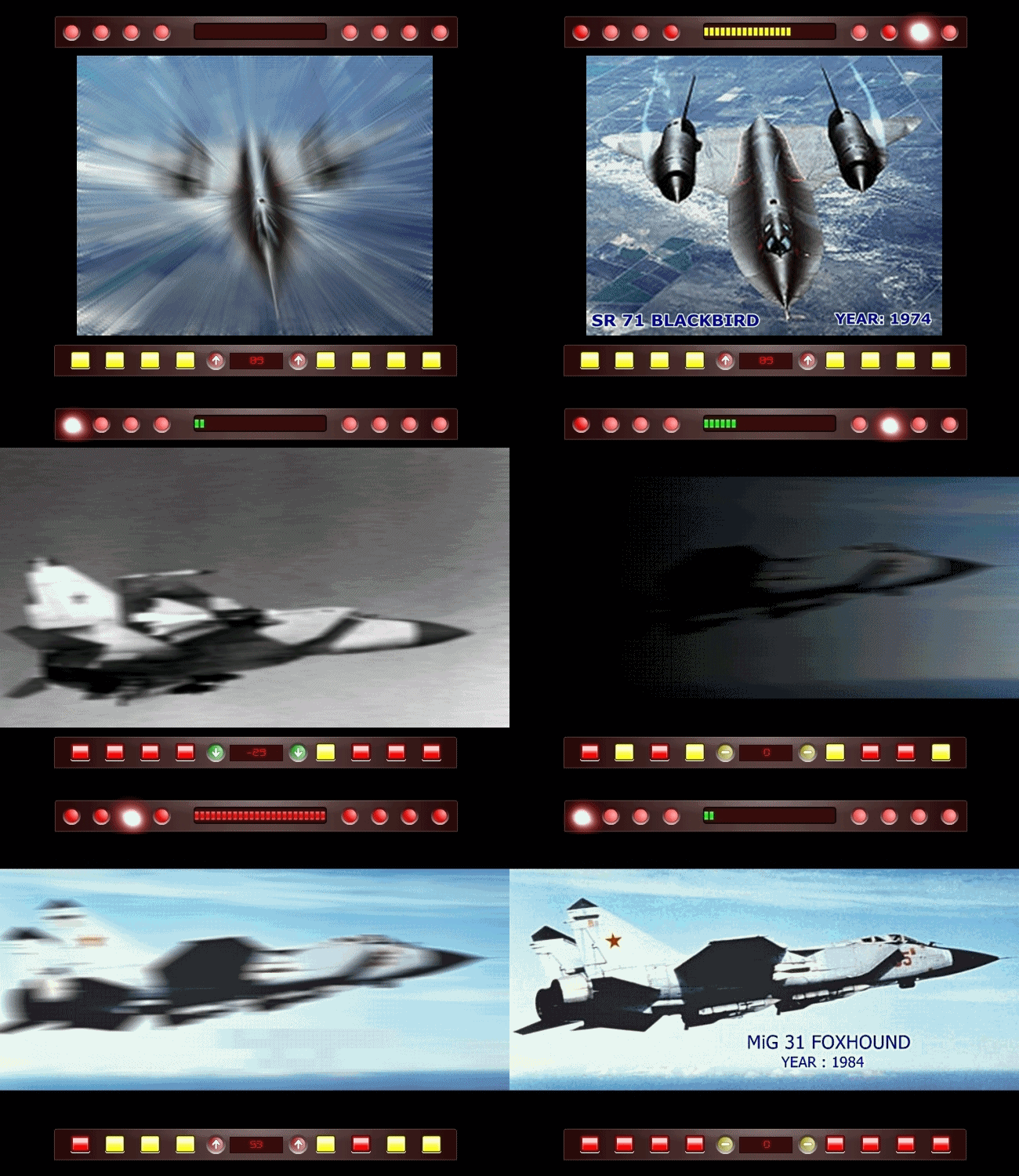
Chapter 1 – The Soviet Planning To Defeat The SR 71 Program :https://sites.google.com/site/sr71xm…oviet-planning
Key Publishing Forum: http://forum.keypublishing.com/showthread.php?t=115044
Chapter 2 – MiG 25 RB X YF 14 Tomcat II Over Sinai in 1973 :https://sites.google.com/site/sr71xm…over-the-sinai
Key Publishing Forum: http://forum.keypublishing.com/showthread.php?t=115178
Chapter 3 – MiG 25P to MiG 31A , From SHADOW to DARKNESS :https://sites.google.com/site/sr71xm…ow-to-darkness
Key Publishing Forum: http://forum.keypublishing.com/showthread.php?t=115390
Chapter 4 – SR 71 Blackbird, The Legacy of Murphy’s Law : https://sites.google.com/site/sr71xm…phy-law-legacy
Key Publishing Forum: http://forum.keypublishing.com/showthread.php?t=119286
Chapter 5 – MiG 31 Foxhound Vs. SR 71 Blackbird , 007 At Service of the Soviet Union: NEXT
Key Publishing Forum : NEXT
It is common to find assertions that the failures are originated during the design phase, especially with regard to the aerospace sector but this is not strictly correct. There are design flaws and manufacturing process failures as in the using of the systems. This is due to the fact that project teams and process many times, especially on large projects or even in secret projects, are not working together, and that on several occasions these teams to operate the new system were not consulted about the characteristics that it must possess to become effective or even capable. The use of tools such as FMEA has demanded the integration of these teams while working independently, should analyze problems and find solutions together, and that because of this provides an environment where new ideas are discussed, creating opportunities for advancement in all areas of the new project.
At this point it is supposed that the Soviet and American teams were different, since both sides had teams of highly intelligent, capable and motivated. Its difficult to believe that the Soviets team were comfortable in expressing their views in publicly and analysis to be discussed for all participants in the project. For those who are in leadership positions to make decisions that can be extremely dangerous, since wrong decisions can be assumed due to the absence of discussions by the staff, where people who have specific knowledge about a potential problem prefer to remain silent for do not feel safe in expressing their thoughts.
In the case of MiG 25P should have been foreseen the possibility that some aircraft could be stolen or even that some of the pilots defected, and hence a remote control of engines made by operators in CGI by datalink, supposedly for the purpose of reducing the burden of workload of the pilot were implemented as solution for this threat. Because of this even if an MiG 25 could be diverted toward f from Soviet Union borders, it would be enough for operators in the Command Ground Control ( CGI) to disable the engines by datalink , causing the lost of the aircraft or even accelerate the engines at max power to explode the MiG 25 high in the sky. Even it fell into foreign territory, only to analyze should remains the wreckage.
Just as the purpose of illustrating the situation in such cases the teams that routinely had been operated those fighter as MiG 25P/RB for years would come to know about these devices in details better than the actual team that designed and built. The MiG 25P were often located at bases in remote parts of the Soviet Union, and so the staff responsible for maintenance and operation as long the pilots had to be able to perform various activities without technical assistance from other sources, in order to maintain these fighters operating in high availability, making these highly skilled and creative teams to maintain and operate those high complex machines.
The MiG 25P was designed to have a crew of only one member, this being the pilot. The Tu 128 that had prior to the MiG 25 has two crew, the pilot and systems operator, while the MiG 25P same function system would be held by operators on the ground( CGI) by datalink for the pilot to concentrate only that were essencial to the mission, while several task could be all performed by data link. The interesting point was that the MiG 31 returned the configuration of two members, a pilot and systems operator, even possessing equipment data links much more complete and advanced than the MiG 25P.Perhaps the defection of the pilot from MiG 25P in Japan in 1976 had influenced this turn of two crew was likely the Tu 128.

This fact indicates that the option for a single crewman on the MiG 25P and the introduction of a remote control system by datalink in the aircraft may had been due not to the advantage of decreasing the number of crew, and thus use this valuable space for other purposes , but to allow more centralized control over the aircraft. Making a simplistic analysis that would be impossible to guarantee that even with two crew members the both had decided to run away with a MiG 25, but as with other crew members of the MiG 25P in the ground they would be in CGI, which thus would be unlikely that operators allow the pilot to escape to the West with the MiG 25P. While these operators in a CGI certainly would be face charges of alleged treason it probably waiting the judgement on the edge of Siberia in an unheated cell during the winter, while the pilot who defected could be on a beach in some tropical paradise, enjoying his retirement.
Another factor to consider for the emphasis on keeping the MiG 25P with only one crew member would be that there would be a smaller contingent of troops that would know in depth the performance of the MiG 25P, ultimately in an Air Force as the Soviet Union, which has high standards of training, the pilot was one who knew about aspects of their aircraft. By eliminating the second crew in the aircraft performance details could not be shared with the ground staff, since these could serve to operate the aircraft systems through indicators and these indicators could be adjusted to show the differents performance parameters obtained by the real aircraft, and perhaps most importantly the fuel consumption and consequently the real autonomy of MiG 25P.
As already mentioned the connection between the datalink MiG 25 and control centers virtually eliminated the possibility of defection of a pilot with the MiG 25, and would keep a number of people with detailed information about the operation of MiG 25, once that this was a crewman.
Using the methodology of FMEA would be possible to observe that the human factor was considered high risk for the integrity of the program secrets MiG 25 by the high command from Soviet Union. Due to this the keeper of the secrets of the MiG 25 was under the responsibility of the datalink system that would prevent any attempt to escape from pilots with one of those MiG 25, however own the datalink system also needed constant maintenance, and this were done by humans in distant and remote bases of the Soviet Union, and many times under the eyes of the pilots or even by its hands.
the fact that this probably was not seen by those who planned the datalink system for the MiG 25, since they could be not familiar with the routines of remote bases where it were constant about the lack of trained personnel to carry out all maintenance and operation activities, even over a complex aircraft such as MiG 25.

REFERENCES
ASAS – ASAS Magazine – http://www.revistasas.com.br
APA – Australian Power Analyzes Website – http://www.ausairpower.net
AIRFORCES – Air Forces Monthly Magazine – http://www.airforcesmonthly.com
GORDON, Yelfin. MiG 25 and MiG 31: Defensive Front Line. Leicester – UK: Midland Prublishing Limeted, 1997.
HACKETT, General Sir John, BARRACLOUGH, Brigadier Sir Jonh, BURROW, Sir Bernard, HUNT, Brigadier Keneneth, McGEOCH, Vice-Admiral Sir Ian, MACRAE, Norman, STRAWSON, Major-General John. THE THIRD WORD WAR – AUGUST 1985. New York – USA: Macmillan Publishing, 1978.
BOLLARDIÈRE, Jacques Paris, PRATS, Juan P. , KISTER, Pierre. THE WAR AND THE DISARM. Editions Grammont. Lausanne – France, 1979.
OVERSCAN’S GUIDE TO RUSSIAN MILITARY AVIONICS – [email]avionics@overscan.co.uk[/email]
WIKIPEDIA – Wikipedia, The Free Encyclopedia. http://www.wikipedia.com
MiG 25 FOXBAT – http://www.vectorsite.net
FAS – Federations of American Scientists – http://www.fas.org
Google Images: Imagery Sources – http://www.images.google.com
maurobaggio3.4 – Battle Plan
“Those who excel at defense bury themselves beyond the lowest depths of the earth. Those who excel in attack move above the highest heights of the sky.”
[RIGHT]General Sun Tzu –
The Art of War
[/RIGHT]
As the U.S. was leaving the Vietnam War in 1973 certainly would be much resistance from the U.S. government to engage directly in war against the Egypt if any aircraft transports as C 5A Galaxy or C 141 Starlifter engaged in the effort to supply Israel with weapons and munitions were attacked in the Israel territory by MiG 25RB had been based in Cairo West Air Base from Egypt, once those MiG 25RB for all circumstances would be about Egypt command .
Thus it was presumed that the U.S. had been faced by its restriction to support Israel caused by the MiG 25RB in Egypt would press Israel to accept a ceasefire in terms favorable to Egypt and Syria, and most probably those favorable terms should be the Sinai territory and the Golan heights to return from Egypt and Syria respectively.
Anyway the high effort in preparing the offensive in 1973 did by Egypt and Syria without the secret services of Israel and the U.S. were able to alert were a remarkable achievement, even more because these extensive preparations had involved two countries at the same time, and the Soviet Union as the main support its, and in the case of the Egypt did its despite the high celebrate departure of the Soviet personnel in 1972 from Egypt .
The governments of the U.S. and even Israel were so convinced that Egypt was not in condition to enter in a new war against the Israel, and that all military demonstrations from Egypt were a smokescreen to cover up the negotiations with the U.S. and Israel from the hard line of Egypt Armed Forces , that even when Bulgaria sent the SS 1 SCUD to Egypt in August 1973, this was interpreted as just another demonstration for the hard lines.
[/B][/SIZE]
With the detachment between Egypt and the Soviet Union in 1972, Egypt became a threat of lower intensity as compared to the period that its was near at the Soviet Union, and Syria alone had not been considered a potential threat to Israel as Egypt.
However other problem that could be important about the decreased the perception from secret services of Israel and the U.S. about Egypt and Syria had been preparing for war against Israel with high support from Soviet Union before 1973 were that Israel and U.S considered as the greatest threat could came from terrorist groups as far as Israel and U.S. interests in the Middle East, especially after the murder of the Israeli athletes in 1972 Olympic games in Munich, West Germany.
The Bulgaria and other countries under the influence of the Soviet Union were used to deliver equipment and weapons to Egypt in order to maintain the illusion that Egypt and the Soviet Union were apart. The case of SS 1 SCUD were perhaps the most interesting, since Bulgaria could not supply the SS 1 SCUD without the approval from Moscow, or in that case under orders from Moscow. However this delivery for the SS 1 SCUD were seen only as a gesture from Moscow to pleasure the Egypt, so that could help to reverse the Egypt decision to move away from the Soviet Union influence.
However what was really the highest secret and therefore the most unpleasant surprise were the concealment of the MiG 25RB in Cairo West Air Base between 1972 and 1973. An aircraft like the MiG 25RB had demand many high specialized technicians in maintenance to keep those aircraft in fly conditions, mainly due to high volume and complexity from electronic equipment of those aircraft in addition to all other systems to keep its operating, it must should be inspected and tested continuously even to avoid the corrosion from air and moisture content about its sensitive parts of the MiG 25RB .
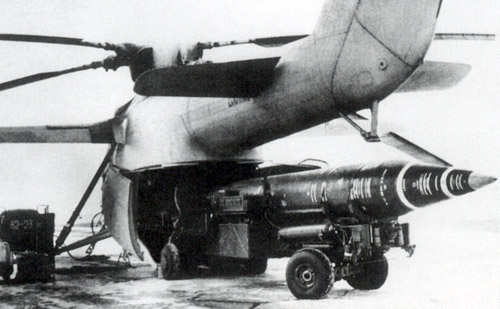
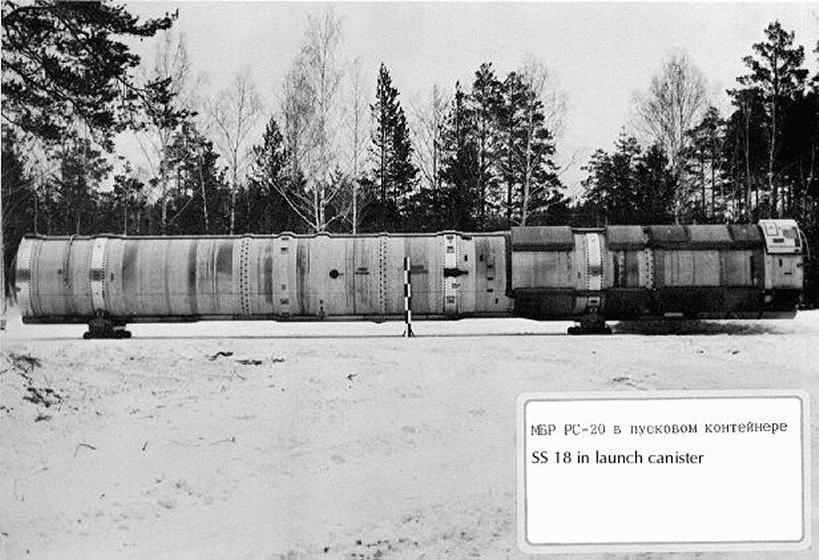
The probable reason that the MiG 25RB could be kept secret in Egypt for years could be the storage process in which it were placed in the underground shelters of Cairo West Air Base. The Soviet Union at that time had been developing ICBM (Inter Continental Ballistic Missiles) since the 60’ that would be stored inside the chamber or cylinders with inert gas atmosphere, so that it just did not cause corrosion in the component from all systems of the missile .
And other utility had been pumped through the cylinder with the cold ejection, so the high pressure and heat from gases generated by the rocket engines after the cold ejection while the missile were out of the silo should not damage the parts of the missile, in special the nozzles devices as well the others parts as the guidance system and even the airframe.
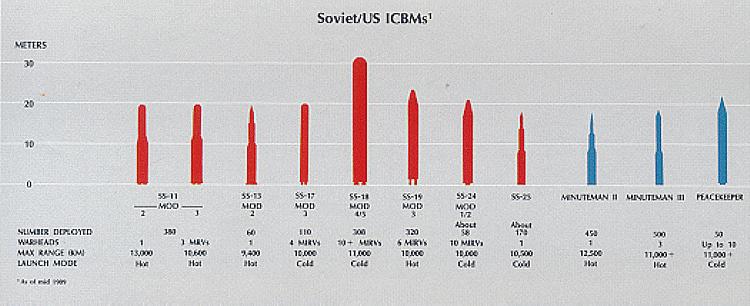
In the case of ICBM as the SS 18 Satan were extremely difficult to determine in which these silos ,during the Cold War, where it were stored those missiles, since after the installation thereof, it were not inspected for more than ten years, what could appears that silos were empty specially when were observed from reconnaissance satellites in low orbits.
After SS 18 ICBM had surpassed its useful life from 10 year more than 150%, all launching of the SS 18 during tests were flawless, which proves that the inert atmosphere from cylinders were able to protect the components of the missile for long time.
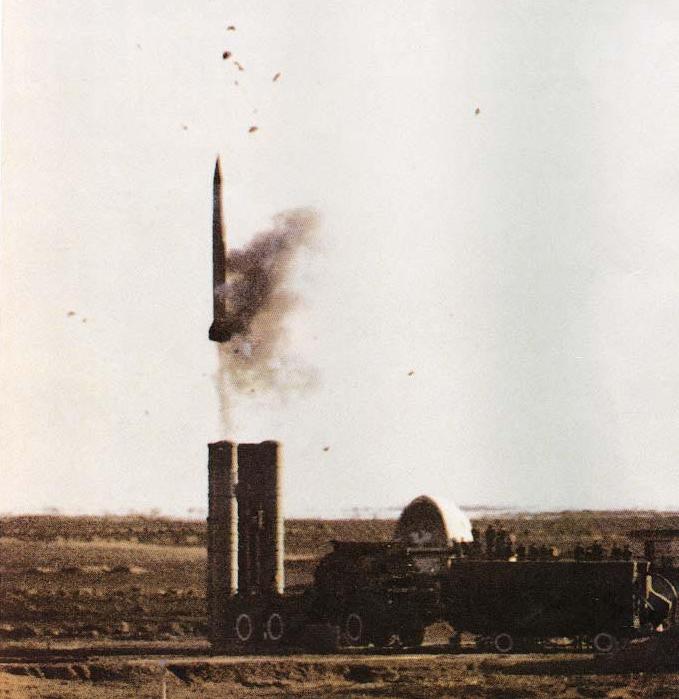
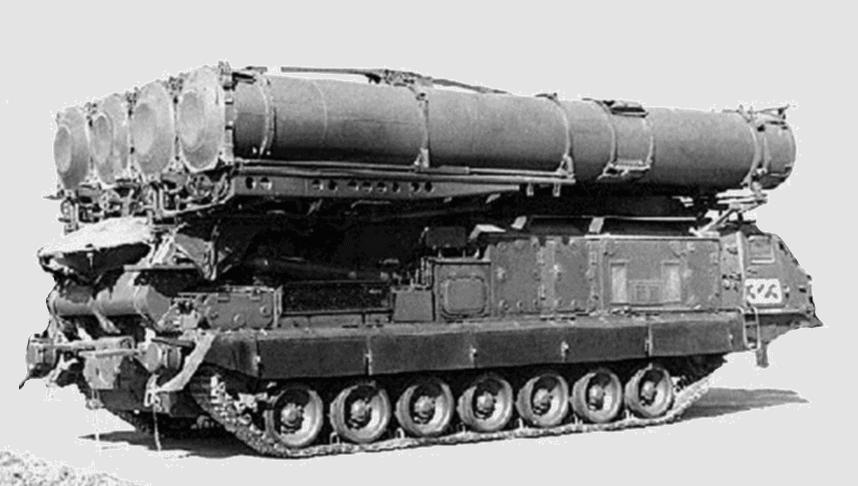
Currently this method has become well known and used since by Soviet SAM as: SA 10 Grumble and SA 12 Gladiator / Giant during the 80’s. With this method with missiles inside of the cylinder or chamber could be keep almost 10 years without the need to pass through maintenance, and this cylinder with missiles inside usually were laid down at the outdoors, even in ditches under mud, snow or water.
maurobaggioPulse jet engines actually are not new concept, since Germany from 1944 had launched against the UK nearly 10,000 cruiser missiles as the Fieseler Fi 103 (V 1 Flying Bomb). The turbine of Fieseler Fi 103 operating through the pulse jet process, without the compressor, and this cycle operated by closing the air inlet.
For the damages to the UK due the V 1, the Allied had made a high effort in destroying the launching bases of V 1 in occupied France, as well as destroy the assembly lines of the V 1, at least prove that the system V 1 was effective as pulse jet engine.
However after the war ended, and the subsequent analysis of the design of the Germans, the concept was eventually abandoned for some reasons.
But it is always possible that someone has a new idea and be able to improve something that already existed and indeed proved that it was achievable in a time in which the technology was rudimentary compared to the present.


 Sign In