 maurobaggio
Tail Wind from Cairo West Air Base
After the ceasefire from August 8th 1970 there was no longer a war between Egypt and Israel till October 1973. Both sides kept some recce flights to monitor the changes of the other side including the intercept attempts of that. The pair of Su-7Bs were on a tactical recce mission along the Suez had just bad luck when passing over an alerted Israeli stronghold. The EAF lost just a handful MiG-21s/Su-7s against the Israeli escorts when they tried to intercept Israeli recce planes over Egypt or by Israeli interceptors, like that one over Mansura AB 1972 f.e. The Israeli realized soon that there was a small chance only to intercept the MiG-25RBs. The F-4E interceptors had to be scrambled to the estimated exit point of the very recce mission. A small Israeli error saved a MiG-25RB. As the Russians learned that they kept a CAP there to escort the MiG-25RB for landing back. When most of the Russians left Egypt in 1972 they retired the MiG-25RBs too. The two loaned USAF RF-4Cs were replaced by six new built RF-4Es from March 1971 already.
.
As has been posted above would be a fact that the Israel Air Force made a great effort to intercept or destroy the MiG 25R/RB in the airspace of the Egypt and even in the Cairo West Air Base that were its base.
According to Mr. Yefim Gordon the MiG 25R/RB in its reconnaissance missions were escorted and protected during their take off and landings by the MiG 21 Egypt’s in attempts of the interceptions from Israel Air Force because in this phase of the mission the MiG 25 would be vulnerable to F 4E Phantom II of the Israel Air Force. Since after the MiG 25R/RB had achieved its maximum altitudes and speeds these were beyond the reach of F 4E Phantom II equipped with air-air missiles as AIM 7E Sparrow.
The decision from Soviet Union to send to Egypt the MiG 25 was taken to even before the ceasefire from Attrition War between Israel and Egypt in 1970, and even before that the Soviet Union had sent a large military contingent to Egypt in order to help Egypt in the air defense of the main facilities of this country.
In fact even before cease-fire between Egypt and Israel the Soviet Union had suffered losses due to attacks from Israel Air Force.
Despite the ceasefire the hostility was high since both countries had bee invading each others with reconnaissance missions or attempts to intercept and attack until the war in 1973.
Facilities at Cairo West Air Base had been prepared by the Soviet Union since 1970 in order to withstand attacks with precision weapons then used by the USA in the Vietnam War since 1967.
With the experience of the Vietnam War the Soviet Union had prepared Cairo West Air Base with facilities so that it were not easily damaged or destroyed by precision weapons used by the U.S. so far as: AGM 62 Wallerey, GBU 8 HOBOS and LGB 117 Bolt. At least AGM 62 Wallerey and possibly the GBU 8 HOBOS had bee provided to Israel even before the Yom Kippur War in 1973.
A Hardened Aircraft Shelters in underground for the MiG 25 would be the best passive defense against attacks mainly with precision weapons, since one aircraft has been equipped with precision weapons could cause far more damage than a dozen of the same aircraft with unguided bombs or rockets as that was see in the Vietnam War.
If the MiG 25RB were taken from Cairo West Air Base after the Soviet Union to withdraw its staff, which some estimate that nearly 20,000 military and accessors, from Egypt in July 1972, after the President of Egypt to expel the Soviets that they had refused to sell the MiG 25RB for the Egypt are facts that has been reported and publicly accepted as well since 1973.
As the fact that the MiG 25RB were reassembled in two days after its return from the Soviet Union at Cairo West Air Base and managed to make a reconnaissance mission at the end of the Yom Kippur War in 1973 .
As another fact widely reported and officially accepted that while civilian aircraft from Israel as B707 and B747 had started the Operation Nickel Glass from 10 October, the USAF only could started from 14 October, while the Soviet Union started from 10 October even to both Egypt and Syria.
However these facts could lead to the following questions:
[*]Why want to buy the MiG 25RB when it was already in Egypt for free?
[*]Would not it be simpler explanation that the MiG 25RB were in Cairo West Air Base before the start of the war in 1973?
[*]Why does the USAF with the most advanced and powerful fleet from cargo transport aircraft jet as the C 5A Galaxy lost the race for the turboprop An 22 Antey by a difference of more than 04 days?
[*] Could it be that the USAF got a strong tail wind from the direction of Cairo West Air Base, and this wind only stopped when the F 14A Tomcat arrived at the Israel?
GBU 8 HOBOS From Israel Air Force
http://www.fez.ch/modules.php?set_albumName=album71&id=GBU_8_Hobos_IAF&op=modload&name=gallery&file=index&include=view_p
RF 4E Phantom II and GBU 8 HOBOS from Israel Air Force
http://www.flickr.com/photos/xnir/3434341108/
F 4E Phantom II armed with 02 AGM 62 Wallerey from Israel Air Force
http://forum.keypublishing.com/showthread.php?t=85288&page=2
User:roberto_yeager
AGM 62 Wallerey displayed with glasses windows to show the components 
http://www.pbase.com/image/100723044
LGB(Laser Guided Bomb) 117 Bolt
http://aviationintel.com/2011/10/15/fast-history-the-bolt-117-laser-guided-bomb/800px-f-4d_497th_tfs_with_bolt-117s_1971/
F 4D Phantom II from USAF during the Vietnam War equipped with two LGB 117 Bolts
http://aviationintel.com/2011/10/15/fast-history-the-bolt-117-laser-guided-bomb/800px-bolt117lgb/
maurobaggioELINT Missions from MiG 25R/RB in 1971
It seems Gordon is not a reliable source.
September 17, 1971 an Egyptian SA-2 shot down the IDF-AF LOROP Stratocruiser EC No 033 of 120. sqdn (ex KC-97G-26-BO, 4X-FPR, cn 16714, 52-2683, 33/033 “Arad”) on the routine mission along the Suez Canal at 28000 feet and about 24 km east from the Canal north of Ismailiya. The aircraft was flying north to south along the Canal, suggesting the camera window was on the starboard side of the aircraft. It was hit by two SA-2 missiles in an apparently planned action – possibly retaliating for the Israeli AAA shoot-down of an EAF Su-7 over the Sinai during a recce-mission on the 11th. The Stratocruiser crashed 35 km east of the waterway. Of the eight-man crew only Hanania Gazit managed to bail out and survived. Israel retaliated the next day September 18 when Kurnass crews (F-4Es from 201. and 69. sqdns) launched AGM-45 Shrike ARMs against the SA-2 batteries allegedly responsible for the Stratocruiser’s shoot down. But the results of Operation Toaster were far from satisfactory. Damaged Radar arrays can be replaced in short notice. Whatever variant of the SA-2 was used, the max range was ~40 km and the SAM-site in question close to the Canal. Cairo West AB was over 140 km away and could not have been hit by error at all. For the intrested ones the SAM-site in question was close to a present one to see at Google Earth 30°38’06 N and 32°18’30 E about that.
Maybe Mr Gordon and his sources did not imagine that critical readers may verify that claims some day with modern tools and details at hand.
Unfortunately there were no mention from Mr. Yefim Gordon about the day in September 1971 that SAM units in Cairo West Air Base had been attacked by F 4E Phantom II with AGM 45 Shrike ARM missiles from Israel Air Force, and were not specified which SAM units were hit. As Cairo West Air Base had been protected by SA 2 Guideline and SA 3 Goa units and the ZSU 23-4 all with Soviet garrison according to the author Mr. Yefim Gordon.
According to what was previously posted the situation in September 1971 could be described almost at war between Egypt and Israel. With the shoot-down of the Su 7 from Egypt, and this should be hardly to explain either once the Egypt Air Force were equipped with MiG 21R that was specialized in reconnaissance missions, and at this time the MiG 25R/RB had been making reconnaissance missions since May 1971.
Apparently it could be a reason that the Su 7 were doing missions at low altitude in order to provoke the reaction of air defenses from Israel, so that the MiG 25R/RB equipped with ELINT sensors would collect data for analysis of the air defenses system from Israel in the Sinai.
It could appears not seem a good idea to conduct a routine reconnaissance mission over the border with Egypt in the Suez Canal after the Su 7 from Egypt were shoot down, and Israel did it with Stratocruiser EC aircraft, once that aircraft were not maneuverable and with subsonic speed at 28,000 feet and about 24 km east from the Canal north of Ismailiya .
Indeed, I really have thought that its little strange if would be necessary the Stratocruiser EC with 08 crews members only to press the button of the photo camera for the reconnaissance mission!
Would it be possible that this aircraft was dedicated to ELINT missions in order to locate and identify SAM units?
This could be like an exact target for SA 2 Guideline, since Israel were equipped with RF 4C Phantom II, and yet Israel did it, almost as if it was a bait to activate SAM units from Egypt so then It could be detroyed by F 4E Phantom II with AGM 45 Shrike ARM missiles.
I have thought that the source of information about these events can even be reliable, however when you do a critical analysis of those details its possible that the all story has not been described yet.
This is only an opinion of someone who has been quoted a source like Mr. Yefim Gordon and and remains able to rely on this. By the way, Mr. Yefim Gordon was not the source who had mentioned that the F 14A Tomcat were used to protect the Operation Nickel Glass in 1973.
Nice Try!
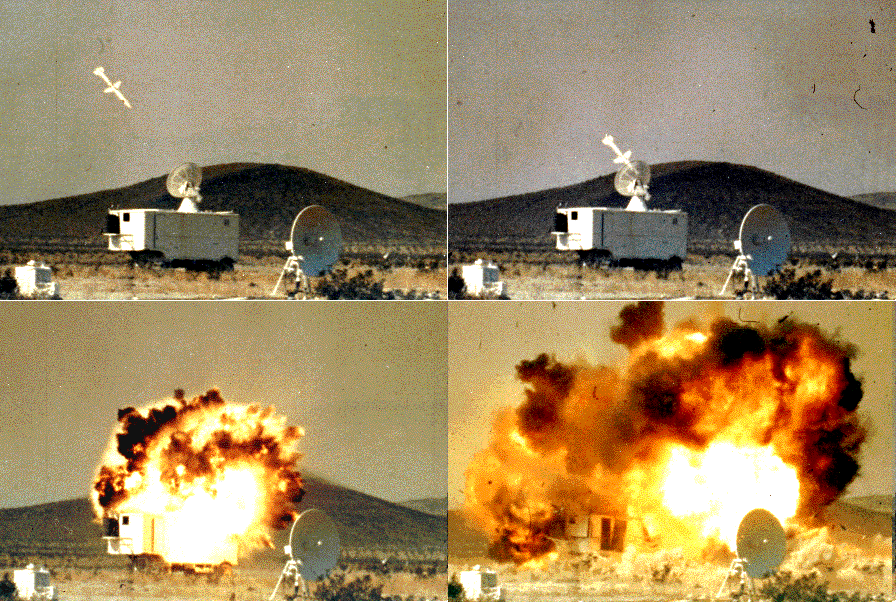
Fire Control Radar of the SA 2 Guideline from Egypt destroyed during the war of 1973.
http://www.militaryphotos.net/forums/showthread.php?68771-Yum-Kippur-War/page54
Fire Control Radar intact of the SA 2 Guideline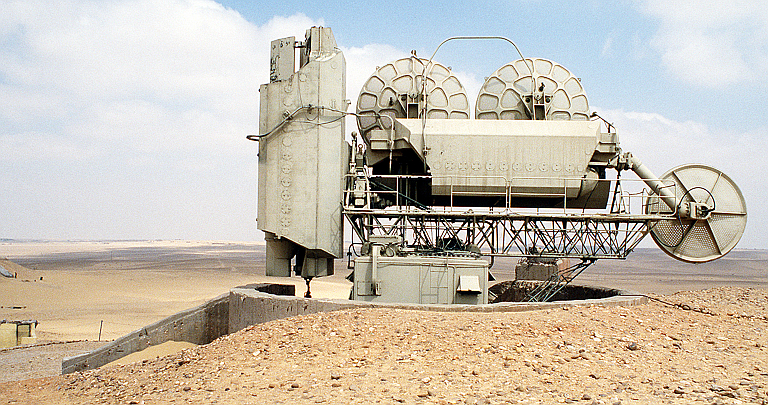
http://www.ausairpower.net/APA-Engagement-Fire-Control.html
maurobaggioFishbone Diagram
Plus some of the diagrams leave the reader wondering what the data presented proves. For example, the “casue and effect” diagram. Big red arrow pointing to SR-71 with several “legacy fighter” boxes surrounding it and various other boxes with various data, this diagram has no obvious meaning
The Fishbone Diagram is an analysis tool for solving problems. The effect is what is desired to eliminate the problem, and the causes are the means by which its possible to find a solution so to eliminate the problem.
This tool is widely used in order to make the “famous” “brainstorm” of ideas that in certain cases(in the most times necessary) could happen with seeking for the solution to a problem. It is directed or focused to the problem in order to identify the strengths and weaknesses of each option or idea has found out to solve a problem.
FISHBONE DIAGRAM
1. EFFECT: To eliminate the problem of future invasion of the SR 71 Blackbird in USSR should be desired to obtain the means to intercept this spy aircraft.
2.CAUSES: The means available or possible to obtain in order to find the solution of the problem that would be to intercept the SR 71. In this case the means were:
[*]The improvement of the fighter interceptors then in production;
[*]The development of a new inteceptor (MiG 25P) with the technology available at the time;
[*]The development a new interceptor with more advanced technologies (MiG 31) but not yet available;
3.Causes Analysis: When analyzing each possibility would be possible identifies the strengths and weaknesses from these.
Each of these possibilities would be analyzed in order to find out those that as example that could be viable and discard those that were not effective or possible.
This analysis was simplified to show the tool the Fishbone Diagram with the purpose about the possibilities that could has the USSR in that time to eliminate the spy missions of the SR 71 Blackbird.
maurobaggioF 14A Tomcat II holds MiG 25RB Foxbat in the Egypt until Cavalry to arrive
Maybe someone involved can tell the choosen solution of 1973.
In October 1973 it was no longer a long-time mission to test the new MiG-25R/RB at first. In the same year the 47th ORAP people had just trained their first bombing test with their new RBs. As you noted there was a related infra-structure/technical support in need to hit something high-up at supersonic speed with “ordinary bombs”. Nothing at hand of that in Egypt to support the MiG-25RBs in such a mission. The 47th ORAP was alerted October 11 to create the 154th OAO and send 220 men with four of its MiG-25RBs to Cairo West AB. A recce mission for a single flight of a recce-regiment. Within two days the MiGs were dis-assembled for the transport by An-22s and An-12s under the command of Col. Tschudin. All arrived till October 18 and 154th OAO had its first recce mission October 22 to verify the first UN sponsored truce. The 154th OAO stayed till May 1975 with several personal exchanges from 47th ORAP. The UN sponsored truce in Egypt came into effect October 24. At that time scale the West had still to learn about the secondary role of the MiG-25RB. The SEP of the Scud B system as well that of the MiG-25RB weapons-system did just allow to hit big stationary targets with a nuke or special weapon as it was called. When the West was informed about the return of Foxbat B at Cairo-West AB the October war was over.Bort number 57 of 154th ORA before its Egyptian hangar. There were no underground hangars at Cairo West AB. Reduced scan from Flieger Revue Extra issue 30 p 84.
By the way is very good the picuture of Cairo West Air Base with the MiG 25RB MiG in front of the hangar.
How about the fact that Cairo West Air Base had received underground shelters that was described by Mr. Yefim Gordon in his book MiG 25 & MiG 31, but at this time I don’t know if another source to confirm this and even to be able to deny it.
In the book MiG 25 & MiG 31 the author has cited the fact that after the attacks of F 4E Phantom II with anti radar missiles AGM 45 Shrike of the Israel Air Force against SAM batteries of the Cairo West Air Base in September 1971, in which militaries from Soviet Union were killed, and because of this incident was the reason that for the Soviet High Command had decided to strengthen the protection of Cairo West with underground shelters for the operation of the MiG 25R/RB.
In addition to the personnel involved in the operation of MiG 25R/RB that depending on the source could be up to 220, there were civilians among them and many of them were importants by the military development from Soviet Union. Those civilian personel had beem belonging both the manufacturer of the MiG 25 and these subsystems as research centers that actually almost never traveled outside the Soviet Union because of the importance of them, even for countries of the then Warsaw Pact. Therefore the protection of researchers and chief designers and their teams in reinforced underground shelters were vital to the Soviet Union since Egypt and Israel were practically at war during this time.

Due to the complexity of the operation of the MiG 25 R / RB in Cairo West Air Base about the author were provided with all necessary facilities for: all necessary communications and support equipment, pre-flight checks and routine maintenance, including engine run-up were done in underground of the Cairo West Air Base.
One of the features that made the MiG 25R/RB perhaps the most complex aircraft from Soviet Union in the 70s was the fact it had counted with an automatic control that almost flew the mission either automated mode, so that the pilot spent most time just monitoring the functioning of those systems. In addition the base of the MiG 25R/RB must had been prepared with all the equipment to program the mission as to monitor the mission as well, so as to avoid any possibility of diversion of those aircraft if the pilot take that decision.
If one pilot died or triet to defect with the MiG 25 R / RB, the Mission Control could destroyed the MiG 25 by sending a command datalink to speed up the engines at the maximum power for a longer time than it could handle, in this case these engines eventually by blowing up the aircraft itself at a high speed had been spreading debris across a wide area making it almost impractical to recover the secret components of the MiG 25 by opponents of the Soviet Union , since as MiG 25R/RB were a reconnaissance aircraft that would be near or even on the opponent’s territories.
Until 1976 with the seizure of a MiG 25P from USSR in Japan by the USA, the MiG 25 were perhaps the most sensitive military secrets from Soviet Union, for its potential as well by its limitations.
If MiG 25RB could be reassembled and put into operation in a few days or if it were already stored in Cairo West Air Base, both possibilities support the possibility that the F 14A Tomcat II had been sent to Israel with mission of to protect the cargo transport aircraft of the USA in the Operation Glass Nickel.
The evidence for this is that while the Soviet Union began the air bridge to resupply Egypt and Syria from 10 October 1973, the U.S. transport aircraft only landed in Israel from October 14, despite the civil aircraft Israel also had started the Operation Nickel Glass from October 10.
Only after the F 14A Tomcat II had held the MiG 25RB in Egypt was that the cavalry arrived in the form of C 5A Galaxy and C 141 Starlifter.
maurobaggioS 37 Berkut could replace the MiG 31BM in the future
Long time ago I had read that the S 37 Berkut would be a project to replace the MiG 31 B/BS and Su 27S in IA PVO (Air Defense Force) and MiG 1.44 MFI was a project to replace the MiG 29 and Su 27 on VVS ( Air Force).
But that after the merger of VVS and IA PVO into the new VVS had decided in light of budget constraints to develop a new project which is now known as PAK FA or T 50, a project that would be more advanced than the MiG 1.44 MFI indeed once would be need to replace the Su 27 either in air defense missions. The MiG 31 would be retired from service because the high cost do keep theses fighter in operational service, and will not replaced since the budget constraints.
With the recent decision from Russian to modernize part of its fleet of MiG 31 B / BS for the standard MiG 31 BM could be an indication that the S 37 Berkut could be used in future to replace the MiG 31, since from the beginning of the project S 37 Berkut had equipped with engines that were used the MiG 31 and supposedly part of your electronics such as radar Zaslon N007.
The priority of the project S 37 Berkut was presumed to achieve a performance as the MiG 31 with Mach 3 speed at high altitudes but with the maneuverability of the Su 27 Flanker, stealth technology is not the high priority as it is in the PAK FA since and that conditions from Mach 3 speed in high altitudes were not available the stealth technology from Russian .
Since Russia has been joined with India and due to this there was a decreasing in development cost per unit built for the PAK FA could be now Russia has better conditions to continue the development of the S 37 Berkut to replace in the future the MiG 31 Foxhound ?
maurobaggioThe Reality Surpasses Fiction

http://www.testpilot.ru/russia/mikoyan/mig/25/rb/mig25rb_e.htm
The first MiG 25R were converted to the standard MiG 25RB since 1972, and production and modernization of the MiG 25RB and MiG 25BM this last one for SEAD mission had been continued until 1986.
The number from attack versions of the MiG 25 Foxbat were quite extensive as:MiG 25RB / RBT / RBS / RBK / RBN / RBV / RBSH / RBF / BM.
The performance had been estimated for the MiG 25RB in 1973 by the intelligence services from West nations that assumed a much better performance than were the reality of the MiG 25 Foxbat. However this was only known after the analysis of MiG 25P had seized in 1976 in the Japan.
Because of this lack of correct information about the MiG 25 in 1973 it had been estimated that the MiG 25RB could be armed with 5,000 kg free-fall bombs or 10 FAB 500 62T on each attack mission with a combat radius of 900km at a speed of Mach 2.8 and an altitude of 22,000 m. Each TBM( Tactical Ballistic Missile) as SS 1 Scud could carried a 500 kg warhead with HE or fragmentacion to a target at distance of 500 km as comparative analisys.
Thus each MiG 25RB could launch over the target as equivalent to 10 TBM SS 1 Scud missiles per mission in a much greater range than would be obtained with those TBM but with the equal or better precision.
Therefore in case that the 04 MiG 25RB could be used in the Yom Kippur War in 1973 since those aircraft could had been performing a mission per day for 15 days, and with this could released over the targets with a destructive power equivalent to 600 SS 1 Scud missiles!
Throughout the war between Iran / Iraq that endured eight years in total were released almost 500 SS 1 Scud missiles. In the first Gulf War Iraq had launched less than 100 SS 1 Scud missiles against targets in the Gulf countries and Israel.
As the transport aircraft in the Operation Nickel Glass had loaded with ammunition would be exposed in the loading and unloading terminal from airports at the MiG 25RB that in each mission of the 04 MiG 25RB according to these estimates could launch the equivalent of 40 SS 1 Scud missiles in each attack!
Since each transport aircraft could be loaded with dozens of tons of explosives and fuel, that one was hit would be enough to cause major damage at the airport and hundreds of casualties on the ground staff, interrupting the Operation Nickel Glass for several days. The worst possibily was that the attacks could continue thereafter as the MiG 25RB were immune at air defenses from Israel with F 4E Phantom II and SAM Hawk.

MiG 25RB armed with 02 Kh 58U anti radar missiles and 04 free fall bombs FAB-500M-62T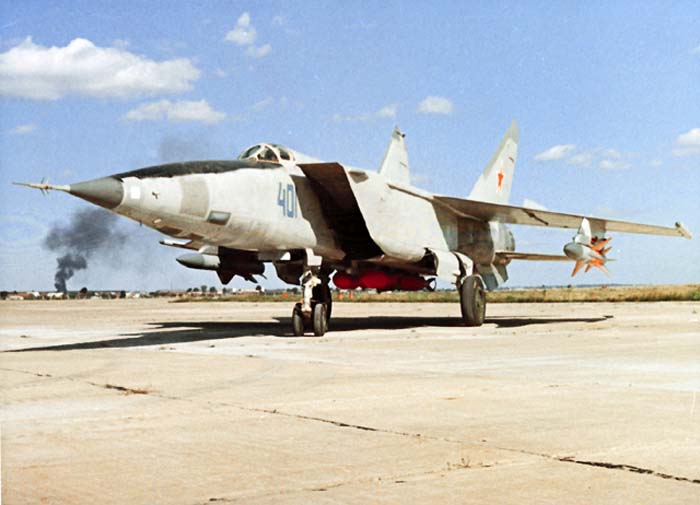
In 1971 the MiG 25R / RB came to Egypt in the dismantled shape aboard heavy cargo aircraft An 22 Antei and were assembled in a few days at the end of the month of March. However it had begun testing missions in April over the Egypt and the first real mission for reconnaissance were performed in the month of May over Israel.
However in 1973 in the middle of a war in Egypt, the MiG 25RB had made a real mission just two days after arriving on board of An 22, and again the MiG 25RB came also dismantled the same way as in 1971. If any lesson has been learned since 1971 are probably keeping in top secret since then.
Another obscure point in 1973 was that the MiG 25RB had arrived and were placed inside the hardened underground shelters into Cairo West Air Base. Those hardened shelters were built from 1970 to withstand direct impacts up to 500kg of air bombs and were extremely complet, since it were all eqquiped with the necessary facilities to operate and maintain aircraft sophisticated as MiG 25RB. But for some reason it was not mentioned that those facilities had not been used by Egypt Air Force since the MiG 25R / RB left in 1972 .
Since when MiG 25RB arrived there were not mentioned about any combat unit that was discharged of this important complex and moved to another base. If transfer combat units in peacetime would be complex task to do this in war time, and even more when it is losing, certanly could be something at least problematic.
The MiG 25RB was aircraft also extremely connected to Ground Command Stations, once its navigation system Peleng had depended from inputs from this stations via data link to update your position in order to obtain precision in reconnaissance missions and even attack.
For the correct use of MiG 25RB would also need to build the Command and Control Center of those aircraft, and test this before the real missions.
So it were make the assembly of MiG 25RB and all equipment on the ground, test and repair all faults and also prepare the mission, all this in just two days was a spectacular accomplishment , worthy of being recognized as a record until today, perhaps not repeated by any other nations or at least not revealed at the public.
While not an impossible task that in 1973, this could have been a mission doomed to failure because of the large numbers of critical activities performed in so short time when compared with the first in 1971.
However when considering the hypothesis that the MiG 25RB never left Cairo West Air Base, and that they were activated from the 20 October with the return of the Soviets pilots, since they were not at the base in order to continue training in the Soviet Union, as the MiG 25RB were stored for possible use in order to be kept in secret and therefore could not be used on operational training missions. This last hypothesis would be more logical at least than the officially described.
That officialy explanation about MiG 25RB were accepted by all parties, including Egypt and Israel, which is also curious as to the present day there were not a consensus almost all events of this war in 1973.
maurobaggioMiG 25 RB into belly of the monster An 22 Antei

Wild Weasel tactics and techniques were first developed in the Vietnam and after the Yom Kippur War, and were later integrated into the Suppression of Enemy Air Defenses (SEAD) that has been used by US air forces to establish immediate air control, prior to possible full scale conflict. The Yom Kippur War was extremely important for the U.S. to test and refine their techniques SEAD.
In the effort of Operation Nickel Glass sent to Israel:
http://en.wikipedia.org/wiki/Yom_kippur_war
While the F 4E Phantom II and A 4 Skyhawk had been provided by the USA in order to recover losses from Israel flew to the same with American pilots, in order to allow the fighters to be used as soon as possible.
However, the Soviet Union’s MiG 25RB had arrived in Egypt totaly dismantled, and yet made its first real mission just two days after his arrival on board the An 22 Antei.
While not impossible to perform the assembly of complex aircraft like the MiG 25 RB in so short time, yet those were not a routine operation from Soviet Union, since the MiG 25 Foxbat were not designed to be transported by An 22 Antei of order to be reassembled and become operational in a few days.
MiG 25 RB almost entirely dismantled lands into the belly of the monsters An 22 and flies off in two days after leaving the same?
Although not impossible, this event could be classified as fiction if the Soviet Union had not disclosed it, and the MiG 25 RB were not tracked by radars from Israel and USA, which confirmed the same mission.
However the lack of details on this spectacular mission does not match very well with the purpose of this mission was carried out only in order to impress the Western nations.
Among the most important lessons of the Yom Kippur War to the Soviet Union was that it should develop a new heavy cargo aircraft so that it were possible to transport larger amounts of loads per mission and loads much more voluminous than the An 22 Antei were able . And for this the Soviet Union should have an aircraft of class C 5 Galaxy, which has spawned the development and production of An 124 Condor.
 maurobaggio
The awakening of the dead’s MiG 25RB
That claim is a mission impossible. Israel much more than Egypt was under constant surveillance by several means. (Radar, HUMINT, ELINT a.s.o.)

In March 1971 the group was ordered to move for Egypt . To save time the personnel and the four MiG 25 R/RB were airlifted by An-12′ Cub’ and An-22 ‘Antei’ transports. But even with the wings, tail units and engines removed the MiGs would not fit into the An-22’s cargo bay. The fuselage width fitted but the mainwheels got stuck in the ‘Antei’s’ cargo door. That was suggested reversing the main gear units so that the main wheels could faced inboard instead of outboard; that tookcare of the problem. It was suggested temporarily fitting MiG-21 mainwheels once its were strong enough to hold the stripped-down MiG 25 but much smaller than the MiG-25’s own mainwheels, enabling the aircraft to pass through the cargo door.

After four MiG 25 R / RB arrive disassembled in Cairo West Air Base in late March 1971, they were reassembled in a few days due to highly trained and qualified personel sent to Egypt along with the aircraft’s. However, the first test flew trial of the MiG 25 R / RB began in late April, and during this period that included the refitting of the aircraft and the beginning of flew’s were used to perform ground test’s and adjustments.

On October 19 and October 20 from 1973 during the Yom Kippur War, the first An-12s and An-22s brought new’s four MiG-25RBs, personnel,spares, support equipment and even fuel to Cairo-West air base again.
On 22 October 1973 one hour prior to initiating the ceasefire, two MiG 25 RB did reconnaissance missions over the Suez Canal on positions occupied by Israel.
I have been summarizing the operations of the MiG 25 R / RB in 1971/72 and the operations of MiG 25 RB in 1973 that describes the author Mr. Yefin Gordon in his book MiG 25 & MiG 31 , which is observed is that in 1971 there were more details about how this was done with little time available to achieve this large operation.
However in 1973 there are a few details and no comments on the short time between reassemble the MiG 25 RB and real mission in a war zone held by it.
In 1973 when moving the four MiG 25 RB to Cairo West Air Base the Soviets had been excelled at various times than compared with 1971 , but there are still many details missing of it in 1973.
Interestingly this operation in 1973 is that despite all the urgency and risk of major failures occur that could lead to loss of some or even both MiG 25 RB due to the absence of time to perform tests before the real mission, there was a great purpose this military since the ceasefire had been negotiated between the nations involved in war.
The risk of losing an aircraft like the MiG 25 RB Foxbat that was the most advanced fighter of the Soviet Union by a technical failure to perform only one task of reconnaissance.
Again the risk of losing an aircraft like the MiG 25RB Foxbat that was the most advanced fighter of the Soviet Union by a technical failure in a war zone were too high for a mission almost unnecessary.
Although the reason for this task MiG 25 RB were intended to convince Israel maintain ceasefire since MiG 25RB would be able to enter the conflict if this was restarted, but still would be an unnecessary risk since the MiG 25 RB could do aerial missions in space from Egypt only to demonstrate to Israel that these were available in Egypt.
This is one reason to consider that the MiG 25 RB were already stored secretly in Cairo West Air Base even with the purpose of being used on missions in support of the Soviet Union in the Mediterranean Sea in case of need for this.

References:
MiG-25 ‘Foxbat’ and MiG-31 ‘Foxhound’© 1997 Yefitn Gordon ISBN 1 85780 064 8 Published by Midland Publishing Limited24 The Hollow, Earl Shilton
Leicester, LE9 7NA, England
maurobaggioSecond Part – MiG 25P To MiG 31A
The complexity of the air defense system in former Soviet Union in which various types of radar operating in different bands are those of the interceptor missile batteries and figthers, must have been one of the factors most relevant to concept of the stealth tecnology adoption by the United States in future projects.
Even the SR 71 during the 80’s must had become more vulnerable to Soviet defenses, and even equipped with sophisticated systems of electronic interference, it should not be more immune to air defense systems, especially in the presence of the MiG 31.

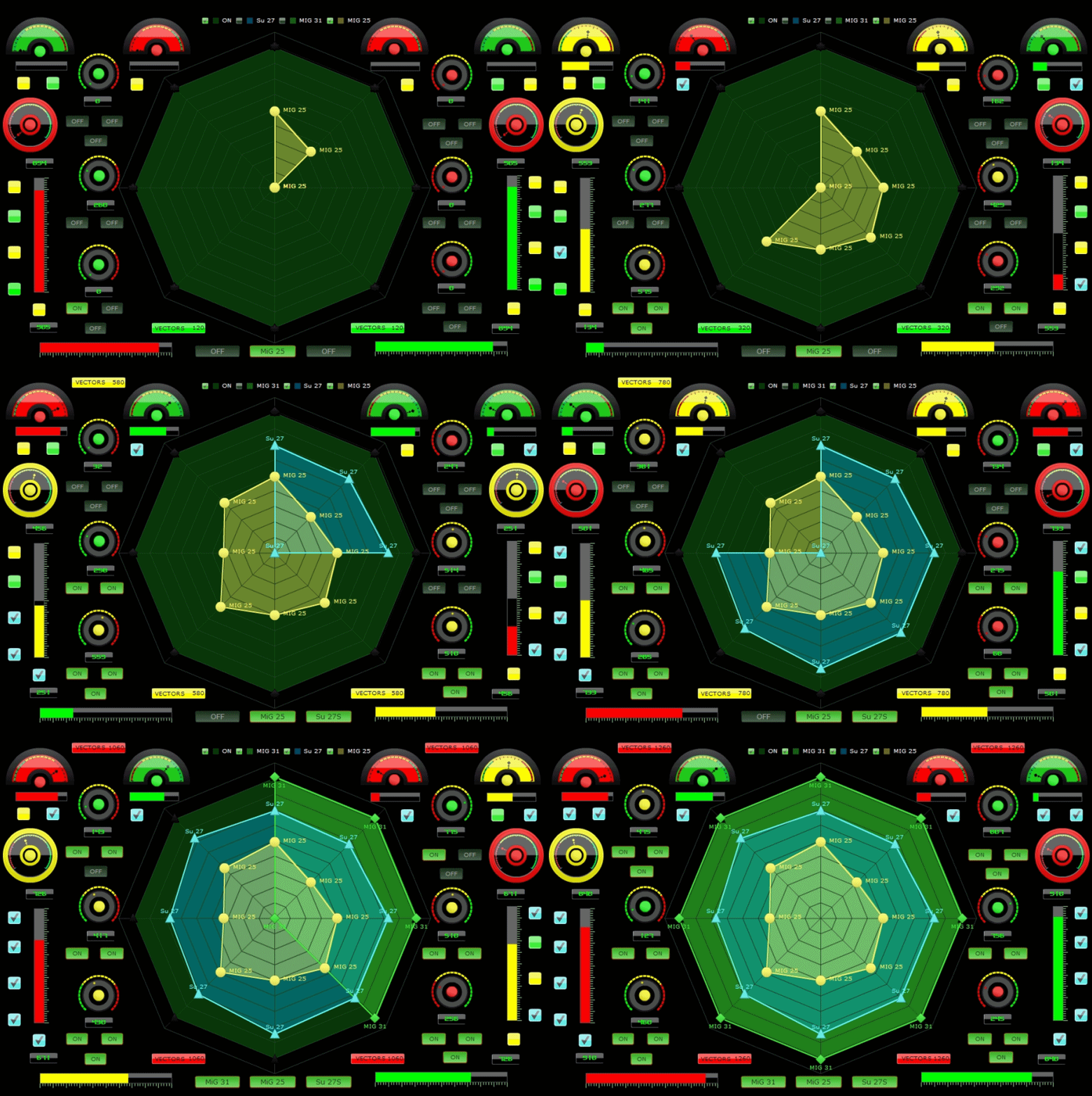
The high effective air defense systems such as missile S-300 (SA 10), S-300M (SA 12) and S-300VM (SA 12VM) all equipped with much more advanced radars than the previous generation of SA 5 and SA 4 may have become a greater threat to SR 71. Although the SR-71 to fly at high altitudes than those systems were able to achieve, with the exception of SA 12VM, their surveillance radars and fire control systems could aid in the air interception by fighter as MiG 31 and MiG 25 ( possibly by Su 27S too), reducing the efficiency of electronic interference from SR 71 to keep away from these menaces.

The concept of aircraft such as F 117A, B 2A, F 22 Raptor could be started due to the fact that at some point it would not be possible to avoid the interception only by electronic interference by jamming systens or high performance in speed and ceiling, since in a tactical situation where the adversary would be able to achieve datas by using own signals from the target that were transmitig signals from the eletronic jamming system, an effective defense would be becoming invisible to radar, which thus would not be necessary to emmiters powerful jamming radiations, which instead of protecting the aircraft could make it an easier target.
[/COLOR]


Currently there are multiple communications and navigations(GPS, Glosnass and the future Galileo as i.e) satellites orbiting the planet Earth and sending a high power electromagnetic waves in the bands X and L. It would not be a much imagination to think that in future those radars that will equip the legacy fighter or futures projects will be capable of operating in passive mode, and use the emission from those satellite networks that will reflect on objects such as aircraft, ships and structures as i.e the light from the Sun . These objects could be tracked by these future radars without the emition radiation from theses, or will allow to do so only for brief periods before the launching of this weapons to confirm the target, increasing the surprise factor and the survival of those fighters.
When analyzing the performance of the F 14A Tomcat II with AIM 54 Phoenix missiles during the Iran / Iraq War, thanks to the work of writer and journalist Tom Cooper who was able to bring this information to the Western audience, it was found that the missiles AIM 54 were highly effective in intercepting targets at long range and high supersonic speed as in the case of Iraq MiG 25 PDS/RB .However, what had impressed the Iranians themselves was that the missile AIM 54 was also effective in shoot down in many cases at low altitude and high speed different targets as: the Mirage F1E , several versions of MiG (MiG 21, MiG 23 BN, MiG 23ML) and Su 22 from Iraq. Those fighters were relatively small compared with bombers Tu 22 Blinder, Tu 16 Badger that were shoot dow too by the AIM 54 or even the MiG 25 that were in high supersonic speed and ceiling by the AIM 54 fired always in high or medium altitude.
Western analysts viewed the same AIM 54 as a weapon designed to intercept large targets like the Soviet supersonic bombers, and the revelation of the performance of AIM 54 fighters against small high maneuverability targets at low altitudes revealed another aspect of these weapons was almost always not just emphasized the fact that these missile attack from the heights.

A mission that the Soviets attributed the MiG 31 with its missiles R 33 Amos ,very similar at the AIM 54, would be to intercept cruise missiles AGM 109 Tomahawk and AGM 86 ALCM with nuclear warheads , that has been launched from any platform (aircraft, land vehicles, ships and submarines) against the Soviet Union. Indeed what is very interesting about this mission is that not enough to be able to intercept the bombers or attack fighters, that the cruise missiles could be fired by other platforms that the MiG 31 could not attack, especially in the case of nuclear submarines. At first this task seems almost impossible, as the cruise missiles had a small radar signature and were still flying at altitude ultra low, but this is where an interceptor capable of operating at high altitude and it had an advanced radar with powerful capabilities had their chance of success, since the radar would detect the cruise missile for its upper area, and in any air vehicle its own upper surface is several times greater than its frontal area, as well as the fact that the MiG 31 was high altitude greatly diminish the appearance of the curvature of the planet in limiting the detection range of the cruise missile.

So have a missile that was capable of climbing at high altitudes and dive beneath the target greatly increases the probability of success, since in any event any aircraft or missile will always have a upper surface area greater than its front, and this is also valid for the interceptor, because in addition to increase the radar range of the interceptor actually be at high altitude and high speed itself increases the range of the missile carried by the same, as in many articles described Dr. Carlo Kopp. Another advantage of a missile that explores this concept as the retired AIM 54 and active R 33 or new R 37 are that the missile’s radar detects the target at a distance much greater than it would if it did fly straight in the target, because the upper surface, so the missile to correct its trajectory long before that if it did fly straight in the target, thereby increasing their reach and avoid losing speed when making high fast maneuvers, which can also cause loss of control of the missile or loose the target .The faster the approaching missile shorter the reaction time of the aircraft under attack.
Since the first study of military strategies, recalling The Art of War written by General Sun Tzu some thousands of years ago, it was observed during this period that those who occupy the heights always have the advantage in battle. Another important aspect is also has been observed since The Art of War is who could be more quick or fast to exploit opportunities or failures of the adversary always has the advantage of the victory in his side. Interestingly of those observation is that both the SR-71 Blackbird and the versions of the MiG 25 or MiG 31 has those aspects in their projects, even the F 14 Tomcat had taken, at least when armed with AIM 54 , this aspect too.


Although currently low detection radar is the most important aspect when considering the lethality of the new combat aircraft, it will most probable never be totally invisible to the means of detection once that it has been evolving also constantly. The General Sun Tzu also attached great value to the ability to not be detected by the opponent, but warned that by basing its strength largely in stealth it just might make your strategy predicable by the opponent if he learn how to discovery your stealth skills, and once this he could reach, its your greatest strength would be nullified even before being employed. The General Sun Tzu warned that has strength in his side will use the heights of sky while who has been weak in means would use the underground to evade from the strongest enemy.
There are several cases in the recent history that has proven this theory, but the stealth aspect in the project of the fighters today has been considered as essential, while the others parameters has become marginal, then with only stealth aspect would be possible not reach these both strategies, because the stealth aspect is more as technological progress than strategy advance. As was mentioned before, the stealth technology could be considered as advance, but when this technological steep forward from adversaries is placed as permanent advance in sacrifices from others aspects as performance capability as i.e. : range , ceiling and speed, its the same to put all eggs in the same basket. If something wrong could be happen with this basket as the remote possibility than it wont be anticipated the advances of the adversary, as the history has several i.e to show , all the eggs will be lost. It’s very usual to accept the technological advances as powerful tool to solve the present problems, and when this technological advance has promise the reduction of financial cost then has become irresistible. But if it has been demanded to exchange capabilities for technological advances as necessary, its time to review the project or the requirements, because something could be out the place.
Technology in several fields has been advancing very fast, but due to this many new technologies that today went to bed as futurists, tomorrow may be these same technologies could wake up already obsolete. In the case of those laws of physics remain the major laws that allow huge advantages or limitations depending on the circumstances in which it are employed, and probably will stand still for long time.
REFERENCES
ASAS – ASAS Magazine – http://www.revistasas.com.br
APA – Australian Power Analyzes Website – http://www.ausairpower.net
AIRFORCES – Air Forces Monthly Magazine – http://www.airforcesmonthly.com
GORDON, Yelfin. MiG 25 and MiG 31: Defensive Front Line. Leicester – UK: Midland Prublishing Limeted, 1997.
HACKETT, General Sir John, BARRACLOUGH, Brigadier Sir Jonh, BURROW, Sir Bernard, HUNT, Brigadier Keneneth, McGEOCH, Vice-Admiral Sir Ian, MACRAE, Norman, STRAWSON, Major-General John. THE THIRD WORD WAR – AUGUST 1985. New York – USA: Macmillan Publishing, 1978.
BOLLARDIÈRE, Jacques Paris, PRATS, Juan P. , KISTER, Pierre. THE WAR AND THE DISARM. Editions Grammont. Lausanne – France, 1979.
OVERSCAN’S GUIDE TO RUSSIAN MILITARY AVIONICS [email]-avionics@overscan.co.uk[/email]
WIKIPEDIA – Wikipedia, The Free Encyclopedia. http://www.wikipedia.com
MiG 25 FOXBAT – http://www.vectorsite.net
FAS – Federations of American Scientists – http://www.fas.org
Google Images: Imagery Sources – http://www.images.google.com
maurobaggioTFX Program
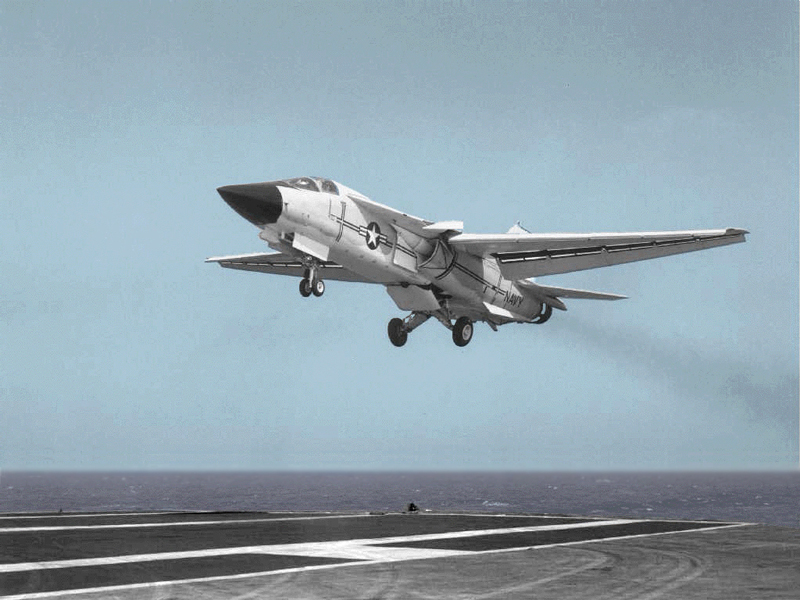
“The F-111B would be replaced by the smaller and lighter Grumman F-14 Tomcat, which carried over the engines, AWG-9/Phoenix weapons system, and similar swing-wing configuration.”
“The F-111B’s replacement, the Grumman F-14 Tomcat, which derived from Grumman’s initial Model 303 design, reused the TF30 engines from the F-111B, though the Navy planned on replacing them with an improved engine later.[20]”
http://en.wikipedia.org/wiki/General_Dynamics-Grumman_F-111B

Tests of the radar AWG 9 radar and AIM 54A Phoenix long range air-air missiles in firts to F 111B had started in 1969 and accomplished several records for the AIM 54A as:

http://en.wikipedia.org/wiki/File:AIM-54A_first_test_A-3A_NAN11-66.jpg
Much of the work about of developing from complex items to the F 14A Tomcat II as radar AWG 9, the long-range missiles as AIM 54A Phoenix and TF 30 afterburning turbofan engines were made in the F 111B TFX Program. Thus in 1973 the prototypes of the F 14A Tomcat II could be already quite capable to intercept the MiG 25RB Foxbat if those were available to Egypt in 1973 during the Yom Kippur War.
The advantage of the F 14A Tomcat II over any possible alternative if such would be effective against the MiG 25RB was that its could arrive in secret at the Israel , and should be kept in shelters so that its presence could be not recorded.
Just as the MiG 25 RB could had been hiding in underground shelters from Cairo West Air Base, also that its presence could be not recorded.
F 14 Tomcat II armed with 06 ( six) AIM 54 long range air – air missiles
http://explow.com/AIM-54_Phoenix
maurobaggioF 111B and F 14A armed with long range missiles AIM 54A Phoenix
The first real launch of the AIM 54A Phoenix against a simulated target was made by a DA 3B Skywarrior in September 1966.
In 1969 tests had been started with AIM 54A Phoenix and AWG 9 radar with F 111B, and that same year the F 111B was able to perform the launch against multiples targets with four AIM 54A against four drones getting hits against all targets. The first system AWG 9 to F 14A Tomcat II was delivered in 1970 and production had begun in 1973 to AIM 54A.
In this case could ever say that the radar AWG 9 radar and AIM 54A Phoenix missiles were with its development more advanced than the F 14A in 1973.
As in case of confrontation with the MiG 25RB Foxbat during the Yom Kippur War in 1973 this would be done in long range interception with the use of AWG 9 radar and AIM 54A Phoenix missiles, its systems could be considered ready for real use in a emergency event.
The F 111B program that aimed to equip the USAF and USN with the same interceptor but was canceled in 1968 after seven prototypes had been built. The USAF had begun the development of the F 15A Eagle Program and the USN the F 14A Tomcat II Program to replace the F 111B.
maurobaggioA little confusion.
That claim was corrected several times. The Soviets had no MiG-25P in Egypt.
Just a flight of MiG-25R and RB for recce missions only. Just an AD-cruiser of the 6th fleet off the coast of Tel Aviv was enough to deal with that fictional threat.
“During the Yom Kippur War Elmo Zumwalt desribes part of the Sixth Fleet buildup as follows (On Watch, 1976, 447)
“On 25 October JCS directed TG 20.1, Kennedy and escorts, to chop[6] to ComSixthFleet as TG 60.3 and proceed to join TG 60 south of Crete. Additionally, F.D. Roosevelt and escorts (TG 60.2) and TF61/62 [the amphibious task forces] were directed to join TG 60.1 south of Crete. … TG 100.1 (Baltic destroyers) were ordered to proceed to the Mediterranean and chop to ComSixthFleet..’.
I think SENS you are a little confused?
I did not mention about the alleged operation of the U.S. Navy in Israel, but it was you as could see above!
Given your problably confusion would now like to know if possible if the U.S. Navy sent or not CG Air defense for the protection of Israel, since F 14A Tomcat II would be enough to meet a possible threat of the MiG 25 RB against Glass Nickel Operation since in the day of 25th October the war was over, and the Nickel Glass Operation began on 9 October.
What I did was just explaining that the CG AD would not be effective in protecting an area on a possible attack by MiG 25RB, since the SAM RIM 2 Terrier and RIM 8 Talos would have a much shorter range due to the altitude of 20,000 m and the top speed of Mach 2.8 from MiG 25RB.
The speed of missiles has been extremely important as factor in achieving capability against maneuverable air targets, since the higher the speed the less likely the missile missing its target.
Yet another factor to consider that at high altitudes as 20,000 m is extremely thin the atmosphere, and any missile which uses aerodynamic controls also need a much higher speed than the target to maintain the maneuverability to reach the target. So a missile with a top speed of Mach 2.5 would not be efective against a target at Mach 2.5 at an altitude of 20,000 m or even less.
[CENTER]S-300V/VM Kinematic Envelope
http://www.ausairpower.net/APA-Giant-Gladiator.html[/CENTER]
As a general rule for application of the missiles against maneuverable air targets that is common the missiles has had a top speed at least double the target to assure that will be destroyed.
The AIM 54A Phoenix missile that had bee equipped the F 14A Tomcat II could reach a top speed of Mach 5.5 at high altitude than in this also allowed a maneuver capability much larger than a target as the MiG 25 with a top speed of Mach 2.8.
The height could be reached by the target would be greatly factor about the range in which the missile could be achieved, since the missile rocket motor or engine has a limited amount of energy, and the if much more energy is used to increase the height less energy could be used to increase the range.
The RIM 67 Standard missile that replaces the RIM 2 Terrier and RIM 8 Talos had a speed much greater than these lasts, around Mach 5.0 problably , since the RIM 67 had the mission to intercept the Soviet supersonic cruise missile.

[CENTER]http://en.wikipedia.org/wiki/File:SM-2_Block_IV_080605-N-0000X-006.jpg[/CENTER]
maurobaggioTargets Engagement Areas
The USN antidote at that time-scale was the:
http://en.wikipedia.org/wiki/RIM-2_Terrier
when the US army had the
http://en.wikipedia.org/wiki/MIM-14_Nike-Hercules
The SAM RIM 2 Terrier or RIM 8 Talos with maximum speed of Mach 2.5 would not be considered a great threat to the MiG 25 RB once would have a maximum speed of Mach 2.8 at an altitude of 20,000 m with a loading of the 5.0 t of free bombs.
Although the SAM RIM 2 Terrier and RIM 8 Talos could reached an altitude of 24.400 m, its range would be considerably reduced in face of the altitude of the MiG 25 RB, and those SAM’s could be effective against targets like the MiG 25RB only if it were very close to the ships that used those system. With those systems it would not be able to perform the air defense from area when it was attacked by MiG 25RB.
As for SAM Nike Hercules that was developed in order to intercept aircraft as strategic bombers Tu 95 Bear against North America and long-range attack aircraft as: Tu 16 Badger , Tu 22 Blinder, Tu 22M2 and Tu 22M3 Backfire, in air defense of important targest of the NATO. Against fighter as MiG 25RB Foxbat could be a possibity once the SAM Nike Hercules had a limited maneuver capabilties.
Israel has never bought the SAM Nike Hercules, and this was a system that used fixed sites that were not built in Israel, since Israel did not considerer a great threat the large-scale air strikes against the Israel until the war in 1973.
By the way there were just a small number of C-5A/C-141A transports unloading at Lod International Airport at the same time. Even when a hypothetical attack of some MiG-25RBs became reality the practical damage was limited when the political one was a desaster for the Soviets. The Soviets never operated their military aircraft under foreign command. Even the use of fake Egyptian markings had changed nothing about that! Sadat was seeking US support and had no intrest to attack US forces. The single hypothetical option was Syria to operate such MiG-25RBs from.
The MiG 25RB squad as attack aircraft could perform several missions along the war, which not only could destroy the transport aircraft on the ground as well as damage these airports that was reducing or even paralyzing the Nickel Glass Operation, once those transport aircrafts were loading with live ammunition.
In case of MiG 25RB were operated under the colors of the Egypt Air Force to the Soviet Union would be no disaster since both superpowers maximally helped its allies, and even the U.S. had sent F 4E Phantom II directly from their operational squad’s to replace losses from Israel, and it were employed by Israel during the battles still carrying the markings of the USAF.
maurobaggioMiG-27K and MiG-25BM were never exported to other nations. Even India received MiG-27M-based variant. MiG-25BMs were the first aircraft flown back to USSR after reunification of Germany. Therefore it is extremely unlikely that Soviet AF, or design bureau would risk valuable aircraft in a warzone.
The MiG 15bis of the IA PVO and VVS had fought in the Korean War during 1951 under the colors of the North Korea Air Force , due to the fact that these pilots of this country were inexperienced with the MiG 15bis at this time.
In the Vietnam War the High Command of the U.S. had demanded that the American pilots before to intercept enemy aircraft should need confirmed the nationality of this, what could only be done at close range. in all analyzes showed that this measure greatly increased the losses of U.S. aircraft, but was intended to avoid shootdown of aircraft from other communist nations as from Soviet Union.
The Soviet Union had sent MiG 25RB/R Foxbat to Egypt since 1971 and keep these until 1972, with the purpose of performing reconnaissance missions on the border with Israel, despite the threat and the firing of the AIM 7E Sparrow from F 4E Phantom II. The MiG 25 RB had returned to Egypt in the last days of the Yom Kippur War in 1973 and made reconnaissance missions even in the face of attempts to intercept the F 4E Phantom II from Israel.
At the beginning of the invasion of Afghanistan in the 1980 by the Soviet Union had sent the prototypes of the Su 25 who were still in testing for the combat missions, this operations was named as Rhombus Program.
In the Chechen War in 1999 there were several speculation from differents sources that the prototypes of new Russian aircraft types had participated of the combat missions as: Su 34, Mil Mi 28N, Ka 50.
Although never confirmed, and probably even if it actually happened, it never will be, at least it is possible to speculate that the Soviet Union had tested on several real missions of their new weapons systems during the Iran / Iraq War, such as the MiG 25BM and MiG 27K among others.
There are many military strategists that prefer to analyze weapons performance in real conditions or near it . The reason that even in the more elaborate testing missions, some parameters can not be simulated.
The most important of these is the interaction man / machine, which in a real combat human factor changes considerably, since in simulations are not trying to shoot and kill the human factor.
There is a term for this is that the war fog, due to which the performance of weapons is reduced because the real conditions of employment of the same
In the Soviet Union this emphasis on analysis in real conditions it were a tradition in much at the costly lessons of World War II
Just a flight of MiG-25R and RB for recce missions only. Just an AD-cruiser of the 6th fleet off the coast of Tel Aviv was enough to deal with that fictional threat.
“During the Yom Kippur War Elmo Zumwalt desribes part of the Sixth Fleet buildup as follows (On Watch, 1976, 447)
“On 25 October JCS directed TG 20.1, Kennedy and escorts, to chop[6] to ComSixthFleet as TG 60.3 and proceed to join TG 60 south of Crete. Additionally, F.D. Roosevelt and escorts (TG 60.2) and TF61/62 [the amphibious task forces] were directed to join TG 60.1 south of Crete. … TG 100.1 (Baltic destroyers) were ordered to proceed to the Mediterranean and chop to ComSixthFleet..’
To deal with the threat against the Nickel Glass Operation were planned alternatives in case of a possible attack by MiG 25RB Foxbat under the colors of Egypt Air Force, if it had received this in secret such fighters, against the C 5A Galaxy and C 141 transport aircraft’s when they were unloading their cargo of military aid in bases and airports from Israel during the Yom Kippur War in 1973.
In this case none of the Air Defense Cruiser’s of the U.S. Navy could intercept with SAM missiles against the MiG 25RB in high altitude over the Isarel air space, and this is why the U.S. sent as secret the prototypes of the F 14A Tomcat II armed with AIM 54A Phoenix in case of a hypothetical but not impossible attack from MiG 25 RB.
maurobaggioWar Fog
To be brief: About the reasons that the U.S. could had secretly send the new F 14A Tomcat II equipped with AIM 54A Phoenix missiles to protect the air bridge with military aid to Israel in 1973 during the Yom Kippur War. The presence of F 14A was aiming to protect the air transports as C 5A Galaxy and C 141 Starlifter of a possible attack by MiG 25 RB since the Soviet Union had operated the MiG 25 RB / P between 1971 and 1972 in Egypt.
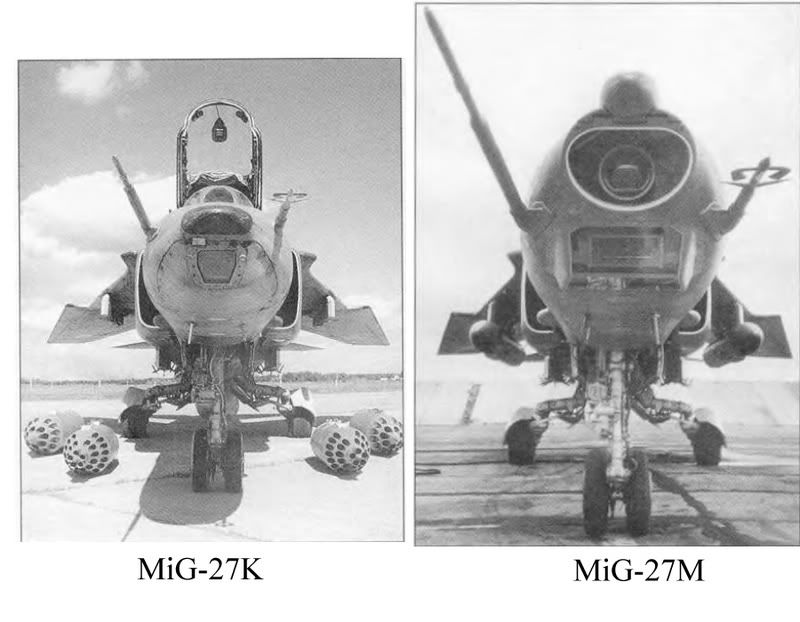
How’s my fault for having wrong in the first place, it is my duty to repair the same ,since there is possible to visualize the nose of the MiG 27 in the photo to prove whether it is the version MiG 27K or MiG 27M, one indicating that it is the MiG 27M is that it does not has the fences in the top of the sleeve of the wings as the MiG 27K has .
The reason for those fences in MiG 27K could be attributed to providing better aerodynamic stability for the TV target laser designator Kaira 1, however when providing better aerodynamic stability reduces the maneuverability of the fighter.
Those fences also sheltered launchers of the chaff / flare but the shape and position of these were aimed to improving the stability for the weapon system and its precision in the attacks missions againt ground targets.
MiG 27K equipped with TV/Laser Designator Kaira 1 in the right photo and MiG 27M equipped with Laser Designator Klen in the left photo.

Artist: unknown
Source: ‘Aviation and Cosmonautics’ 2004, No.11 (No.101)

Artist: unknown
Source: M-Hobbie magazine
http://wp.scn.ru/en/ww3/a/686/1/1
The Soviet Union would never admit that their aircraft had been operated in real missions during the Iran / Iraq War, since this would be a declaration of war against Iran.
In my humble opnion I do not believe that the nations that formed in the past the Soviet Union would be interested in confirming these actions today. How several people could have participated in this, problably some allegedly state about this but keeping their identities in secret, even with all political changes in these countries the Siberia territory has not changed, since it is remain cold as the time of the Soviet Union.
Many military strategists prefer to analyze weapons performance in real conditions or near it . The reason that even in the more elaborate testing situations, some parameters can not be simulated.
The most important of these is the interaction man / machine, which in a real combat human factor changes considerably, since in simulations are not trying to shoot and kill the human factor.
There is a term for this is that the war fog, due to which the performance of weapons is reduced because the real conditions of employment of the same
In the Soviet Union this emphasis on analysis in real conditions it were a tradition in much at the costly lessons of World War II.


 Sign In










![[CENTER]http://en.wikipedia.org/wiki/File:SM-2_Block_IV_080605-N-0000X-006.jpg](http://en.wikipedia.org/wiki/File:SM-2_Block_IV_080605-N-0000X-006.jpg)