 MadRat
MSphere-
You already demonstrated the Bars was 200kg and 60mm (>13%) larger than Irbis. Nobody disputed Irbis E has more sensitive, newer technology, elements than Bars. And their designers figured out how to essentially run two power channels through it at the same time. Bravo. Welcome to F-15C circa 1990. You still need to feed the monster. So they upgraded the engines and their power units, too. Nothing comes free. They added much complexity and worked on the man-machine interface. Again, bravo. But the software to automate doesn’t write itself. Wake me up when Su-35S demonstrates attacking ground targets and air targets at the same time.
An enlarged fuel tank like on MiG-29SMT for extending range isn’t bad. MiG-35 is using the same highly touted technologies found on Su-35S. I’m not here to knock any of the three mentioned; MiG-35, Su-30SM, and Su-35S. It’s pretty obvious that Su-30SM is the most mature of the three. That cannot be disputed, because unlike the other two, it’s been operational substantially longer. And for all around utility, Su-30SM is currently the only proven model of the three. Technology flaws and all.
MadRatMSphere, you were citing capabilities that have been described by the manufacturer using superfluous language. The 400km range was against a massive target. Meanwhile, Bars magically is still limited to its original range even though it’s been almost completely reworked since Su-30SM was first manufactured. The true range is not probably 400km even against an Airbus A380, but IAF pilots have loosely suggested 350km was closer to reality with the newer Bars. There is this funny notion that Irbis E is electrical power-wise 400% more powerful than Bars M. Only when you compare it to early Bars do you get anything remotely near that number. Be careful what you listen to when it comes to marketing.
Su-35S has a lighter and more durable frame simply because it supports far less weight out front. Su-30SM has to support a much heavier array – and wider – than the one on Su-35S. It also has to support a second pilot, his ejection seat, his equipment, etc. And when you maneuver around at 9G all that weight becomes grossly prohibitive to a lighter front section, hence Su-30SM has a heavier frame and slightly less fuel.
Su-35S enjoys a few things over Su-30SM like a more sensitive IRST, newer ECCM suite, newer RWR, etc. But all of this can be backported if they wanted.
Su-30SM also has the second man. His workload is substantially more focused. Su-30SM has substantially more development time behind it. It can actually demonstrate all its claimed capability. Su-35S not so much. On paper it obviously sounds better.
MadRatMSphere, you keep citing the manufacturer propaganda that the track record sucks.
MadRatI wish Northrop would reveal their aircraft in the air like Boeing has already done. Boeing is in the drivers seat ATM.
MadRatSo for fulfilling air defense, you have from those numbers 1.2 bil RUB per Su-35S and .94 bil RUB per MiG-35. Su-35S is pretty expensive as it sits in development. I bet it begins to approach Su-30SM price by the time they flesh out its potential. Not that A2G is truly something that a VKS-based unit needs, but for the fulfilling needs of regular Russian air force and naval military units you would want to expand its full envelope. Then again, maybe the Chinese will fund it.
MadRatMSphere,
I appreciate your devil’s advocate role. But keep truth in your rebuttals. Su-35 is derivative from Bars, but that’s not the whole story. Su-35S relies on Irbis that continues to grow software support, but there is zero reason to take claims of ‘can’ or ‘could’ to be equivalent to ‘does’. Su-35S requires maturity of it’s software no different than any other modern program, development not fully funded even to this day. So much was left to flesh out that Sukhoi skipped rushing an interim production PAKFA out based upon it. And they had planned to do that before the money dried up.
And a big fuel tank on a fighter with a radar based on the same one in Su-35S, yet simpler and more affordable, would negate need for Su-35S. The Su-35S is multirole on paper, but hasn’t demonstrated this claim. And there are ample real world opportunities out there to have done so by now. A hunchback offers a large expansion to it’s fuel tank. A bigger fuel fraction encroaches on territory that Su-35S can perform. And to be honest, Su-35S doesn’t have any unique roles that a MiG-35SMT cannot fill.
MadRatSu-30SM has considerably larger radar than Su-35S. The Su-35S is an apples to oranges comparison. Su-35S has nicer engines and lighter airframe because it plays to a different niche.
I want to see MiG-35OVT take on the MiG-29SMT hunchback. You couldn’t probably justify Su-35S over such a monster as MiG-35SMT. Sure Su-35S is better because it’s bigger. But it’s about filling a niche with good enough. Su-35S is just a stepping stone for the T-50 program and has literally no strategic value.
MadRat
MadRatShort answer, yes. But technically an insignificant capability. They already liked to ripple off a pair considering their low probabilities to hit. I’m pretty sure F-15A began life with capacity to target two independent targets with its illuminator within a design envelope. Early Flankers and, up until a decade ago, most Flanker exports shared this limitation.
MadRatNo you are right. It was a terrible fighter.. in fact operate it as a frontline fighter was plain stupid. Its clear as crystal that Mig-25 was a Interceptor, not a fighter.
MiG-25 was a lot of things. They did use monkey models as fighters. But even the export models with their RWR were too much for SARH armed Tomcats and smaller fry. AMRAAM obviously made it obsolete. But it did roles like photo reconnaissance, electronic warfare, sigint, and scientific research. It wasn’t exactly a failure at its niches.
MadRatLooks good from the side. Would probably resemble an SR-71 – blending the chine to the main wing – from above.
BTW – was thinking Su-34’s front gear would open/close ahead of the front scoops. That would make the front wheel bay unnecessary.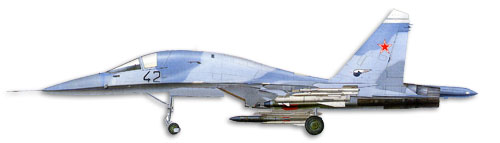

MadRatSu-34’s cockpit could look nice grafted onto MiG 1.4X.
In Novosibirsk aviation plant nose of the Su-34 with the installation of “Marabou” it was built. She had to work “plasma stealth”. Perhaps for the bomber “izd.54S”, their noses are similar.
Plasma spheres around a vehicle that large must involve serious megavoltage to reach, which would then require capacitors and storage and shielding. Not practical in subsonic aircraft. If hypersonics gets you closer it just may be practical. Unfortunately what obscures EM also inhibits visible wavelengths and imparts an effect on metal parts on every scale. The shielding is unavoidable.
MadRatHow does Su-47 fit into these arguments? Please start another thread if you want to debate MiG 14X.
MadRatHa, 80% of the mission in a permissable environment.
Trump doesn’t control the order quantity. He can try and cut back all he wants and congress will just add them back. Either way, any cut back on the Cee has little inpact on the A.
Congress controls the purse. The executive branch controls what gets spent out of the purse. So, yes, Trump does control more than you suggest.
MadRatI see people dismissed the notion of A-12 Avenger being a better share plan with the UK government. The A-12 probably would have actually finished development. Conservatively it had about a 5,000-pound payload for a 1500 km combat range. Typical of projects of its era, performance stats were very conservative. Not terrible, especially if it had received modernization like EODAS or MAWS, EOTS, DIRCM, AESA radar, etc. Plus it was actually designed to fire AMRAAM, even if only a pair. And it was every bit the stealth LGB dropper as F-117A. And it was a two-seater. No telling what kind of performance from a single-seater, but modernization probably eliminated need for a second man. The GE motors in the A-12 were supposed to be much larger front stages than the ones used on the F-117A, giving it about 3,000 pounds more thrust and better economy. The A-12 also had nearly double the wing area of the F-117A. The F-117A had a better penetration velocity and maximum ceiling, but it also had higher takeoff and landing speeds to match. The MTOW of A-12 was approximately 33% heavier than F-117A. The A-12 was an A-6E replacement, much more ambitious than the F-117A. More than likely A-12 would have been something special by the time it went into production. But we’ll never know because Rumsfeld was dead-set on Super Hornet and cancelled everything even remotely in competition with it.
But USAF continued to fund targeted maintenance enhancements in the 1990s and the RAM strip and re-coat program was one. The strip and re-coat program reduced total maintenance man hours per flight hour from 50+ to less than 8, similar to F-15 and less than F-111.
This 8 hours number is pretty dubious, because AFAIK the F-15 in any version has never been sub-double digits man hours per flight hours.


 Sign In







