Supercruise is for optimized survival while transiting along the edge of threat environments. It’s not for your average stroll.
An x-32 lite derived design would be pretty neat. Remember it’s not really the airframe design that ratchets up cost, it’s all the little pieces of the puzzle thrown into it. Boeing could whip it up pretty quickly.
Don’t just offer a second seat, BUT make a single-seater AND tout UCAV-derived exterior-cockpit training features to revolutionize training. (Why does a trainer need a rear seat anyway?) It cuts down weight and the need for multiple pilots in the back seat! Combining safe training height restrictions, FBW, and UCAV-like co-piloting is a great safety initiative. Cut the overall dimensional design to three-quarters its old size.
Height: 17 ft (similar to original)
Length: 35 ft
Wingspan: 32 ft
Wing area: 400 ft²
MTOW: 30,000 lbs
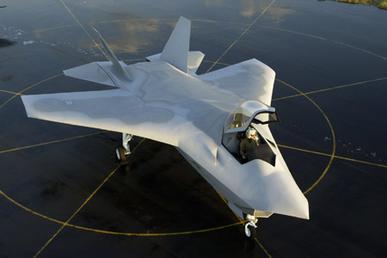
Aim for simplicity. Use F-16 subcontractors for landing gear. Stick to proven wing from the original Hornet. Avoid the fiasco aiming for delta wing by using separate wing and tail-planes. Stick with the GE F4x4-family if the competition is so high on it, but offer a non-afterburning F100/F110 option. Modular engine department for easy engine swaps. Modular cockpits for future growth. Optional modular space for an M197 Gatling gun. Simple weapons bays for captive missile support; don’t sell internal weapon carriage in the trainer version. Note that the wing is fully configurable for exterior weapons. Although it looks stealth, don’t promise it. Get foot in door for possible future stealth sales to FMS clients.

If they were going the F4x4 route is it too much to ask for an internal bay and non-tubular fuselage to avoid putting old designs into service? I’d rather see them train F-35 & F-22 pilots in something that has a weapon bay, if for nothing more than target bombs and trapeze mounted catm-9x, catm-120d, etc.
Gripen T needs a designation. It is in the same weight class, but probably needs heavier landing gear. Might even need a heavier wing to handle abuse. Its in the same weight class as T-50 and the ANG could eventually use it for pretty much anything an F-16 would be used. Its a natural fit if you intend to use the airframe for more than training. Otherwise, what is the justification for such heavy trainers?
I don’t get these specs. Its like they are writing it with a specific vendor in mind. I frankly feel the F4x4 is too big for the role. Maybe NG will dust off the T-38 design and go F125, fbw, and whatnot. It makes as much sense as T-50.
Putin already frameworked their version. May as well use his PAKDA specs as general outline of LRS-B.
I just happened to see this:
http://russianplanes.net/images/to89000/088728.jpgThe captions said it was shot this year, at Kubinka. Is this some kind of graveyard-ish part of the base? I haven’t seen parked 23’s in ages.
Nice find. Beautiful pic. I cannot answer your question, but sure hope they keep some 23’s around for demo flights.
The only reason to new build AMX is to move to commonality between high and low regimes. The M88-3 is a helluva good engine to build around for Brazil. All they need after new build AMX is to re-engine F-5BR to M88-3 with afterburger to F-20BR standard. Then they really go all out for ludicrous. 8D
Detection range has much to do with the granularity and probability of hitting the target. If an aircraft somehow fits between lobes of the signal it doesn’t matter what technology is used. The AESA has a huge jump in search granularity, probably less in signal strength than people imagine.
The AMX is a low risk and sturdy design. I wouldn’t doubt with some slep work they could get 30,000 hours out of it. Service life of a F-15E is being projected out to 32K hours. It’s all how you design the usage, upkeep, and overhauls.
The F-5’s have proven to be that sturdy, too. If the Iranians can completely rebuild F-5’s there is no doubt the Brazilians could do it, too. I’m surprised they didn’t design their own delta wing fighter in the image of Mirage III over the years. They certainly had the talent. They probably could have done as well as the Tejas.
Maybe you confuse Korea with Taiwan?
Very nice. This kind of footage would make Top Gun 2 a better movie than the first.
The afterburner may be too long to drop in place as is, but by the time you design a new engine sleeve you are already re-balancing everything at that point. Shifting the engine forward is trivial. The T-50 is pretty similar to the AMX in size and it fits an F404 fine. The M88 is not as large as the F404 and if the goal is sovereignty then they won’t want to use F404.
Ranging radar for guns?
Radar systems
The Italian Air Force AMXs are equipped with a variant of the EL/M-20001B radar, operating at I band. Fiar in Italy manufactures the radar, which is designed by Elta in Israel. The AMX in operation with the Brazilian Air Force is equipped with the Fiar / Tectelcom SCP/01 radar. Venezuelan AF planes house Elta EL/M-2032 radar.
It does go to show that the nose isn’t perhaps as cramped as one would believe. Relocating the gun, or opting for something smaller, would give it significant room. The Spey is substantially larger than the F404, which is much stronger in dry thrust. With the M88 further yet smaller in size it leads me to suspect that would be a good route for a new build AMX. (Ordering Rafale also gives you a high-low set of aircraft built around the same engine.) Your aircraft would obviously be similar to T-50 Golden Eagle. It’s not for export so it is justifiable as long as it has a niche role to fill.
The other choice is to keep rebuilding F-5BR’s over and over. Sooner or later you have to think about retiring them. Going as much indigenous material as possible makes a lot of sense in my mind.







