 Andraxxus
I would like to continue the discussion (regarding Russian shipbuilding capability to build 100k ton 300m aircraft carrier) in the T-50 thread;
Its true Russians haven’t build any large combat ship in the last 15 years or so, in fact largest ship designed and build by Russians is Gorskov-class frigates, 135m and probably around ~3000-3500 tons empty weight.
However, I think its unfair to judge Russian shipbuilding capability just looking at that figure; if shipyard wasn’t asked to build a large combat ship, you can’t blame them for not building that. So I ask, what is the largest commercial ship (tanker, bulk cargo ship, container ship, etc) Russia has built in last 15 years?
AndraxxusMeanwhile, the project 22350 ships are the largest surface combatants built by Russia in the last 15 years. Not dismissive of Russian capability to design and fund such a project, but there is a hell of a lot of infrastructure and industrial base to regenerate before any 100,000 ton carrier is built.
Surface combatants yes, but what about cargo ships or tankers? Have they build anything larger? For example, South Korea never built a large warship, but they do build 500k ton 380m long TI-class tankers, they have also built Barzan (200k ton 400m long cargo ship) in ~6 months. No one can say they will have problems building a 100k 330m aircraft carrier. Could same thing be said for Russian shipbuilding industry?
AndraxxusI would like to know too, my guess is a combination of several factors; enemy fire, explosion/accident, further enemy fire preventing firefighters or ground crew to save vehicles/helicopters etc etc. Mentioned fuel depot, (which is actually a SyAF MiG-25 hangar but its logical that it may be used as ammo/supply depot) is more than 300 meters away from the Helicopters. I don’t buy a fire could spread such distance on dry sand.
I’m confused. So who is accused of faking pictures, Russia or Stratfor?
Stratfor.
AndraxxusLooks like the Stratfor site may have been spreading disinformation with digital modification of the satellite picture of the “attack” on the helicopters!
Rotors sitting in same position does not make pictures fake. As for shadows, well, Helicopters sit paralel to each other in airbase, I don’t see how shadows could not be same. Resolution is too low to make grain analysis (compare film grain patterns) and JPG compression ruins it all. But there is nothing in the overall picture to suggest that it is fake.
[ATTACH=CONFIG]246199[/ATTACH]
In fact, with sufficently high wind conditions, rotor blades are ought to take similar positions. To be honest, I don’t see why people try to see what doesn’t exist or deny what is seen, why even RuAF desperately tries to cover the helicopter loss? Had it been, say, Armenian Air Force, loss of 4 helicopters may have been something to cover up, as it would mean substential reduction in capability. For RuAF, they will just reactivate 4 Mi-24s from reserve and be done with it.
AndraxxusHaavarla, you are wrong in your assesment. F-15Cs were only there for 3 weeks or so. USAF operated 6 F-16’s for months. After shooting down event, those F-16’s were slowly replaced with a dozen A-10Cs. Whether not to operate same type of aircraft as TuAF to avoid getting shot, or to provide CAS better for longer times, I don’t know. In any case, those routinely operate at northern Syria there are several dozen videos “syria.liveuamap.com” showing just that. Add to that, since 10.12.2015, there are a 4-6 Tornado IDSs of German Air Force, they routinely fly recon for German Air Force since 8 Jan 2016. Since February, there are 4 Saudi F-15s in Incirlik, but I am unaware if they have ever flown a mission.
From 25 Dec 2015:
From ?? Jan 2016: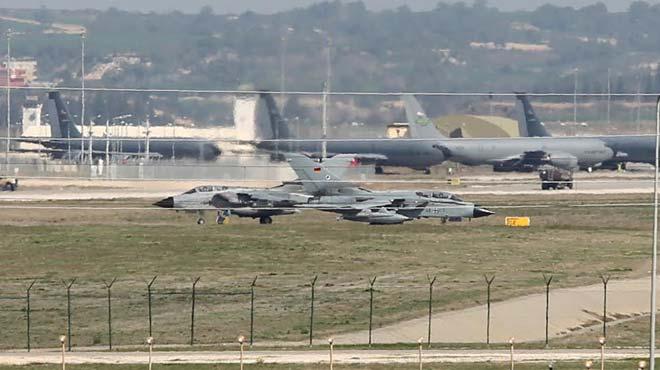
From 26 Feb 2016 (newspaper claims)
[ATTACH=CONFIG]246097[/ATTACH]
Also, Turkey gave permission to French in 02 December 2015 to operate from the base, two cargo planes belonging to French Air force came, but I am unaware of any French combat aircraft operating from base.
As for UAV’s operating from incirlik, well, one Predator belonging to USAF crashed in 3rd February during landing was all over the news. After crash, Hürriyet newspaper claims there are 5 USAF Predators remaining in the base. Nevertheless, crash itself is sufficent proof to me.
As for Turkish operations in Syria, there is at least one occassion a Turkish airforce Bayraktar UAVs was caught in the camera some 2-3 weeks ago. A few Turkish newspapers claimed in 08 May 2016 a Turkish Special Forces team consisting of 15-20 soldiers entered Syria from 13-14 km east of Kilis, to locate ISIS Rocket launchers targeting Kilis for 9 days (46 rockets fired, caused 17 deaths, 61 injured). Turkish artillery continiously fired until Sunday morning, killing 103 ISIS terrorists, and “USA and Russia is informed about the operation.” Normally, I would not take such news agency claims seriously, especially when they point to an “unnamed military source”, but somehow not one rocket fell after this day, making me think this one is true.
Here’s a new speculation topic about İncirlik (Although its totally irrelevant with the AH-1W shot-down, its more relevant to the title of the thread then the mentioned shooting down event itself). Turkish F-16’s regularly pictured in İncirlik (taxiing or taking-off) with Guided Bombs; see above picture with A-10s. Now Turkish Airforce never used İncirlik to bomb PKK in Turkey or Iraq; Its way too far away (~700km), and Turkey has very few F-16 in that base. (around 8, compared to 65 in Diyarbakır AFB as of 17th May). Its not used for training either, as pictured aircraft are all single seater F-16s, and Incirlik both lacks facilities and its not convinient to use a NATO base for that.
So the question is, what are Turkish F-16’s doing there with bombs? Could they be silently operating under the flag of NATO/coalition?
AndraxxusSystem is not AMPS-M. It is Aselsan HEWS. In short, its a combined defense suite for RWR, MAWS, Laser Warning, and RF Jammer:
According to undersecretariat for defence industries, 309 systems were manufactured in 2002, with integration was proceeding by then:
http://www.ssm.gov.tr/anasayfa/projeler/Sayfalar/proje.aspx?projeID=68
MAWS sensors do like AN/AAR-60 to me: Here’s one of the sensors from the crash:
[ATTACH=CONFIG]246047[/ATTACH]
Casing is slightly different, but screw positions and small extruded component in the side/bottom part is exact match:
MILDS AN/AAR-60:
[ATTACH=CONFIG]246048[/ATTACH]
Turkish militiary acknowledged the missile is shot down by a missile of unknown type. Also, they -indirectly- confirmed protective suite was on board; it was standard procedure to set system on auto before take-off, (can be set auto, semi-auto, manual, off or bypass) and investigation is ongoing as to why system failed to react to the missile (whether pilot forgot to turn it on, maintenence problem, defect, malfunction etc)
As for recent ex-USMC Cobras mentioned, they had no MAWS when they were transferred; They are refitted with HEWS as well, however:
[ATTACH=CONFIG]246049[/ATTACH]
Those units have different engine exhausts when compared to standard Army Super Cobras, easy to identify.
Edit:
AH-1W in the back is the one shot down (tail number 10608 matching the wreckage pictures), picture from 2+ years ago:

Andraxxusso AH-1W was without self protection suite. its called shoddy procurement.
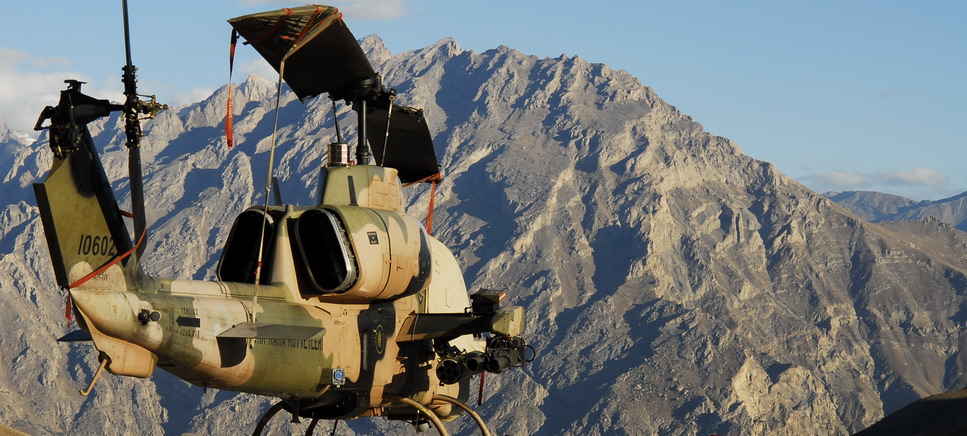
Problem is not procurement or obsolete equipment you keep flamebaiting, the problem with equipment is in either a)pilot did not switch them on b)they were malfunctioning. Like I’ve said, all our AH-1Ws have IRCM and all around MAWS sensors. In fact PKK always had MANPADS, and only 3 helicopters lost to MANPADS in 20+ years of asymetric warfare is not something I would call a “failure” in any part. Sometimes bad things do happen.
it is certainly not first time misleading statement from Turkey.
I am not talking about statements from politicians or defense ministry. I am talking about military’s own statement. Especially when it comes to casualties, they have always been honest about the causes.
AndraxxusI don’t think its logical to automatically blame Russians here. Its the third Turkish helicopter shot down by PKK in the last 12 years an S-70, AH-1 and latest AH-1W; two of them by Igla, other by Strela system. All these Systems are Russian built, so latest “alleged” arms support AFTER Su-24 shooting does not make sense. Like TR1 said, had Russians provided MANPADS it would have more pronounced effects and I don’t think providing MANPADs would serve Russian interests in anyway.
I believe there are two more important aspects of this event:
1-Following the S-70 shooting down by MANPAD in early 2000s, ALL Turkish helicopters down to archaic UH-1s were retrofitted to carry flare launchers. Add to that, ALL AH-1, S-70s and some Cougars were even retrofitted with a MAWS system. Also, 2008 Shooting down of an AH-1 was broadly in similar region, so why MAWS was not active, or why it didn’t pick up the incoming missile? At the very least, why no automatic flare drops every few seconds? Some unofficial statements claim pre-flight checks were skipped while in a hurry (helicopter was dispatched to support an operation following a PKK attack on Çığlı military base from Iraqi territory, causing 6 deaths). I think our pilots or operational planners are more to blame than Russians or anyone else.
2-This is the first time Turkish Military gave a misleading information in their official statement. They claimed cause of crash was a “Technical Problem”. While it may be understandable that no one (on Turkish side) withnessed the crash, it is not acceptable. They should have just said “cause unknown”.
AndraxxusOnce again, nonsense without numbers, actually I am getting used to it;
Lets put thermodynamic equations, forward:
Required Battery capacity = (Power required by engine + power required by auxillaries)
Power required by engine * engine net efficiency = Work done by engine = Work done by air and rolling resistance.
For a car going at 100 km/h (27,78m/s) constant speed;
Drag Force = 1/2 * air density * frontal area * drag coefficient * car speed^2
-A super mini like Fiat 500 have 1,63m width and 1,49m height giving 2,43 m2 frontal area.
-Lowest Cd ever made to a production car is 0,189.
So net drag force = 217,1 Newtons.
Rolling resistance of 800 kg having a tiny 14 inch wheel + 165/65/14 tires = 0,57m (total diameter) = 800*9,8184*0,01/0,57 = 137,8 Newtons
So for a car moving at 100 km/h, “work done by air and rolling resistance” = (217,1+137,8)*27,78 = 9589 Watts. For partial load, Brushless DC motors are the most efficient, around 85% at best.
So “Power required by the engine” = 11599 Watts.
Power required by auxillaries are simple;
I am only taking minimalist configuration that will move the car, and allow people to breath:
-Electric brake hydrolic pump consumes 1600 watts, lets take 800 to be more optimistic as a “800 kg” car could do with smaller pump.
-Ventilation fan consumes around 1000 watts.
-Electric Steering around 1200 watts max, but highway usage would generate less consumption, lets lets take 300 as average.
Note that I am excluding:
-air conditioning or ventilation (which would take around 2500-6000 watts (depending on interior volume of the car)
-ECU and other electrical components which would take consume as much as 200-300 watts.
-Radio speakers = 200+ watts to few kWs depending on configuration.
-Headlights = 200 watts, tail lights = 60 watts and other lights.
-Interior lightning = 20 to 100 watts depending on configuration.
-Multimedia computer + LCD screen = 50-100 watts depending on configuration.
So your net power consumption = 11599 + 2100 watts = 13698 watts. Traveling at 100 km/h you need 13698 * 10 hours to reach 1000 km range. That means 136987 watt hours of energy provided by battery.
Best of the best Lithium batteries offer around 90% discharge efficiency, so you need around 152,3 kWh battery capacity for your car.
Best commercial Lithium-ion batteries offer ~160 watts per kg, including the casing, voltage regulators for each 14,4 Volt battery pack, appropirate to be used in a vehicle.
So in short; you need 951 kg lithium-ion battery in your 800 kg car, to make it reach 1000 km range. And that is ONLY constant speed. Accelerate from stand still, waste energy while accelerating decelerating, at this range will go down.
But dont worry, there will be a new lithium polimer battery pack, that will be offered commercially in a few months. It claims 200 watts/kg, totaling 761 kg of battery weight. So if you can design your platform, chassis, suspension and engine components to be under 39 kg, you can have your 800 kg vehicle.
Of course, those are all under assumptions about your 800kg car will have the frontal area of Fiat 500, yet seat 6 people, and have equivalent aerodynamic of the most aerodynamic production car ever designed.
And going through these numbers DO notice a few things:
-Weight has little to do with range, as long as your propulsion is as efficient on full loads as it is in partial loads. It only affects rolling resistance, but as larger cars generally have larger tire diameter than a super-mini, rolling resistance increase is not also so severe. That is why most electric cars in real life are actually very heavy, Tesla Model S (actually seating only 5 properly) weigh 1963 kg with 60kWh battery pack, and 2239kg with 90 kWh battery pack. Also this makes volumetric efficiency of battery pack (watts per liter) much important weight efficiency, as does its cost. Tesla’s battery pack offer around 100-110 Watt/kg weight efficency, is slightly smaller per watt, and at at an acceptable price tag so a mere mortal can buy and drive the car.
-Max power of engine is totally irrelevant, only partial load efficiency matter. So companies offer more powerful engines on their models, at addional price, with negligable (or nonexistant) reduction in range.
-Auxillaries affect range drasdically; turning on the 3kW air conditioning will automatically shave 20% from maximum theoratical range. Such different usage of auxillaries are the reason why EPA range is 15-20% shorter than NEDC range, and the reason why you see several comments about no user being able to reach even EPA numbers in real world conditions.
To be blunt. Dont mistake me -or anyone else “raping” your drawings- as ignorant, or fools that doesn’t understand your “concepts”. Regarding your concept, I understand it perfectly, and I present the reasons why it won’t work. Its up to you to accept them, use some math and some engineering methods to prove me I am wrong.
To be very blunt: Your “concepts” are not that difficult to understand, nor they are miraculous in any way. 95% Majority of your “concepts” are a) so useless that they weren’t even considered b) considered, researced but failed because numerically unsound, c) tested built, and failed because of unforseen consequences d) tested worked, but better solutions devised later, so they are obsolete. Remaining 5% MAY have some use, but without some math to back it up, none of your ideas have any chance of working.
And claims that you did helps in nothing but eliminating your credibility.
AndraxxusOnce again, nonsense without numbers, actually I am getting used to it;
Lets put thermodynamic equations, forward:
Required Battery capacity = (Power required by engine + power required by auxillaries)
Power required by engine * engine net efficiency = Work done by engine = Work done by air and rolling resistance.
For a car going at 100 km/h (27,78m/s) constant speed;
Drag Force = 1/2 * air density * frontal area * drag coefficient * car speed^2
-A super mini like Fiat 500 have 1,63m width and 1,49m height giving 2,43 m2 frontal area.
-Lowest Cd ever made to a production car is 0,189.
So net drag force = 217,1 Newtons.
Rolling resistance of 800 kg having a tiny 14 inch wheel + 165/65/14 tires = 0,57m (total diameter) = 800*9,8184*0,01/0,57 = 137,8 Newtons
So for a car moving at 100 km/h, “work done by air and rolling resistance” = (217,1+137,8)*27,78 = 9589 Watts. For partial load, Brushless DC motors are the most efficient, around 85% at best.
So “Power required by the engine” = 11599 Watts.
Power required by auxillaries are simple;
I am only taking minimalist configuration that will move the car, and allow people to breath:
-Electric brake hydrolic pump consumes 1600 watts, lets take 800 to be more optimistic as a “800 kg” car could do with smaller pump.
-Ventilation fan consumes around 1000 watts.
-Electric Steering around 1200 watts max, but highway usage would generate less consumption, lets lets take 300 as average.
Note that I am excluding:
-air conditioning or ventilation (which would take around 2500-6000 watts (depending on interior volume of the car)
-ECU and other electrical components which would take consume as much as 200-300 watts.
-Radio speakers = 200+ watts to few kWs depending on configuration.
-Headlights = 200 watts, tail lights = 60 watts and other lights.
-Interior lightning = 20 to 100 watts depending on configuration.
-Multimedia computer + LCD screen = 50-100 watts depending on configuration.
So your net power consumption = 11599 + 2100 watts = 13698 watts. Traveling at 100 km/h you need 13698 * 10 hours to reach 1000 km range. That means 136987 watt hours of energy provided by battery.
Best of the best Lithium batteries offer around 90% discharge efficiency, so you need around 152,3 kWh battery capacity for your car.
Best commercial Lithium-ion batteries offer ~160 watts per kg, including the casing, voltage regulators for each 14,4 Volt battery pack, appropirate to be used in a vehicle.
So in short; you need 951 kg lithium-ion battery in your 800 kg car, to make it reach 1000 km range. And that is ONLY constant speed. Accelerate from stand still, waste energy while accelerating decelerating, at this range will go down.
But dont worry, there will be a new lithium polimer battery pack, that will be offered commercially in a few months. It claims 200 watts/kg, totaling 761 kg of battery weight. So if you can design your platform, chassis, suspension and engine components to be under 39 kg, you can have your 800 kg vehicle.
Of course, those are all under assumptions about your 800kg car will have the frontal area of Fiat 500, yet seat 6 people, and have equivalent aerodynamic of the most aerodynamic production car ever designed.
And going through these numbers DO notice a few things:
-Weight has little to do with range, as long as your propulsion is as efficient on full loads as it is in partial loads. It only affects rolling resistance, but as larger cars generally have larger tire diameter than a super-mini, rolling resistance increase is not also so severe. That is why most electric cars in real life are actually very heavy, Tesla Model S (actually seating only 5 properly) weigh 1963 kg with 60kWh battery pack, and 2239kg with 90 kWh battery pack. Also this makes volumetric efficiency of battery pack (watts per liter) much important weight efficiency, as does its cost. Tesla’s battery pack offer around 100-110 Watt/kg weight efficency, is slightly smaller per watt, and at at an acceptable price tag so a mere mortal can buy and drive the car.
-Max power of engine is totally irrelevant, only partial load efficiency matter. So companies offer more powerful engines on their models, at addional price, with negligable (or nonexistant) reduction in range.
-Auxillaries affect range drasdically; turning on the 3kW air conditioning will automatically shave 20% from maximum theoratical range. Such different usage of auxillaries are the reason why EPA range is 15-20% shorter than NEDC range, and the reason why you see several comments about no user being able to reach even EPA numbers in real world conditions.
To be blunt. Dont mistake me -or anyone else “raping” your drawings- as ignorant, or fools that doesn’t understand your “concepts”. Regarding your concept, I understand it perfectly, and I present the reasons why it won’t work. Its up to you to accept them, use some math and some engineering methods to prove me I am wrong.
To be very blunt: Your “concepts” are not that difficult to understand, nor they are miraculous in any way. 95% Majority of your “concepts” are a) so useless that they weren’t even considered b) considered, researced but failed because numerically unsound, c) tested built, and failed because of unforseen consequences d) tested worked, but better solutions devised later, so they are obsolete. Remaining 5% MAY have some use, but without some math to back it up, none of your ideas have any chance of working.
And claims that you did helps in nothing but eliminating your credibility.
Andraxxuswhether topspeed is actually a designer, or a “designer”.
Neither, IMO. He is “draftsman”; he does good technical drawings (3 view, cutaway) without technical background expected from a draftsman (no dimensions, markings, symbols or terminology).
In order to design something (even with quotation marks), one must base its design on some mathematical grounds. Otherwise such pure drawings remind me of myself: I once claimed I have designed a car-shaped time machine when I was 4 years old…
best way to deal with this reality-challenged “designer” is not to comment his posts. Just let him discuss with himself for a while.
A wise proposal… To be honest, I do want to comment on his designs, but other than a drawing and a pure technical specifications he provides nothing at all.
I mean, I can claim I’ve designed a car that can go to 200km/h in 3 seconds, yet consume 1 lt/100 km, It handles like a formula 1 car yet as confortable as a saloon car. I can also provide 3-way drawings, or much more convincing, properly done technical drawings and a solid model obtained from catia or whatever.
But when people ask “how”, if I can’t show any calculation but only say “I tested a prototype it does” or “it could”, I would be ignored at best, or declared mad at worst.
@topspeed: I will repeat myself that you don’t use ANY number to backup anything you are saying. Without that, people are right when they do trash talk your works (to be frank, I am one of those people). That being said; i will try to do a relatively more constructive critisism this time; Like I’ve said before, you have some fatal problems in your designs.
a) You are working purely on 2d sheet, and on 3d you don’t have enough volumes to fit half the things you say inside the airframe.
b) You are ignoring several dozen items that necessarily exist inside the aircraft.
c) you are shrinking the size of many components that exist inside the aircraft.
Here, I’ve modified your drawing added some placeholder models to your 3-view drawing:
[ATTACH=CONFIG]242087[/ATTACH]
Items in blue:
Radar = Raytheon RACR radar, its one of the smallest fighter radars that would be appropirate for a 5th gen aircraft.
big blue boxes from top to bottom: Flight control system, IFR-TACAN-INS Navigation computer, RWR processor, Raytheon mission computer.
small 4 blue boxes = RWR sensors (if you want DIRCM or MAWS they are similar in size)
Turqoise object = Honeywell T-62 auxillary power unit, shaft driven (bleed air version is slightly larger) its also one of the smallest APU that could power all the equipment in a 4th-5th gen aircraft. Its quite modern, and its derivatives are operating in Gripen and V-22 etc.
Green = GSh-30-1 gun with 109 30×165 rounds.
MLG = Tire is the same size as one on the F-16’s front landing gear.
Purple = IRIS-T, AIM-120D (ignore the fins its a placeholder, not necessarily accurate), AGM-84D, GBU-16, Mk-84, Kh-31PD.
Red = small one is AL-222-25F, large one is EJ-200 without auxillary gearbox.
Obviously large Black box = volume required for 1600 kg usable fuel. (roughly same as T-38 talon.
So let me draw some obvious conclusions;
-Two IRIS-T missiles may fit in top view, but they wont fit when looked from front or right sides.
-GSh-30-1 is the smallest 30mm gun. While it would fit in the area you designated, you don’t have enough volume to fit 50 rounds in ammo bay, let alone 250.
-Even a small RACR radar will not fit in your drawing, all its dimensions (width, height, length) exceed your desired area severly.
-Your design doesn’t even have an avionics bay), to fit some of the most basic equipment like FCS, navigation computer, mission computer and RWR inside. Technically if you want a VLO 5th gen aircraft many more equipment are to be added, but I am ignoring them since you want a minimalist design. You also add fuse boxes which look like this: http://designer.home.xs4all.nl/aircraft/af-16/f16-old-avlf.jpg
-Your entire propulsion system is smaller than a Kh-31PD missile, both in length and diameter.
-Wing thickness is too thin to accomodate MLG, if thats where you intend to put them.
-APU alone occupies rouhly half of your fuselage volume. Auxillaries (hydrolic pumps, generators, air conditioning compressor, pneumatic system compressor, bleed air generator) occupy just as much (and maybe larger) space as the APU itself, leaving room for nothing else inside the fuselage.
-Since you are trying to achive thrust with rockets, you have no means of driving auxillaries from main shaft, so you will a) have to run APU all the time, and on a different type of fuel than rockets. b) On typical engine, APU is a secondary power unit to the engine. Without the engine driving auxillaries, you also need to fit a second APU to serve as EPU.
Fuel and propulsion choice. Now some calculations;
A typical turbofan has a specific impulse of around 3000s whereas a typical liquid rocket has around 500 at best. So for each kg of fuel, a rocket engine can generate 1/6th thrust of a turbofan. Or inversely, if you generate exact same thrust with rocket, you will require 6 times the fuel flow rate. Such inefficiency of rocket engine is the primary reason why everyone is trying to fit a ram-jet or a turbojet inside missiles: Trade of half of the fuel weight/volume for 4 times more efficient propulsion, and you have doubled your flight range. Its also the reason why no one uses rockets in their aircraft (or not even prefer turbojets).
You do have volume to fit a liquid rocket engine inside, but your design doesn’t even have space left for 500 kg of fuel (roughly 1/3 of that black box’s volume). With 6 times the consumption per each kN of thrust, your aircraft won’t even take-off after taxiing. You should really give up the ridiculous rocket powered idea and go for a turbofan engine.. But your design has insufficent volume for the reheating variant of AL-222 -which is among the smallest turbofans- even with exactly zero fuel volume.
Since you are doing no calculations at all, you are actually deleting both fuel and propulsion volume, and declaring victory as your design has shrinked in size.
And about wood. You need VOLUME. Wood is good for cheap consruction; its easy find, easy to machine easy to assemble, easy to repair etc etc. You don’t need any of that in a fighter aircraft. Once again, you need VOLUME. So you use either the strongest materials, or materials with highest mass effectiveness. Former being steel and titanium, latter being aluminium and plastic composites. All are just the polar opposite of the material you are suggesting. If a heat treatment or alloying makes your material harder to make, harder to machine, harder to weld, but you can still use it, and if it shaves 200 kg from your airframe, THAT is the good material.
Best woods for such application barely have ~1/5 tensile/compression strength of Aluminium, and they have ~1/4 density. So they are NOT light. They offer *LESS* strength per weight as Aluminium in the best circumstances, and waste 5 times internal volume. They are also very weak in shear strength, and they have much lower fatigue life, and resistance to environmental conditions. They are NOT good materials, period.
Andraxxuswhether topspeed is actually a designer, or a “designer”.
Neither, IMO. He is “draftsman”; he does good technical drawings (3 view, cutaway) without technical background expected from a draftsman (no dimensions, markings, symbols or terminology).
In order to design something (even with quotation marks), one must base its design on some mathematical grounds. Otherwise such pure drawings remind me of myself: I once claimed I have designed a car-shaped time machine when I was 4 years old…
best way to deal with this reality-challenged “designer” is not to comment his posts. Just let him discuss with himself for a while.
A wise proposal… To be honest, I do want to comment on his designs, but other than a drawing and a pure technical specifications he provides nothing at all.
I mean, I can claim I’ve designed a car that can go to 200km/h in 3 seconds, yet consume 1 lt/100 km, It handles like a formula 1 car yet as confortable as a saloon car. I can also provide 3-way drawings, or much more convincing, properly done technical drawings and a solid model obtained from catia or whatever.
But when people ask “how”, if I can’t show any calculation but only say “I tested a prototype it does” or “it could”, I would be ignored at best, or declared mad at worst.
@topspeed: I will repeat myself that you don’t use ANY number to backup anything you are saying. Without that, people are right when they do trash talk your works (to be frank, I am one of those people). That being said; i will try to do a relatively more constructive critisism this time; Like I’ve said before, you have some fatal problems in your designs.
a) You are working purely on 2d sheet, and on 3d you don’t have enough volumes to fit half the things you say inside the airframe.
b) You are ignoring several dozen items that necessarily exist inside the aircraft.
c) you are shrinking the size of many components that exist inside the aircraft.
Here, I’ve modified your drawing added some placeholder models to your 3-view drawing:
[ATTACH=CONFIG]242087[/ATTACH]
Items in blue:
Radar = Raytheon RACR radar, its one of the smallest fighter radars that would be appropirate for a 5th gen aircraft.
big blue boxes from top to bottom: Flight control system, IFR-TACAN-INS Navigation computer, RWR processor, Raytheon mission computer.
small 4 blue boxes = RWR sensors (if you want DIRCM or MAWS they are similar in size)
Turqoise object = Honeywell T-62 auxillary power unit, shaft driven (bleed air version is slightly larger) its also one of the smallest APU that could power all the equipment in a 4th-5th gen aircraft. Its quite modern, and its derivatives are operating in Gripen and V-22 etc.
Green = GSh-30-1 gun with 109 30×165 rounds.
MLG = Tire is the same size as one on the F-16’s front landing gear.
Purple = IRIS-T, AIM-120D (ignore the fins its a placeholder, not necessarily accurate), AGM-84D, GBU-16, Mk-84, Kh-31PD.
Red = small one is AL-222-25F, large one is EJ-200 without auxillary gearbox.
Obviously large Black box = volume required for 1600 kg usable fuel. (roughly same as T-38 talon.
So let me draw some obvious conclusions;
-Two IRIS-T missiles may fit in top view, but they wont fit when looked from front or right sides.
-GSh-30-1 is the smallest 30mm gun. While it would fit in the area you designated, you don’t have enough volume to fit 50 rounds in ammo bay, let alone 250.
-Even a small RACR radar will not fit in your drawing, all its dimensions (width, height, length) exceed your desired area severly.
-Your design doesn’t even have an avionics bay), to fit some of the most basic equipment like FCS, navigation computer, mission computer and RWR inside. Technically if you want a VLO 5th gen aircraft many more equipment are to be added, but I am ignoring them since you want a minimalist design. You also add fuse boxes which look like this: http://designer.home.xs4all.nl/aircraft/af-16/f16-old-avlf.jpg
-Your entire propulsion system is smaller than a Kh-31PD missile, both in length and diameter.
-Wing thickness is too thin to accomodate MLG, if thats where you intend to put them.
-APU alone occupies rouhly half of your fuselage volume. Auxillaries (hydrolic pumps, generators, air conditioning compressor, pneumatic system compressor, bleed air generator) occupy just as much (and maybe larger) space as the APU itself, leaving room for nothing else inside the fuselage.
-Since you are trying to achive thrust with rockets, you have no means of driving auxillaries from main shaft, so you will a) have to run APU all the time, and on a different type of fuel than rockets. b) On typical engine, APU is a secondary power unit to the engine. Without the engine driving auxillaries, you also need to fit a second APU to serve as EPU.
Fuel and propulsion choice. Now some calculations;
A typical turbofan has a specific impulse of around 3000s whereas a typical liquid rocket has around 500 at best. So for each kg of fuel, a rocket engine can generate 1/6th thrust of a turbofan. Or inversely, if you generate exact same thrust with rocket, you will require 6 times the fuel flow rate. Such inefficiency of rocket engine is the primary reason why everyone is trying to fit a ram-jet or a turbojet inside missiles: Trade of half of the fuel weight/volume for 4 times more efficient propulsion, and you have doubled your flight range. Its also the reason why no one uses rockets in their aircraft (or not even prefer turbojets).
You do have volume to fit a liquid rocket engine inside, but your design doesn’t even have space left for 500 kg of fuel (roughly 1/3 of that black box’s volume). With 6 times the consumption per each kN of thrust, your aircraft won’t even take-off after taxiing. You should really give up the ridiculous rocket powered idea and go for a turbofan engine.. But your design has insufficent volume for the reheating variant of AL-222 -which is among the smallest turbofans- even with exactly zero fuel volume.
Since you are doing no calculations at all, you are actually deleting both fuel and propulsion volume, and declaring victory as your design has shrinked in size.
And about wood. You need VOLUME. Wood is good for cheap consruction; its easy find, easy to machine easy to assemble, easy to repair etc etc. You don’t need any of that in a fighter aircraft. Once again, you need VOLUME. So you use either the strongest materials, or materials with highest mass effectiveness. Former being steel and titanium, latter being aluminium and plastic composites. All are just the polar opposite of the material you are suggesting. If a heat treatment or alloying makes your material harder to make, harder to machine, harder to weld, but you can still use it, and if it shaves 200 kg from your airframe, THAT is the good material.
Best woods for such application barely have ~1/5 tensile/compression strength of Aluminium, and they have ~1/4 density. So they are NOT light. They offer *LESS* strength per weight as Aluminium in the best circumstances, and waste 5 times internal volume. They are also very weak in shear strength, and they have much lower fatigue life, and resistance to environmental conditions. They are NOT good materials, period.
Andraxxus4 shafts, 8 boilers. I don’t know how one can be dumb enough to claim it broke down and had to be towed to base.. Even for propoganda…
However unreliable they are, there are 4 propulsion units on Kuznetsov. 4 systems working paralel at 80% reliability is more reliable than 1 system working at 99,8% reliability. I don’t recall a single shaft Perry frigate had to be towed because of a break down in its propulsion system (with it’s >99% reliability and >98% availability rates), and I don’t think a ship with a 80% reliability/availability rate would be accepted into military service and used as it is.
Andraxxus1; well I should have said “R-77-like” missile, obviously a R-77 will not fit anywhere.
2; All is true for A-A config, however with 4 AG munitions in main bays there is no space left for any missiles. A two BVR missiles would offer much better self defense than two WVR missiles; At what cost?
Sidebay’s max. length (speaking of door) is already longer than R-77, but -maybe- it won’t fit because of the diamond shaped rear end of the door. A R-77’s diameter is only 3,5cm larger than R-73, and I assume dimensions of their modern derivatives are similar. Enlarge the bay downwards by 3,5 cm, lengthen it by 15 cm and Izd-180/K-77M etc will easily fit in there. So there is negligable cost to aerodynamics, ~140kg addition to total missile weight and PAK-FA will fly with 2xIzd.180+4xKAB-500, instead of 2xIzd.750+4xKAB-500. It would have been a good compromise IMHO.
AndraxxusPersonally, I found sidebays to be a a little long for R-73-like missile, and little short for anything else; extend it by a mere 15-20 cm and I believe a R-77 will fit in there.


 Sign In







