 Andraxxus
i cant find any solid information ( either flight manual graph or producer claim ) to show that they can supercruise with missiles , hence the reason i say they cant supercruise . And if we was to count relaxed supercruise then F-35 can do that as well ( 150 miles at mach 1.2 without afterburner )
His data (referring to post at f-16.net) is wrong, here is the chart:
[ATTACH=CONFIG]241777[/ATTACH]
So F-15E can supercruise @ M1,14 only when clean. As for F-15E drag index system, its 4 pages long but to name few relevant items;
LAU-128A launcher + ADU-552A adapter (used for both AIM-120 and AIM-9) -> Drag index = 1,1
AIM-120A -> 2,3 on wing stations, 1,3 if mounted conformally, 1,7 if mounted on CFT stations. (note that conformal mounting does not require launcher/adapter)
AIM-9M -> 2,1
Type 4 CFT -> 20,1
Type 5 CFT -> 21,3
LANTIRN -> 9,5 + 7,4 if carrying cft mounted A-G stores, 7,4 + 6,5 if not.
Mk-82 -> 0,8 if mounted without bombs/tanks on wing stations, 0,9 if mounted with bombs/tanks on wing stations
GBU-12 -> 3,9 if mounted without bombs/tanks on wing stations, 4,3 if mounted with bombs/tanks on wing stations
Mk-84 -> 3,0 if mounted on centerline, 2,1 if mounted on wing without cft, 2,3 if mounted on wings with cft, 2,8 if mounted on cft stations without bombs/tanks on wings, 3,0 if mounted on cft stations with bombs/tanks on wings.
GBU-10 -> 10,5 if mounted on centerline, 7,5 if mounted on wings, 9,8 if mounted on cft stations without bombs/tanks on wings, 10,7 if mounted on cft stations with bombs/tanks on wings.
610 Gal Fuel tank -> 12,2 if mounted on centerline, 5,5 if mounted on wing without cft, 6,0 if mounted on wings with cft, 12,3 if mounted on wings with cft with bombs on outboard cft station.
So with CFT and minimalist armament of 4 AIM-120s, F-15E can barely exceed mach 1. Without CFT, it can supercruise slightly faster than M1,08 with 8x AIM-120s, or 4xAIM-120s+4xAIM-9s, or LANTIRN + 2xMk-84 bombs, or 4xAIM-120s + 2x Wing fuel tanks.
AndraxxusWithout taking drag and weight that is not in F 35 favor you are explaining that it is normal the F 35 do the same than 40 years old design that it supposed to replace ?
Not in favour of F-35? I am picking the most minimalist A-A configuration of F-16* againist F-35 in realistic A-A configuration with missiles carried internally.
*F-16C with 2xAIM-9+4xAIM-120, no wing eft, no centerline fuel tank, no cft, no ALQ-131 ecm pod, no lantirn or anything:
Stations 1 and 9: LAU-129 launcher on stations 1,9 -> Drag index 1 each. Missiles included in basic aircraft drag index.
Stations 2 and 8: LAU-129 launcher+adapter on 2,8 -> DI=6 each. AIM-120 missiles on 2,8 -> DI=4 each.
Stations 3 and 7: Launcher 16S210 + adapter 16S301 on 3,7 -> 6 each AIM-9M missiles on 3,7 -> DI=5 each.
Basic F-16C Drag index = 7
Sums up to Drag index = 51, I pick my data from Drag index 50 chart.
For carrying 370gal wing tanks with single stores on stations 3 and 7, you need to add further 70 to net at drag index = 121 for example, and with that drag index, F-16 cannot go to M1,6.
I dont have info about rafale etc, but if F-16 cannot go M1,6 with A-A missiles + just 2 external fuel tanks, I don’t think Rafale or Typhoon or Grippen have enough thrust to go above M1,6 with 3 or 5 much larger EFTs anyway. Of course, I am not putting F-15 or Su-27 into discussion; they are different beasts.
So while I do agree F-35 is much slower than F-16, I disagree about its utility; If F-16 requires to match F-35’s range, it cannot go as fast. If not then yes, F-16 is considerably faster, but F-35 can sustain its max supersonic speeds much longer; read twice longer than F-16.
As for if it is “normal”; well, we all expect too much from F-35 based on the assumption that F-22’s kinematics exceed its predecessor F-15C so much that they would be beyond comparison; A view I don’t share (F-22’s achived sustained G performance as written in its KPP is exact same as F-15A with 8 missiles for example). F-22 is more likely to be just a little better in some areas, and quite possibly a little worse in some others; not exactly beyond this world. So just like F-15 vs F-22, F-35 exceeds F-16 in some areas (like maneuverability with heavier armament) and lags behind in some others (like acceleration & top speed), and overall its comperable to its predecessor in kinematics.
Frankly I don’t see anything wrong about that, F-22 posses capabilites that make it perform tasks cannot be performed by 10 F-15s. Same thing could be said for F-35 and F-16. So its a good replacement for a “40 years old design”. Maneuverability may not be obsolete, but its clearly not a priority of 5th gen designs as it was in 4th gen, and its only childish to expect improvements in all areas. So if F-22 and F-35 can match some of the best aircraft in the air in kinematics, and add many, significant means to actually fight&kill them (rather than merely turn&burn with them) I can live with that.
PS: Your latest post about comparison with Rafale’s fuel capacity is nonsense; with F-18E-like fuel flow rate, F-35 can fly at its dash speed at full AB for 10+ minutes (and that is assuming F-35’s max speed is thrust limited, so MAX AB is necessary), and still have more fuel than a clean Rafale, Typhoon, MiG-35 has right after taking-off from runway.
AndraxxusYes they are slow, and if they go supersonic then they are short in range.
No. A Su-27S or an CFT equipped F-15E can fly more supersonic distance than F-22. A MiG-31 can fly twice distance at 1.5 times speed of F-22 with missiles hanging under it. Supercruise is not magic, it only reduces fuel consumpion part of the equation; fuel capacity and drag also matter.
AndraxxusI am not debating whether F-35 is fast or not, numbers are very clear on this; F-35 is considerably slower. (F-35 known top speed vs F-16 flight manual data) But I don’t understand;
a) Why F-35’s M1,6 speed is useless in real life?
Lets compare with F-16 At Drag index 50, @30k feet, with 32000lbs weight, we know both F-16 and F-35 will travel at ~M0,8 optimum cruising speed (just like any other aircraft in existance). When they both go max afterburner, we know (from achieved KPP figure) that both have exact same acceleration from M0,8 to M1,2.
Then F-16 takes additional 188 seconds to go from M1,2 to its top speed of M1,75. Lets assume F-35 takes exact same time (188 sec.) to go from M1,2 to M1,6 instead of M1,75;
Assuming linear acceleration; Both F-35 and F-16 will travels 15,4 km to accelerate from M0,8 to M1,2; Then F-16 travels 84km while accelerating to M1,75, F-35 travels 79,7 km accelerating to M1,6
So when both F-16 and F-35 make an acceleration from their cruising speed to their dash speed, F-16’s higher top speed gives 4,2 km further flight distance, that is a mere 4,5% advantage.
b) Why F-35 needs all its fuel, or it cannot operate at supersonic speeds?
For MAX-AB fuel flow, closest aircraft to F-35 is F-18E; around 190kN thrust engines behind fixed inlet;
at 30k feet, maximum power (Mmax) fuel flow of F-18E at 30k feet is 1080 pounds per minute (489kg/m), at 45000 feet its as low as 610 pounds per minute (276kg/min)
-Assuming F-35’s Max-AB fuel flow is similar to F-18E (in fact it maybe better as it slighly has less thrust, 191kN vs 196kN and DSI vs fixed inlet) F-35 can maintain its M1,6 speed for at least 15 minutes.
-Assuming F-35 achieves its top speed at 38k feet like F-16 but consumes fuel like F-18E, this translates to 408 kg/min fuel flow at M1,6; So F-35 can fly at M1,67 for 150km radius (300km total flight range), and still have more than 50% of its fuel capacity, (4269 kg to be exact) which can be used for take off, climb, cruise, acceleration and landing.
Like I’ve said above, this M1,6 speed is not that difficult, just 4-6 minutes away from M0,8 cruising speed, which looks pretty usable to me.
AndraxxusWhile I do think F-35 has comparable/better turn performance to clean F-16, or acceleration comperable to F-16 @ drag index 50 or so, top speed of F-35 is really unimpressive;
F-16 @ drag index 100 can go M1.7. Possible loadouts are;
2x370gal + 1×300 gal EFTs + 4 AIM-120s (DI=100), or
2xMk-84 + 4x AIM-120 + 300 Gal fuel tank (DI=95), or
4xMk-84, (DI=99)
Only if we equip F-35’s heavilest internal payload to F-16 and add 600 gal fuel tanks;
2xMk-84 + 2xAIM-120 + 2×600 Gals = Drag index 119, F-16’s top speed drops to around M1.58 and we can say F-16 is slower than F-35.
However with lighter armament, F-35 cannot go faster than its already clean state, but an F-16 will go much faster (top speed @ DI=50 is M1,87. example payload at this drag index include “6xAIM-120” , “2×370 Gal tanks” , “4xAIM-120+ 300 gal tank” etc)
That is, if we are talking about high altitude speeds. F-35 will possibly go M1.1+ at S/L when clean, but an F-16 @ DI=100 cannot even go supersonic at sealevel.
Andraxxus“The F-22 is slower than the MiG31/25”
-Well the F-22’s exact speed is classified, but estimates range around 1490-1700 mph while the MiG31/25 can go up to 1800-2000 mph. But people don’t realize that the MiG has to carry external weapons meaning it can never reach its top speed in realistic combat. Jane’s studies shown, Eurocanards, Super Hornet and Su-30 are no faster than an F-35 despite going 250 mph+ faster in max speeds. I’d say the MiG-31/25 is around the same speeds as an F-22.
A PW-229 engined F-15E has much higher T/W than F-22. Its has same wingloading, airfoils at half thickness, and has less wing area to cause drag. It also has multishock variable inlet ramps in place of fixed pitot inlet of F-22, and doesn’t need to be oversized to accomodate an internal bay. This F-15E can do M2,35 at around 37k feet when clean (that means no CFT), fastest turbofan aircraft without a variable inlet mechanism to control shockwave geometry is F-16, which does M2,05 clean. F-22 with huge wing area, and inferior T/W will surely be more F-16-like rather than being even comperable to F-15. Claiming F-22 doing M2,6 is horse**** hardly worth answering. F-22’s exact speed is known to be Mach 2.0 class, so its somewhere between M2.0 and M2.1, really no dreams about M2.3 or anything.
On top of that, aircraft you are comparing to is MiG-25/31, quite laughable actually.
Both MiG-25 and MiG-31 can go M2.83 with full A-A complement. Typical intercept missions are conducted at M2.5+ routinely. Suprising maybe, but actually this is not the most impressive part;
Most impressive thing is, you can arm a MiG-25RB with 4xFAB-500 bombs and it will still fly at M2.6+. Or climb to 21500 meters with those bombs. This is on standard day conditions, not like F-15 doing M2.5 at -10 degrees cold air.
Higher, no. They both fly 20 km+ high.
F-22 factsheet says above 15km, nothing concerete, so we are speculating.
F-15E with lower bypass ratio engines, better pressure recovery inlets, and much lower wing loading, cannot go any higher than 19 km even when clean and carrying only 3800kg fuel. So how will F-22 *operate* above that? Remember “oparating” mean carrying ordnance and fuel, not simply half filled fuel tank as F-15.
Like I’ve said, a MiG-25 can fly at 20km+ with 4 FAB-500 bombs, at speeds from M2.3, to M2,6. Since F-22 cannot possibly go 20km+ with any kind of ordnance, and it cannot go M2,3 to M2,6 speeds, you have really picked up a very wrong aircraft as a comparison basis. To quote another user;
Lol you just failed hard.
Also, I would like to say a thing or two about this;
Eurocanards, Super Hornet and Su-30 are no faster than an F-35 despite going 250 mph+ faster in max speeds.
Ok, F-18E is correct, with 2xAIM-9 and 2xAIM-120, F-18E cannot reach M1,6.
Ok, I am willing to swallow Eurocanards; I have no factual data about them, and if I were to speculate, they are small meaning external stores would cause relatively larger drag increase and would require EFT to match F-35’s range. There MAY be conditions F-35 would do better than them.
But Su-30??? I don’t have factual data about it either, but lets talk about comparsion, F-15E (PW-229);
An F-15E can reach M1,70 with type-5 CFT, LANTIRN, 4x Air-to-air missiles, and 12xMk-82 bombs. OR;
An F-15E can reach M1,55 with type-5 CFT, LANTIRN, 4x Air-to-air missiles, 12xMk-82 bombs and centerline fuel tank.
So F-15E can carry 6 times payload of F-35, at faster speeds, to ranges F-35 cannot reach. Su-30 has much larger airframe, and doesn’t require CFT or EFT. Granted, Su-30’s thrust is more similar to PW-220 engined F-15C than PW-229 powered F-15E, but in any case, how does this translate to Su-30 being slower than F-35???
That is I assume you are talking about A/G payload. Because with AA payload F-35’s performance is hardly comperable to “heavys” like Su-27/30/35 or F-15/22. A Su-27 can go M1.7 with 6xR-27 and 4xR-73 at full fuel load. an F-35 can neither carry 10 missiles, nor can go M1,7. With 4 AAMs, a Su-27 can go M2.2, and F-15C can go M2,3, there is no contest.
AndraxxusBoth F-15 vs F-22 and F-16 vs F-35 top speed comparison depends on the “combat load”. With 4 AIM-120s, F-15C>>F-22 > F-16C>>F-35; if we assume F-22 and F-35 will reach their top speed with 4 AAMs and take F-15/16 data from flight manuals. F-16’s may need EFTs to match F-35’s fuel, but F-15C is still faster than F-22 irrelevant of fuel load.
AndraxxusPersonally, I find “some” truth to Sprey’s ideas. If every BVR capability is comperable between two aircraft, WVR combat is unavoidable, and aircraft performance will decide who has the advantage.
Take an F-18E with AIM-120C (pre C-5) againist a good old Su-27 with R-27RE/TE. Can F-18E engage a Su-27 and safely expect a kill at BVR? At head-on 30k feet, Su-27 can launch R-27REs from 65 km with M4.5 top speed, and F-18E can launch its AIM-120Cs from 60km with M4.0 top speed. The question is, when should F-18E pilot launch his missile? Its a tough question. Longer he waits, better chances of hitting his target, but higher risk of getting hit by R-27RE Su-27 can launch. It also applies to Su-27 pilot, when should he launch his R-27RE? If F-18E pilot has to play to his ARH seeker advantage, but if he miscalculates, there is a quite realistic possibility R-27RE will reach him first, and force him to lose his SA (and lose the mid-course updates to missile) in order to evade the missile. So while F-18E, has -on paper- better radar, RWR, missiles which translate to higher BVR capability, its not enough to guarantee a victory againist a relatively old Su-27S.
Su-27 has much better maneuverability, acceleration, endurance and top speed. Su-27 will be the one dictating whether BVR combat will occur or not. It will be the one who has the advantage if all AIM-120 and R-27REs are exchanged without success.
But, what IF there was a big, gamechanger capability?
Let’s arm Su-27’s with R-73 only vs F-18E. This game will be decided on BVR, as F-18E pilot is unchallenged, he can launch his AIM-120Cs one after another at exactly right range to make kill.
Let’s leave R-27REs on, but replace F-18E with F-22. Without any external support, F-22 can shoot missile-armed Su-27 down even with guns. If Su-27 pilot is aware of F-22s presence, he can prevent getting shot at BVR, but he still has no reliable means to shoot F-22 down. Even then, WVR combat will in conditions F-22 pilot dictate.
Last two conditions are what Sprey cannot imagine. Like I’ve posted before on another post, F-16A was truly a nonsense; it was APG-68 radar + AIM-120C capability, that made F-16 a real good air-to-air fighter. Otherwise, its A-A combat capabilities was less than MiG-23MLD, not even comperable to MiG-29 of 1980s.
AndraxxusThere is nothing prevents such design to be used in a modern fighter. It has its advantages and disadvantages. It actually offers some structural advantages as some weight is placed towards the middle of the wing (and not at the fuselage end), so bending forces are reduced and airframe could be made lighter. Obvious disadvantage is increased skin area per internal volume, leading to increased drag, Depending on design, booms, tails and elevators MAY cause increased interference drag.
Then there are structural problems. You can’t just fit a modern jet engine into a “boom” with reasonable size. Simply putting engines underwing, and using a more conventional tail design is better for most scenarios. Moving weight futher away from CG will reduce roll rate, and moving wing structure’s CG futher aft of aerodynamic center will decrease resistance to flutter.
So today, for most (if not all) cases, twin boom design end-up preferrable only if
a) you want a light, long ranged but slow aircraft, which will not see high speeds so increased drag is not an issue, does not require maneuverability so CG and aeroelasticity problems are not an issue, but lightened structure will provide benefits like increased payload, fuel or reduced wing loading. (Obvious example is Virgin Atlantic Global Flyer, which has flown to a longer distance than any other aircraft)
b) you have dimensional constraints like length/height, or you want an airframe feature that prevents using a conventional design (like the rear entry ramp on Su-80), and you are forced to use twin boom.
Ignoring the someone‘s utterly useless (as usual) post only directed at flamebaiting me…
AndraxxusKh-101 is significantly longer.
Is it?

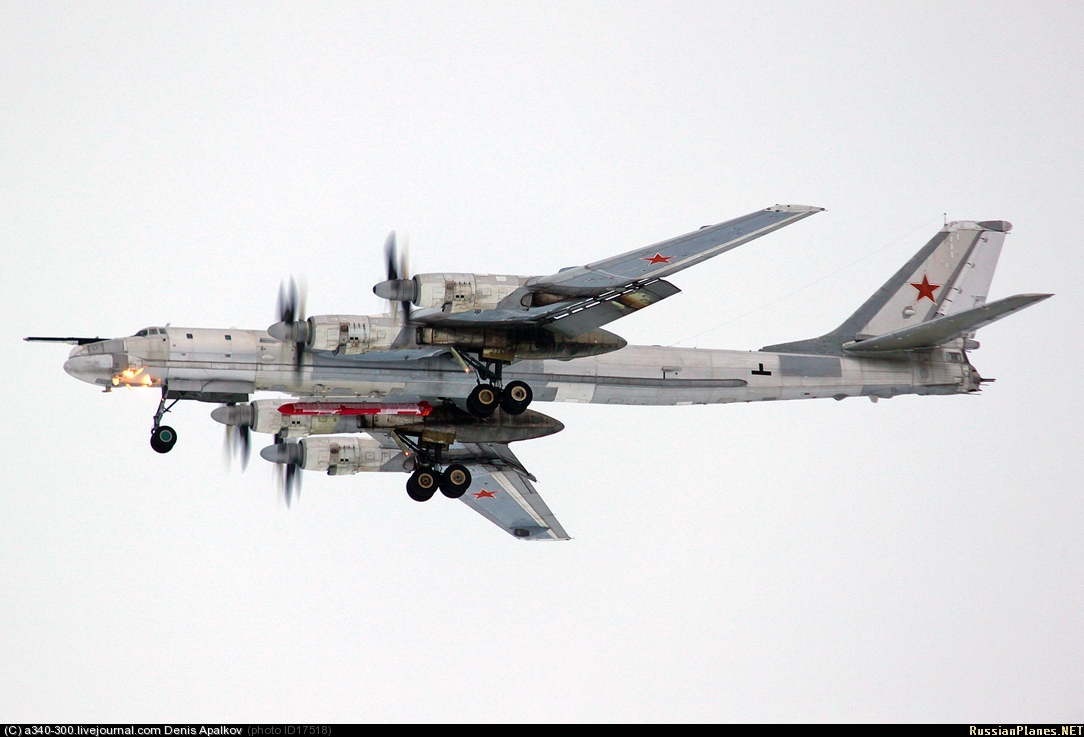
According to my Mk1 eyeball inspection it could fit into internal bay of Tu-95 with very similar clearances as Kh-55.
Andraxxusbut MiG-23 more manoeuverable than F-5E? I don’t think so.
Well I admit that part is a little subjective:
MiG-23ML’s max S/L STR is 14,1 deg/s (with 2xR-23). F-5E manual doesn’t give S/L STR, but for 5000 feet (max 13,1deg/s with 2xAIM-9) and 15000 feet (max 11,9deg/s with 2xAIM-9) . If I were to linearly interpolate between altitudes (which is not too far off, see F-15C manual), I get 13,7 deg/s @ S/L for F-5E.
This number says MiG-23 is better at maximum STR point with heavier payload. However, i can’t guarantee this linear behaviour is accurate (only 0,4 deg/s difference leaves no room for error), My reasoning is; if MiG-23ML is at least comperable when low and subsonic, its variable wings and higher thrust will give it an edge as aircraft goes higher, faster or both.
MLD upgrade raises G limit to 8,5Gs, and adds vortex generators for better high AOA maneuverability. F-5E’s g limit is 7,33, so I believe MLD will also achieve better max ITR as well.
AndraxxusWas it really? I get the impression they wanted to parry the F-16, but the MiG design had twin engines and not nearly enough fuel for them (partly due to those auxiliary fuel tanks). Thus it did bring improved maneuverability, cockpit visibility, HMS and superior (all-aspect) short range missiles, but without fuel it couldn’t make good use of them.
On simplest analysis, MiG has 3300kg fuel capacity feeds 162kN thrust at 188 kg/kN-h SFC, not very off from F-16 block 60, which has 3175 kg internal fuel, which feeds 143kN with 200kg/kN-h SFC. Granted, early F-16A was better in this area (it had less SFC, and less thrust), but in a WW3, several hundred km range MiG-29 have would have been more than enough.
Its true, when MiG carry wing tanks it can’t carry BVR missiles, but F-16 of 1980’s wasn’t BVR capable anyway. So with EFTs, it was better than F-16 because it still had R-73 + HMS. With R-27R replacing wing EFT, it was pretty comperable to AIM-7 capable F-15As. (obviously not in range, but in BVR capability)
It’s radar was problematic (some sources say less useful than the MLA/MLD one) so it still depended on the GCI guidance to its targets at which it was supposed to fire both medium range missiles given the limits imposed on its maneuvering with an asymmetrical BVR load.
MiG-29’s N019 radar was not any more problematic than F-16A’s APG-66, F-15A/C’s APG-63, Su-27’s N001; all these radars were similar in that they were constrained by processing power. These were adressed in APG-68, APG-63(V)1, N001V, N019M. Those were upgraded even futher, but unfortunately for N019M radar, MiG-29 had little priority after the cold war. Even with its problems, original N019 radar still has better head-on range than APG-68 due to high PRF mode, and its -on paper- range is more than 1.5 times range of APG-66, which equipped 90% of F-16’s in 1980s.
So I completely disagree that MiG-29 needed GCI guidance. However, it would most definately benefit from it: In 1980s, when F-15/16 lacked datalinks, but MiG-29 had lazslo/lazur datalinks. So in a WW3, when we would be seeing hundreds of aircraft in air, coordinating 40+ MiG-29s in the air would have been much simpler as they would autopilot to their targets as GCI dictates, and GCI decides which aircraft will perform what task, and engage which target.
Add to that, unlike most 4th gen fighters, MiG-29 had ability to operate from dirt strips, grass or mud fields, and gives its engines complete protection to FOD damage. As most airfields would be leveled by SRBMs and cruise missiles in day#1, those intakes are a good trade-off for internal fuel capacity. You can park a MiG-29 80 km from the war zone, arm&refuel it there with mobile trucks (to avoid retribution from SRBM and cruise missiles), and MiG-29 would enter combat two minutes after take-off. An F-15’s range and combat capabilities would not matter squat if nearest undamaged airbase is 1000 km away, and F-15 waste 2.5 hours and 70% of their fuel for ferrying between war zone and airbase. This also allows MiG-29’s mission planner to easily trade-off between fuel and payload, or both for airframe performance. Its not possible if you require EFTs to reach war zone, and most/all of your internal fuel just to make it back home (as in the case of F-15/16).
Plus, MiG-29 (of 1980s) gave this capability at much cheaper price than all 4th gen fighters out there. Its airframe is much more crude, lacks exotic materials, so easier to mass produce and repair in time of war. Unlike F-16, its twin engine and unlike F-15 its engines are widely seperated, and doesn’t share some gearbox equipments like some pumps or engine starter, so its much tolerant to battle damage. Its engines are smaller, has fewer high pressure stages, has less blades in its each stage so its easier to produce than F100. Its dimensions and lighter weight allows easier transportation to forward bases as replacement units. Unlike others, MiG-29’s engine can be replaced within the footprint of the aircraft, again simplifying maintanence within constrained spaces, which may happen in war.
So in deteriorated war conditions, MiG-29 can be produced in greater numbers, has better chance to actually fly, can be strategically positioned better, tactically its much more available with more flexibility in mission planning, and performance-wise, its somewhere between F-16A and F-15A. All this translates to best war-time aircraft to me. Of course, these are all my subjective opinions.
AndraxxusI think MiG was just unlucky. Like Su-27, MiG-29 was also built for the demands specifications of Soviet airforce. Its not MiG’s fault that their product was something that had no role after cold war. Othervise MiG did built some great aircraft; MiG-21, MiG-25, MiG-31 are all excellent aircraft, even today.
-MiG-23 is a good aircraft with superb supersonic performance (better than F-15A/16A), and good (better than F-4E, F-5E etc) subsonic maneuverability. Its only disadvantage was complexity, but its performance reflects the engineering capability of MiG company.
-MiG-29 was good for exactly Soviet airforce wanted. For late 1980s, it would have been the best aircraft for WW-III IMO, good trade-off of ruggedness, simplicity, avionics, kinematics and cost. But in last two decades world has changed, and MiG-29 needed much bigger advancements to fit in this new world and be competetive on the market with F-16/18, Rafele or Typhoon; advancements that MiG failed to make in time.
Also, lets not forget Sukhoi designed T-4 Sotka, a truly advanced and unique aircraft for Soviet aerospace industry. Now with PAK-FA, Sukhoi is truly getting the experience MiG won’t have.
AndraxxusThey say that was just a test.
People are either just too ignorant or way too biased to take a *flight test* for what it is. I have explained a dozen times why a high AOA test cannot indicate anything about sustained turn rates or climb rates; which are the most important factors of energy maneuverability -and dogfighting. Even if it was actually a “dogfighting test” (really, I see exactly 0.0000 possibility in that; it sounds just ridiculous), then you are testing a prototype againist a highly mature aircraft. Like I’ve said, F-35 with its current limit G limit gives less overall maneuverability comperable to MiG-31 (being optimistic), there is no contest againist F-16. Some further thoughts;
-Take all 5 PAK-FA prototypes to dogfight a single Su-27 today; At T-50’s current maturity, a single Su-27 will quite easily wipe the floor with all 5. How would this give us indication about PAK-FA’s maneuverability?
-Fully fuel Su-27, and pit it in a gunfight againist an F-4E with 15% fuel. All else being equal, F-4 will win because it will have better turn/climb performance. If we don’t know fuel loads, this tells us about Su-27’s maneuverability what exactly?
-Take an F-22/Su-35 againist F-86. Order F-86 pilot to make basic flight manuvers like immelman, scissors etc, and order F-22/Su-35 pilot to constantly use their control limited AOAs and point your nose at F-86. After a few minutes of maneuvering, F-86 will have several times more specific energy remaining. In fact, given F-22’s or Su-35’s controllability limit far exceed their aerodynamic limit, insisting upon using high AOAs will result in them stall and crash before test duration reaches “few minutes”. So does this mean F-22/Su-35 posses inferior maneuverability to F-86?
AndraxxusNeither the R-40 or R-33 missile nor the the S-200 missile have any proven ability to shoot down Mach 3+ targets flying at 70,000 feet, never mind 85,000 feet which is the cruise altitude of the SR-71. Both MiG-25 and S-200 were no doubt accepted in to Soviet service for their exceptional long range.
I find such comment way too biased. F-22 doesn’t have a proven ability to shoot down anything. Neither does Rafale or Typhoon. So by your logic, I would be right to assume they are not capable of A-A combat… Or from another POV, F-22’s design *purpose* was stealth. You are claiming its not stealthy at all, based on the fact its never proven to elude Russian air defenses.
In 1960, Soviets had Yak-28, its range&endurance at combat speeds was deemed insufficent, so Tu-28 was built. Both Yak-28 and Tu-28 have much better range than MiG-25 and Ye-152. After B-58 entered service, Soviets designed Ye-152. Ye-152 was also capable of M2,83 and 70k+ feet ceiling. When XB-70’s specs are revealed, PVO’s specifications were revised and it was clear Ye-152’s radar and missile system is inadaquate, so it was canceled; new Smerch radar had 3 times the size of Ye-152’s Uragan-5, and new R-40 missile has 2 times the weight of K-9 missile. This resulted in a aircraft twice the size of Ye-152.
So if MiG-25 cannot perform the very purpose of its design, why waste resources? Why not build Ye-152? Or just stick with Tu-28?


 Sign In







